Lash Tray Inspection Checklist: 8 Alignment and Packaging Checks
Share
Direct answer:A lash tray inspection checklist should confirm row alignment, strip release, length marks, tray label wording, barcode placement, packaging proof and carton records before sample approval or reorder.
What Should a Lash Tray Inspection Checklist Include?
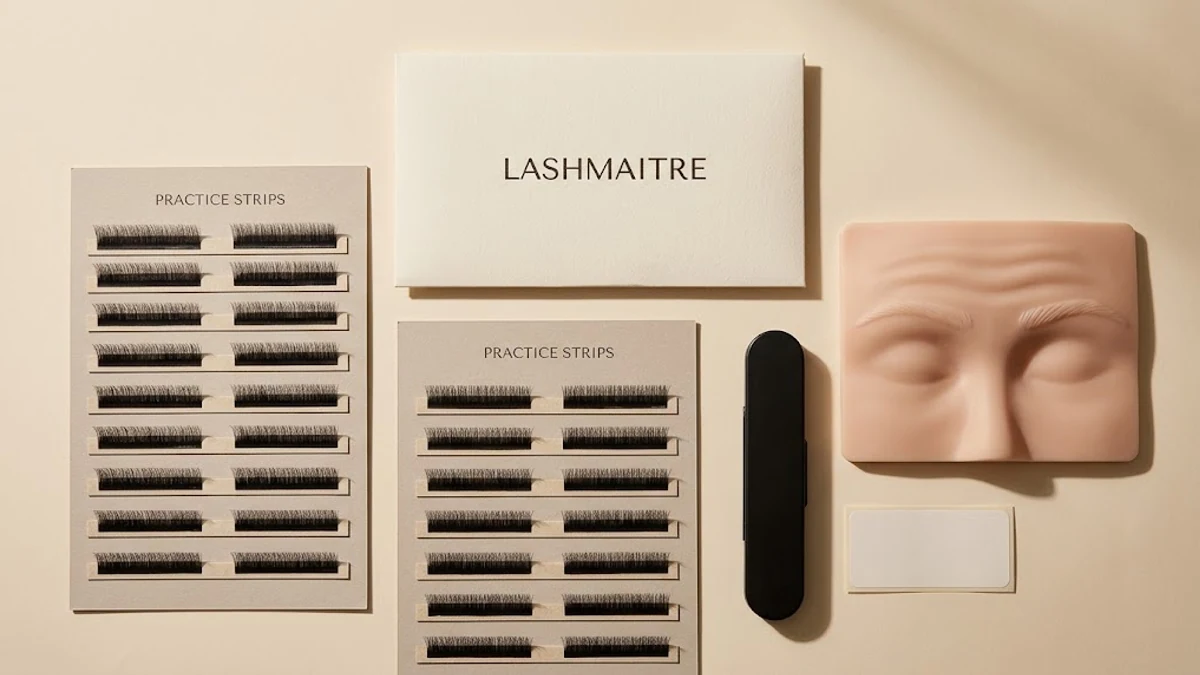
A lash tray inspection checklist should confirm row alignment, lash direction, curl and length labels, strip release, tray card wording, barcode placement, packaging proof, carton label and reorder record. These checks help wholesale buyers approve samples and receive repeat orders with fewer mix-ups.
For a lash brand, distributor, salon chain or academy, the tray is both a product and a record. If the tray looks clean, the label is clear and the packaging file is traceable, the buyer can approve samples and reorders with less confusion.
LASHMAITRE recommends checking the tray before bulk production, again before final packing, and once more when the reorder file is prepared.
For buyers who are still building the approval process, start with lash extension samples and keep the final inspection record inside your lash quality control file.
This lash tray inspection checklist gives buyers a simple way to compare the approved sample, private label proof and reorder file before accepting bulk stock.
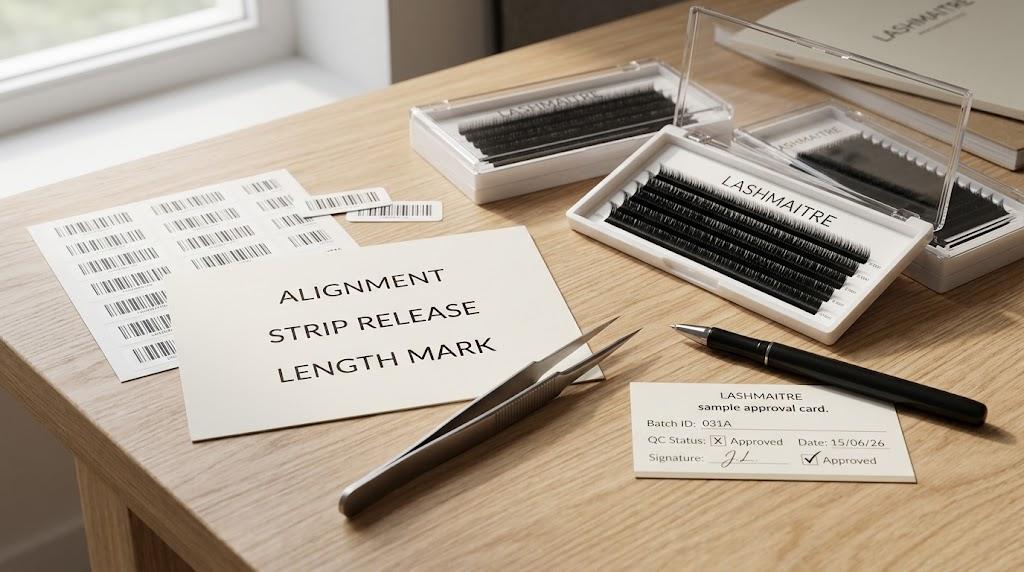
Check 1: Row Alignment and Lash Direction
The first visual check is row alignment. Rows should look neat, evenly spaced and consistent across the tray. Lash direction should be controlled enough that the tray looks professional when opened.
Look for:
- Rows that are straight.
- Lash tips facing consistently.
- No obvious gaps or messy areas.
- No shifted strips after opening.
- A clean tray card behind the rows.
This is not only a beauty detail. A neat tray helps the buyer compare the sample against future orders.
Check 2: Curl and Length Marking
Every tray should make the key spec easy to read. The curl, length, thickness and product family should match the order sheet.
For mixed trays, check the sequence carefully. For single-length trays, confirm the label does not accidentally carry mixed-tray wording. If the buyer uses style-map products, the tray card should also support the approved map.
For mapped products, compare the tray against the approved lash mapping styles record so length marks and style names stay aligned.
Check 3: Thickness and Product Family Label
Thickness must match the product family and customer use. A tray labeled 0.05, 0.07 or 0.10 should not be treated as a generic black lash tray. The buyer should know whether it belongs to classic, volume, flat, premade fan, easy fan or another product family.
A practical inspection sheet can include:
| Label field | What to verify |
|---|---|
| Curl | C, CC, D, M, L or other approved curl. |
| Thickness | Matches order and tray card. |
| Length | Matches row marks or mixed tray map. |
| Product family | Classic, volume, flat, premade fan or other. |
| Finish | Matte, silk-like, cashmere-like or approved finish. |
This is why tray inspection should sit inside a broader lash quality control process, not only a last-minute visual check.
Check 4: Strip Release and Pickup Feel
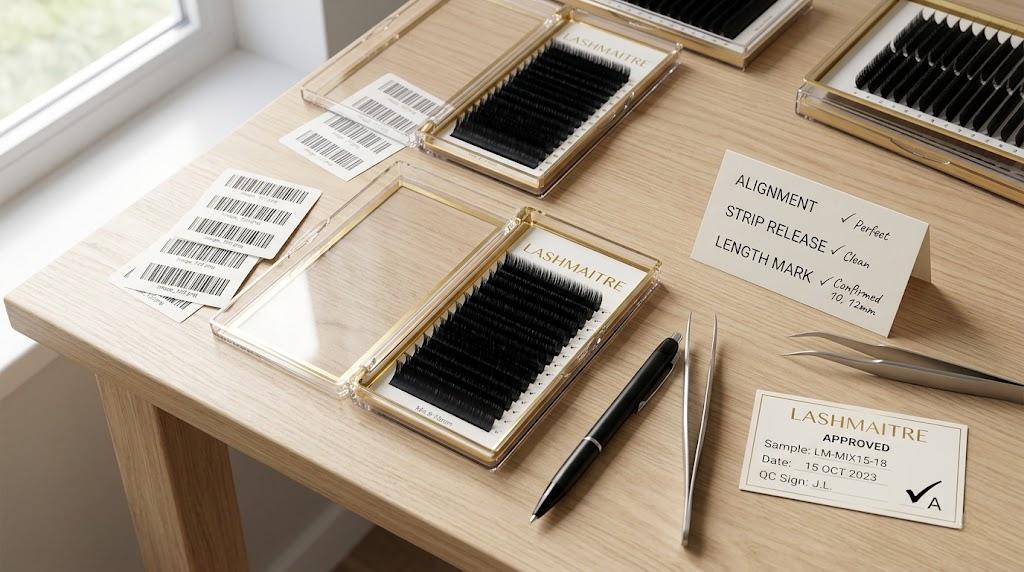
Strip release affects technician experience. A sample tester should open the tray and check whether the strips release smoothly. If pickup feels too tight, too loose or uneven between rows, the note should be recorded before bulk approval.
Use plain feedback:
- Strip release is clean.
- Pickup feels too strong.
- Base lifts unevenly.
- Row shifts after opening.
- Sample passed for MOQ test.
These comments are easier for a supplier to act on than a general message like "tray quality bad."
Check 5: Tray Card and Private Label Wording
Private label buyers should inspect the product wording as closely as the physical tray. A spelling issue, unclear style name or wrong thickness mark can create customer-service problems after the trays are sold.
For private label lash extensions, this wording check should happen before the tray card and box proof are approved.
Check:
- Brand name.
- Product name.
- Curl and length.
- Thickness.
- Style name.
- Logo placement.
- Any approved label version.
Use the lash tray labeling guide as a reference when checking tray card wording, SKU fields and private label layout.
Check 6: Barcode and SKU Placement
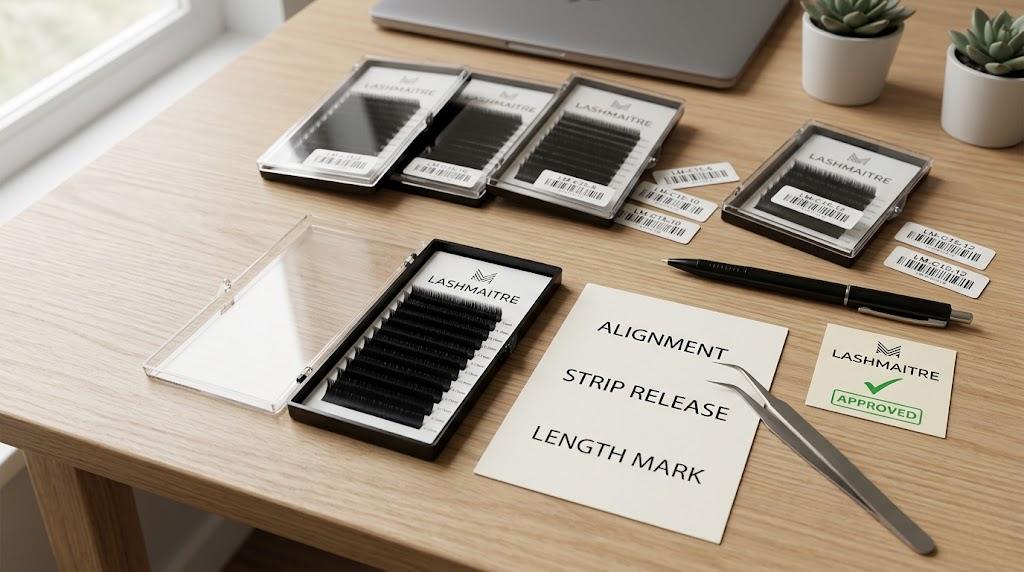
Barcode and SKU labels help connect the tray to the order record. They should not cover important tray information, and they should match the buyer's reorder file.
GS1 standards are widely used in supply chains to improve identification and traceability. A lash tray buyer does not need to copy every large-scale retail process, but the principle is useful: product IDs, batch references and carton labels should help the team identify what was ordered and what was received.
For a private label lash tray, barcode checks should include:
- Buyer SKU.
- Supplier SKU.
- Product family.
- Curl and thickness.
- Label version.
- Carton quantity.
If the inspection is part of a trial order, keep it connected to the MOQ 50 wholesale lash extensions approval path.
Check 7: Packaging Proof and Box Fit
Packaging should be checked before bulk packing. The tray may pass product inspection, but the packaging can still create issues if the tray does not sit correctly in the box or the approved artwork is not used.
Review:
| Packaging item | Inspection point |
|---|---|
| Sample box | Tray fits cleanly. |
| Tray sleeve | Logo and product name align. |
| Packaging proof | Matches approved version. |
| Barcode sticker | Placed in approved location. |
| Carton label | Matches destination and quantity. |
Packaging details should also match the eyelash extension packaging checks used for private label proofing.
Check 8: Carton Label and Reorder File
The final inspection should connect the tray to the carton and reorder file. A carton label should not be an afterthought. It helps the buyer receive, store and reorder the correct product.
Record:
- Buyer name or account.
- SKU.
- Product family.
- Curl, thickness and length range.
- Quantity.
- Carton number.
- Batch or lot reference.
- Destination.
- Approval status.
This makes the next order easier because the buyer can request the same product using a clear record instead of describing it from memory.
Keep the lash tray inspection checklist with the carton label and SKU record so the next reorder can be checked against the same standard.
Buyer-Side Inspection Workflow
A lash tray inspection checklist works best when it follows the same order every time. Start with the approved sample tray, then check the new tray, then check the label and packaging file. After that, compare the carton label and reorder sheet before the batch is released.
For a first order, this workflow helps the buyer decide whether the sample is ready for MOQ production. For a repeat order, the same workflow helps the buyer confirm that the new batch still matches the approved sample file.
| Inspection stage | Buyer action |
|---|---|
| Sample review | Compare row alignment, curl, length and thickness. |
| Label review | Check tray card wording, SKU and barcode placement. |
| Packaging review | Match box, sleeve and packaging proof. |
| Carton review | Confirm quantity, carton label and batch record. |
| Reorder review | Save QC notes for the next production run. |
The checklist should be short enough for daily use but clear enough to prevent reorder confusion. If a buyer cannot identify the approved tray, SKU and packaging version from the inspection file, the reorder record is not complete enough.
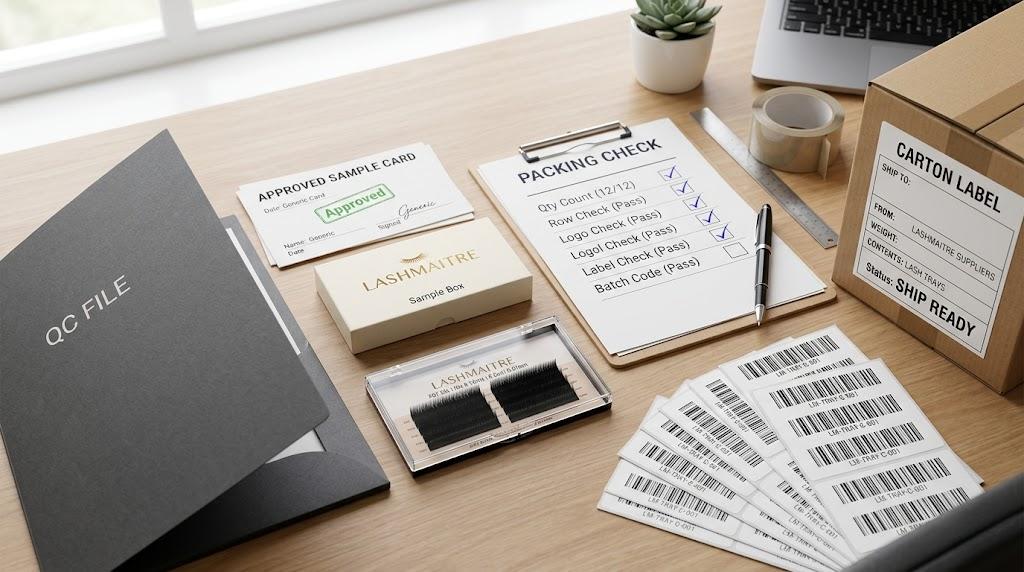
LASHMAITRE Buyer Checklist
| Lash tray inspection point | Status |
|---|---|
| Row alignment checked | |
| Lash direction reviewed | |
| Curl and length marks confirmed | |
| Thickness and product family checked | |
| Strip release tested | |
| Tray card wording approved | |
| Barcode and SKU placement checked | |
| Packaging proof and carton label recorded |
FAQ
What should be checked before approving a lash tray sample?
Check row alignment, lash direction, curl, length, thickness, product family, strip release, tray card wording, barcode placement, packaging proof and carton label.
Why does row alignment matter in lash extension trays?
Row alignment affects the professional look of the tray and makes it easier to compare a future reorder against the approved sample.
Should barcode and SKU labels be checked before bulk production?
Yes. Barcode and SKU labels should match the order record and should not cover important tray information. They help prevent packing and reorder confusion.
How does a lash tray inspection record help with reorders?
It gives the buyer and supplier a shared reference for the approved tray, packaging, label version, carton mark and batch details. This makes repeat orders easier to match.
Request a Lash Tray Inspection File
Send LASHMAITRE your tray card, SKU label and packaging requirements so the sample file can be checked before MOQ or bulk production.
Use the wholesale lash extensions inquiry page when you are ready to send tray card, SKU label and packaging requirements.
Authority and Source Notes
- GS1 traceability standard: GS1 Global Traceability Standard
- GS1 US supply-chain identification reference: GS1 US food and retail grocery standards
For a broader buyer approval workflow beyond tray checks, see the lash QC checklist for curl, thickness, length map, finish, label, batch and packaging review before a bulk order.
Before approving a production batch, define a measurable lash specification tolerance for curl, thickness, length map, finish, labels and packaging against the approved sample.

Lash Maitre: Your Trusted Partner in Eyelash extension Solutions
Lash Maitre is dedicated to providing professional insights and tips in the eyelash extension industry. Sharing the latest trends, techniques, and product knowledge, Lash Maitre helps lash artists and enthusiasts enhance their skills, stay inspired, and achieve the perfect lash experience.