Colored Premade Fans Wholesale: 8 Sample Checks

Share
Colored premade fans wholesale programs give lash brands a faster way to add brown, burgundy, muted plum and mixed-color volume options, but color alone is not a complete buying specification. Wholesale buyers should approve the shade family, D-count, fiber diameter, curl, length mix, fan base, tray quantity, packaging version and retained sample before bulk or private-label production.
This guide is for lash brand owners, salon groups, distributors and procurement teams comparing colored premade lash fans. It turns a visual product choice into a controlled sample, SKU and reorder decision.
Quick Answer: What Are Colored Premade Fans?
Colored premade fans are ready-made volume fan units produced in brown, accent, fashion or mixed shades. Each unit joins several fine fibers at one narrow base before professional application. A wholesale specification should identify color code, D-count, diameter, curl, length, fan geometry, tray format and approval version so the same result can be reproduced on reorders.
Key takeaways
- Treat every shade and construction combination as a controlled SKU, not a color name alone.
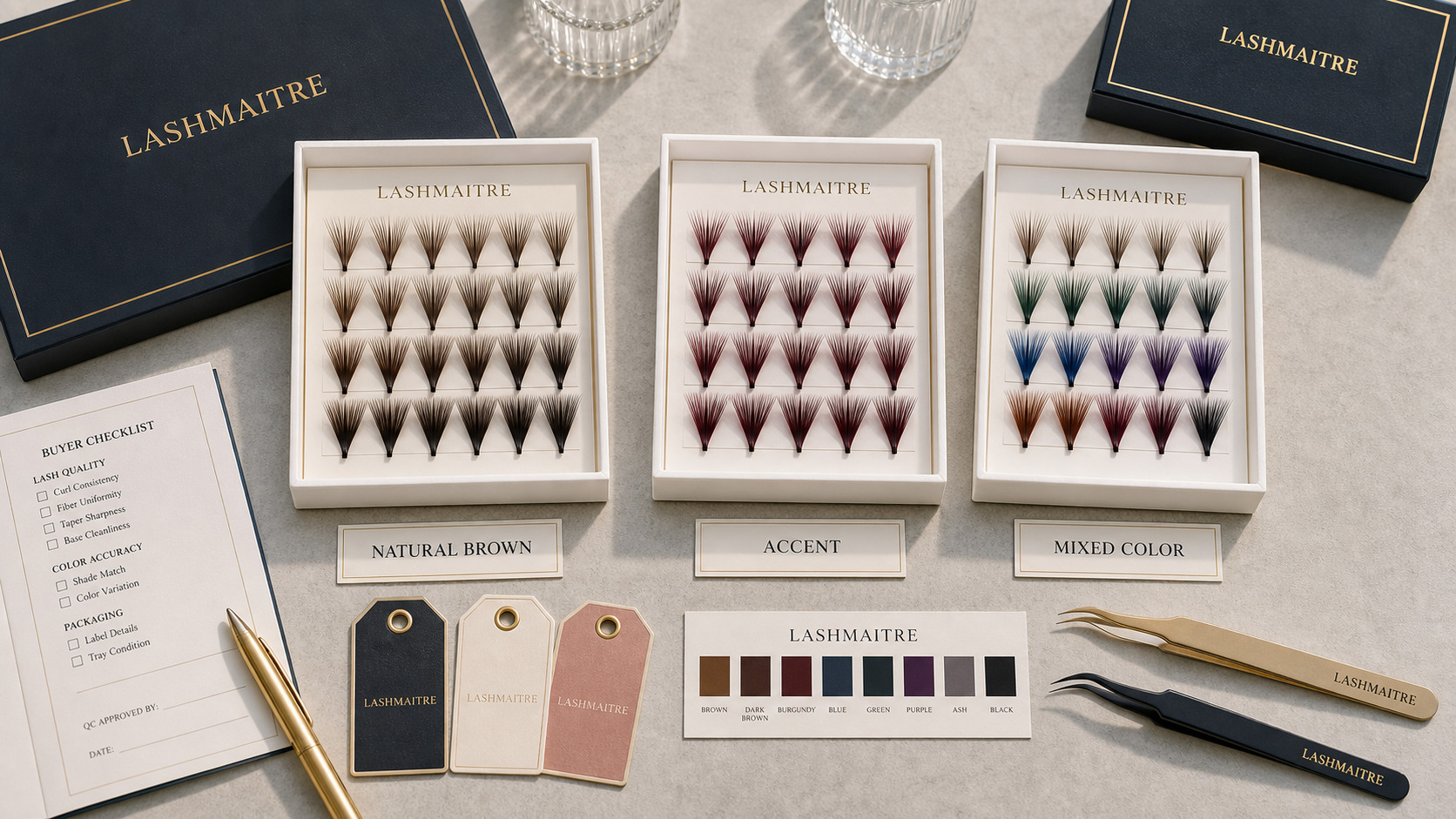
- Compare natural browns, accent shades and mixed-color trays under the same lighting and background.
- Match D-count, diameter, curl, length and base before judging color intensity.
- Approve a physical sample, tray label and private-label packaging proof as separate linked records.
- Start with a focused sample range before expanding wholesale colored lash fan trays.
Brown vs Accent vs Mixed-Color Premade Fans
Brown premade fans are usually selected for softer contrast, warm or cool tonal ranges and natural-looking volume services. Accent shades such as burgundy, muted plum, forest green or navy add controlled color without requiring a fully bright set. Mixed-color lash fans combine two or more approved shades within one tray or assortment.
The same shade can look different when fiber finish, D-count and fan width change. A 3D matte brown fan can appear lighter than a 10D fan made with the same nominal fiber color because more fibers create a denser silhouette. Buyers should therefore compare color and construction together.
| Range type | Typical wholesale role | Main approval risk | Recommended record |
|---|---|---|---|
| Natural brown | Softer everyday range | Warm/cool undertone drifts between lots | Physical shade reference and supplier color code |
| Accent shade | Seasonal or editorial range | Color name is interpreted differently | Printed swatch plus physical fan sample |
| Mixed-color tray | Curated styling assortment | Row allocation or shade ratio changes | Row map, shade code and tray quantity |
| Bright fashion shade | Statement range | Saturation and finish vary in different light | Standard lighting photos plus retained sample |
Use the broader brown and colored lash extensions wholesale guide to plan the overall color family. Use this article specifically to approve colored premade fan construction and reorder controls.
8 Sample Checks for Colored Premade Fans Wholesale
1. Approve a Physical Shade Family
Start with a physical shade matrix containing the proposed natural, accent and mixed-color options. View every sample under the same neutral light, background and camera settings. Record whether the buyer approved a warm brown, cool brown, burgundy, plum, another accent or a defined mixture.
Do not approve from a screen image alone. Displays, exposure and white balance can shift the apparent shade. Keep the supplier code and the buyer-facing shade name in the SKU master so future orders do not depend on memory.
2. Match the D-Count Before Judging Color
D-count states how many fibers form one fan, such as 3D, 5D or 10D. A higher D-count generally produces a fuller visual result, so the same pigment can appear denser. Compare shades at the intended D-count rather than comparing unrelated fans.
If a range carries more than one D-count, approve each combination separately. Do not use one 5D color sample as automatic approval for 3D and 10D production.
3. Confirm Fiber Diameter
Individual fiber diameter affects the visual weight and handling of the fan. Record the diameter in millimeters, such as 0.05 mm or 0.07 mm, together with the D-count. A color premade fan specification that lists only “brown 5D” leaves an important product field uncontrolled.
The buyer should also confirm whether the finish is matte, satin or another defined surface treatment. Finish changes how light reflects from the fan and can change perceived color intensity.
4. Verify Curl and Length Mix
Approve the curl and nominal length range for every sellable tray. For a mixed-length tray, document the number of rows allocated to each length rather than writing only “8–15 mm mix.” A production tray can contain the correct endpoints and still have the wrong row distribution.
Keep curl naming supplier-specific until a matched physical sample is approved. One supplier's CC Curl may not visually match another supplier's CC Curl.
5. Inspect Fan Base, Stem and Spread
A usable colored premade fan should show separate fine fibers gathered into one narrow, controlled base. Inspect the root taper, stem, spread, symmetry and loose fibers under magnification. Reject samples that resemble dense continuous strip rows, blunt bars or irregular glue clumps.
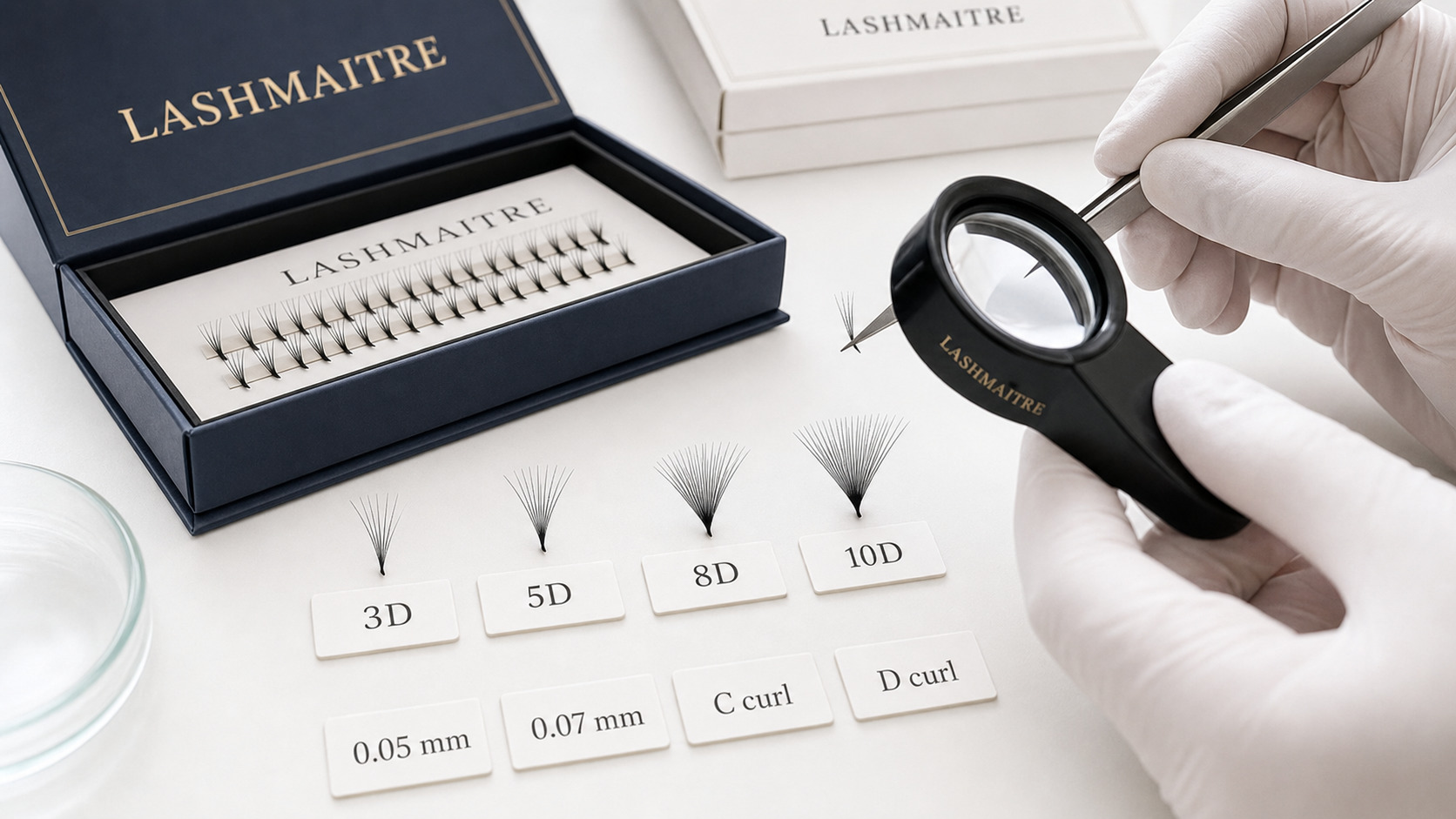
Sample fans from multiple tray positions instead of selecting only the best-looking row. Record how many units were checked and how many differed from the approved base or spread reference.
6. Reconcile Tray Quantity and Shade Allocation
Confirm the number of rows, fans per row or other agreed counting method. For mixed-color trays, record the shade sequence and allocation by row. The tray card, retail box, barcode label, purchase order and SKU master should describe the same configuration.
Count usable rows, not only printed row numbers. Damaged, missing or poorly released units should be recorded separately so landed cost is based on usable product.
7. Test Private Label Artwork and Color Codes
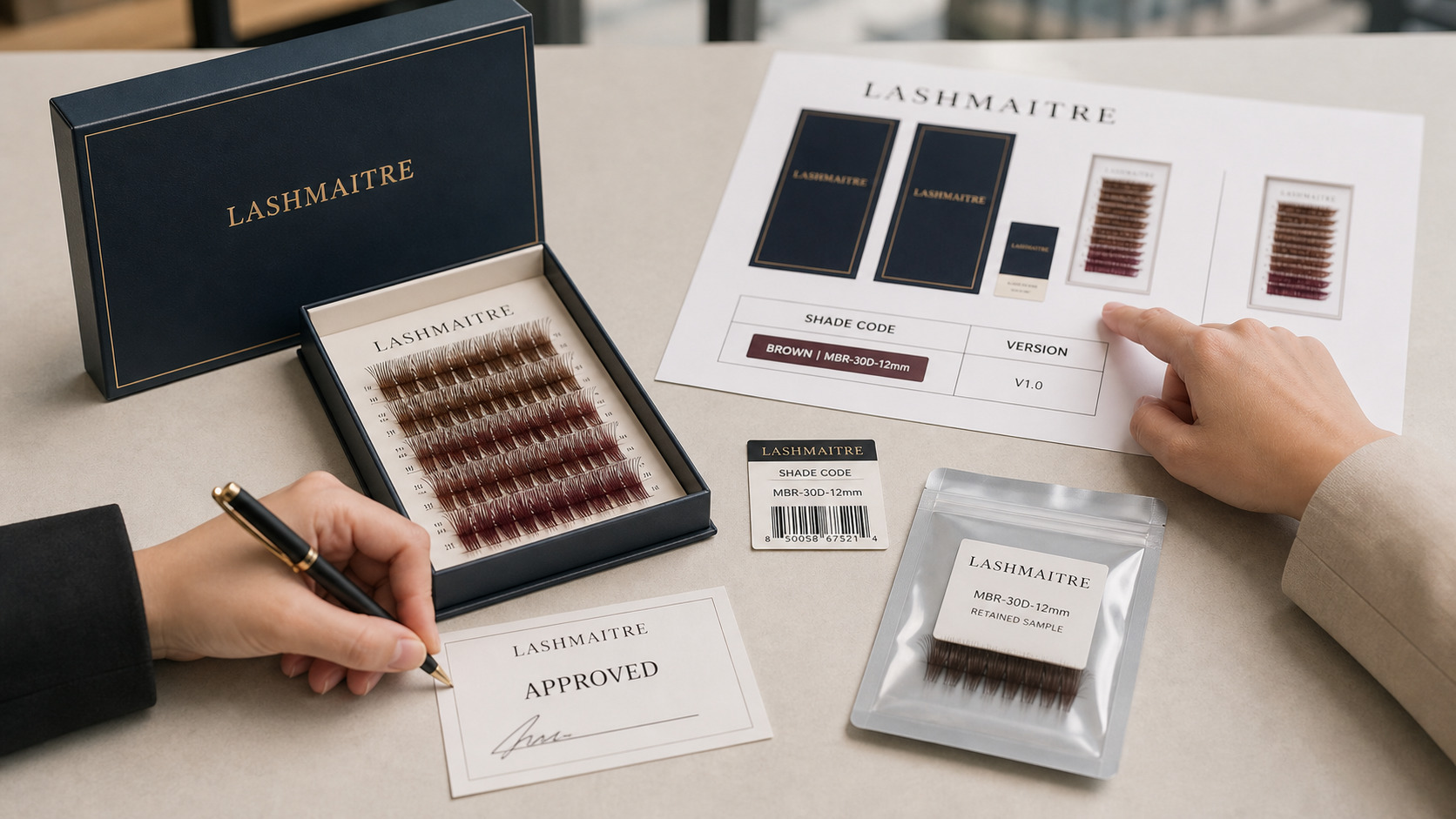
Product approval does not automatically approve the packaging. Review the box, tray insert, shade name, supplier code, D-count, diameter, curl, length, barcode and artwork version as a separate proof.
For private label lash extensions, link the approved physical fan to the exact packaging version. This prevents a warm brown fan from being packed under a cool brown label or an old shade name from returning during a reorder.
8. Lock the Retained Sample and Reorder Rule
Protect one approved sample as the master reference and use another for working comparisons when practical. The approval record should identify the sample code, shade code, construction, tray format, approver, date and any conditional acceptance.
The sampling plan should be written before inspection begins. The NIST/SEMATECH guidance on acceptance sampling explains the general accept-or-reject logic, while its guidance on defining a sampling plan emphasizes defining the method and sample size. These sources support a documented sampling process; they do not certify a lash product or prescribe LASHMAITRE specifications.
How D-Count, Diameter, Curl and Length Change the Range
A colored premade fan range grows quickly because every variable multiplies the number of possible SKUs. Three shades × two D-counts × two curls × four lengths already creates 48 combinations before packaging versions are counted. That is why a disciplined opening assortment matters.
| Variable | Example choices | Buying effect | Approval rule |
|---|---|---|---|
| Shade | Brown, burgundy, plum | Changes tone and merchandising role | Approve physical color code |
| D-count | 3D, 5D, 10D | Changes fullness and apparent color density | Approve each D-count |
| Diameter | 0.05 mm, 0.07 mm | Changes visual weight and construction | Record in millimeters |
| Curl | C, CC, D | Changes silhouette | Compare physical curl samples |
| Length | Single or 8–15 mm mix | Changes styling range and row map | Record every row allocation |
| Base | Pointed or another approved geometry | Changes pickup and attachment workflow | Keep magnified retained reference |
For a lower-risk launch, select one or two shade families, one main D-count and the most commercially relevant curl and length format. The MOQ 50 wholesale lash extensions pathway can help buyers test a focused configuration before adding more color and construction combinations.
Private Label Packaging and SKU Color Control
Use a code structure that separates product construction from the marketing name. For example, a SKU master can include the shade code, D-count, diameter, curl, length range, fan-base code, tray-row count and packaging version as separate fields. The consumer-facing name can remain simple while the procurement record stays precise.
At minimum, the approval packet should contain:
- the physical colored premade fan sample;
- the supplier shade code and buyer-facing shade name;
- D-count, diameter, curl, length and base specification;
- tray quantity or mixed-row allocation;
- label and barcode proof;
- retail box or sleeve artwork version;
- approval date and approver;
- reorder and change-control rule.
Reapproval is appropriate when the colorant or fiber source, shade code, finish, fan construction, curl, diameter, length allocation, strip, tray, label, barcode or packaging version changes.
Common Buying Mistakes
- Approving a color name without a physical reference. “Chocolate brown” is not a measurable supplier specification.
- Comparing different fan constructions. A dense 10D fan and a light 3D fan cannot isolate shade performance.
- Treating mixed-color trays as random assortments. Buyers need a repeatable shade ratio and row map.
- Skipping usable-quantity checks. Printed row counts do not prove that every row releases and meets the approved sample.
- Combining product and packaging approval. The fan can pass while the shade code, label or artwork remains wrong.
- Expanding too many SKUs before demand is known. Each added shade, D-count, curl and length increases inventory and reorder complexity.
Colored Premade Fan Buyer Decision Rule
Approve a wholesale colored lash fan tray only when the physical fan, shade code, construction fields, tray quantity, packaging proof and retained sample all agree. If any one record is missing, keep the sample in review rather than treating an attractive product photo as production approval.
Buyers ready to compare physical options can request colored premade lash extension samples. Include the target shade family, D-count, diameter, curl, length mix, fan base, tray format, private-label requirement and estimated quantity in the request.
FAQ About Colored Premade Lash Fans
What are colored premade lash fans?
Colored premade lash fans are ready-made volume fan units in brown, accent, fashion or mixed shades. Multiple fine fibers are joined at one controlled base before professional application. Wholesale buyers should approve the shade code and the complete construction rather than ordering from the color name alone.
Which shades should a wholesale buyer sample first?
Start with the shades that have a clear range role: one warm or neutral brown, one cooler brown or soft accent, and one optional mixed-color combination. A focused sample set makes differences easier to judge and reduces the number of D-count, curl, length and packaging combinations that need approval.
How do D-count and fan width change color appearance?
A higher D-count or wider spread places more colored fibers in the same visual area, which can make the shade appear fuller or darker. Compare color only after matching D-count, fiber diameter, curl, length, finish and fan geometry under the same viewing conditions.
Should brown and bright colored fans use separate SKUs?
Yes. Every sellable combination should have a distinct controlled SKU when the shade, D-count, diameter, curl, length mix, base, tray quantity or packaging differs. Separate records prevent a visually similar product or outdated label from replacing the approved reorder reference.
Can colored premade fans use private label packaging?
Yes. Private label colored premade fans can use branded boxes, sleeves, tray cards and barcode labels. The buyer should approve the physical fan and packaging proof separately, then connect both records to the same shade code, SKU and version before production.
What should buyers check before reordering colored premade fans?
Compare the reorder with the retained sample and confirm shade, D-count, diameter, curl, length allocation, base, spread, tray quantity, labels, barcode and packaging version. Any change to product construction, shade reference or pack record should trigger documented review or reapproval.
What MOQ should a new colored premade fan range use?
The right MOQ depends on the supplier, customization and number of SKU combinations. A focused MOQ 50 test can be useful when available, because it lets the buyer validate fewer shade and construction combinations before carrying a larger private-label assortment.
How should buyers compare colored premade fan suppliers?
Send the same written specification to each colored premade fan supplier and compare matched samples, usable quantity, label accuracy, version control, response quality and reorder evidence. Do not compare one supplier's 3D brown tray with another supplier's 10D mixed-color tray and treat the result as equivalent.
For shade assortment planning, compare light brown vs dark brown premade fans with matched fan geometry and one controlled light source.
Request Colored Premade Fan Samples
Colored premade fans wholesale decisions should begin with matched physical samples and end with a controlled reorder record. Define the shade family, D-count, diameter, curl, length, base, tray quantity and private-label version first; then judge the product against the same specification.
Send those fields through the wholesale lash extensions inquiry to request a focused LASHMAITRE sample plan, MOQ review and private-label quotation.

Lash Maitre: Your Trusted Partner in Eyelash extension Solutions
Lash Maitre is dedicated to providing professional insights and tips in the eyelash extension industry. Sharing the latest trends, techniques, and product knowledge, Lash Maitre helps lash artists and enthusiasts enhance their skills, stay inspired, and achieve the perfect lash experience.