Lash QC Checklist for Wholesale Buyers
Share
Direct answer: what should a wholesale lash QC checklist include?
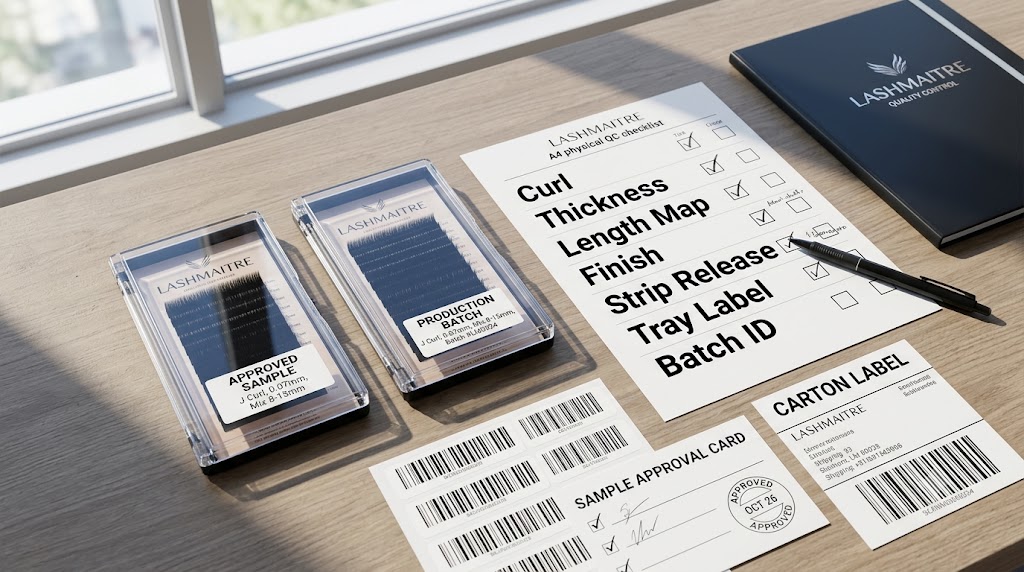
A wholesale lash QC checklist should confirm curl, thickness, length map, fiber finish, strip release, row alignment, tray label, barcode, packaging proof, carton label, batch ID and reorder record. The most important QC comparison is not the tray alone; it is whether the production batch matches the approved sample.
Use this checklist before sample approval, before bulk shipment, and before reorders.
For broader quality context, ISO describes quality management through the ISO 9000 family, and inspection sampling concepts are covered in the current ISO 2859-1:2026 sampling standard. In a wholesale lash order, these references support the idea of documented checks; the buyer's practical benchmark is still the approved sample.
Lash QC checklist at a glance
| QC area | Buyer check | Pass / adjust / reject | Notes |
|---|---|---|---|
| Curl | Does the curl match the approved sample and order spec? | ||
| Thickness | Does the fiber thickness match the requested SKU? | ||
| Length map | Are rows and mixed lengths arranged correctly? | ||
| Finish | Is the finish matte, glossy, cashmere, silk or other requested texture? | ||
| Fiber feel | Is the lash soft enough and consistent across rows? | ||
| Strip release | Can the lash be removed cleanly without damage or excess adhesive? | ||
| Row alignment | Are rows neat, level and usable by technicians? | ||
| Tray label | Does label match SKU, curl, thickness, length and quantity? | ||
| Packaging | Does box, tray card, logo and label match approved proof? | ||
| Batch record | Is batch ID tied to approved sample and reorder file? |
For small first orders, the QC checklist should also connect to quantity planning. If a buyer is testing multiple SKUs under a small first run, use MOQ 50 planning to decide which trays need stricter sample approval before bulk production.
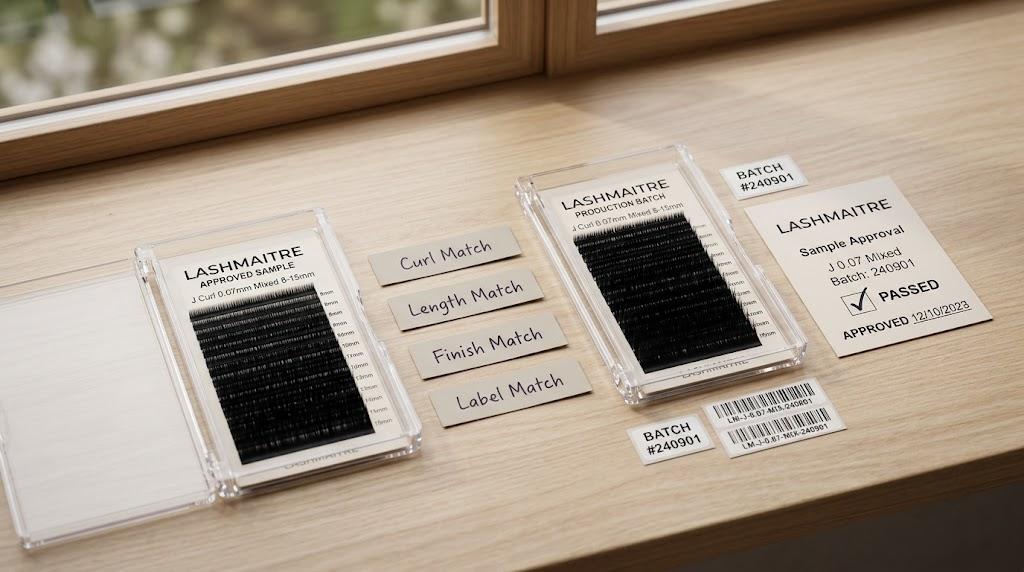
1. Curl and thickness match
Start with the technical specs.
For wholesale buyers, curl and thickness are not decoration. They define the product buyers expect to receive again in future orders.
Check:
- curl type, such as C, CC or D
- thickness, such as 0.05, 0.07, 0.10 or 0.15
- whether the tray label matches the actual tray
- whether the production batch matches the approved sample
Reject or adjust when:
- curl lift is visibly different from the approved sample
- thickness feels heavier or lighter than expected
- tray labels and actual lash specs do not match
- mixed cartons contain inconsistent spec labels
For the broader factory workflow, review the LASHMAITRE quality control process.
2. Length map and tray row accuracy
Length map errors create buyer complaints quickly because they change how the tray performs in salon or retail use.
For mixed trays, check:
- listed length range
- row order
- length labels on the tray card
- whether the row count matches the order
- whether repeated lengths are intentional
For single-length trays, check:
- the tray label
- row labels
- barcode or SKU label
- carton label
A buyer should not approve a tray only because it looks full. The row structure must match the order record.
3. Fiber softness, finish and curl hold
Fiber quality is partly visual and partly tactile.
Check whether the lash fiber feels and behaves like the approved sample:
- softness
- flexibility
- matte or glossy finish
- color consistency
- curl hold
- fiber direction
- absence of rough or uneven fibers
For PBT lash fibers, the buyer should compare touch, finish and curl retention against the sample card. If the sample was approved as soft matte black, the bulk batch should not arrive glossy, stiff or uneven.
For a deeper material check, see PBT lash fiber quality.
4. Strip release and pickup behavior
Strip release matters because it affects salon use and product perception.
Check:
- whether lashes lift cleanly from the strip
- whether adhesive residue is excessive
- whether the strip tears the lash base
- whether rows remain organized after pickup
- whether fans or fibers deform during removal
A tray may pass visual QC and still fail technician use if strip release is poor.
Score this as:
- Pass: clean pickup, stable base, no visible damage.
- Adjust: slight resistance but usable.
- Reject: lash damage, heavy adhesive, distorted fibers or inconsistent pickup.
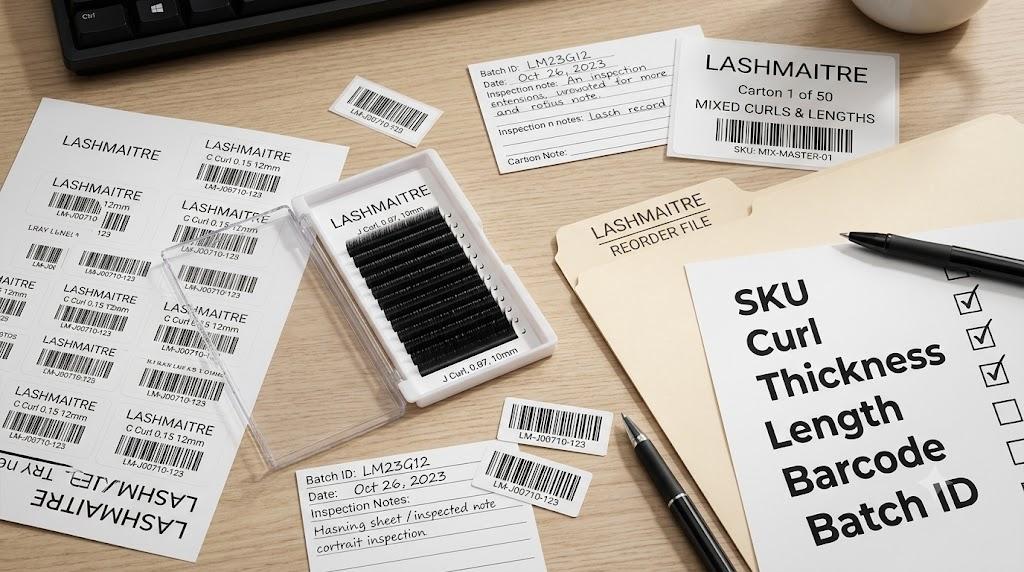
5. Tray label, SKU and barcode match
Label mistakes can create inventory and reorder problems even when the tray itself is acceptable.
Check:
- SKU
- curl
- thickness
- length
- finish
- tray type
- barcode
- carton label
- batch ID
The tray label should match the buyer's order sheet and the supplier's reorder file. This is especially important for private label buyers, distributors and brands managing multiple SKUs.
For tray-level inspection details, use the lash tray inspection checklist.
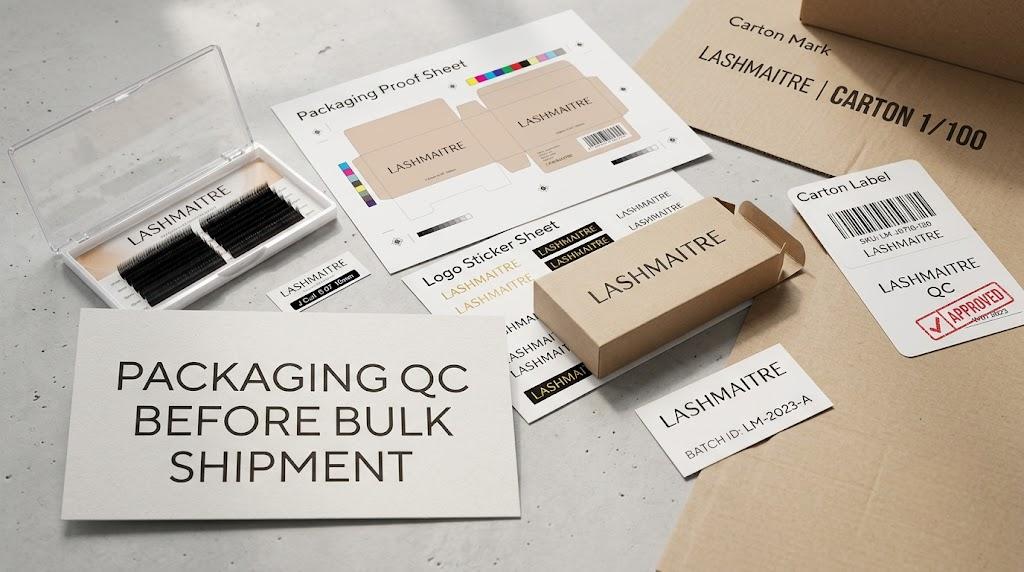
6. Packaging proof and carton label check
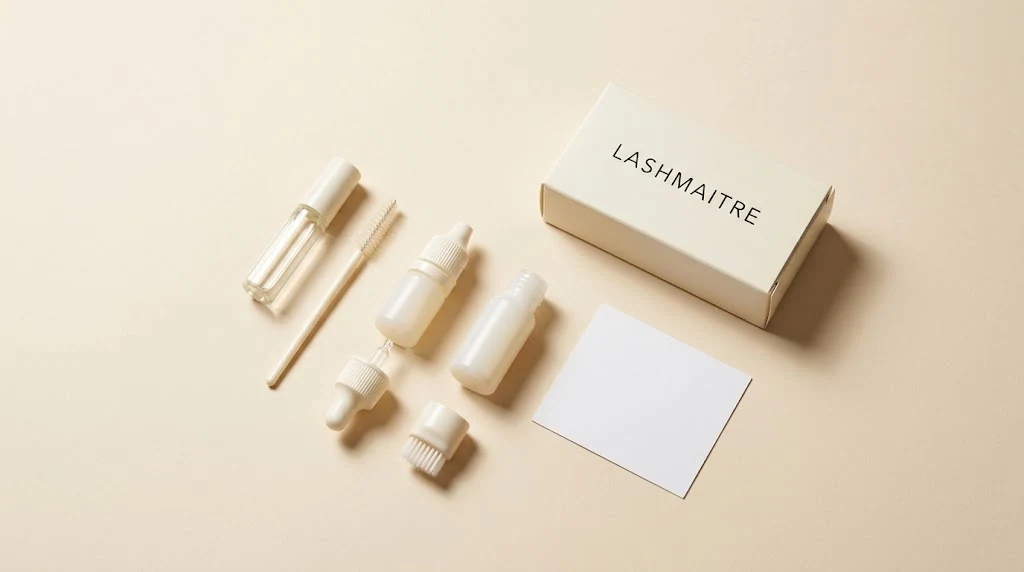
For private label or retail-ready trays, packaging is part of QC.
For OEM or branded retail packaging, review the full private label lash extensions process before approving box artwork, tray cards, logo stickers or carton marks.
Check:
- logo placement
- tray card design
- box text
- barcode position
- label sheet
- carton mark
- spelling
- color direction
- approved proof version
Packaging should be checked before production and again before shipment. If the carton label says one SKU and the tray label says another, the buyer has an operational problem even if the lash product is usable.
For shipment and reorder records, see the guide to carton labels.
7. Approved sample versus production batch
The approved sample is the benchmark.
For B2B lash orders, the key QC question is:
Does the production batch match what the buyer approved?
Compare:
- approved sample tray
- production batch tray
- sample approval card
- batch ID
- tray label
- carton label
- production file or reorder file
If the sample approval card is missing, the supplier and buyer may argue from memory. If the sample, batch and labels are documented, the QC conversation becomes much easier.
For the sample-to-production path, start with approved lash samples.
8. Reorder file and batch record
QC should not end at shipment.
A good reorder file helps the buyer repeat the approved result next time. It should include:
- approved sample reference
- SKU name
- curl
- thickness
- length map
- finish
- tray card version
- packaging proof version
- batch ID
- carton label
- reorder quantity
- QC notes
When a buyer reorders, the supplier should not rebuild the product from a chat message. The reorder should reference the approved file.
For production and reorder consistency details, use the lash batch consistency guide.
QC checklist table for buyers
Use this table before approving a sample, before shipment, or before a reorder.
| Checkpoint | What to inspect | Pass | Adjust | Reject | Buyer note |
|---|---|---|---|---|---|
| Curl | Actual curl matches approved sample and order spec | ||||
| Thickness | Fiber thickness matches requested SKU | ||||
| Length map | Row labels and mixed lengths are correct | ||||
| Finish | Matte/glossy/cashmere/silk direction is correct | ||||
| Fiber feel | Softness and fiber direction are consistent | ||||
| Strip release | Lashes release cleanly without damage | ||||
| Row alignment | Rows are neat and usable | ||||
| Tray label | SKU, curl, thickness and length are accurate | ||||
| Barcode | Barcode or SKU sticker matches order record | ||||
| Packaging proof | Box, tray card, logo and labels match approved proof | ||||
| Carton label | Quantity, SKU, destination and batch info are correct | ||||
| Batch record | Batch ID and QC note are tied to approved sample | ||||
| Reorder file | Reorder details are stored for future production |
When to reject, adjust or approve
Use three decision levels.
Approve when:
- product specs match
- labels match
- packaging matches proof
- batch record is complete
- minor issues do not affect product use or reorder control
Adjust when:
- packaging text needs correction
- label placement needs improvement
- one record is incomplete but the product is correct
- buyer needs a revised proof before production continues
Reject when:
- curl or thickness is wrong
- length map is wrong
- fiber feel or finish does not match approved sample
- strip release damages lashes
- labels or carton records create inventory risk
- production batch does not match the approved sample
LASHMAITRE QC path for wholesale buyers
A practical LASHMAITRE QC path is:
- Confirm buyer specs.
- Prepare sample or sample set.
- Record approved sample.
- Lock packaging proof if private label is needed.
- Compare production batch against approved sample.
- Check tray label, barcode and carton label.
- Record batch details for reorder.
This keeps the buyer's first order and reorder connected to the same approved standard.
FAQ
What should wholesale buyers check before approving lash samples?
Wholesale buyers should check curl, thickness, length map, fiber finish, strip release, row alignment, tray label and sample approval notes. The sample should become the benchmark for the first bulk order.
How do buyers compare an approved sample with a production batch?
Place the approved sample and production batch side by side, then compare curl lift, thickness, length rows, finish, strip release, tray labels, barcode, carton label and batch ID. The production batch should match the approved sample and order record.
What QC records should be kept for reorder control?
Keep the approved sample card, SKU, curl, thickness, length map, finish, packaging proof, tray label, carton label, batch ID and QC notes. These details help the supplier repeat the product during reorders.
Should tray labels and carton labels be part of lash QC?
Yes. Tray labels and carton labels are part of wholesale QC because they affect inventory, shipping, reorder accuracy and buyer trust. A good product with the wrong label can still create a serious operational problem.
When should a buyer reject a lash shipment?
A buyer should reject or stop a shipment when the production batch does not match the approved sample, when curl or thickness is wrong, when labels conflict with the order, or when packaging errors affect retail or inventory use.
Soft CTA
Need help checking a sample, production batch or reorder plan? Send LASHMAITRE your curl, thickness, length map, tray type, packaging proof and quantity. We can help you connect sample approval, QC and reorder records before bulk shipment.
Primary CTA:
Secondary CTA:

Lash Maitre: Your Trusted Partner in Eyelash extension Solutions
Lash Maitre is dedicated to providing professional insights and tips in the eyelash extension industry. Sharing the latest trends, techniques, and product knowledge, Lash Maitre helps lash artists and enthusiasts enhance their skills, stay inspired, and achieve the perfect lash experience.