Lash Tray Labeling Guide for Private Label Brands
Share
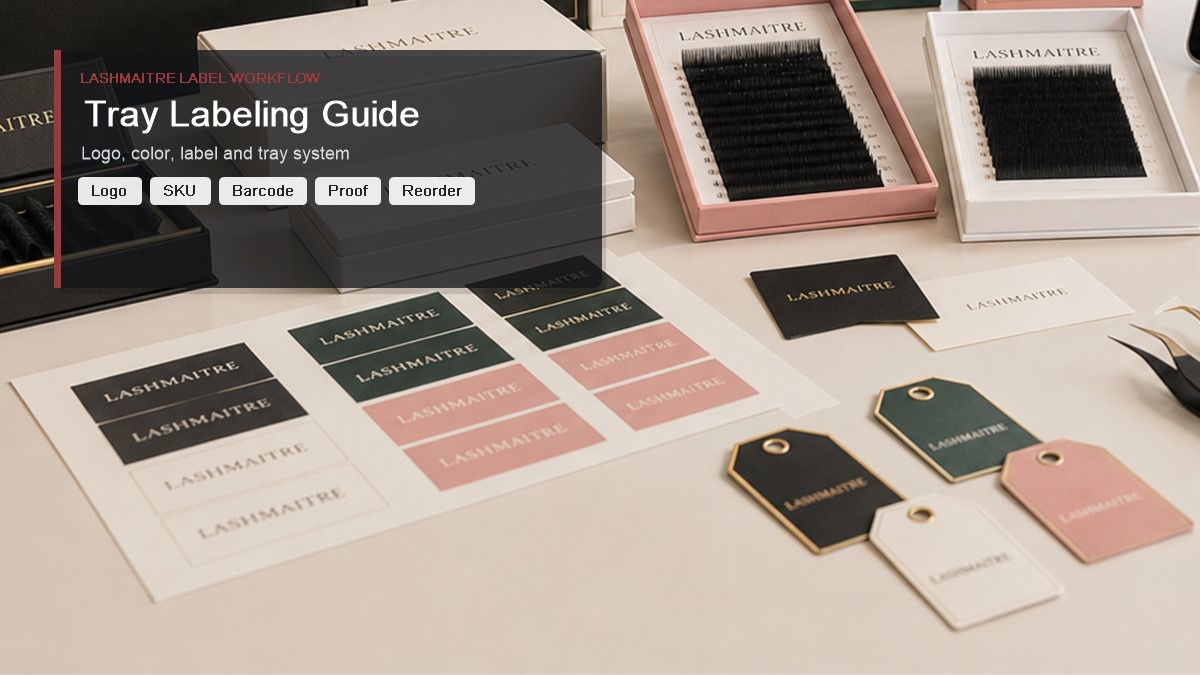
This lash tray labeling guide is for private label buyers who want labels that look professional and also protect product accuracy. A tray label is not only a logo sticker. For a lash brand, salon chain, distributor, ecommerce seller, or academy, the label helps identify product specs, organize SKUs, reduce packing mistakes, and make reorders easier.
This lash tray labeling guide is also useful before artwork proofing because it keeps brand labels, SKU labels, and carton labels aligned. Use the lash tray labeling guide as a reference whenever a tray spec, label version, or reorder note changes.
A good lash tray labeling guide should connect branding with operations. The label should make the tray easy to sell, store, pick, ship, and reorder. If the label looks attractive but does not clearly match the product spec, it can still create buyer complaints and reorder confusion.
The safest label process is staged: confirm product specs first, approve sample trays second, review label artwork third, check a packaging proof fourth, and only then move into bulk production.
What Lash Tray Labels Should Communicate
Private label lash tray labels should communicate enough information for the buyer's sales and reorder process. Some brands prefer a clean front label and a more detailed back or side label. Others need visible curl, thickness, length, and SKU details because salons or warehouse teams handle many similar trays.
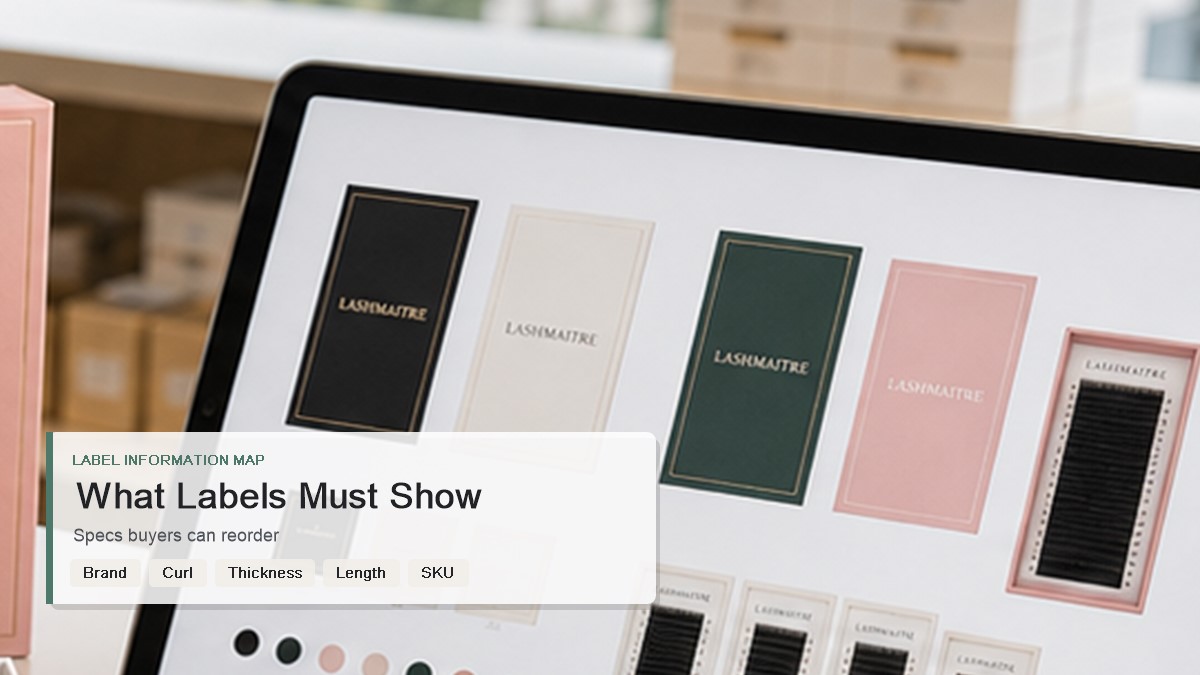
A practical tray label may include:
- Brand name or logo
- Product name or tray type
- Curl
- Thickness
- Length or length range
- Fiber finish or color if relevant
- Internal SKU or style code
- Barcode or GTIN if needed
- Country or market-specific information if required
- Batch, carton, or reorder reference if used internally
Not every label needs every field. The key is that the label should match the buyer's sales channel. A salon-focused tray may need different visible information than a retail-ready private label product.
Separate Logo Labels, SKU Labels, Box Labels, and Carton Labels
Buyers often use the word "label" for several different things. Before artwork starts, clarify which label is being discussed.
| Label type | Where it appears | Main purpose | Buyer check |
|---|---|---|---|
| Logo label | Tray, sleeve, or box | Brand presentation | Logo, color, placement |
| SKU label | Tray, box, or back label | Product identification | Curl, thickness, length, SKU |
| Box label | Retail box or outer packaging | Customer-facing packaging details | Product name, specs, barcode if needed |
| Carton label | Shipping carton | Warehouse and reorder control | SKU list, quantity, destination, carton number |
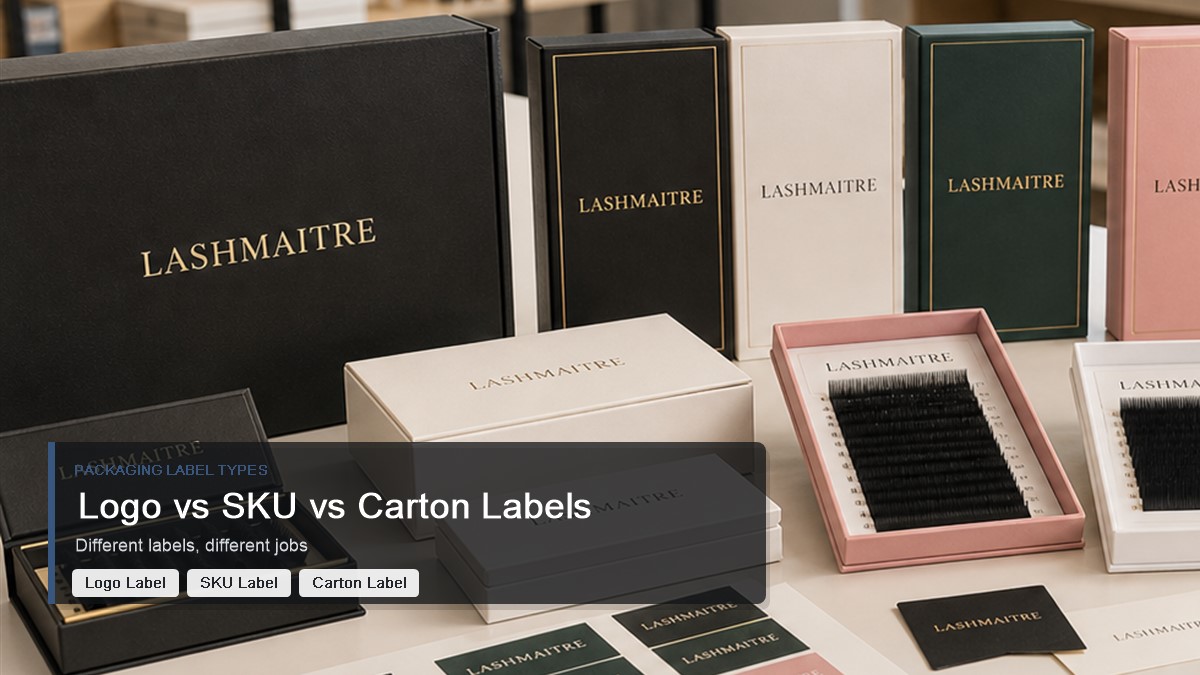
This separation matters because a buyer may start with lash tray logo labels before moving into custom boxes. Another buyer may need carton labels more urgently than full retail packaging because warehouse handling and repeat shipments are the main risk.
For broader packaging planning, review the custom lash packaging page. For artwork checking, the lash packaging artwork proof checklist explains why label proofing should happen before production.
Confirm Product Specs Before Approving Artwork
The most expensive label mistakes often happen when artwork is approved before product specs are final. If curl, thickness, length, finish, tray type, or product name changes after proofing, the label may need to be edited or reprinted.
Before approving tray label artwork, confirm:
- Tray type.
- Curl.
- Thickness.
- Length or length range.
- Finish or color.
- Product name.
- SKU or style code.
- Packaging format.
- Destination market.
- Reorder reference method.
If the buyer is still deciding between mixed length and single length trays, finalize that choice before printing labels. Label text should match the final tray structure, not an early idea.
Decide Whether Barcode or GTIN Planning Is Needed
Not every first lash order needs a retail barcode. Many early private label orders can start with logo labels and clear SKU names. However, buyers selling through retail, marketplaces, distributors, or structured ecommerce catalogs may need barcode or GTIN planning earlier.
GS1 US explains that a SKU is an internal inventory number, while a GTIN is a globally unique product identifier used by trading partners and marketplaces. A buyer planning retail expansion should understand this difference before designing label space. Reference: GS1 US cosmetics barcode guidance.
Use this simple decision rule:
- If the tray is only for internal salon use, a clear internal SKU may be enough.
- If the tray will be sold online under a private label brand, SKU clarity is still required.
- If the tray will enter retail or major marketplaces, barcode and GTIN planning may be needed.
- If carton handling is complex, carton labels may need stronger SKU and quantity fields.
Leave space for future identifiers if the brand expects to grow. It is easier to reserve label space now than to redesign the packaging system later.
Review Regulatory and Market Labeling Context
Lash extension trays are sold into different markets, and labeling expectations can vary by product type, claims, and destination country. Buyers should not treat a supplier's sample label as automatic compliance for every market.
For U.S. cosmetics context, the FDA provides a cosmetics labeling guide covering labeling requirements and examples. Buyers should review requirements for their own product category, claims, and market before finalizing retail packaging. Reference: FDA cosmetics labeling guide.
This does not mean every lash tray label needs the same content. It means private label buyers should avoid making unverified claims, should check market requirements, and should keep product information accurate.
Review Artwork Proof and Label Sample
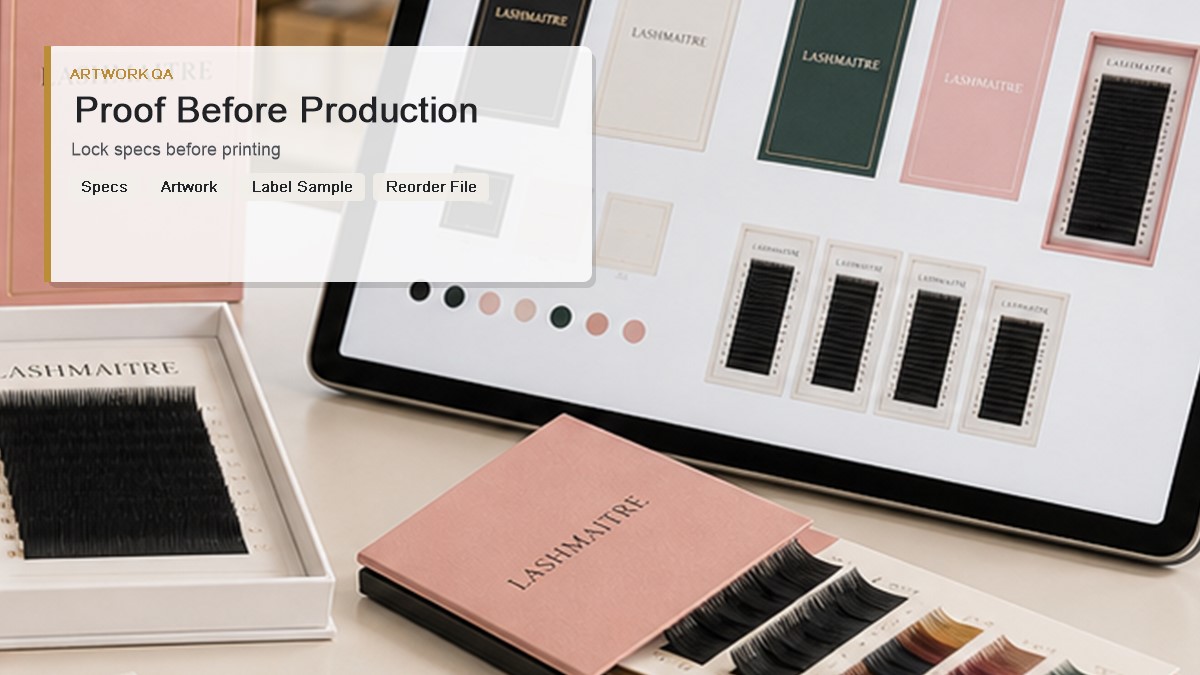
Artwork proofing should catch design and information mistakes before printing. A label proof should be reviewed on screen and, when possible, as a physical sample or production-style mockup.
Check the proof for:
- Logo quality and placement
- Spelling and capitalization
- Curl, thickness, and length accuracy
- SKU or barcode accuracy
- Color contrast and readability
- Safe margins and cutting space
- Label fit on the tray or box
- Match between tray spec and label text
Do not approve the proof only because the design looks nice. A beautiful label with the wrong length, curl, or SKU can create real reorder problems.
Connect Labels to Reorder Records
Tray labels should connect to the reorder record. When the buyer places a second order, the supplier should know exactly which product and packaging version to repeat.
A reorder record should save:
- Final label artwork file
- Approved sample photo
- Tray specs
- SKU name or code
- Barcode or GTIN if used
- Packaging version
- Carton label format if used
- First order quantity
- Notes from buyer feedback
LASHMAITRE can support buyers who need OEM and private label planning. The OEM lash extensions manufacturer page explains how product specs, packaging, and wholesale production can connect.
Common Lash Tray Labeling Mistakes
Private label buyers can avoid many issues by slowing down the label approval step. The most common mistakes are practical, not creative.
Avoid these label mistakes:
- Approving artwork before tray specs are final.
- Using product names that do not identify curl, thickness, or length.
- Printing several label versions without a clear SKU list.
- Forgetting carton labels for larger wholesale shipments.
- Leaving no space for barcode or GTIN needs if retail expansion is planned.
- Using low-contrast text that is hard to read.
- Reordering from old artwork files instead of approved records.
- Making label claims that have not been checked for the target market.
The goal is not to make the label crowded. The goal is to make the product clear.
Private Label Tray Labeling Checklist
Before bulk production, use this checklist:
- Confirm the final tray type.
- Confirm curl, thickness, and length range.
- Decide whether the label needs only brand presentation or also SKU details.
- Confirm the SKU naming system.
- Decide whether barcode or GTIN planning is needed.
- Review market and claim requirements for the destination country.
- Check artwork spelling, margins, and readability.
- Approve a label proof or packaging sample.
- Save the label version in the reorder record.
- Send final files and specs before bulk production.
If several people review the label, assign one final approver. Too many informal comments can create version confusion.
How LASHMAITRE Supports Staged Label Planning
LASHMAITRE can help buyers plan tray labels in stages. New private label buyers may start with logo labels and clear SKU names. More mature brands may need custom boxes, barcode planning, insert cards, and carton labels.
To prepare a label-ready inquiry, send logo files, brand colors, tray specs, SKU list, packaging direction, barcode needs, destination country, and sample requirements through the wholesale lash extensions inquiry page.
If you are not ready for final artwork, start with product samples first. Labels should be built around approved specs, not guesses.
Before a tray label file moves into reorder production, use this lash tray inspection checklist to confirm row alignment, strip release, length marks, barcode placement and packaging records.
FAQ: Lash Tray Labeling Guide
What should a lash tray label include?
A lash tray label can include brand name, tray type, curl, thickness, length or length range, finish, SKU code, barcode or GTIN if needed, and packaging version details.
Can I start with logo labels before custom boxes?
Yes. Many private label buyers start with logo labels before investing in full custom boxes. The label should still match the final product specs and reorder record.
Do lash tray labels need barcodes?
Not always. Barcodes may be needed for retail, marketplaces, distributors, or structured ecommerce catalogs. Internal salon or sample orders may only need clear SKU labels.
What is the difference between SKU and GTIN?
A SKU is an internal inventory code created by the brand or seller. A GTIN is a globally unique product identifier used by trading partners, marketplaces, and barcode systems.
How do I avoid label mistakes on reorders?
Save the approved label artwork, tray specs, SKU code, packaging version, sample photo, and order notes in one reorder file. Do not reorder from memory or chat history alone.
LASHMAITRE Buyer Notes
LASHMAITRE uses lash tray labels as part of the buyer's reorder system. The label should match the approved sample, SKU record, product family, curl, thickness, length range, finish wording, and packaging proof so private label buyers can reorder the same tray without confusion.
Tray labels should stay connected to the full branding file. Review private label lash extensions and custom lash packaging when tray cards, box artwork, and carton labels must match. Buyers can send label details through the wholesale lash extensions inquiry page.
FAQ: lash tray labeling guide
What information should be on a lash tray label?
A tray label should include product family, curl, thickness, length range or mixed-length format, finish name, SKU or reorder code, brand name, and any packaging version notes needed for reorders.
How do tray labels help private label lash brands reorder?
They turn approved samples into a repeatable record. When the label matches the sample and SKU file, the buyer can reorder the same specs with fewer mistakes.
Should tray labels match carton labels and box artwork?
Yes. Tray labels, carton labels, and box artwork should use the same product wording, SKU logic, and approved spec format.
Conclusion: Good Tray Labels Make Reorders Easier
A lash tray labeling guide should help private label brands connect packaging design with product accuracy. Good labels do more than display a logo. They help buyers identify specs, organize SKUs, reduce mistakes, and repeat approved products.
Send LASHMAITRE your logo files, tray specs, label needs, barcode questions, destination country, and sample request. We can help prepare a staged tray labeling path before bulk production.
Related LASHMAITRE Sourcing Pages
Use these related LASHMAITRE pages to move from this guide into samples, specifications, packaging and wholesale inquiry planning.
Buyer next step: Before locking tray names, test the label wording on lash extension samples so the physical tray card, curl and thickness information match the buyer approval file.
Buyer next step: Tray labels should match the approved product record, so connect label wording with LASHMAITRE lash quality control before printing repeat tray cards or carton labels.

Lash Maitre: Your Trusted Partner in Eyelash extension Solutions
Lash Maitre is dedicated to providing professional insights and tips in the eyelash extension industry. Sharing the latest trends, techniques, and product knowledge, Lash Maitre helps lash artists and enthusiasts enhance their skills, stay inspired, and achieve the perfect lash experience.