Lash Tray Order Quantity Calculator: How Many Trays Should You Buy?

Share
The number of lash trays to buy should be calculated by SKU, not as one total order. A practical lash tray order quantity is the forecast demand until the next replenishment, plus safety stock, minus usable stock on hand and confirmed incoming stock. Then round the result to the supplier’s ordering multiple or MOQ.
The lash tray order quantity calculator works best when every curl, diameter, length range and packaging version is treated as a separate SKU.
This guide gives lash brands, salon groups, distributors and private label buyers a repeatable way to calculate an opening order or replenishment quantity without overbuying slow SKUs or running out of best sellers.
Quick formula: Order quantity = forecast demand for the coverage period + safety stock − usable on-hand stock − confirmed incoming stock. If the result is below zero, order zero. If it is positive, round up to the permitted ordering multiple.
Lash Tray Order Quantity Calculator Inputs
Prepare one row for every curl, thickness, length range, tray format and packaging version you plan to sell. Do not combine all trays into one number because demand can be very different between SKUs.
| Input | What to record | Lash buyer example |
|---|---|---|
| Forecast demand | Expected trays sold or consumed during the coverage period | 88 trays |
| Safety stock | Extra trays kept for demand or supply variation | 20 trays |
| Usable on-hand | Sellable, approved trays physically available | 32 trays |
| Confirmed incoming | Approved trays already ordered and expected on time | 20 trays |
| Ordering multiple | Carton, pack or supplier ordering unit | 10 trays |
| MOQ rule | Minimum total or SKU quantity accepted by the supplier | Confirm before ordering |
IBM defines safety stock as extra inventory held to reduce stockout risk caused by demand, supply or manufacturing variability. Oracle’s NetSuite inventory documentation also distinguishes the reorder point from the quantity ordered and uses preferred stock levels to help calculate order quantities. Those general inventory principles should be applied at the individual lash SKU level.
Step 1: Define the Coverage Period
The coverage period is the number of days your new order must support before another replenishment can arrive. It normally includes supplier preparation, private label packaging, QC, shipping and your normal purchasing review interval.
If your supplier needs 30 days to prepare and deliver an order and your team reviews inventory every 14 days, the planning window can be 44 days. Use a realistic lead time from previous orders rather than the fastest quoted scenario.
For the separate decision about when stock should trigger a purchase order, use the existing guide to the lash inventory reorder point.
Step 2: Forecast Demand by Lash SKU
Use recent sales, salon consumption or distributor orders to estimate daily or weekly demand. Record demand separately for each meaningful curl, thickness, length range, tray type, finish, packaging version and sales channel.
For a stable SKU, a simple average can be enough. For a launch, promotion or seasonal order, create a base forecast and a higher-demand scenario. Do not let one fast-moving mixed tray hide several slow single-length trays.
Step 3: Count Only Usable Lash Tray Inventory
On-hand stock is not automatically usable stock. Exclude units that are damaged, held for QC, linked to an obsolete packaging version, missing labels or reserved for samples.
Usable on-hand = physical count − damaged units − QC hold − reserved samples − obsolete versions.
For trays already opened for salon or training use, calculate remaining capacity by row when that is how your team controls consumption. If planned demand is 48 rows and an approved tray provides 16 usable rows, the requirement is three trays before other stock adjustments.
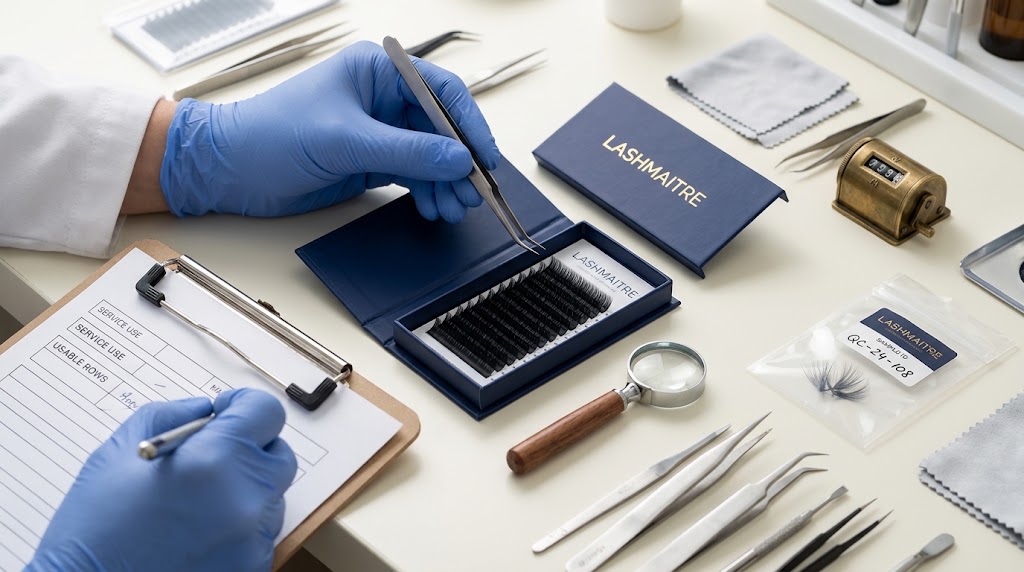
Confirm product consistency through lash extension samples before treating a new SKU as approved inventory.
Step 4: Add Safety Stock Without Treating Every SKU the Same
Safety stock protects against a demand spike, supplier delay or shipping disruption. It should be higher for proven best sellers and lower for experimental or slow-moving SKUs.
- Use a larger buffer for best sellers, variable lead times, promotions, distributor orders and private label products.
- Keep the buffer controlled for sample-stage, weak-demand or changing-packaging SKUs.
Step 5: Calculate the Net Lash Tray Order Quantity
Net order quantity = forecast demand during coverage period + safety stock − usable on-hand − confirmed incoming.
Worked example
A C-curl mixed-length tray is forecast to sell 88 units during the coverage period. The buyer wants 20 trays of safety stock, has 32 usable trays on hand and has 20 approved trays already in transit.
| Calculation | Trays |
|---|---|
| Forecast demand | 88 |
| Plus safety stock | +20 |
| Less usable on-hand | −32 |
| Less confirmed incoming | −20 |
| Net order quantity | 56 |
If the ordering multiple is 10 trays, round 56 up to 60. Do not round every SKU up independently before checking the total budget, supplier MOQ and carton logic.
Step 6: Allocate Mixed-Length and Single-Length Trays
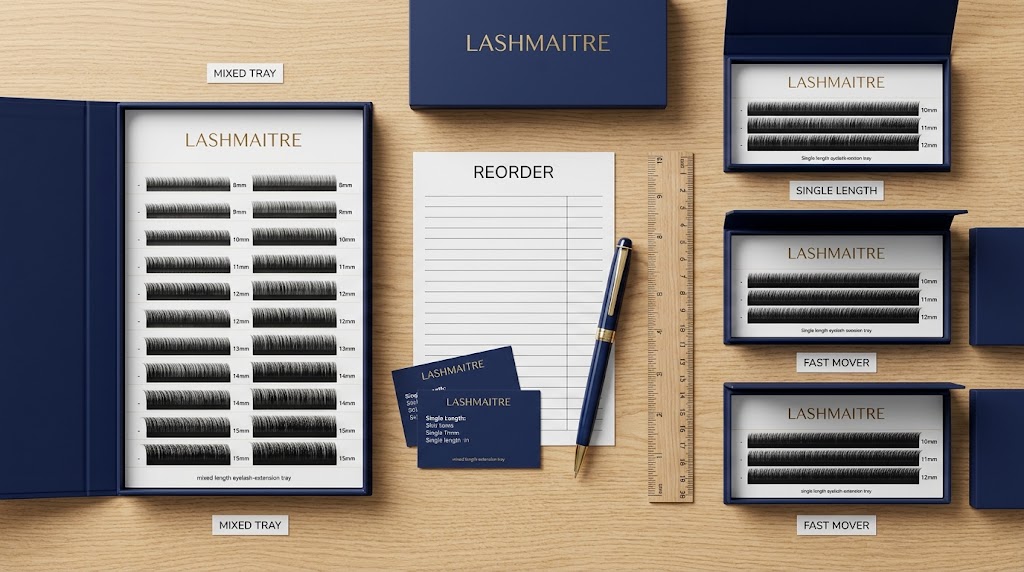
Mixed-length trays reduce the number of separate SKUs a buyer must hold, while single-length trays provide more depth in specific fast-moving lengths. The right allocation depends on actual sales or service consumption.
| Inventory group | Share | Planned trays |
|---|---|---|
| Mixed-length trays | 70% | 70 |
| 10 mm single-length | 12% | 12 |
| 11 mm single-length | 10% | 10 |
| 12 mm single-length | 8% | 8 |
| Total | 100% | 100 |
Use mixed trays to test demand when length-level data is limited. Add single-length depth only where sales or salon consumption demonstrates a repeatable need.
Step 7: Apply MOQ, Budget and Packaging Constraints
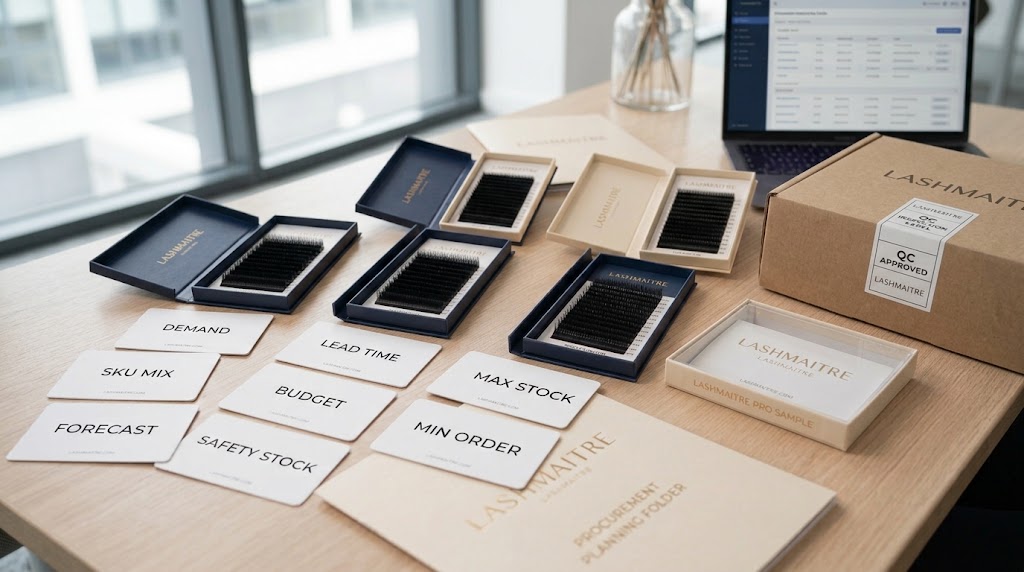
The calculated quantity is a planning answer, not automatically a valid supplier order. Check it against total MOQ, any per-SKU minimum, ordering multiples, landed cost, packaging quantities, approved artwork and realistic lead time. Confirm the available wholesale eyelash extension tray options before finalizing the SKU allocation.
If the calculated order is smaller than the supplier’s minimum, do not add random slow-moving SKUs simply to reach MOQ. Prioritize proven SKUs, use samples for unproven variants, or ask whether the order can be grouped across a controlled range. Review the MOQ 50 wholesale lash extensions path for low-risk range planning.
For branded orders, confirm the private label lash extensions workflow before counting packaging as ready inventory.
Lash Tray Order Checklist
- Define one row for each lash SKU and packaging version.
- Include realistic production, QC and shipping time.
- Exclude holds, damage, samples and obsolete packaging.
- Count incoming stock only when it is confirmed.
- Set higher safety stock for proven best sellers.
- Match mixed and single-length allocation to demand.
- Round to the permitted ordering multiple.
- Check MOQ, landed cost, budget and carton quantities.
- Match approved samples and QC records.
- Send the SKU table and quantities with the inquiry.
Use the lash quality control process to connect approved samples, specifications and reorder records.
Frequently Asked Questions
How many lash trays should I order?
Use the lash tray order quantity calculator for each SKU separately: forecast demand for the coverage period plus safety stock, minus usable on-hand and confirmed incoming stock. Round a positive result up to the supplier’s ordering multiple, then validate the complete order against MOQ and budget.
Is a lash tray order quantity the same as a reorder point?
No. A reorder point tells you when available inventory should trigger a new purchase order. Order quantity tells you how many trays to buy after that trigger or during an opening-stock plan.
Should a new lash brand order mixed or single-length trays?
When length-level demand is uncertain, mixed-length trays usually reduce initial SKU count. Add single-length trays where sampling, sales or salon consumption shows a reliable fast-moving length.
How should incoming stock be handled in the calculation?
Subtract incoming stock only when the SKU, quantity, approval status and expected arrival are confirmed. Do not count a quotation, unapproved sample or uncertain shipment as available supply.
How does MOQ affect lash tray order quantity?
MOQ can require the buyer to round or regroup calculated quantities. Protect the highest-demand SKUs first, avoid padding the order with unproven variants and confirm whether MOQ applies to the total order, product family or SKU.
Should private label packaging be included in inventory planning?
Yes. Track boxes, tray cards, labels, barcodes and approved artwork versions separately. Product trays without the correct packaging may not be sellable inventory for a private label launch.
Prepare a More Accurate Wholesale Lash Inquiry
Send the SKU specification, calculated tray quantity, sample status, packaging version, target date and destination. This makes it easier to confirm MOQ, lead time, QC and landed-cost assumptions before production.
Submit a wholesale lash extensions inquiry with your planned SKU mix, or start with samples when demand is not yet proven.
Sources

Lash Maitre: Your Trusted Partner in Eyelash extension Solutions
Lash Maitre is dedicated to providing professional insights and tips in the eyelash extension industry. Sharing the latest trends, techniques, and product knowledge, Lash Maitre helps lash artists and enthusiasts enhance their skills, stay inspired, and achieve the perfect lash experience.