Lash Specification Tolerance Sheet for Wholesale Buyers
Share
Direct Answer
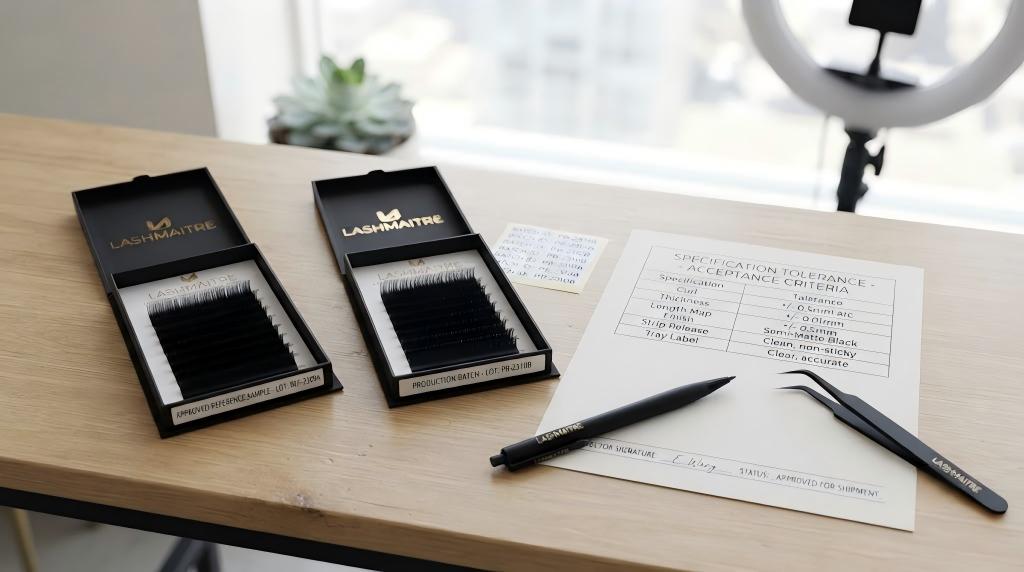
A lash specification tolerance is the buyer-approved limit for variation from an approved sample or written product specification. A useful tolerance sheet identifies the characteristic, comparison method, acceptable range or visual boundary, sample size, decision owner, and required action when a production batch falls outside the agreed limit.
Lash Specification Tolerance Buyer Summary
Lash specification tolerance gives a wholesale buyer an agreed way to compare a production batch with the approved sample. Record the reference sample, inspection method, acceptable variation, sample size, decision owner, and action required when curl, thickness, length, finish, strip release, labels, or packaging fall outside the agreed boundary.
There is no single tolerance that fits every curl, fiber, tray format, finish, and brand. Wholesale buyers should lock acceptance criteria with the supplier before bulk production rather than inventing limits after a disagreement appears.
Why Lash Specification Tolerance Matters
An approved lash sample may look clear on the buyer's desk, but the production decision can still be vague. One person may compare curl visually, another may check the printed tray card, and a third may judge only whether the tray looks sellable.
That creates avoidable disputes:
- Is a small curl difference acceptable?
- Is apparent length being measured from the same reference point?
- Does
0.07describe the ordered specification or a verified measurement method? - Is a matte finish allowed to vary slightly between lighting conditions?
- Does one label error fail a tray, a carton, or the whole batch?
A tolerance sheet turns those questions into agreed buyer decisions before the order reaches shipment.
What Should a Lash Tolerance Sheet Include?
The sheet should not be a list of arbitrary numbers. It should connect each requirement to an inspection method and a business decision.
| Characteristic | Reference | Check Method | Acceptance Boundary | Action if Outside Boundary |
|---|---|---|---|---|
| Curl | Approved sample and curl card | Side-by-side comparison under consistent setup | Buyer-approved visual or measured limit | Hold and review affected batch |
| Thickness | Written specification and approved sample | Supplier measurement record plus sample comparison | Agreed product specification | Recheck, sort, or reject |
| Length map | Approved tray map | Compare marked rows and representative fibers | Correct sequence and agreed apparent lengths | Correct tray map before release |
| Finish | Approved sample | Controlled visual comparison | Agreed matte, semi-matte, or gloss appearance | Buyer review or retest |
| Strip release | Approved handling result | Pickup test on agreed sample units | Usable release without damage or excess residue | Adjust strip or adhesive process |
| Tray label | Approved proof and SKU record | Text, barcode, and SKU match | No material mismatch | Relabel before packing |
| Carton mark | Approved shipping record | SKU, batch, count, destination match | Exact record match | Hold shipment and correct |
Define the Reference Before Defining the Tolerance
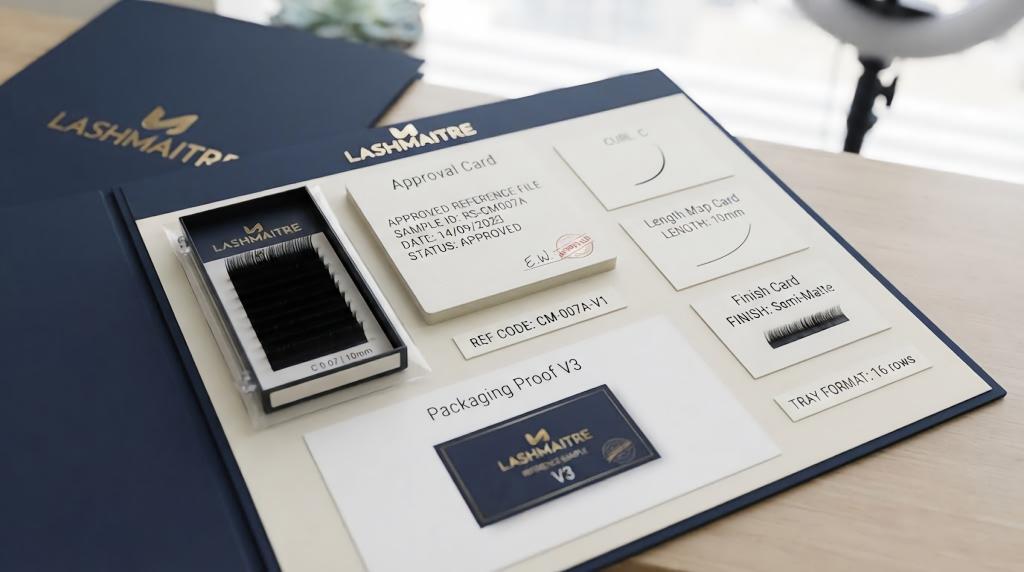
The reference should be identifiable. “Same as the last sample” is not enough.
A professional reference record may include:
- approved sample code
- curl, thickness, and length map
- fiber or product family
- finish
- tray format and row count
- tray card version
- packaging proof version
- approval date and approver
The LASHMAITRE sample approval process helps buyers connect the physical tray with a written record before the order moves to bulk.
Measured Requirements Versus Visual Requirements
Some requirements can be recorded as variables. Others are attributes or visual decisions.
Examples of variable checks include a measured dimension. Attribute checks include whether a barcode scans, a label matches, a row is missing, or a carton mark is correct. NIST explains acceptance sampling as using information from a selected sample to decide whether a lot is acceptable and distinguishes attribute plans from variable plans.
For lash orders, this distinction matters because a buyer should not treat every feature as if it can be controlled by one number. Curl appearance, finish, fanning, and strip release may require an approved comparison setup and practical buyer test in addition to production records.
How to Build Acceptance Criteria From an Approved Sample
Use this five-step process:
- Identify the characteristic. Write exactly what is being checked: curl, length map, label, finish, strip release, or another defined feature.
- Name the reference. Record the approved sample code, proof version, SKU, or buyer-approved specification.
- Define the method. State how the comparison will be made and under what conditions.
- Define the decision boundary. Use a measurable limit where a valid method exists, or a clear approved visual boundary where it does not.
- Define the response. Decide whether an out-of-limit result triggers a recheck, sort, relabel, rework, replacement, or rejection.
Do Not Copy Arbitrary Tolerance Numbers
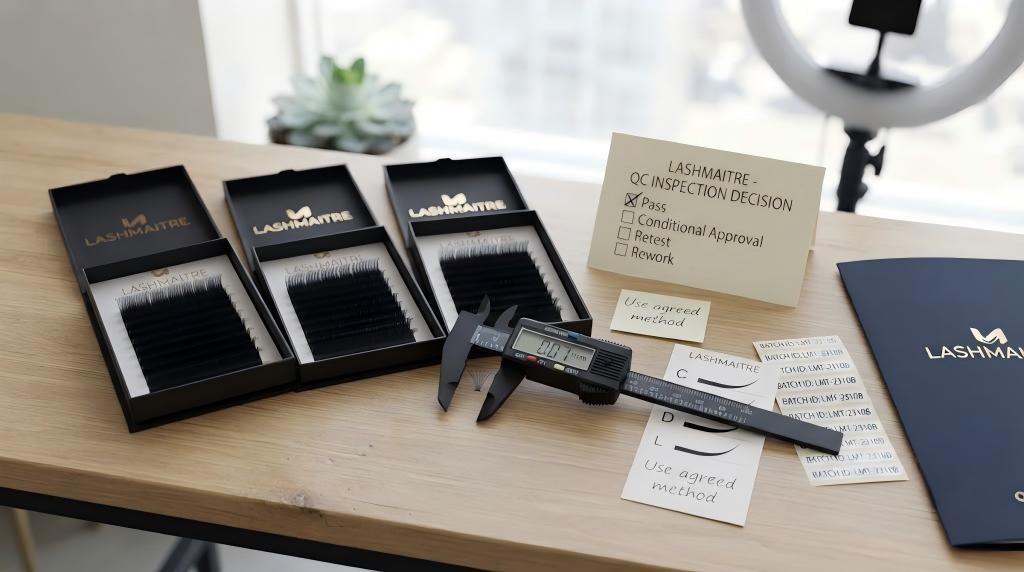
A number can look professional while still being meaningless. A tolerance copied from another product may not fit a different fiber, curl, tray design, measurement method, or buyer market.
Before accepting a number, ask:
- What is being measured?
- Which tool and method are used?
- Is the method repeatable?
- Is the approved sample part of the decision?
- Does the limit protect product use and reorder consistency?
- Who has authority to approve a deviation?
The right answer is an agreed control plan, not the tightest-looking number.
Pass, Conditional Approval, Rework, or Rejection
Not every difference requires the same response.
| Decision | When It May Apply | Required Record |
|---|---|---|
| Pass | Checks meet agreed criteria | QC result and batch ID |
| Conditional approval | Difference is understood and buyer accepts it for a defined order | Written deviation approval |
| Rework or correction | Label, carton, packing, or another correctable item is wrong | Corrected proof and verification |
| Retest | Result is unclear or method was inconsistent | New test record |
| Reject | Material requirement fails and no approved disposition exists | Nonconformance and next action |
LASHMAITRE's quality control resource connects sample approval, batch comparison, tray inspection, labeling, and reorder records.
Buyer Checklist Before Bulk Approval
- Is the approved sample identified by code?
- Are curl, thickness, length map, finish, and tray format written down?
- Is each check method clear?
- Are visual checks made under a consistent setup?
- Is the sample size or inspection scope defined?
- Is the action for a failed result agreed?
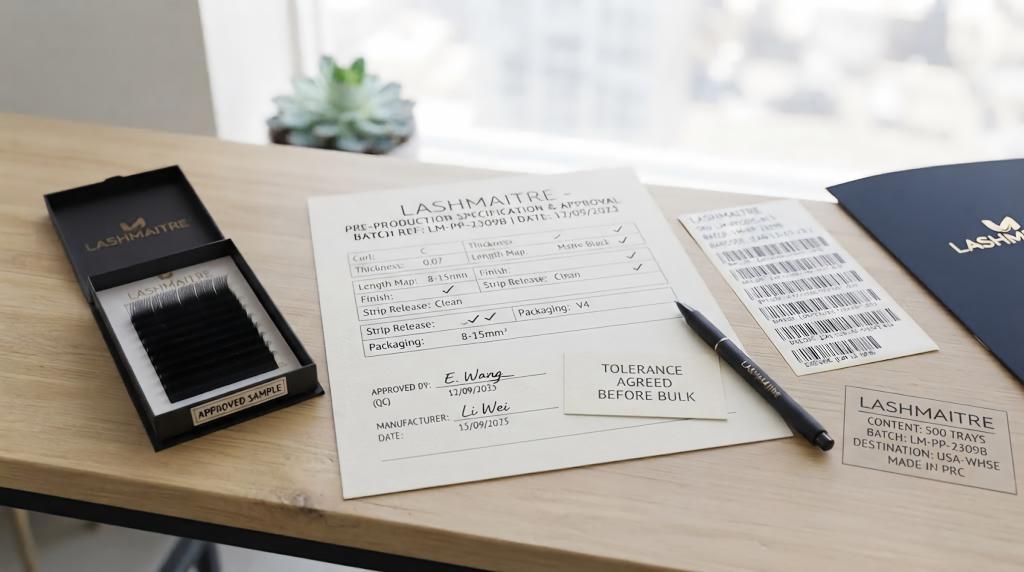
- Are label, barcode, batch ID, and carton mark included?
- Is any deviation approved in writing?
Lash Specification Tolerance FAQ
What is a lash specification tolerance?
It is the agreed limit for acceptable variation from an approved sample or written product specification. It should include the characteristic, check method, boundary, inspection scope, and action for failure.
Is there one standard curl tolerance for every lash tray?
No. Curl appearance and control depend on the product, reference sample, method, and intended use. Buyers and suppliers should agree on a repeatable comparison method and acceptance boundary before production.
Should the buyer inspect every tray?
The inspection plan depends on lot size, risk, defect history, and the agreed sampling plan. A sample can support a lot decision, but it should be representative and linked to clear acceptance criteria.
What happens when production is outside tolerance?
The batch should be held for a documented decision. Possible actions include recheck, sorting, relabeling, rework, replacement, written deviation approval, or rejection.
Should packaging and labels be included?
Yes. A sellable wholesale order depends on product specifications and record accuracy. Tray labels, barcodes, batch IDs, carton marks, and counts should have their own acceptance rules.
Request a Measurable Sample Approval Plan
Use the LASHMAITRE wholesale inquiry form to send the product, sample, packaging, destination, and QC requirements that need to be confirmed before bulk production.
—
When a measured result falls outside the approved tolerance, hold the affected stock and review a documented lash production deviation approval before accepting, reworking or rejecting the batch.
A stated tolerance is useful only when the inspection system is controlled, so review the supplier’s lash calibration records for tool identity, reference method, due date and out-of-tolerance action.

Lash Maitre: Your Trusted Partner in Eyelash extension Solutions
Lash Maitre is dedicated to providing professional insights and tips in the eyelash extension industry. Sharing the latest trends, techniques, and product knowledge, Lash Maitre helps lash artists and enthusiasts enhance their skills, stay inspired, and achieve the perfect lash experience.