Standard Volume Lash Trays Wholesale: 7 Sample Checks for Handmade Fans
Share
Standard volume lash trays wholesale should be evaluated as loose-fiber tools for handmade fan creation—not as premade fan products. A useful buyer sample must confirm the product type, diameter, curl and length mix, pickup behavior, strip release, fiber finish and repeat-order specification before a bulk or private label order is approved. Review the broader wholesale lash tray range when comparing standard volume with other tray formats.
For a lash brand, distributor or salon chain, the important question is not simply whether a tray looks full. The real question is whether trained artists can repeatedly create the intended fans from the tray while the supplier maintains the same approved specification across production batches.
This guide gives procurement teams a seven-part sample check. It also shows where standard volume trays differ from Easy Fan and premade fan trays, so buyers can request the correct product from the start.
Quick answer: Standard volume lash trays contain individual loose fibers arranged on strips for artists to create handmade fans. Buyers should approve them by product identity, diameter, curl and length, pickup, strip release, finish, packaging and batch record—not by tray appearance alone.
What Are Standard Volume Lash Trays?
Standard volume lash trays are trays of individual extension fibers intended for manual fan-making techniques. They are different from:
- Easy Fan lashes, which are engineered to help multiple fibers stay together during pickup; and
- Premade fans, which arrive as completed fans with a defined fan count, width and base.
This distinction matters commercially. If a buyer requests “volume lashes” without stating the product type, two suppliers may quote products with different construction, labor requirements and service positioning.
Before requesting prices, write the product identity at the top of the inquiry:
Standard loose-fiber volume tray for handmade fans
Then add the diameter, curl, length format, row count, finish and packaging requirements. Buyers comparing multiple product types can use the existing premade fans vs handmade guide to keep those purchase decisions separate.
A Fast Comparison: Standard Volume, Easy Fan and Premade Fan
| Product type | What is supplied | Artist workflow | Specifications buyers must lock |
|---|---|---|---|
| Standard volume | Individual loose fibers on strips | Artist creates each fan manually | Diameter, curl, length, fiber finish, strip behavior, rows |
| Easy Fan | Fibers designed to assist fan formation | Artist picks up and opens assisted fiber groups | Base behavior, pickup method, adhesive system, diameter, curl, length |
| Premade Fan | Finished fans placed on strips | Artist selects and applies completed fans | D count, fan width, base, stem, curl, length, heat- or adhesive-bonded construction |
Do not use one approved sample as the control for all three categories. Each product type needs its own specification and retained sample.
Check 1: Confirm the Product Type Before Comparing Prices
Start by confirming that every supplier has quoted a standard loose-fiber tray. Ask for a physical sample and a specification sheet that identifies the product as standard volume rather than Easy Fan, promade or premade.
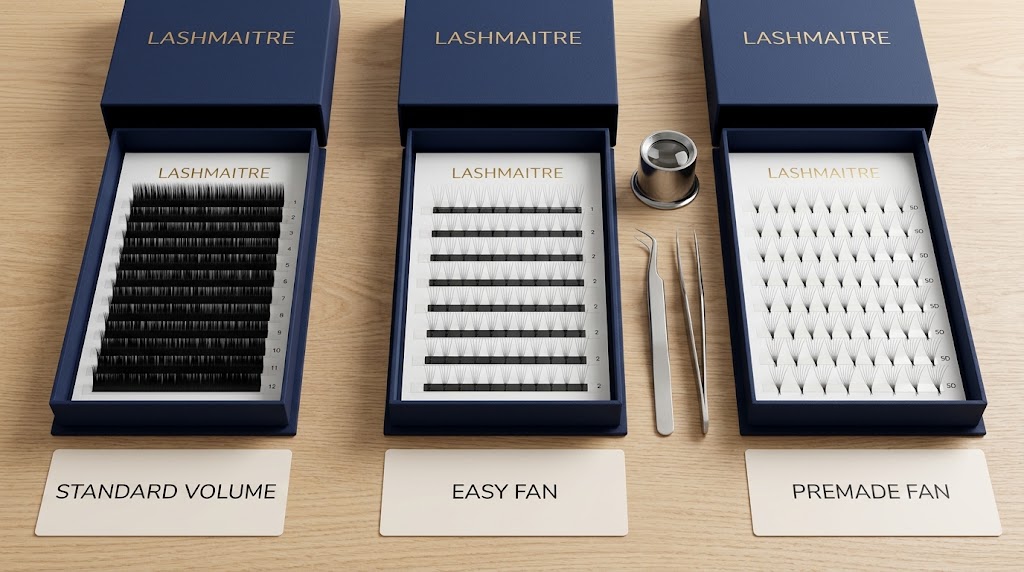
During inspection, check whether fibers can be separated and manipulated individually. Record how the product behaves under the same technique used by the buyer’s test artist. A low quotation is not comparable if the construction or intended workflow is different.
Use the comparison image and sample notes to answer four questions:
- Are these individual fibers or completed fans?
- Is the strip designed for manual fan creation or assisted fan formation?
- Does the quoted SKU match the physical tray label?
- Will the product description be clear to the final B2B or retail customer?
This product-identity check prevents a common sourcing error: approving a visually attractive tray that does not match the service technique or catalog description.
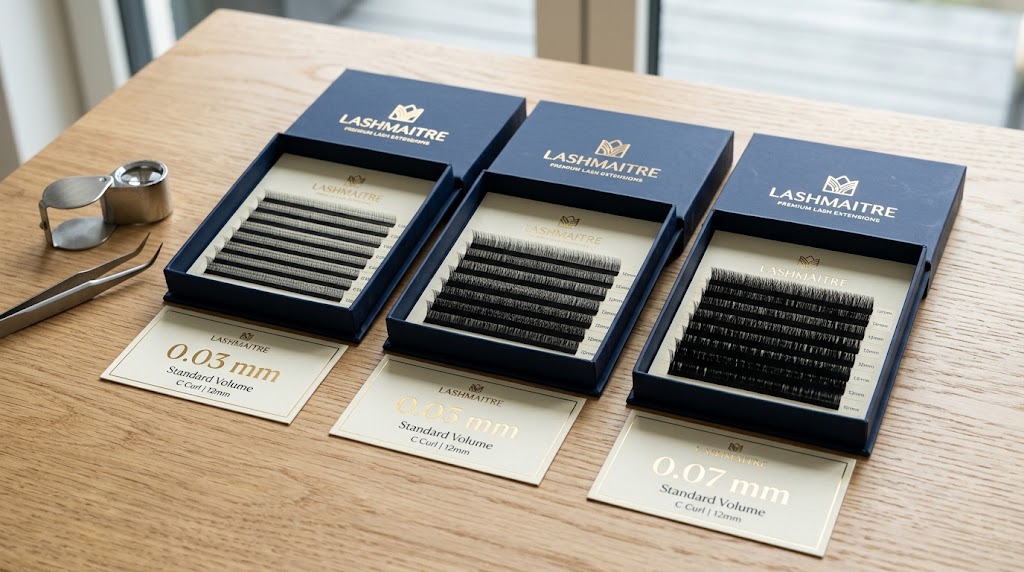
Check 2: Match 0.03, 0.05 or 0.07 mm to the Intended Range
Diameter should be treated as a product specification, not a marketing label. The buyer should test each diameter with the intended technique, fan size and professional application protocol.
| Diameter | Typical wholesale positioning to validate | Sample decision |
|---|---|---|
| 0.03 mm | Very fine volume and advanced fan-building ranges | Verify separation, visibility, handling and consistency |
| 0.05 mm | Fine volume or mega-volume-oriented ranges | Verify pickup control, finish and the target fan workflow |
| 0.07 mm | Widely used standard volume ranges | Verify handling, fan formation and the brand’s service menu |
These are purchasing categories, not universal application rules. Suitability depends on the artist’s technique, the finished design and professional assessment. Buyers comparing the two common options can link to the dedicated 0.05 vs 0.07 lash extensions comparison rather than duplicating that full decision inside this article.
Request samples in the exact diameter, curl and length combination that will be ordered. A 0.05 C curl sample cannot confirm the behavior of a 0.07 D curl production SKU.
Check 3: Lock Curl, Length Mix, Row Count and Tray Format
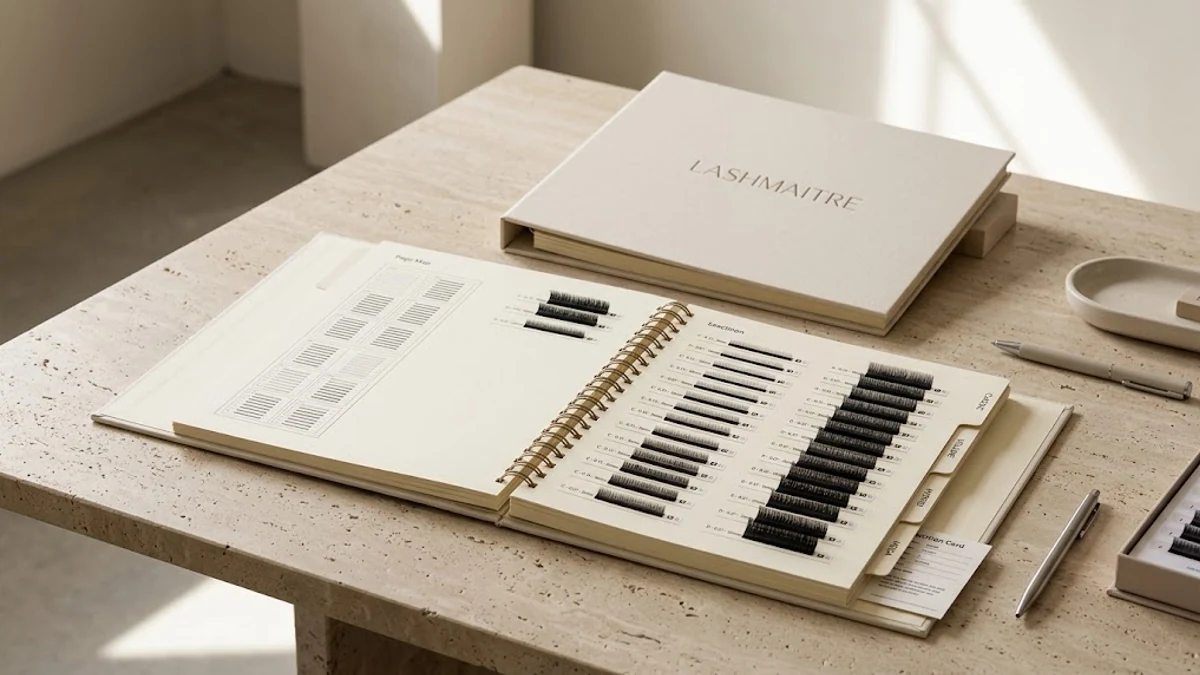
A standard volume sample is incomplete unless its commercial format is recorded. At minimum, the approval sheet should list:
- diameter;
- curl;
- single-length or mixed-length format;
- included lengths;
- row count;
- strip width and strip label format;
- tray card and outer-box version; and
- matte, semi-matte or other approved finish description.
Mixed trays can support sampling and broad salon use, while single-length trays may suit predictable replenishment of fast-moving lengths. The best choice depends on sales data and the buyer’s service menu.
Row count also affects the apparent tray price. Compare usable product and format, not only the unit price. The 12 row vs 16 row lash tray guide provides a separate framework for comparing tray capacity and cost per usable row.
For private label orders, ensure that the printed SKU and barcode structure distinguish every diameter, curl and length format. Similar-looking trays should not depend on memory or box color alone.
Check 4: Test Pickup and Controlled Fanning
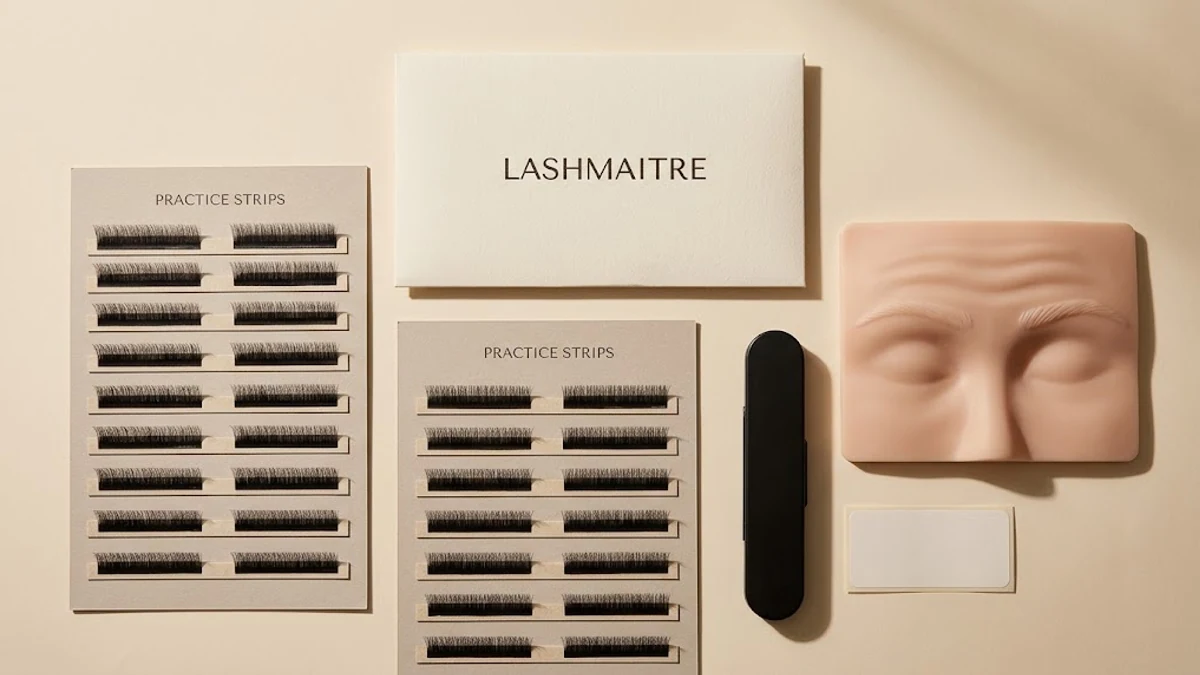
Pickup testing should use a repeatable method. Give each coded supplier sample to the same trained tester, use the same tweezers and work surface, and record observations without relying on packaging appearance.
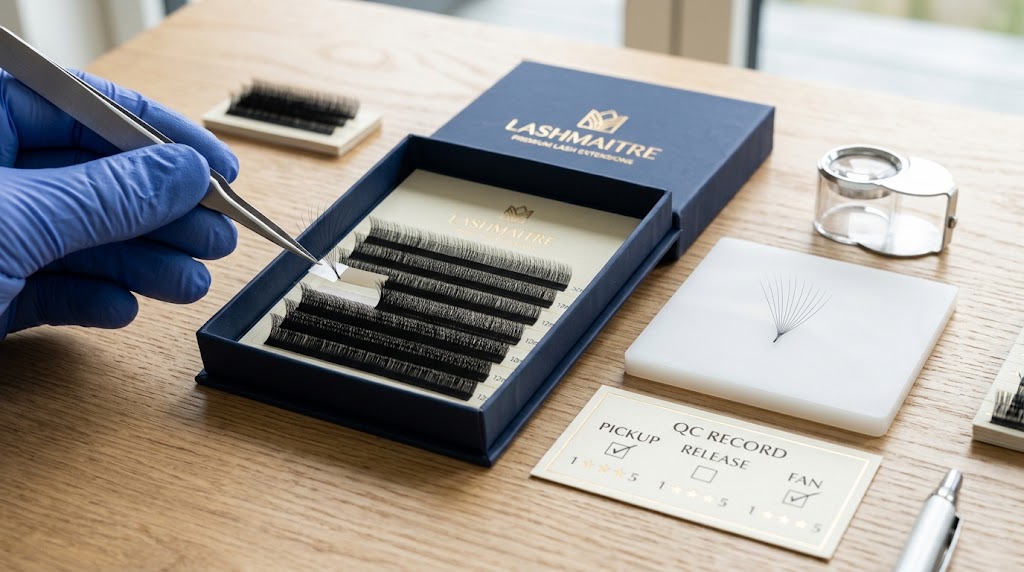
The tester should evaluate:
- whether the intended number of fibers can be selected cleanly;
- whether neighboring fibers remain orderly on the strip;
- whether the selected fibers can be opened into a controlled fan;
- whether the base remains manageable for the intended technique; and
- whether behavior stays reasonably consistent across the beginning, middle and end of the strip.
Do not turn this into a single “good” or “bad” score. Record pickup, separation and fan control as separate fields. This gives the supplier useful correction notes if one attribute fails while the others pass.
A sample that performs well only in one area of the tray is not enough for bulk approval. Test multiple strips and more than one tray when possible.
Check 5: Inspect Strip Release and Residue
The strip should support controlled pickup without forcing the tester to compensate for an unsuitable adhesive level. Check whether fibers release cleanly and whether the strip leaves visible residue that interferes with the intended workflow.
Use the same evaluation conditions for every supplier. If temperature, tools, technique or storage conditions change, record the change instead of treating the results as directly comparable.
For a deeper production-control procedure, link to the dedicated lash tray strip consistency checklist. The new article should use that page as supporting QC content rather than repeat its complete test method.
When reporting a failure, include the SKU, lot or sample code, strip position, photo and short description. “Hard to pick up” is less actionable than “the middle three strips required repeated pickup and left fibers displaced on the strip.”
Check 6: Compare Fiber Finish, Taper and Batch Consistency
Inspect the tray under consistent lighting. The buyer is checking whether the approved finish and fiber appearance match the intended brand position—not making a medical or safety certification from visual inspection alone.
Review:
- color and matte level;
- visible uniformity within the tray;
- curl alignment;
- taper and tip appearance;
- unexpected shine or plastic-like appearance;
- foreign material or visible contamination; and
- differences between coded samples or lots.
For material-focused purchasing, use the existing PBT lash fiber quality guide as a supporting reference. Buyers investigating tactile appearance can also consult the dedicated volume lash tray no-plastic-feel inspection.
Because eyelash extensions are used near the eye area, product identification, labeling and professional-use controls deserve careful attention. The U.S. FDA states that false eyelashes, eyelash extensions and their adhesives are cosmetic products subject to applicable safety and labeling requirements; buyers should review the FDA’s Eye Cosmetic Safety information and obtain market-specific compliance advice.
Check 7: Approve the Sample, Private Label Version and Reorder Record
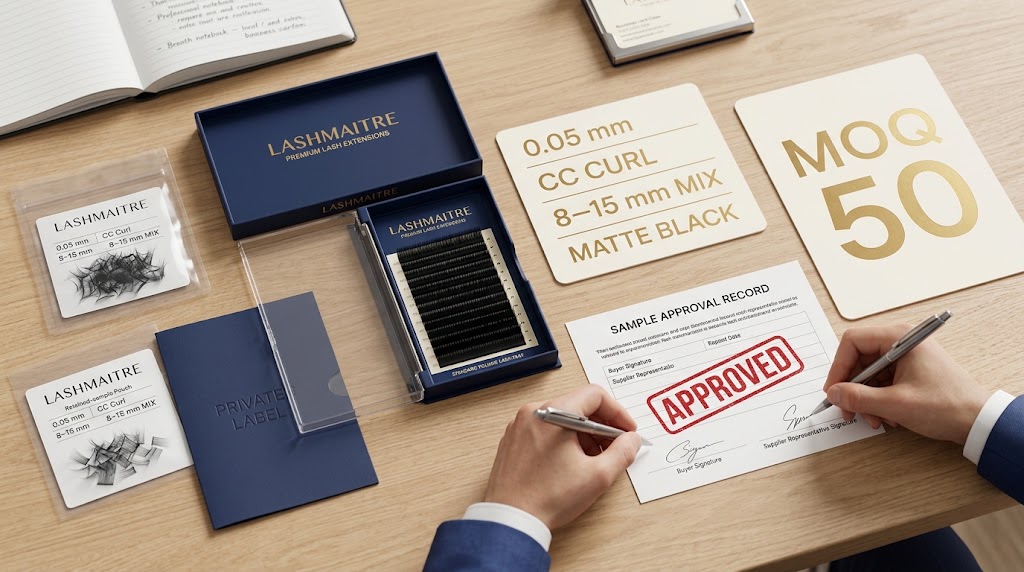
A good sample is only useful when the approved version can be reproduced. Create one approval record that connects the physical tray to the commercial order.
Record:
- supplier and buyer sample IDs;
- SKU and product type;
- diameter, curl and length format;
- row count and tray dimensions;
- fiber finish and strip requirement;
- packaging artwork version;
- barcode or product identifier;
- approved date and approver;
- MOQ allocation by SKU; and
- retained-sample location.
Use the lash sample approval form guide to structure sign-off before production. If the order must be distributed across a small assortment, the MOQ 50 planning sheet helps buyers separate total MOQ from per-SKU allocation.
Private label packaging should carry a clear SKU and version reference so the approved tray can be matched to the correct artwork. In the EU, the General Product Safety Regulation summary highlights product safety processes and traceability information on products or packaging. Buyers selling into the EU should review the applicable EUR-Lex GPSR summary and obtain compliance advice for their exact market and business role.
How to Build a Practical Sample Request
A useful standard volume lash tray inquiry should include enough information for suppliers to quote the same object. Separate density labels from supplied format with the volume vs mega volume buying comparison. For a colored range, use the ombre vs full color specification guide to record fiber color placement separately from the tray assortment.
Send a short request containing:
- product type: standard loose-fiber volume tray;
- diameter options to sample: 0.03, 0.05 and/or 0.07 mm;
- curl and length format;
- single-length or mixed tray;
- row count;
- finish and color expectation;
- private label packaging requirement;
- target MOQ and SKU count; and
- delivery market and requested documentation.
Ask the supplier to label every sample with a unique code. If a revised sample is sent, keep both versions and record what changed. Never approve a production order from an unmarked tray or chat photo alone.
Standard Volume Lash Tray Buyer Checklist
Before approving a wholesale order, confirm that the answer to each question is “yes”:
- Is the product clearly identified as a standard loose-fiber tray for handmade fans?
- Does the physical sample match the requested diameter, curl and length format?
- Are pickup, separation and controlled fan formation acceptable to the test artist?
- Is strip release consistent across more than one area of the tray?
- Does the fiber finish match the approved brand position?
- Are row count, packaging, SKU and artwork version recorded?
- Is a retained approved sample connected to the purchase order and reorder record?
If any answer is uncertain, hold the bulk order and request a corrected, coded sample.
FAQ: Standard Volume Lash Trays Wholesale
What is a standard volume lash tray?
A standard volume lash tray contains individual loose fibers on strips so a trained artist can create handmade volume fans. It is not the same as an Easy Fan tray or a tray of completed premade fans.
Which diameter should wholesale buyers choose: 0.03, 0.05 or 0.07 mm?
The buyer should select diameter according to the intended professional technique, fan range, service menu and sample performance. Each exact diameter, curl and length combination should be physically tested before bulk approval.
Are standard volume lashes the same as premade fans?
No. Standard volume lashes are loose fibers used to build fans manually. Premade fans arrive as completed fans with defined fan count, width and base specifications.
What should be included in a standard volume lash tray sample request?
Specify product type, diameter, curl, lengths, mixed or single-length format, row count, finish, packaging, private label needs, target MOQ, SKU count and destination market.
How many trays should be tested before a wholesale order?
There is no universal number for every order. Buyers should test enough coded samples and tray areas to confirm repeatable pickup, strip release and appearance, then keep an approved retained sample for production comparison.
Can standard volume lash trays use private label packaging?
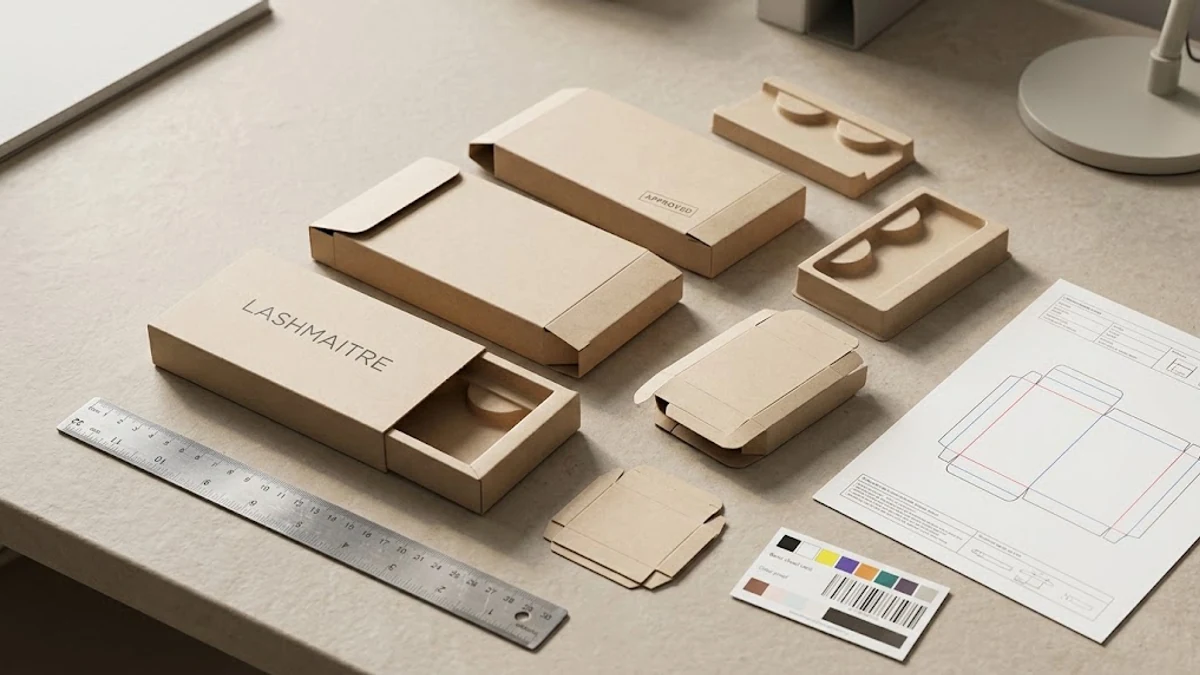
Yes. Buyers can specify branded tray cards, boxes, labels and product identifiers. The artwork version and physical tray specification should be approved together so packaging changes do not obscure a product change.
What should be recorded for a repeat order?
Keep the supplier SKU, buyer SKU, diameter, curl, length format, row count, finish, strip requirement, packaging version, sample code, batch or lot reference and approval date.
Request Standard Volume Lash Tray Samples
LASHMAITRE supports B2B buyers evaluating standard volume lash trays, mixed or single-length formats, MOQ 50 planning and private label packaging. Send the intended diameter, curl, length mix, row count, SKU quantity and target market so the sample request can be matched to the correct specification.
Request standard volume lash tray samples and a wholesale quotation

Lash Maitre: Your Trusted Partner in Eyelash extension Solutions
Lash Maitre is dedicated to providing professional insights and tips in the eyelash extension industry. Sharing the latest trends, techniques, and product knowledge, Lash Maitre helps lash artists and enthusiasts enhance their skills, stay inspired, and achieve the perfect lash experience.