Angel Lash Extensions Wholesale: 8 Essential Sample Checks
Share
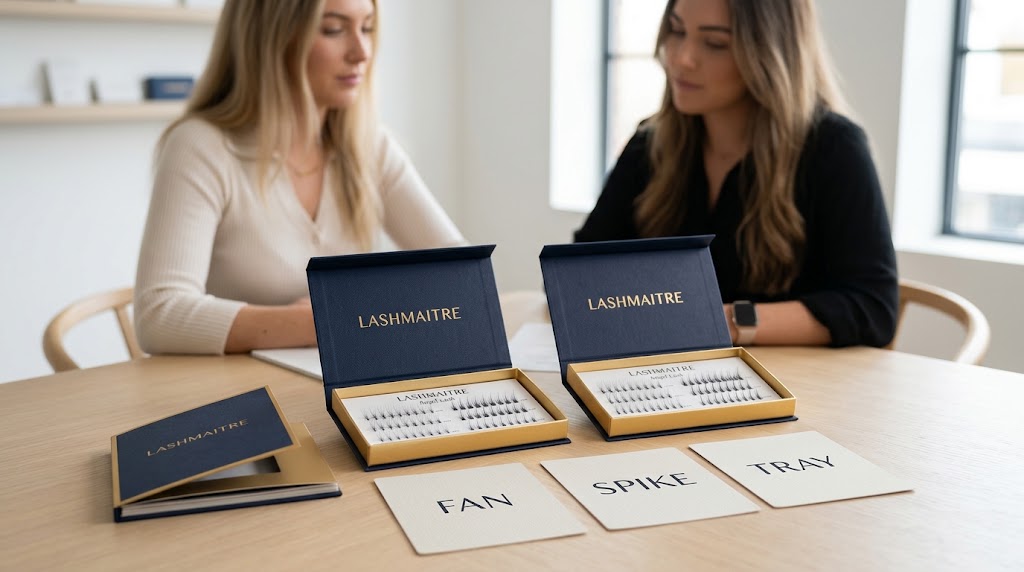
Angel lash extensions use lightweight narrow or closed fans with controlled spikes to create a soft, airy and textured result. For wholesale buyers, however, “Angel Lash” is not a complete product specification. A purchase order should also define the fan structure, diameter, curl, length mix, spike ratio, tray format, packaging version and approved physical sample.
This guide is for lash brands, distributors, salon groups and private-label buyers comparing angel lash extensions wholesale. It explains how to translate a visual style into repeatable product requirements before committing to MOQ, packaging or bulk production.
Buyer decision rule: Never approve “Angel Lash” as a style name alone. Approve the physical tray specification and retained sample that produce the intended result.
Quick Takeaways
- Angel Lash usually describes a softer, airier and more textured direction than a uniform Wet Set.
- The name is used differently across the market, so the written specification matters more than the label.
- A useful sample review should cover fan architecture, diameter, curl, length mix, spike ratio, pickup, strip release and packaging data.
- Compare physical samples under the same lighting and inspection method.
- Keep one approved tray, packaging proof and SKU record for future reorders.
Table of Contents
- What are Angel Lash extensions?
- Angel Lashes vs Wet Set, Wispy and Kim K
- Eight wholesale sample checks
- How to plan an Angel Lash tray range
- Private-label and reorder controls
- Common wholesale buying mistakes
- Frequently asked questions
What Are Angel Lash Extensions?
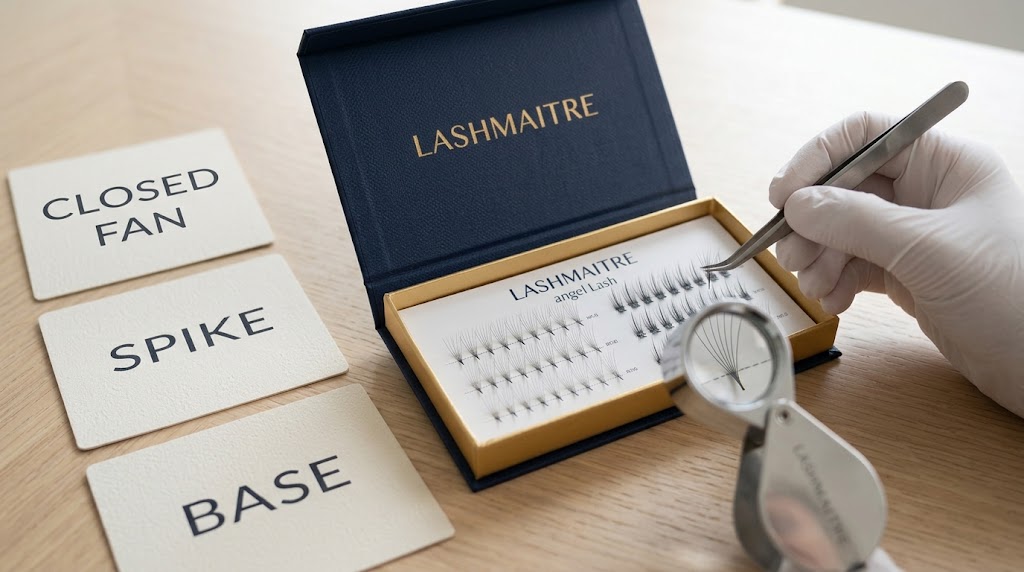
Angel lash extensions are a light, textured lash style commonly built with narrow or closed fans and deliberately spaced spikes. The intended result is usually soft and airy rather than uniformly dense. Because Angel Lash is a market style name rather than one universal manufacturing standard, buyers should define the physical fan, spike and tray specifications for every SKU.
Some suppliers or artists describe Angel sets as a softer variation of a Wet Set. Others treat them as a separate wispy design. That difference is precisely why wholesale buyers should not assume that two products carrying the same style name will have the same diameter, D-count, base, curl, spike height or tray layout.
For a broader view of premade fan construction and purchasing variables, review the premade lash fans wholesale guide.
Angel Lashes vs Wet Set, Wispy and Kim K
The following comparison is a buying framework, not a universal salon-design standard. The final specification should always be confirmed with physical samples.
| Style direction | Typical visual objective | Product structure to confirm | Main wholesale risk |
|---|---|---|---|
| Angel | Soft, airy and lightly textured | Lightweight narrow or closed fans, controlled spikes and a balanced length mix | Approving the name without defining the product |
| Wet Set | Glossy, defined and more uniformly narrow | Consistent closed fans or spikes with controlled closure | Receiving inconsistent fan closure across trays |
| Wispy | Layered texture with noticeable length variation | Mixed lengths, supporting fans and spike placement | Excessive length jumps or an unbalanced tray mix |
| Kim K | Stronger, more dramatic spikes over a supporting base | Pronounced spikes, shorter filler fans and clear layering | A result that looks too bold for the intended Angel range |
If the buying decision is primarily about narrow closed fans and a glossy Wet Set result, use the dedicated Wet Set lash extensions wholesale sample guide. If the requirement is broader layered texture, compare it with the Wispy lash extensions wholesale guide.
8 Sample Checks for Angel Lash Extensions Wholesale
1. Define the fan and spike architecture
Begin by deciding what the tray actually contains. Does the SKU use narrow premade fans, closed fans, separate spikes or a planned combination? Record the expected D-count or fiber count where relevant, but do not rely on D-count alone. Two fans with the same stated count can still differ in base width, closure, spread and visual weight.
Ask for close-up sample images and a physical tray. Inspect whether each premade unit has multiple fine fibers gathered into a narrow, tapered root. Reject samples that look like continuous lash strips, blunt black bars or thick adhesive clumps.
2. Confirm diameter and weight strategy
Diameter affects the visual result and how the product is positioned, but it should not be used as a standalone safety claim. Record the fiber diameter, fan structure and intended professional-use context together. If a supplier offers several diameters, compare like-for-like samples rather than assuming a smaller number automatically produces the preferred Angel result.
For products sold into the United States, false eyelashes, eyelash extensions and their adhesives are treated as cosmetics by the U.S. Food and Drug Administration’s eye cosmetic guidance. Product use, claims and labeling should therefore be reviewed carefully for the target market.
3. Lock the curl and length mix
Write the curl and every included length into the specification. A mixed tray should state which lengths are present, how many rows each length receives and whether longer spike rows are included. “Mixed length” without a row plan is not enough for reliable sampling or reorders.
Use the same curl reference and inspection angle when comparing suppliers. If one sample is viewed flat and another is viewed from the side, the curl and fan closure can appear different even before application.
4. Check narrow-fan consistency and symmetry
Select samples from the beginning, middle and end of the tray. Compare base taper, stem length, closure, spread and left-to-right symmetry. A single attractive fan does not prove that the complete tray is consistent.
A simple review record can use three inspection zones and one pass/review/reject result for each zone. This creates a repeatable QC method without turning the article into a salon mapping tutorial.
5. Approve the spike ratio and height
If the Angel range includes dedicated spikes, specify their length difference, spacing and proportion within the tray or finished design. The aim is not to define one “correct” Angel pattern. The aim is to ensure that the approved sample and the bulk tray contain the same product logic.
For example, a buyer may approve a subtle Angel range with fewer, controlled spikes or a more textured range with a stronger length contrast. These should be separate SKU decisions, not undocumented production variations.
6. Test pickup, base integrity and strip release
Product appearance is only part of the sample review. A trained lash professional should test whether individual fans or spikes can be picked up cleanly, whether the base remains intact and whether the strip releases consistently from different tray zones.
Record the test method used. If Method A and Method B use different tweezers, pickup pressure or inspection conditions, the result may not be comparable. A retained test note helps the buyer repeat the same approval method during a reorder review.
7. Approve the tray label and private-label proof
The tray label should match the approved content: product name, curl, diameter, length or mix, fan type, SKU and applicable batch information. The packaging proof should use the same version as the tray specification and purchase order.
Private-label buyers should also confirm artwork placement, barcode data, carton markings and required market-specific information before bulk production. The FDA notes that cosmetic labeling can be considered misleading when required information is missing or the presentation is deceptive; consult its summary of cosmetic labeling requirements and obtain appropriate regulatory advice for the destination market.
For packaging options and approval steps, visit private label lash extensions.
8. Retain the approved sample and reorder record
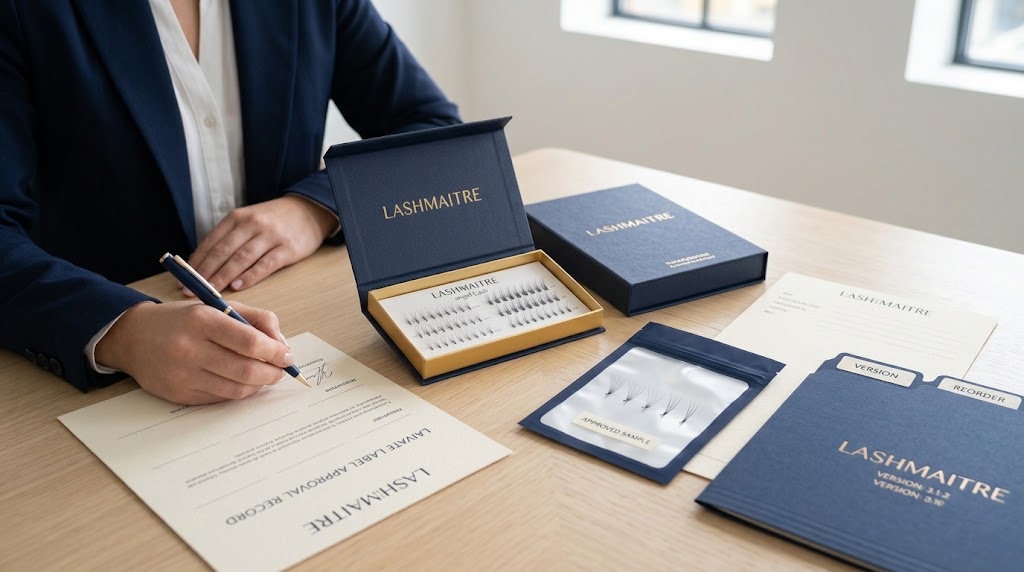
Keep one approved physical tray, the final packaging proof and the signed SKU specification. Give the approved version a clear date or revision code. When reordering, compare the new sample with this retained set rather than relying on memory or a compressed product photo.
The reorder record should identify at least the SKU, approved version, batch or order reference, tray specification and decision status. This makes supplier communication clearer when an Angel range expands into additional curls, lengths or packaging versions.
How to Plan an Angel Lash Tray Range
Start with the smallest range that still tests genuine buyer demand. Too many early SKUs can spread sample feedback, packaging work and inventory across minor variations before the core product has been validated.
| Stage | Buyer action | Required evidence | Decision |
|---|---|---|---|
| 1. Specification | Define fan, spike, diameter, curl, lengths and tray rows | Written SKU sheet | Ready for sampling or revise |
| 2. Sample | Inspect appearance, pickup, base and strip release | Physical tray + QC record | Approve, revise or hold |
| 3. MOQ planning | Confirm the first commercial quantity and packaging split | Quote + SKU count + packaging plan | Proceed or simplify range |
| 4. Private label | Approve tray label, box artwork and carton data | Final proof with version number | Release or correct |
| 5. Reorder | Compare new production with the retained standard | Retained tray + reorder record | Accept, review or escalate |
Buyers testing a focused launch can review the current MOQ 50 wholesale lash extensions pathway. Final availability, specifications, pricing and lead time should be confirmed through a current quotation rather than assumed from a general article.
Private-Label Angel Lash Extensions: What to Send a Supplier
A useful inquiry should provide more than a reference photo. Send a short specification package containing:
- The intended Angel visual direction and target buyer.
- Fan type, D-count or structure, diameter and curl.
- Single-length or mixed-length tray plan.
- Spike length, spacing or ratio where applicable.
- Tray row count and packaging format.
- Logo files, label information and barcode requirements.
- Target sample quantity, first-order quantity and destination market.
- Any approved reference tray or retained sample.
If some fields are not yet decided, mark them as open questions. A supplier can then propose sample options without treating an incomplete reference image as a final production specification.
Common Wholesale Buying Mistakes
Treating Angel Lash as a universal specification
The same style name can describe different physical products. Always confirm the tray and retained sample.
Reusing a Wet Set specification without checking the intended result
Angel and Wet styles may use related narrow-fan structures, but their density, softness, spike distribution and visual objective can differ.
Approving only the front of the tray
Inspect the bases, pickup, strip release, row allocation and label data. A polished front photo cannot confirm those details.
Expanding the SKU range before validating the first sample
Approve the product logic first. Then extend it to additional curls, lengths or packaging versions using controlled records.
Failing to retain a signed approval set
Without a physical standard and version record, reorder discussions depend on memory, screenshots or outdated artwork.
Frequently Asked Questions
Are Angel Lashes the same as a Wet Set?
Not necessarily. Both may use narrow or closed fans, but Angel Lashes are generally positioned as softer, airier and more textured, while Wet Sets are usually more uniformly defined and glossy. Because terminology varies, wholesale buyers should compare physical samples and approve written fan, spike, curl, length and tray specifications.
What trays are used for Angel Lash sets?
Angel styles can be created from narrow or closed premade fans, dedicated spikes or a planned combination. There is no single universal Angel tray. Buyers should define the fan structure, diameter, curl, length mix, spike ratio, row allocation and base quality required for the intended product range.
Can premade fans be used for Angel Lashes?
Yes, premade narrow or closed fans can support an Angel-style range when their base, closure, spread and weight match the intended result. Buyers should sample the exact product rather than assume that every premade fan tray will create the same soft, airy or textured appearance.
What should a buyer check in an Angel Lash sample?
Check fan and spike architecture, diameter, curl, length allocation, base taper, symmetry, pickup, strip release and label accuracy. Sample several tray zones instead of selecting one ideal fan. Keep the approved tray, packaging proof and SKU record as the reference for bulk production and future reorders.
Can Angel Lash extensions use private-label packaging?
Yes, subject to the supplier’s current options and order requirements. Approve the product sample before releasing packaging. Then match the tray label, SKU, curl, diameter, length mix, barcode and artwork version to the purchase order so the packaging and physical product remain aligned.
What is the MOQ for Angel Lash extensions wholesale?
MOQ depends on the product structure, number of SKUs, packaging customization and current production terms. LASHMAITRE offers an MOQ 50 pathway for selected wholesale lash projects, but buyers should request a current quotation to confirm whether the proposed Angel tray and private-label configuration qualify.
How should an Angel Lash reorder be approved?
Compare the reorder sample with the retained approved tray under the same inspection method. Verify fan closure, spikes, diameter, curl, length mix, strip release, tray label and packaging version. Record the result against the original SKU and order reference before releasing the next production batch.
Request Angel Lash Extension Samples
Successful angel lash extensions wholesale sourcing starts with a precise sample, not a style name. Prepare the desired fan structure, curl, diameter, lengths, spike direction, tray format and packaging requirements, then compare the resulting sample with a written approval checklist.
Request lash extension samples or send your Angel Lash specification for review. LASHMAITRE can then confirm which sample, MOQ and private-label options fit the proposed range.
For a direct supplier-name comparison, use the Fairy vs Angel lash extensions buyer guide to separate visible texture, construction, tray labeling and reorder evidence before approving a named range.

Lash Maitre: Your Trusted Partner in Eyelash extension Solutions
Lash Maitre is dedicated to providing professional insights and tips in the eyelash extension industry. Sharing the latest trends, techniques, and product knowledge, Lash Maitre helps lash artists and enthusiasts enhance their skills, stay inspired, and achieve the perfect lash experience.