Lash Advance Shipping Notice: 9 Fields Before Retail Delivery
Share
A lash advance shipping notice is the supplier's electronic message that tells a retailer what shipped, when it shipped, how it is packed and which purchase-order lines and logistics units are included. Build the ASN from the final packed shipment, reconcile it to the PO and carton labels, transmit it within the retailer's required window and retain the acceptance response.
Lash Advance Shipping Notice: Direct Answer
Buyer rule: A lash advance shipping notice should be created from the final packed shipment and retained with its validation response.
Before retail delivery, verify nine ASN areas: shipment identity, trading partners, PO references, ship and arrival dates, carrier details, item lines, quantities, packaging hierarchy and logistics-unit identifiers. The electronic notice must match the physical cases. If packing changes after the ASN is created, correct the shipment source and retransmit according to the retailer's procedure rather than allowing the message and cartons to diverge.
What Is an ASN and Why Does a Lash Supplier Need One?
Oracle defines an inbound advance shipment notice as a supplier message that notifies the buyer when shipping occurs and provides details so the buyer can prepare to accept delivery. Its ASN documentation places the message within the procure-to-pay process.
For a lash retailer order, the ASN can help receiving teams connect the PO, items, case contents, carrier and expected delivery before cartons arrive. A late or inaccurate notice can create receiving exceptions even when the physical products are correct.
Nine Fields to Control in a Lash ASN
| Field group | Minimum data | Match against |
|---|---|---|
| 1. Shipment identity | Unique ASN or shipment number | Transmission log |
| 2. Parties and locations | Supplier, ship-from, buyer and ship-to | PO and route instruction |
| 3. PO references | PO number, line and release as required | Accepted PO |
| 4. Dates | Ship date, expected arrival and relevant time zone | Booking and retailer window |
| 5. Carrier/freight | Carrier, mode, tracking, PRO or BOL details | Carrier record |
| 6. Item identity | Retailer item, supplier SKU and GTIN as required | Accepted item master |
| 7. Quantity | Shipped quantity and unit of measure | Final pack count |
| 8. Packaging hierarchy | Item-to-case/pallet structure | Approved case pack |
| 9. Logistics identifiers | SSCC or retailer-required carton/pallet IDs | Printed logistics labels |
Retailers may require additional segments, codes or acknowledgments. Treat this table as a control framework, not a universal EDI specification.
Build the ASN From the Final Shipment
Do not create the ASN from the original order alone. The PO states demand; the ASN states what actually shipped. Use the final warehouse record after shortages, substitutions, case splits and holds are resolved.
The controlled sequence is:
- freeze the pick and pack scope;
- confirm released SKU and packaging revisions;
- count each item and case;
- capture logistics-unit identifiers;
- reconcile the packed shipment to open PO lines;
- create the ASN from approved source data;
- validate retailer-specific rules;
- transmit within the required timing window;
- retain acceptance or exception evidence.
Pull item identity from the controlled lash product master data record and validate printed symbols through the existing lash barcode verification process. For a new product, keep the approved lash extension sample reference linked to the released SKU and packaging revision.
Reconcile the PO, ASN and Physical Cartons
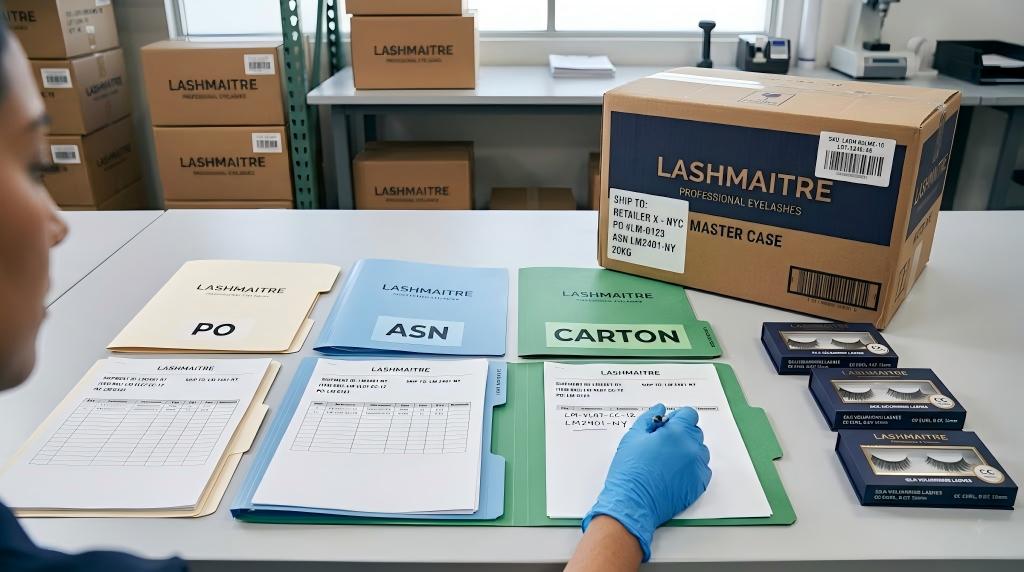
Use the approved lash case pack configuration and final packing record to prove how sellable units are grouped. Then compare three views:
| Control | PO | ASN | Physical shipment |
|---|---|---|---|
| Item | Ordered retailer item/GTIN | Shipped item reference | Product and case labels |
| Quantity | Ordered and open quantity | Actual shipped quantity | Counted units |
| Pack | Ordered unit of measure | Hierarchy/pack details | Inner and master cases |
| Destination | Ship-to location | Receiving location | Carrier label/BOL |
| Timing | Required window | Ship/arrival dates | Pickup appointment |
If any row fails, place the shipment on hold until the retailer's correction procedure is followed.
Connect the ASN to Logistics Labels
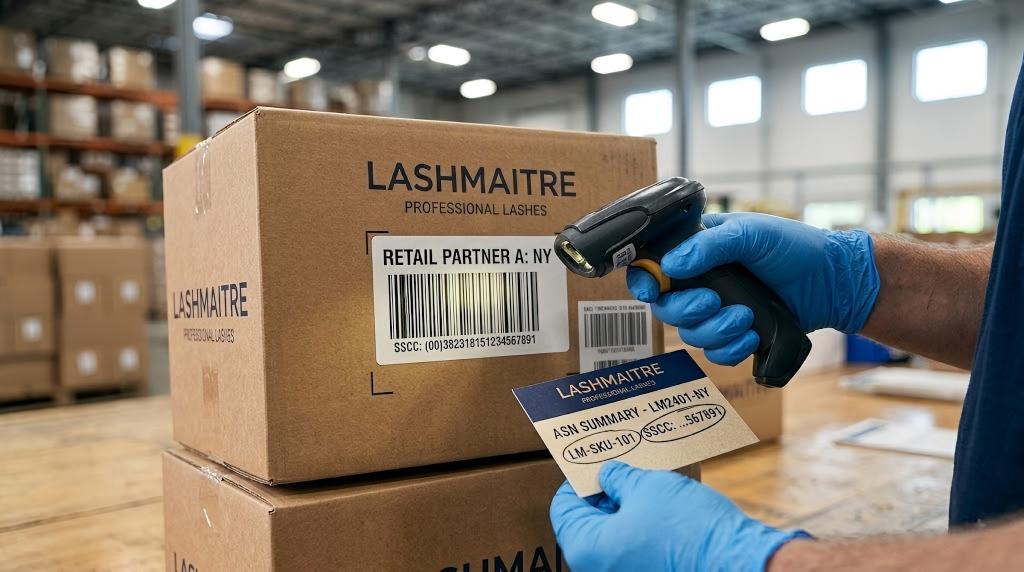
The GS1 Logistic Label Guideline describes the SSCC as the unique identifier for a logistics unit and explains how scanning can connect physical movement with related electronic messages. The retailer may require SSCCs or another carton identifier in a specific ASN hierarchy.
Assign identifiers only after the logistics units are defined. Avoid duplicate labels, reused SSCCs and identifiers printed on a carton but omitted from the message. Scan a representative label and query the underlying shipment record before release.
Understand EDI 856 and Hierarchical Detail
The Oracle 856/DESADV description explains that an advance ship notice can communicate order, product, packaging, marking, carrier and goods-configuration information at multiple levels of detail.
That hierarchy matters when a shipment contains pallets, cases, inner packs and sellable lash items. Define the relationship consistently. A retailer expecting case-level detail may reject an ASN that provides only a total shipment quantity.
Control ASN Timing and Acceptance
Sending an ASN is not the same as proving acceptance. Record:
- creation time and source version;
- validation result;
- transmission time and time zone;
- control number or message ID;
- technical acknowledgment;
- business acceptance or error response where available;
- correction and retransmission history;
- final accepted version.
Do not assume that silence means success. Name the owner who monitors exceptions before pickup and the contact who can authorize a hold or correction.
Manage Packing Changes After Transmission
If a carton is removed, quantity changes or a new logistics unit is created after transmission, stop and determine the retailer's required correction path. It may require cancellation, replacement, retransmission or a portal update.
The warehouse, EDI team and account owner should all use the same final shipment version. Manual portal edits must return to the source record so the evidence chain remains complete.
Assign Clear ASN Ownership
Define who creates the shipment record, who validates the retailer mapping, who monitors acknowledgments and who can stop dispatch. The warehouse owns physical accuracy; the EDI or integration owner controls message processing; the account team confirms retailer exceptions. Use one escalation list with response deadlines so an error is not discovered only after the carrier has departed. Review access rights as well: users should not be able to overwrite an accepted notice without leaving a revision and approval trail.

Lash Advance Shipping Notice FAQ
What is an advance shipping notice?
It is a pre-arrival shipment message that identifies what the supplier shipped and provides order, item, quantity, packing, carrier and timing details for receiving.
Is an ASN the same as a packing list?
No. A packing list is a physical or document-level shipment record. An ASN is an electronic trading-partner message, although the two should reconcile.
When should a supplier send the ASN?
Follow the retailer's exact rule. It is normally sent after the final shipment is known and before delivery, but the required event and cutoff vary by trading partner.
What causes ASN errors?
Common causes include wrong PO references, item or unit-of-measure mismatches, late transmission, incorrect quantities, incomplete hierarchy, duplicate identifiers and disagreement with carton labels.
Does every lash shipment need an EDI 856?
No. The retailer or distributor determines the required message, format and channel. Some use EDI 856, while others use portals, APIs or different standards.
Final Buyer Decision
Treat the lash advance shipping notice as a controlled release record that must match the shipment still sitting at the dock.
Treat the ASN as part of shipment release, not an administrative message created after dispatch. It should be derived from the final packed goods, pass the retailer's validation and remain traceable to the PO and logistics labels.
For a pre-shipment review, send the PO, retailer ASN specification, case hierarchy, label sample and transmission deadline through the wholesale lash extensions inquiry page. LASHMAITRE can align the data check with the lash quality control and sample/packaging records.
Before carrier pickup, reconcile the final ASN and physical handling units with a controlled lash bill of lading covering destination, carton count, weight, carrier details, signatures and exceptions.

Lash Maitre: Your Trusted Partner in Eyelash extension Solutions
Lash Maitre is dedicated to providing professional insights and tips in the eyelash extension industry. Sharing the latest trends, techniques, and product knowledge, Lash Maitre helps lash artists and enthusiasts enhance their skills, stay inspired, and achieve the perfect lash experience.