Lash Case Pack Configuration: 8 Fields Before Carton Release

Share
A lash case pack configuration defines exactly which sellable item is inside a shipping unit, how many units it contains, how the hierarchy is identified, and which dimensions, weight and barcode belong to that case. Approve the configuration before carton labels, packing lists, warehouse records or retailer routing instructions are released.
Lash Case Pack Configuration: Direct Answer
Control eight fields: packaging level, child SKU/GTIN, units per level, assortment type, case identity, dimensions, gross weight and status/effective date. Then reconcile those values across the purchase order, packing specification, barcode record, carton label, inspection brief and receiving template. A case should not be released when any of those records describe a different hierarchy.
For buyer control, record the lash case pack quantity, the packaging hierarchy and any GTIN-14 lash carton identity in one approved table so the same values reach purchasing, labeling, inspection and receiving teams.
Why Case Pack Errors Become Expensive
One lash SKU can move through several physical levels: an individual tray, a branded retail box, an inner pack, a master case and a pallet. When teams use “box,” “carton” and “case” interchangeably, quantity and barcode errors become difficult to detect.
A wrong case-pack record can cause:
- inaccurate freight and landed-cost calculations;
- purchase-order and packing-list mismatches;
- incorrect warehouse receiving quantities;
- retailer or distributor item-setup rejection;
- carton-label and barcode reprints;
- mixed-SKU inspection mistakes;
- inventory variance after receipt;
- unreliable reorder and capacity planning.
The GS1 US packaging-level definitions distinguish each, inner pack, case, mixed case, pallet and other levels. Use the definitions that fit the actual selling and shipping structure; do not assign a label merely because the supplier calls the outer box a “case.”
Compare the Main Packaging Levels
| Level | Practical lash example | Main control question |
|---|---|---|
| Each | One retail-ready lash tray or box | Is this the lowest item sold individually? |
| Inner pack | Six identical retail boxes grouped for handling | Is it a defined intermediate pack and is it sellable? |
| Case | Forty identical retail boxes for shipping | Does it contain one child GTIN at one fixed quantity? |
| Mixed case | Several curls, lengths or product GTINs in one case | Is the assortment and quantity of each child item fixed? |
| Pallet | Multiple cases shipped as one handling level | Is the pallet homogeneous or mixed? |
| Display shipper | A shipping unit that also serves as a display | Are the display contents and channel use controlled? |
The commercial reality determines the hierarchy. A box of ten trays sold as one unit is not the same as ten individually sellable trays placed in a shipping carton.
Eight Fields in a Lash Case Pack Record
| Field | What to record | Release evidence |
|---|---|---|
| 1. Packaging level | Each, inner pack, case, mixed case or pallet | Approved hierarchy diagram |
| 2. Child item | Exact product name, SKU and GTIN | Product master and approved sample |
| 3. Quantity | Units of each child item per parent level | Packing trial and count sheet |
| 4. Assortment | Single item or fixed mixed-SKU composition | Assortment table and PO |
| 5. Parent identity | Case SKU, GTIN or approved logistics identifier | Identifier record and label proof |
| 6. Dimensions | Final external length, width and height with units | Measured packed case |
| 7. Gross weight | Product plus all case packaging | Calibrated scale record |
| 8. Status and date | Draft, approved/in use, discontinued; effective date | Named approval and revision log |
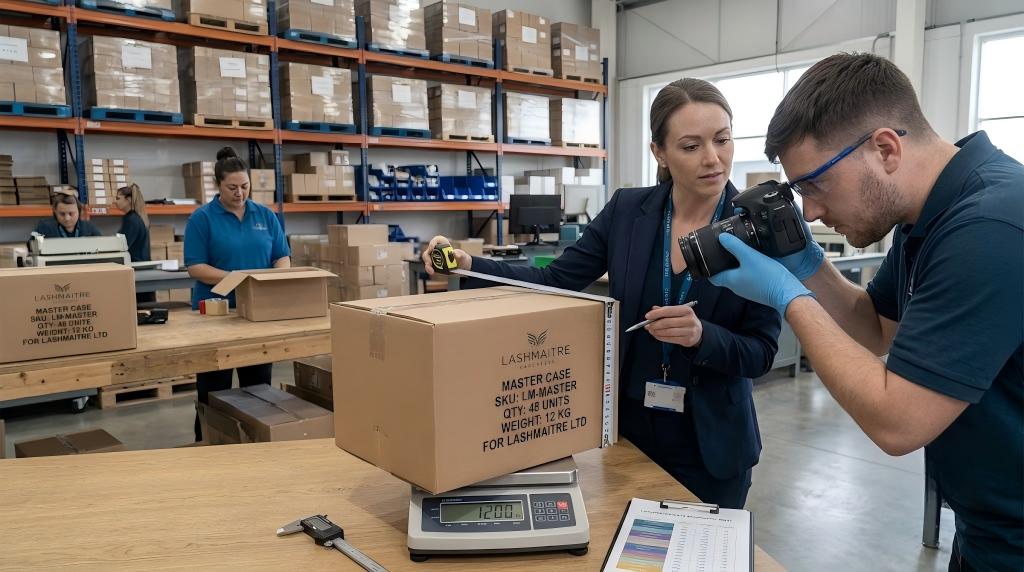
Do not copy dimensions from a dieline alone. Measure a representative packed case after the product, inserts, retail packaging, dividers, void fill and sealing method are final.
Decide Whether the Case Is Homogeneous or Mixed
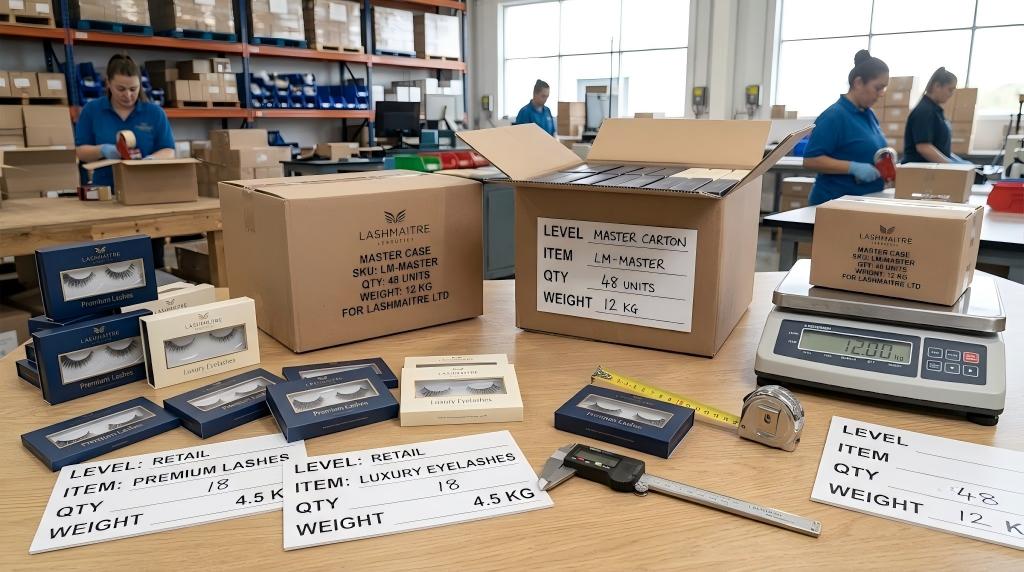
A homogeneous case contains the same child trade item at a fixed quantity. A mixed case contains more than one item identity. That difference affects the parent record, label, inspection and warehouse setup.
For example:
- Homogeneous: 40 boxes of Classic C Curl 0.15 Mixed 8–15 mm.
- Mixed: 10 boxes each of C, CC, D and L curl under separate child SKUs.
If a buyer changes the mixed assortment, do not quietly reuse the old record. Review whether the new composition is a distinct trade item and update the identifier, packing instruction and receiving data as required.
Link Each and Case Identities
GS1 US explains that a shipping case containing one product GTIN can receive a GTIN-14 and use an ITF-14 barcode for shipping and receiving. Its shipping-case guide also emphasizes confirming the child item and quantity before changing the status to “In Use.”
For a lash buyer, the controlled hierarchy should show:
Retail item SKU/GTIN → inner pack and count → case SKU/GTIN and count → pallet or shipment reference
Keep this relationship in the lash product master data record, and use the lash packaging bill of materials for the physical components used at each level.
Reconcile Six Operational Records
Before carton release, compare the case pack against:
- Purchase order — ordered SKU and quantity basis.
- Approved product master — child and parent identities.
- Packing specification — count, orientation, dividers and sealing.
- Carton label — SKU, GTIN, lot and quantity fields.
- Packing list and invoice — unit and case quantities.
- Receiving template — warehouse or retailer expectations.
A simple three-way check should prove that number of cases × units per case = expected sellable units, adjusted only for documented samples, inspection withdrawals, replacements or agreed quantity tolerance.
Run a Physical Packing Trial
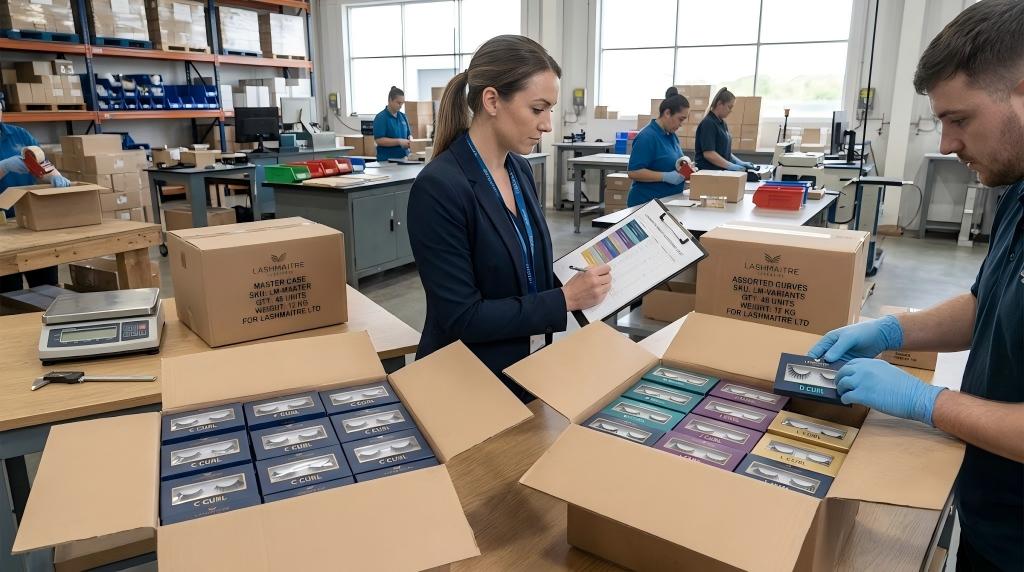
Use approved production-equivalent packaging, not an empty mockup. Pack one case and verify:
- the child item and version;
- count and orientation;
- divider or protective material;
- closure and tamper evidence where specified;
- external dimensions and gross weight;
- carton-label placement and readability;
- barcode scanability on the corrugated surface;
- stacking and handling suitability;
- photo evidence of the closed and open case.
Connect this trial with the existing lash packaging transit test when transport risk warrants compression, drop, vibration or route-specific testing.
Case Pack Release Workflow
Step 1: Freeze the sellable item
Confirm product specification, approved sample, retail packaging revision and item GTIN.
Step 2: Define the hierarchy
Choose the actual packaging level, child item, fixed quantity and assortment type.
Step 3: Pack and measure
Build a representative case, count it, measure it and weigh it with calibrated equipment.
Step 4: Approve the identifier and label
Verify the parent identity, printed data, placement and barcode quality.
Step 5: Reconcile documents
Match the PO, master data, packing instruction, label, shipping documents and receiving setup.
Step 6: Release and retain evidence
Name the approver, effective date and revision; keep photos, measurements, scan results and the approved sample.
Common Case Pack Failures
- The carton says 40 units while the packing list says 48.
- A mixed case is described as one homogeneous SKU.
- Dimensions exclude the closed carton or protective material.
- Gross weight is copied from an estimate.
- The case barcode encodes the retail-item GTIN.
- The assortment changes without a new revision or decision.
- Old and new case labels remain available on the line.
- Warehouse setup uses “cases” while the PO quantity uses “eaches.”
Lash Case Pack Configuration FAQ
What should a lash case pack configuration include?
It should include packaging level, exact child item, quantity per level, assortment, parent identity, external dimensions, gross weight, status and effective date. It should also link to the approved packing instruction and carton-label proof.
Is an inner pack the same as a case?
No. An inner pack is an intermediate grouping; a case is generally a shipping unit containing eaches or inner packs. The commercial and logistics use determines the correct level.
Does every shipping case need a GTIN?
Not automatically in every business workflow. Requirements depend on how the case is ordered, scanned and exchanged with trading partners. Confirm current GS1 and receiving requirements for the actual channel.
What happens when units per case change?
Treat it as a controlled change. Update the hierarchy, review the GTIN requirement, revise labels and documents, separate old inventory and verify the new packed case before release.
Should case dimensions come from the supplier quote?
Use quote dimensions for planning only. Release dimensions and weight should come from a representative final packed case with agreed packaging and a recorded measurement method.
Conclusion: Make Every Quantity Mean the Same Thing
A controlled lash case pack configuration makes the each, inner pack, case and shipment quantities unambiguous. Define eight fields, verify the physical pack and reconcile every document before cartons move to inspection or shipping.
Review LASHMAITRE lash extension samples and LASHMAITRE quality control and private-label lash services, then send an inquiry with the each-level SKU, units per inner pack and case, assortment, dimensions, gross weight, destination and receiving rules.
Once the physical case hierarchy is confirmed, reconcile it with the PO, item, quantity, carrier and SSCC fields in a controlled lash advance shipping notice before retail delivery.

Lash Maitre: Your Trusted Partner in Eyelash extension Solutions
Lash Maitre is dedicated to providing professional insights and tips in the eyelash extension industry. Sharing the latest trends, techniques, and product knowledge, Lash Maitre helps lash artists and enthusiasts enhance their skills, stay inspired, and achieve the perfect lash experience.