Lash Inventory Reorder Point: 8 Restock Signals for Lash Brands
Share
A lash inventory reorder point is the stock level where a brand should place the next wholesale lash order before best-selling trays run out. It should consider daily sales, supplier lead time, safety stock, MOQ, SKU priority, approved samples and shipping delay risk.
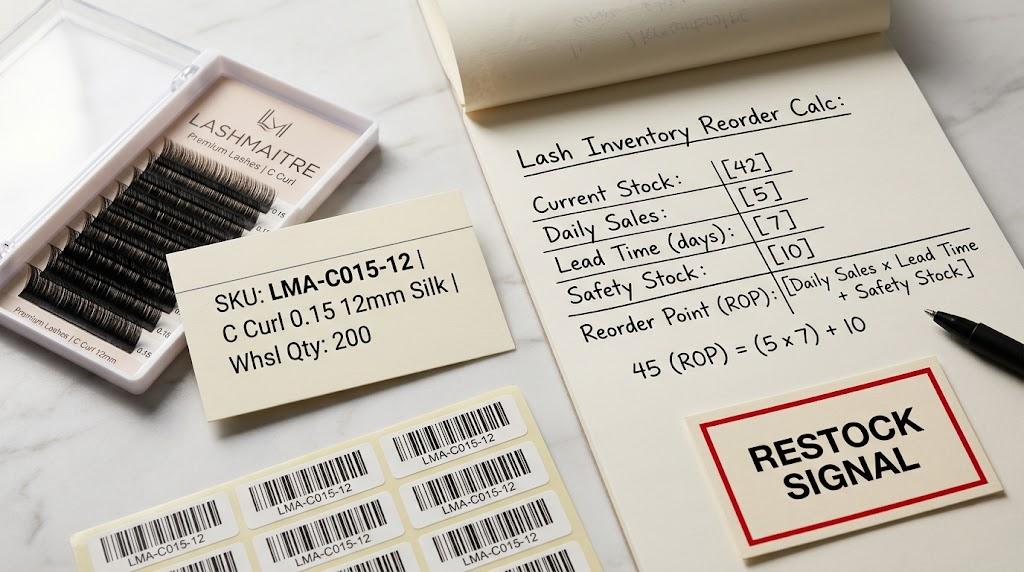
Quick answer: a simple lash inventory reorder point can be calculated as daily sales x supplier lead time + safety stock. For example, if a lash SKU sells 5 trays per day, lead time is 14 days and safety stock is 20 trays, the reorder point is 90 trays.
This guide is for lash brands, salon chains, distributors and ecommerce sellers that need a more reliable reorder rhythm for lash trays.
Contents
- What is a lash inventory reorder point?
- Signal 1: Daily sales by curl, length and style
- Signal 2: Supplier lead time
- Signal 3: Safety stock for best sellers
- Signal 4: MOQ and case quantity
- Signal 5: Private label packaging version
- Signal 6: Carton label and SKU record
- Signal 7: Seasonal or promotion demand
- Signal 8: Approved sample and reorder file
- LASHMAITRE reorder point checklist
- FAQ
What Is a Lash Inventory Reorder Point?
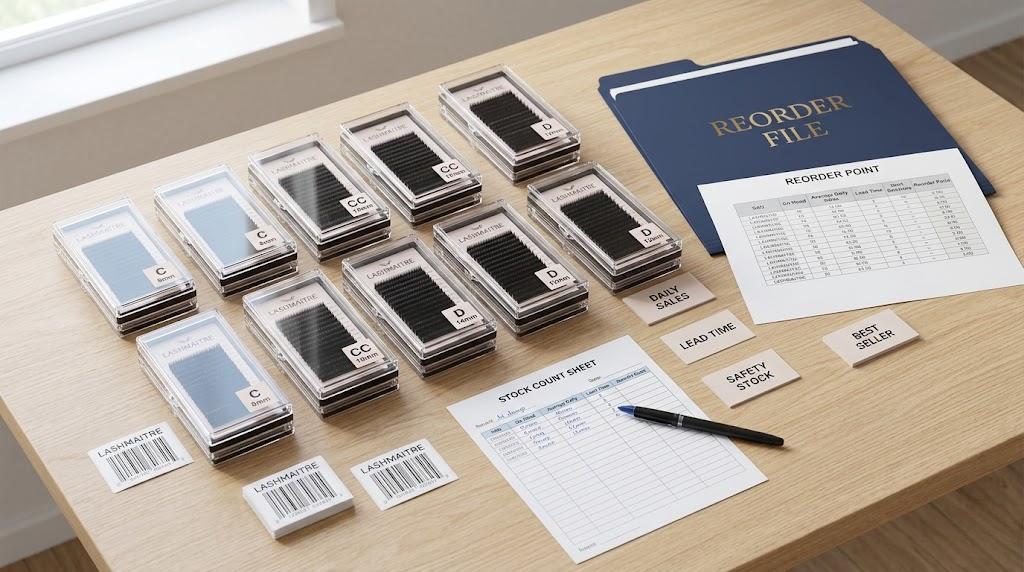
A lash inventory reorder point is the minimum stock level that triggers the next purchase order. It helps a buyer reorder before the current stock runs too low.
Fishbowl describes the reorder point formula as unit sales per day multiplied by lead time, plus safety stock. MRPeasy also explains reorder point as lead time multiplied by demand rate, plus safety stock. For lash buyers, this inventory logic becomes a practical SKU-level restock trigger.
For lash trays, the idea is simple, but the execution needs SKU discipline. Best-selling curls, thicknesses and lengths should not be reordered at the same pace as slow-moving experimental styles.
Basic formula:
| Formula element | Lash example |
|---|---|
| Daily sales | 5 trays per day |
| Lead time | 14 days |
| Safety stock | 20 trays |
| Reorder point | 5 x 14 + 20 = 90 trays |
Signal 1: Daily Sales by Curl, Length and Style
Start with real sales by SKU. Do not only count total lash trays. A brand may have plenty of stock overall but still run out of C curl 0.07 mm 10-15 mm mixed trays.
Track daily or weekly movement by:
- Curl
- Thickness
- Length
- Tray format
- Finish
- Private label version
- Customer group or sales channel
For example, if C curl 0.07 mm mixed length sells 35 trays per week and D curl 0.10 mm sells 8 trays per week, the reorder point should be different.
Signal 2: Supplier Lead Time
Lead time is the number of days needed to prepare and deliver the next order. For lash buyers, this can include sample confirmation, production, QC, packaging, carton labeling and shipping.
If a supplier needs 21 days to complete a reorder and shipping takes another 7 days, the buyer should not wait until only 7 days of stock remain.
Use the actual reorder lead time, not the best-case lead time. For more planning detail, see lash extension lead time.
Signal 3: Safety Stock for Best Sellers
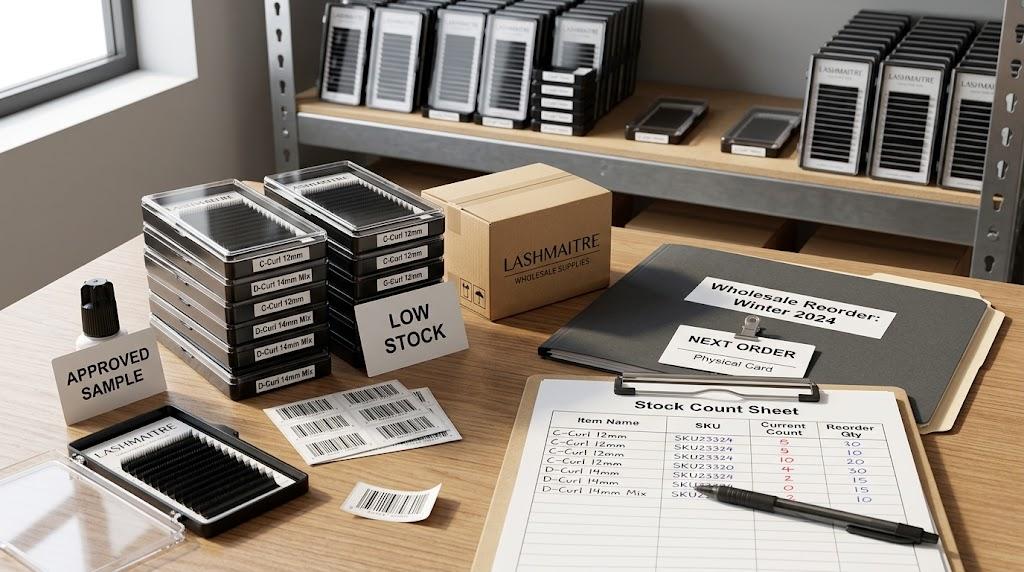
Safety stock is the extra inventory kept to protect against sales spikes, supplier delays or shipping disruption. Best sellers need more safety stock because running out creates lost sales and customer frustration.
Set safety stock higher for:
- Best-selling curls and lengths
- Launch campaign SKUs
- Distributor orders
- Private label products with longer packaging time
- Seasonal or promotion styles
Set safety stock lower for test SKUs or slow-moving styles, especially when storage space or cash flow is limited.
Signal 4: MOQ and Case Quantity
MOQ affects reorder timing because buyers may not be able to reorder exactly the number of trays they need. If the supplier MOQ is 50 trays, the buyer should plan reorder points around that buying unit.
For example, if a SKU reaches a reorder point at 42 trays, waiting until zero stock is risky. But ordering too late may also mean the buyer has to rush a 50-tray order by expensive shipping.
Connect MOQ planning with stock planning:
- Which SKUs are worth holding at MOQ level?
- Which SKUs should be grouped into one reorder?
- Which SKUs should remain sample-only?
- Which SKUs need private label packaging inventory?
Signal 5: Private Label Packaging Version
Private label lash trays need packaging version control. If your reorder uses a new box design, tray card, barcode or carton label, the packaging lead time may change.
A reorder point should therefore include packaging readiness. A lash tray may be in stock, but the matching private label box or label sheet may not be ready.
For private label SKUs, track:
- Packaging version
- Approved proof date
- Barcode version
- Carton label format
- Logo or box revision
- Remaining packaging inventory
Signal 6: Carton Label and SKU Record
SKU records and carton labels make reorders repeatable. They also help the warehouse receive the next shipment quickly.
A good reorder file should connect:
- Product SKU
- Curl, thickness and length
- Tray type and finish
- Approved sample code
- Carton label format
- Reorder quantity
- Destination or warehouse
For carton control, see lash carton labels.
Signal 7: Seasonal or Promotion Demand
Do not calculate reorder points only from normal weeks if a promotion is coming. Lash brands often need extra stock before product launches, academy classes, holiday demand or distributor campaigns.
Before a promotion, check:
- Expected order volume
- Featured SKUs
- Campaign dates
- Shipping cutoff dates
- Safety stock after the promotion
If a lash tray is part of a planned campaign, its reorder point should move higher before the campaign starts.
Signal 8: Approved Sample and Reorder File
The approved sample is the physical reference for repeat orders. Without it, a reorder may drift in curl, thickness, finish, strip release, tray card or packaging version.
Keep a reorder file that includes:
- Approved sample photo or physical card
- SKU details
- Supplier batch note
- Packaging proof
- Carton label sample
- Last order quantity
- Next reorder point
For batch consistency planning, see lash batch consistency.

LASHMAITRE Reorder Point Checklist
Use this worksheet before best-selling lash trays reach low stock.
| Checkpoint | Buyer question | Status |
|---|---|---|
| Daily sales | How many trays sell per day or week? | Pending |
| Lead time | How many days are needed to reorder? | Pending |
| Safety stock | How many trays should remain as protection? | Pending |
| MOQ | What is the minimum reorder quantity? | Pending |
| SKU priority | Is this a best seller or test SKU? | Pending |
| Packaging version | Is the private label version approved? | Pending |
| Carton label | Does the label match the SKU record? | Pending |
| Reorder file | Is the approved sample record saved? | Pending |
FAQ
What is a lash inventory reorder point?
A lash inventory reorder point is the stock level that triggers the next wholesale order. It helps a brand reorder before the SKU runs out. The basic formula is daily sales multiplied by lead time, plus safety stock.
How should lash brands calculate when to reorder trays?
Lash brands should calculate reorder timing by SKU, not only by total tray count. Use daily or weekly sales, supplier lead time, safety stock, MOQ and campaign demand to decide when each curl, length and tray format should be reordered.
Which lash SKUs need higher safety stock?
Best-selling curls, core mixed-length trays, academy kit trays, distributor favorites and private label SKUs with longer packaging lead time usually need higher safety stock. Slow-moving test SKUs can carry lower safety stock until sales data proves demand.
How do lead time and MOQ affect reorder timing?
Longer lead time means the buyer must reorder earlier. MOQ affects how many trays must be ordered at once. Together, lead time and MOQ decide whether a buyer can reorder gradually or needs a planned bulk reorder before stock becomes low.
Related LASHMAITRE Sourcing Pages
- Lash extension samples keep the approved physical reference for repeat orders.
- MOQ 50 wholesale lash extensions helps buyers plan focused restock quantities.
- Lash quality control helps verify that reorder stock matches the approved batch record.
- Private label lash extensions need packaging version control when reorder points trigger new production.
- Wholesale lash extension inquiry is the next step when you want LASHMAITRE to help plan best sellers, lead time and safety stock.
Conclusion
A lash inventory reorder point gives buyers a practical trigger for the next wholesale order. Instead of waiting for stockouts, the buyer can connect daily sales, lead time, safety stock, MOQ, packaging version and approved sample records.
Share your best-selling curls, lengths, current stock count, reorder lead time and target safety stock with LASHMAITRE so the next wholesale order can be planned before stock runs low.
Sources
- Fishbowl: Reorder Point Formula
- MRPeasy: What Is Reorder Point and Reorder Point Formula?
Use a lash reorder forecast to turn the inventory trigger into an SKU-level order date, projected stockout and supplier-confirmed production week.
Before approving replenishment, review a lash inventory aging report so usable stock, slow-moving variants, old packaging revisions and open supply are visible beside the reorder trigger.
Before relying on the available-stock figure in a reorder calculation, use a controlled lash inventory cycle count to verify exact SKUs, locations, units and unresolved movements.

Lash Maitre: Your Trusted Partner in Eyelash extension Solutions
Lash Maitre is dedicated to providing professional insights and tips in the eyelash extension industry. Sharing the latest trends, techniques, and product knowledge, Lash Maitre helps lash artists and enthusiasts enhance their skills, stay inspired, and achieve the perfect lash experience.