Lash Inventory Aging Report: 8 Critical Fields

Share
Lash Inventory Aging Report Buyer Summary
A lash inventory aging report should connect every SKU and approved revision to its receipt date, age bucket, usable quantity, sales velocity, value, open supply and next action. Review the lash inventory aging report before reordering so slow-moving inventory, old packaging versions and held stock do not inflate the buying decision.
A lash inventory aging report should show which lash SKUs are sitting, how long they have been in stock, how quickly they are selling and what decision is required before the next wholesale order. At minimum, record the SKU and approved revision, receipt date, age bucket, usable quantity, sales velocity, inventory value, open supply and next action.
Buyer Summary
- Review inventory age by SKU, not only by total tray count.
- Keep curl, thickness, length map and packaging revision visible.
- Separate physical age from quality status; older stock is not automatically defective.
- Compare age with sales velocity, future demand, MOQ and incoming orders.
- Assign every slow mover an owner and action date.
Why a Stock Count Is Not Enough
A stock count answers how many units are present. It does not explain whether 120 trays arrived last month or have remained untouched through several reorder cycles. That difference matters because the same quantity can represent healthy launch stock, a seasonal build, a duplicate packaging version or a slow-moving assortment decision.
Oracle's general stock-aging documentation groups inventory by item or SKU, location, on-hand quantity, cost and age buckets. That framework is not a lash-industry standard, but it demonstrates a useful control principle: inventory age needs identifiable units, dates and value. See the Oracle Stock Aging Report.
For lash brands, the report should preserve the product identity behind the number. C curl 0.07 mm mixed length, D curl 0.05 mm single length and a private-label tray with an old artwork revision are not interchangeable stock.
Eight Fields in a Lash Inventory Aging Report
| Field | What to record | Buyer decision supported |
|---|---|---|
| SKU and specification | Curl, thickness, length format, fiber/finish and tray format | Confirms exactly what is aging |
| Packaging revision | Tray card, box, label or barcode version | Separates current and obsolete presentation |
| Receipt or production date | Date the usable stock entered inventory | Establishes the age basis |
| Age bucket | For example 0-30, 31-60, 61-90, 91-120 or 120+ days | Makes older groups visible |
| Usable on-hand quantity | Released units after holds, damage and samples | Prevents overstating sellable stock |
| Sales or usage velocity | Units sold, transferred or used per week/month | Distinguishes slow movement from planned stock |
| Inventory value and open supply | Unit cost, stock value, purchase orders and supplier-held units | Shows total exposure before reordering |
| Next action | Keep, transfer, promote, consolidate, hold, discontinue or investigate | Converts the report into a controlled decision |
The age buckets are management ranges, not universal shelf-life rules. Choose ranges that match the brand's review cycle and keep the same logic long enough to compare trends.
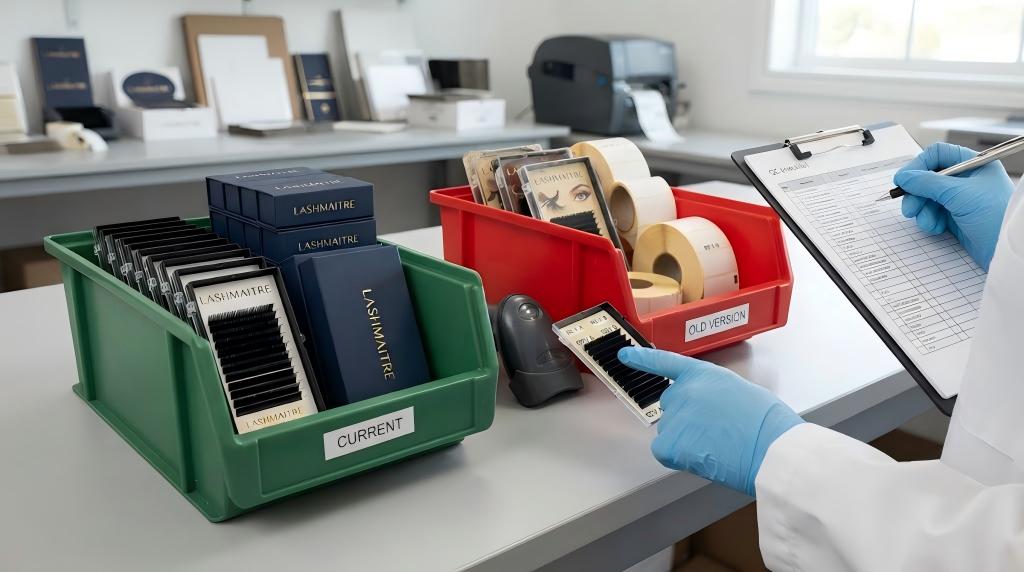
Separate Current Stock From Old Versions
The first practical control is version separation. A tray may remain physically usable while its box, barcode, product name or label no longer matches the current catalog. Combining old and current versions in one count hides the real exposure.
Record at least three statuses:
- Current and released.
- Current but held for inspection or reconciliation.
- Superseded, obsolete or awaiting disposition.
If the product is private label, include supplier-held boxes, tray cards and label sheets in the review. A warehouse count that ignores packaging components can lead to a reorder of trays that cannot be packed in the approved version.
Calculate Movement Without Hiding Zero Sales
Use a consistent review period, such as the last 28, 60 or 90 days, and record both units moved and the number of days the SKU was actually available. A product that sold zero because it was out of stock should not be classified the same way as a product that was available but had no demand.
For an active SKU, a simple days-of-inventory estimate can be useful:
usable on-hand quantity ÷ average units sold per day
If average daily sales are zero, do not force a false number. Mark the result as no recent movement and investigate launch timing, listing status, channel placement and sample feedback.
Age Is Not the Same as Quality Failure
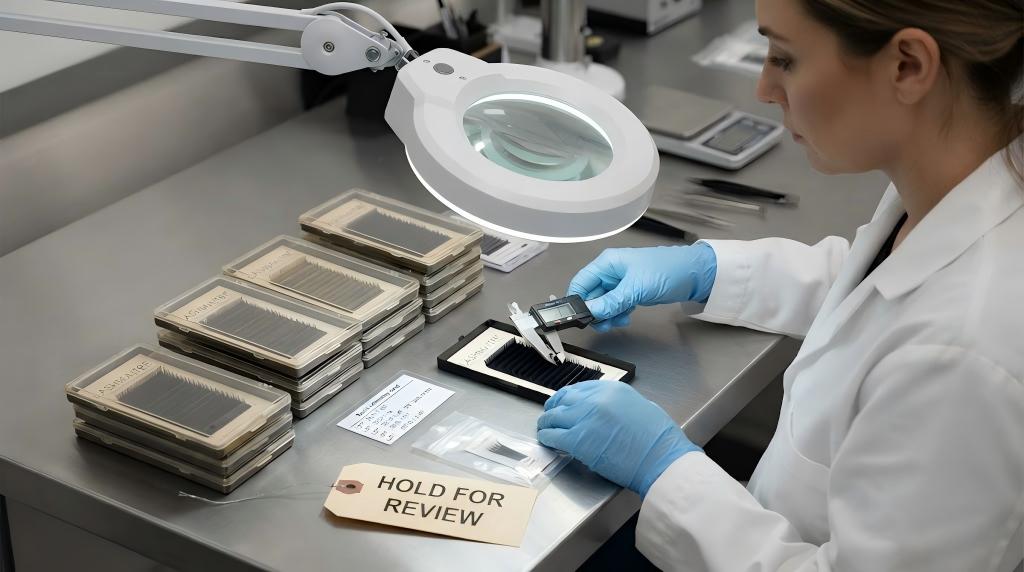
Inventory age should trigger review, not an unsupported quality claim. Check storage conditions, packaging condition, label accuracy, batch identity, approved reference and any applicable product-specific controls. Keep held units out of usable quantity until the documented review is complete.
Use the LASHMAITRE lash quality control process when a tray or package needs inspection evidence. Do not automatically clear, discount or dispose of stock based only on the number of days in a report.
Connect Aging Stock to the Next Reorder
The lash inventory reorder point guide explains when current demand and lead time can trigger replenishment. Add aging data before issuing the purchase order.
Ask four questions for every proposed reorder:
- Is current stock genuinely usable and correctly versioned?
- Is demand concentrated in this exact SKU or in a similar curl/length combination?
- Is incoming supply already committed?
- Will MOQ create another aging block before the current units move?
The MOQ 50 wholesale lash planning page can support a smaller, more controlled reorder mix when the brand needs to protect core SKUs without deepening slow-moving variants.
Assign an Action Instead of Writing “Review”
A useful report ends with a named disposition. “Review later” is not a control. Record an owner, decision date and evidence requirement.
| Condition | Possible action | Evidence to keep |
|---|---|---|
| Current SKU, healthy movement | Keep and reorder by trigger | Sales rate, usable stock, lead time |
| Current SKU, slow movement | Watch or reduce next MOQ | Aging trend, channel plan, forecast |
| Duplicate role across SKUs | Consolidate after comparison | Sales, margin, sample and customer role |
| Old packaging revision | Hold and reconcile disposition | Version count and written approval |
| Suspected quality issue | Quarantine and inspect | Batch, photos, measurements, decision |
| No strategic role | Begin discontinuation review | Remaining stock, packaging and replacement plan |
How to Use a Lash Inventory Aging Report
- Build the lash inventory aging report by exact SKU and packaging revision.
- Separate usable, held and obsolete units in the lash inventory aging report.
- Compare age with sales velocity and open supply.
- Assign a keep, watch, transfer, hold or exit action.
- Review the lash inventory aging report before approving MOQ.
Lash Inventory Aging Report FAQ
What should a lash inventory aging report include?
It should include SKU/specification, packaging revision, receipt date, age bucket, usable quantity, sales or usage velocity, inventory value/open supply and a named next action.
How do you identify slow-moving lash inventory?
Compare how long each SKU has been available with its units sold or used during a consistent period. Then check whether the result reflects real weak demand, a listing problem, a stockout period, seasonality or a duplicated product role.
How old is too old for lash inventory?
There is no universal age number that automatically applies to every lash SKU or package. Use inventory age as a review trigger, then evaluate storage, packaging, batch identity, quality evidence, sales role and channel requirements.
Should aging stock be reordered?
Not automatically. Confirm usable stock, recent demand, incoming supply, MOQ, packaging readiness and the SKU's role before placing another order.
Turn Aging Data Into a Reorder Decision
A lash inventory aging report is valuable when it changes what the buyer does next. Send LASHMAITRE the SKU list, current count, receipt date, recent sales velocity, packaging revision and incoming order status through the wholesale lash inquiry page to discuss a controlled reorder mix.
If the aging review exposes a mismatch between physical and recorded stock, investigate the lash inventory variance through receipts, picks, samples, transfers, holds, returns and approved adjustments before changing the balance.

Lash Maitre: Your Trusted Partner in Eyelash extension Solutions
Lash Maitre is dedicated to providing professional insights and tips in the eyelash extension industry. Sharing the latest trends, techniques, and product knowledge, Lash Maitre helps lash artists and enthusiasts enhance their skills, stay inspired, and achieve the perfect lash experience.