Lash Reorder Forecast: 7 Proven Capacity Planning Steps

Share
A lash reorder forecast estimates when each SKU may run short, how much usable stock will remain during supplier lead time, and which production week the buyer needs. Combine recent demand, stock on hand, confirmed incoming units, MOQ, packaging lead time and a buyer-defined buffer. Then ask the supplier to confirm capacity before issuing the final purchase order.
Lash Reorder Forecast Buyer Summary
- Forecast by SKU, not only by total tray quantity.
- Separate usable stock, reserved stock and confirmed incoming stock.
- Use a defined planning window, such as 8 or 12 weeks, and update it regularly.
- Count backward from the required arrival date through freight, production and packaging lead time.
- Treat a requested production week as unconfirmed until the supplier accepts it in writing.
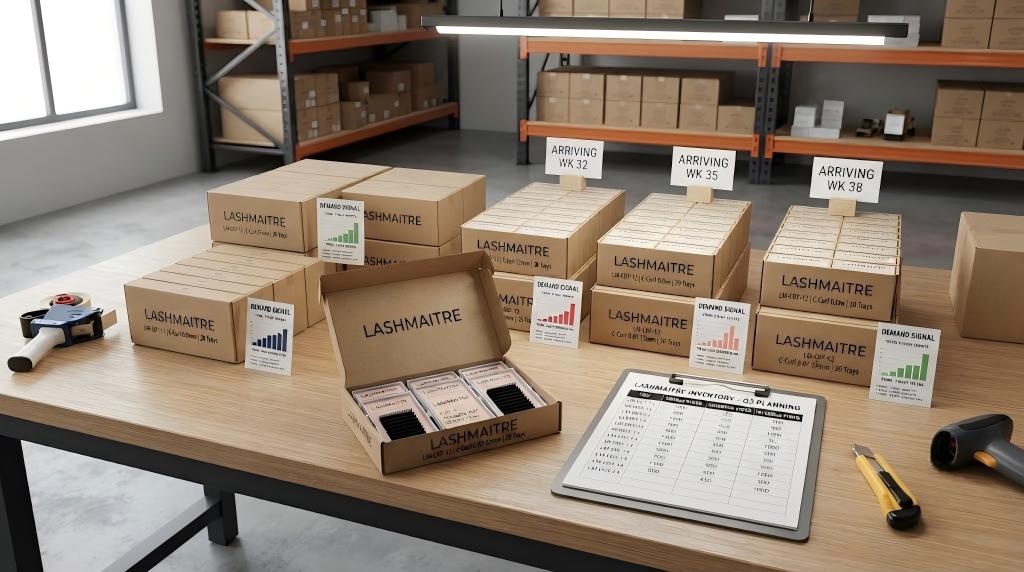
Demand planning and supply planning are related but different. The Association for Supply Chain Management demand and supply planning overview explains that demand planning projects future demand, while supply planning aligns output and inventory with that demand. A lash buyer needs both: an internal sales forecast and a supplier-confirmed production plan.
What Goes Into a Lash Inventory Forecast?
Start with one row per SKU. A brand with C, CC and D curls or multiple length maps should not hide those differences inside one total quantity.

| Forecast field | Buyer record | Why it matters |
|---|---|---|
| SKU and approved reference | Product code, curl, thickness, length map, finish | Prevents one fast seller from masking a slow variant |
| Usable stock | Sellable units after holds or defects | Avoids overstating available inventory |
| Reserved stock | Units allocated to wholesale, salon or launch orders | Shows demand already committed |
| Incoming stock | Confirmed quantity and arrival date | Prevents duplicate purchasing |
| Demand rate | Recent weekly sales adjusted for known events | Estimates depletion |
| Supplier lead time | Production, packaging and approval time | Sets the order decision date |
| MOQ and pack multiple | Minimum per SKU or packaging version | Makes the recommendation orderable |
| Required production week | Week the supplier must start or finish | Connects the forecast to factory capacity |
Build a 12-Week Reorder View
A 12-week view is a planning tool, not a universal rule. A short lead-time stock program may use fewer weeks, while private label packaging may require a longer horizon.

For each SKU:
- Record current usable stock.
- Add confirmed incoming stock by expected arrival week.
- Subtract reserved orders and forecast demand.
- Flag the first week projected stock falls below the buyer's buffer.
- Count backward through freight, production, packaging and approval time.
- Compare the calculated quantity with MOQ and carton multiples.
- Ask the supplier to confirm the requested production week.
The resulting table should show an order date, projected stockout date and requested production week. It should not say only “reorder soon.”
Reorder Point vs Reorder Forecast
A reorder point is a trigger based on inventory and replenishment risk. A forecast looks forward across multiple weeks and incorporates known changes.
Use the lash inventory reorder point guide to define the stock trigger. Use the forecast to decide whether upcoming promotions, launches, wholesale commitments or supplier constraints require an earlier order.
Adjust for Promotions, New SKUs and Stockouts
Historical sales are not automatically future demand. Mark unusual events instead of averaging them blindly.
- A promotion may create a temporary spike.
- A stockout may make historical sales look lower than real demand.
- A new curl or color has no mature history and may need a controlled first order.
- A discontinued packaging version should not remain inside the active forecast.
- A wholesale commitment should be recorded separately from expected retail demand.
For uncertain new products, use the MOQ 50 wholesale lash planning path to limit inventory exposure while the brand collects real sell-through evidence.
Confirm Supplier Capacity Before the Purchase Order
A forecast is an internal planning signal. It becomes actionable only when the supplier confirms material, tray, packaging and production availability.
Ask the supplier to confirm:
- affected SKUs and packaging versions;
- MOQ and quantity per SKU;
- artwork or label approval status;
- requested and accepted production week;
- planned completion date;
- inspection and shipment window;
- any capacity constraint that changes the delivery plan.
Do not treat an informal “should be okay” message as a reserved production slot. Link the confirmed plan to the final wholesale lash purchase order.
Lash Reorder Forecast FAQ
How far ahead should a lash brand forecast reorders?
Use a horizon long enough to cover supplier production, private label packaging, inspection, freight and a buyer-defined buffer. Review fast-moving SKUs more frequently than slow variants. The correct horizon depends on actual lead time and demand volatility, not one universal number.
Should every lash SKU use the same forecast?
No. Forecast by SKU or a clearly controlled product family. Different curls, thicknesses, length maps, colors and packaging versions can sell at different rates and may have different MOQ or production constraints.
Does a forecast reserve factory capacity?
No. A forecast signals expected need. Capacity is reserved only after the supplier confirms the production window, required materials, packaging status, quantity and commercial terms.
How should a buyer handle a new SKU with no sales history?
Use a conservative test quantity, define the review period and record actual sell-through. Do not copy the forecast of an unrelated bestseller simply because both products are lash trays.
Turn the Forecast Into a Confirmed Reorder
A useful lash reorder forecast connects sales evidence with stock, incoming supply, lead time, MOQ and a supplier-confirmed production week. Send LASHMAITRE the SKU list, usable stock, expected demand window, packaging status and required arrival date through the wholesale lash inquiry page for a reorder-plan review.
When the forecast identifies a peak-season requirement, turn it into a documented lash capacity reservation with SKU mix, readiness, dates, freeze rules and a recovery plan.

Lash Maitre: Your Trusted Partner in Eyelash extension Solutions
Lash Maitre is dedicated to providing professional insights and tips in the eyelash extension industry. Sharing the latest trends, techniques, and product knowledge, Lash Maitre helps lash artists and enthusiasts enhance their skills, stay inspired, and achieve the perfect lash experience.