Lash Inventory Cycle Count: 7 Critical Control Rules

Share
Lash Inventory Cycle Count Buyer Summary
A lash inventory cycle count should verify exact SKUs, locations, packaging revisions and count units on a controlled schedule. Use the lash inventory cycle count to protect the movement cutoff, require an independent recount and investigate material differences before an authorized stock adjustment or reorder decision.
Treat lash stock cycle counting as a control for eyelash inventory accuracy, with frequency and evidence matched to SKU risk.
A lash inventory cycle count is a recurring count of selected SKUs, locations or risk groups without waiting for a full physical inventory. It improves record accuracy when teams freeze the count area, identify exact SKU revisions, count independently, reconcile differences and retain an approved adjustment trail.
Buyer Summary
- Count exact lash SKUs and packaging revisions, not broad product families.
- Use frequency based on value, movement, discrepancy history and business risk.
- Freeze or control movements while each location is being counted.
- Keep the first count independent from the expected system quantity when practical.
- Investigate material variances before changing the inventory record.
Cycle Counts Versus a Full Physical Inventory
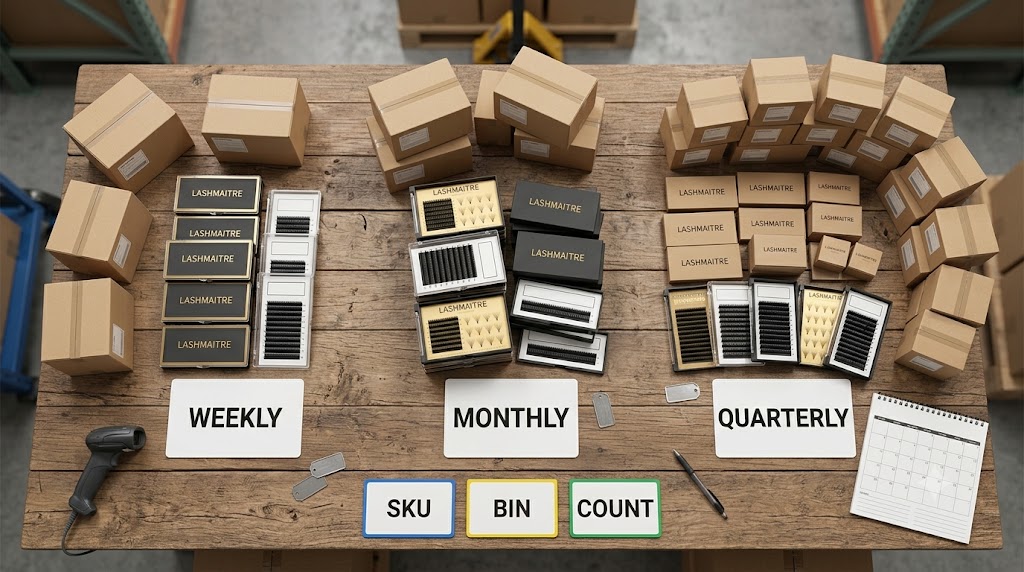
A full physical inventory attempts to count all stock at a defined point. A cycle-count program checks smaller groups on a recurring schedule. It can find process problems earlier and spread the workload, but it only works when the selection method and follow-up are disciplined.

Oracle's cycle-count guidance describes regular counts of selected items and the comparison of count results with system quantities. It is general inventory documentation, not a lash-specific requirement, but it supports the basic control model used here. See Oracle Cycle Counting.
For lash brands, the main risk is false grouping. Two trays can look similar while representing different curl, thickness, length format, artwork revision or sales channel. The count identifier must match the unit used for purchasing and fulfillment.
Seven Rules for a Lash Inventory Cycle Count
| Rule | Required control | Why it matters |
|---|---|---|
| 1. Define the count unit | State whether the unit is tray, box, bundle, inner carton or master carton | Prevents conversion errors |
| 2. Identify exact stock | Use SKU, specification, batch and packaging revision | Prevents unlike products being combined |
| 3. Prioritize risk | Count fast movers, high-value SKUs and repeat variances more often | Directs effort to meaningful exposure |
| 4. Control movement | Freeze or log receipts, picks, samples and transfers during the count | Protects the count cutoff |
| 5. Count independently | Avoid leading the counter with the expected quantity | Reduces confirmation bias |
| 6. Recount and investigate | Verify location, unit and documents before adjustment | Separates count error from process failure |
| 7. Approve the result | Record adjustment, owner, cause and corrective action | Creates accountability and learning |
Build the Count Schedule Around Risk
Do not count every SKU at the same frequency simply because the spreadsheet is easier to arrange that way. A useful schedule reflects business exposure.
Count more frequently when a SKU has high sales velocity, high value, repeated receiving differences, many sample withdrawals, multiple picking locations or a recent packaging transition. Stable, low-risk SKUs may be reviewed less often, provided that the overall program still covers the inventory population.
The lash inventory aging report guide can reveal slow-moving or old-version stock that deserves a targeted count before a reorder or discontinuation decision.
Define the Count Unit and Cutoff
A label saying “50” is meaningless unless the unit is known. Record whether the quantity means 50 trays, 50 retail boxes or 50 inner packs. If cartons contain mixed SKUs, count the contents rather than relying only on the carton label.
Control movements during the count window. If normal work cannot stop, create a clear cutoff and movement log. Record receipts, picks, samples, returns, transfers and damaged units that occur after the cutoff so they can be reconciled separately.
| Movement during count | Control record | Reconciliation question |
|---|---|---|
| New receipt | Receiving time and accepted quantity | Was it included in the physical count? |
| Customer pick | Pick ticket and time | Had the units left the location? |
| Sample withdrawal | Sample log and approver | Was inventory relieved correctly? |
| Location transfer | From/to locations and scan | Was one side counted twice or missed? |
| Damage/hold | Status and physical location | Is it excluded from usable stock but still owned? |
Count Without Letting the System Answer First
When practical, give the counter the item and location but not the expected quantity. This “blind” approach reduces the temptation to stop when the physical count seems close to the system number. The counter should record the result, unit, location, date and name.
A second person can recount exceptions using the same unit definition. Do not erase the first result. Keeping both counts shows whether the difference came from a counting mistake or remains unresolved.
Investigate Before Adjusting
An inventory adjustment can make the system equal the shelf while hiding the root cause. Before approval, review recent receiving records, shipment picks, returns, sample use, transfers, holds, damaged stock and unit conversions.
If the variance involves the same SKU repeatedly, inspect the operating process rather than accepting repeated adjustments as normal. The lash order quantity verification guide provides a useful ordered-to-shipped reconciliation model for tracing quantity differences back to source documents.
Record a reason code only when evidence supports it. “Unknown” is more honest than a guessed supplier shortage, but unknown differences should trigger an owner and corrective review.
Use Accurate Counts Before Reordering
Cycle counts should feed purchase decisions, not remain isolated warehouse exercises. A reorder calculation based on overstated stock can cause a stockout; one based on understated stock can deepen excess inventory.
Combine the verified usable quantity with demand, open orders, lead time and safety-stock logic. For buyers building a controlled assortment, the MOQ 50 wholesale lash planning page supports smaller SKU-level planning without assuming demand is equal across every curl and length.
Lash Inventory Cycle Count FAQ
How often should lash inventory be cycle counted?
There is no single frequency for every SKU. Set the schedule using movement, value, discrepancy history, location complexity and business risk, then review whether the program is actually finding and reducing errors.
What should be included on a cycle-count sheet?
Include count date, location, exact SKU/specification, batch or revision where needed, count unit, physical quantity, counter, recount result, system quantity, variance and authorized disposition.
Should held lash stock be counted?
Yes, if the business still owns it, but count it in its physical hold location and status. Do not combine held units with usable available stock.
Can the inventory system be adjusted immediately?
Small differences may follow an approved tolerance workflow, but material or repeated variances should be recounted and investigated before adjustment. Keep the approver, cause and evidence.
Plan an Accurate Lash Inventory Mix
Bring your SKU structure, current stock, demand pattern and packaging requirements to the wholesale lash inquiry page. LASHMAITRE can help align an MOQ and supply brief with the inventory controls your team needs.

Lash Maitre: Your Trusted Partner in Eyelash extension Solutions
Lash Maitre is dedicated to providing professional insights and tips in the eyelash extension industry. Sharing the latest trends, techniques, and product knowledge, Lash Maitre helps lash artists and enthusiasts enhance their skills, stay inspired, and achieve the perfect lash experience.