Classic Lash Core Range Planning: Curls, Thicknesses and Reorder Files for B2B Buyers
Share
Classic lash core range planning is the step between understanding classic lashes and placing a wholesale or private label order. A buyer may already know that classic lashes are single lash extensions arranged in strip rows, but that does not answer the business question: which curls, thicknesses, lengths, labels, and reorder records should be included in the first range? For a focused first curl decision, the C vs CC vs D curl lashes guide helps buyers keep the core range practical before adding specialty curls.
For a broad product explanation, start with LASHMAITRE's classic eyelash extensions guide. This article focuses on range architecture for lash brands, salon chains, distributors, academy kit buyers, and private label buyers who need a practical core range before bulk production.
The goal is not to launch the largest catalog first. The goal is to build a classic lash range that is easy to sample, easy to sell, easy to label, and easy to reorder.
For classic diameter planning, compare 0.15 mm vs 0.20 mm classic lash extensions using the exact product construction, label and sample record rather than the number alone.
Decide the Buyer Type Before Choosing Specs
Classic lash core range planning should begin with the buyer type. The same tray specification can be useful or inefficient depending on who will buy, stock, or use the product.
Common buyer types include:
- Salon chains that need reliable refill trays for repeated service work.
- Distributors that need shelf depth and clear tray labels for many customers.
- Private label startups that need a focused first range before custom packaging.
- Academy or training kit buyers that need easy-to-explain curl and thickness choices.
- Existing lash brands that want to strengthen core classic SKUs before adding new families.
When the buyer type is unclear, the first order often becomes too wide. The buyer asks for several curls, many thicknesses, mixed and single length trays, custom boxes, and label variations before any tray has been tested by the target user.
Good planning narrows the first decision. If the buyer is a salon chain, service reliability and fast refill lengths may matter most. If the buyer is a distributor, label clarity and reorder depth may matter more. If the buyer is a private label startup, the first job is to approve a repeatable sample and product file.
Build the First Core Range Matrix
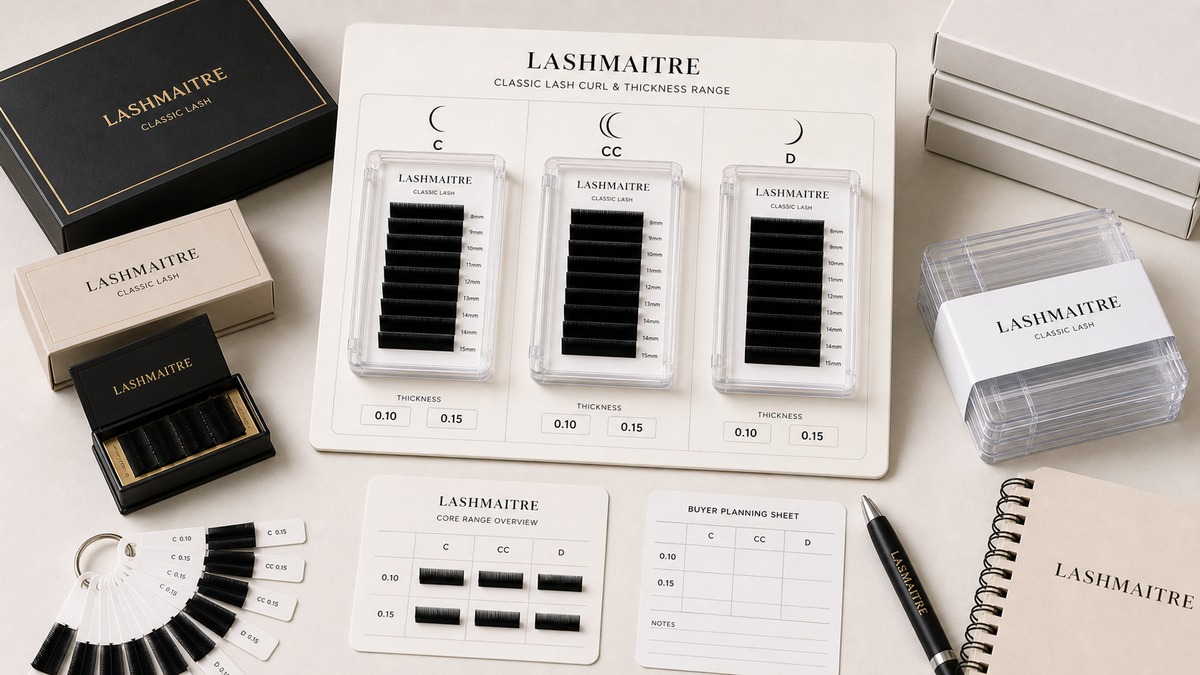
The first core range should be wide enough to serve real buyer demand but narrow enough to manage inventory. Classic lash trays can be planned around curl, thickness, length format, and packaging level, but each field should have a reason.
Use this starter matrix:
| Planning field | First decision | B2B reason |
|---|---|---|
| Buyer type | Salon, distributor, academy, private label, or existing brand | Prevents over-building the first range |
| Core curls | Usually C, CC, D, or the buyer's proven curl demand | Keeps the first sample set easy to compare |
| Classic thickness | Common classic examples include 0.10 and 0.15 | Avoids mixing every thickness into one unclear range |
| Length coverage | Use realistic planning such as 8mm-15mm | Helps buyers see short, middle, and long tray needs |
| Tray format | Mixed length, selected single length, or both | Connects the product to actual reorder behavior |
| Label system | Product family, curl, thickness, length, code | Reduces packing and reorder mistakes |
| Packaging level | Stock tray, logo label, sleeve, or custom box | Keeps artwork tied to approved specs |
This matrix supports the existing lash extension SKU planning guide. The SKU file should describe the product clearly enough that the buyer, sales team, warehouse, and supplier all understand the same tray.
Keep Curl Planning Practical
C, CC, and D are common references in classic lash range discussions, but the right curl depends on the buyer's market and the training habits of the salons using the trays. A distributor may need more curl variety than a small private label launch. A salon chain may only need the curls that match its core service menu.
During classic lash core range planning, ask:
- Which curl already sells or gets used most often?
- Which curl should be sampled first by the target buyer?
- Does the buyer need one core curl or a side-by-side C, CC, D sample set?
- Will the tray label and reorder code make the curl clear?
- Can the supplier repeat the same curl behavior in later production?
The LASHMAITRE article on lash extension curl sample sets can help buyers design the curl testing path. In this core range article, the key point is simpler: do not add curls just to make the catalog look larger. Add curls because the buyer can test, explain, stock, and reorder them.
Treat Thickness as a Product Role
Thickness is not only a number on a label. It tells the buyer how the tray fits the range. For classic lash core planning, 0.10 and 0.15 are common classic examples, while finer options such as 0.03, 0.05, and 0.07 usually belong to fine volume, mega-volume, volume, or hybrid planning contexts unless the buyer has a specific reason and training path.
That distinction matters because a buyer may ask for every thickness from 0.03 to 0.15 without realizing that the product role changes. The first classic range should not become a confusing thickness library.
Use this practical split:
| Thickness area | Typical planning role | Buyer check |
|---|---|---|
| 0.03 and 0.05 | Fine volume or mega-volume planning contexts | Confirm training level and product family |
| 0.07 | Volume or hybrid planning context | Confirm whether it belongs beside classic SKUs |
| 0.10 | Lighter classic planning example | Test pickup, finish, and customer feedback |
| 0.15 | Common classic planning example | Check demand, comfort expectations, and reorder depth |
If a buyer wants a true classic core range, keep the first thickness set controlled. Additional thicknesses can be added after sample feedback and reorder behavior are visible.
Test Samples Before Approving Labels
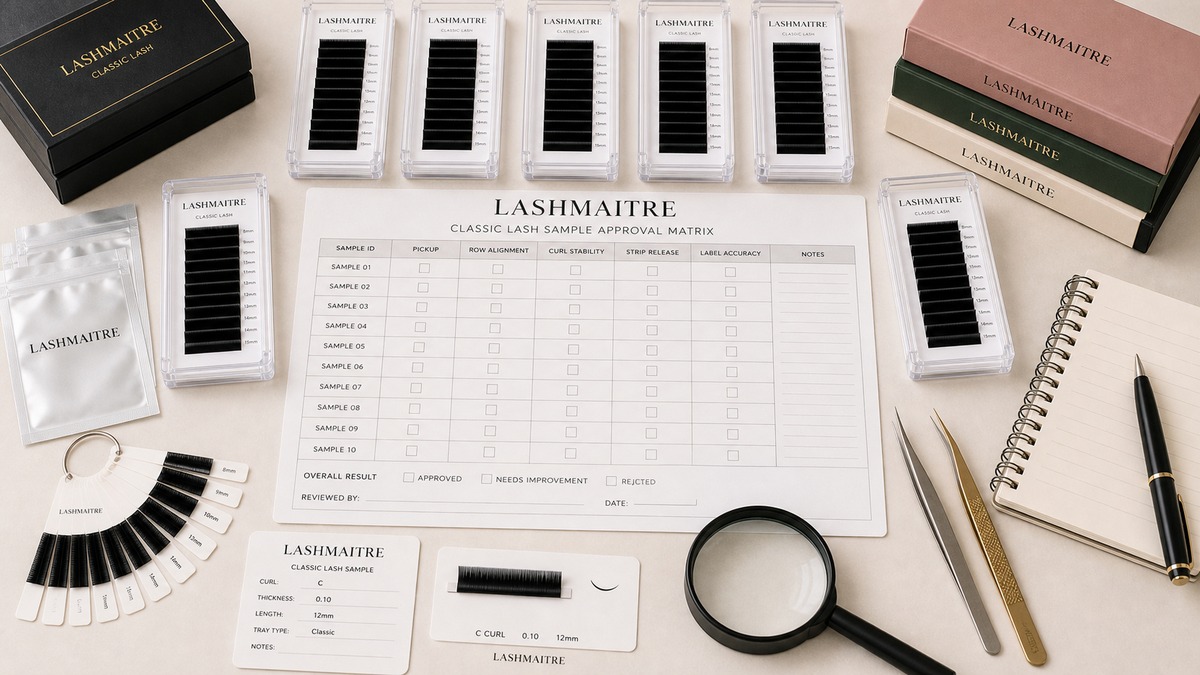
Private label packaging is important, but it should not lead the process. If the curl, thickness, length structure, or tray naming is still changing, the tray card and box proof will also change.
Before approving label artwork, test samples for:
- Curl consistency across tray rows.
- Row alignment and strip cleanliness.
- Pickup control.
- Fiber finish and visual density.
- Thickness feel compared with the buyer's intended product role.
- Length labeling, especially where 8mm-15mm is shown.
- Tray label clarity.
- Buyer and artist feedback.
The Shopify manufacturer and supplier guide is a useful general reminder that supplier selection should happen before production commitment. In lash purchasing, supplier fit includes whether the approved sample, tray label, and reorder file can be repeated.
Buyers who need physical trial sets can also start from LASHMAITRE's lash extension samples page before finalizing the bulk order file.
Connect Core Range Planning to Wholesale Tray Depth
The existing LASHMAITRE wholesale lash trays guide explains broader tray purchasing considerations. For a classic lash core range, the buyer should decide how much depth each spec deserves.
Not every length needs the same stock quantity. Middle lengths may move faster in some markets, while shorter or longer lengths may need shallower depth. Salon chains may reorder based on service flow. Distributors may need a wider display but still deeper stock for high-turnover specs.
Use a simple depth review:
| Range area | Low-risk approach | Risk if ignored |
|---|---|---|
| Core curl | Start with the buyer's strongest curl demand | Slow-moving curl stock |
| Thickness | Limit first classic thickness choices | Too many weak SKUs |
| Length | Track 8mm-15mm movement by length | Overstock in slow lengths |
| Tray code | Match labels, photos, and reorder file | Wrong tray repeated |
| Packaging | Approve after sample specs are stable | Artwork changes and delays |
The Shopify wholesale suppliers guide is a useful general reference for comparing wholesale supplier fit and inventory planning before committing to stock. For lash buyers, this is where range width and inventory strength separate. A narrow range with strong depth can be easier to sell than a large range with weak stock behind every SKU.
Write a Reorder File Before Bulk Production
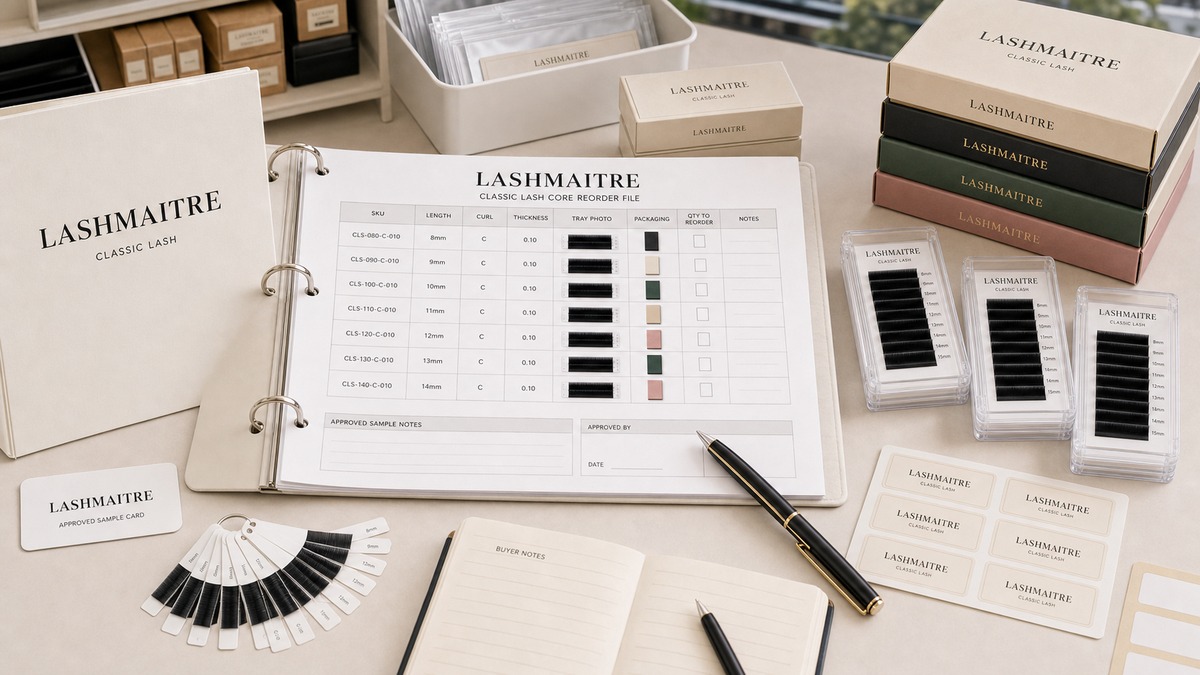
The reorder file is the buyer's protection against vague repeat orders. Without it, a buyer may approve a sample in one message thread, approve labels in another, then later request "the same classic trays" without the exact curl, thickness, length, label, and packaging record.
A useful classic lash reorder file should include:
- Product family: classic lash.
- Curl.
- Thickness.
- Length range or exact length.
- Tray format.
- Tray card text.
- Label and packaging version.
- Approved sample photo.
- Buyer feedback notes.
- MOQ or first order quantity.
- Reorder code and version date.
The ISO 9001 quality management systems standard is a general reference for documented and repeatable requirements. Lash buyers do not need to turn every order into a formal quality audit, but they should keep approved requirements visible for the next purchase. Reference: ISO 9001:2015.
Classic Lash Core Range Planning Quick Review
- Use classic lash core range planning to define the buyer type before choosing curls and thicknesses.
- Use classic lash core range planning to control the first sample set instead of launching every possible tray.
- Use classic lash core range planning to connect labels, packaging, sample approval, and reorder files before bulk production.
If the first range may include both classic and fuller products, compare classic vs volume lash extensions before widening sample trays, MOQ depth and private label packaging.
Academy and educator buyers can also turn the core classic range into an eyelash extension student kit by documenting approved trays, SKU labels, QC files, packaging proof and reorder records for each class intake.
For a one-to-one product review, use the classic lash set supplies checklist to compare fiber identity, strip release, labeling and reorder records.
FAQ: Classic Lash Core Range Planning
What is classic lash core range planning?
Classic lash core range planning is the process of choosing the first practical set of classic lash curls, thicknesses, lengths, labels, packaging options, and reorder records for a B2B buyer.
Which curls should a first classic lash range include?
Many buyers start by testing common curls such as C, CC, and D, but the final choice should follow buyer type, market demand, artist feedback, and sample approval.
Which thicknesses fit classic lash planning?
0.10 and 0.15 are common classic planning examples. Finer thicknesses such as 0.03 and 0.05 usually belong to fine volume or mega-volume planning unless the buyer has a clear product reason.
Should private label packaging be designed before samples?
No. Packaging should follow approved product specs. First confirm curl, thickness, length, tray structure, and label wording, then prepare the tray card, box, sleeve, or label proof.
How does a reorder file help a lash buyer?
A reorder file keeps the approved tray spec, label text, packaging version, sample photo, and buyer notes in one place so the next order can match the approved product.
Conclusion: Make the First Range Easy to Repeat
Classic lash core range planning is not about creating the biggest first catalog. It is about building a focused range that fits the buyer type, passes sample testing, has clear labels, and can be reordered without confusion.
Send LASHMAITRE your current classic lash demand, planned curls, thicknesses, 8mm-15mm length needs, buyer type, packaging level, sample request, destination country, and first order plan through the wholesale lash extensions inquiry page. We can prepare a focused classic lash sample and reorder file before bulk production.
Buyer next step: For branded core classic trays, keep the range plan aligned with private label lash extensions so tray names, SKU codes and reorder files remain consistent.
Buyer next step: Classic core ranges should be checked through LASHMAITRE lash quality control before reorders, especially for curl memory, thickness, length accuracy and batch references.

Lash Maitre: Your Trusted Partner in Eyelash extension Solutions
Lash Maitre is dedicated to providing professional insights and tips in the eyelash extension industry. Sharing the latest trends, techniques, and product knowledge, Lash Maitre helps lash artists and enthusiasts enhance their skills, stay inspired, and achieve the perfect lash experience.