Classic Eyelash Extensions: Wholesale Buying Guide for Lash Brands and Salons
Share
Definition:
Classic eyelash extensions are individual lash extension fibers applied one-to-one to natural lashes by trained lash artists. In B2B sourcing, classic lashes are usually the foundation SKU for salons, lash brands, distributors, academies, and private label buyers because they support natural sets, training programs, daily salon services, and repeat wholesale orders.
Author: Alex, LASHMAITRE – B2B eyelash extensions manufacturing & private-label programs (https://www.lashmaitretrade.com)
Why Classic Lashes Are the Foundation SKU
Many buyers are attracted to trend styles first: premade fans, wispy looks, brown lashes, colored lashes, cluster kits, and private label packaging. Those categories can be valuable. But for most professional lash businesses, classic lash extensions remain the foundation of the product line.
Classic lashes are easier to explain, easier to train with, and easier to reorder. They are used for natural sets, beginner training, salon menu basics, and product line stability. A brand can build creative categories later, but the classic tray range often determines whether the buyer trusts the supplier for repeat orders.
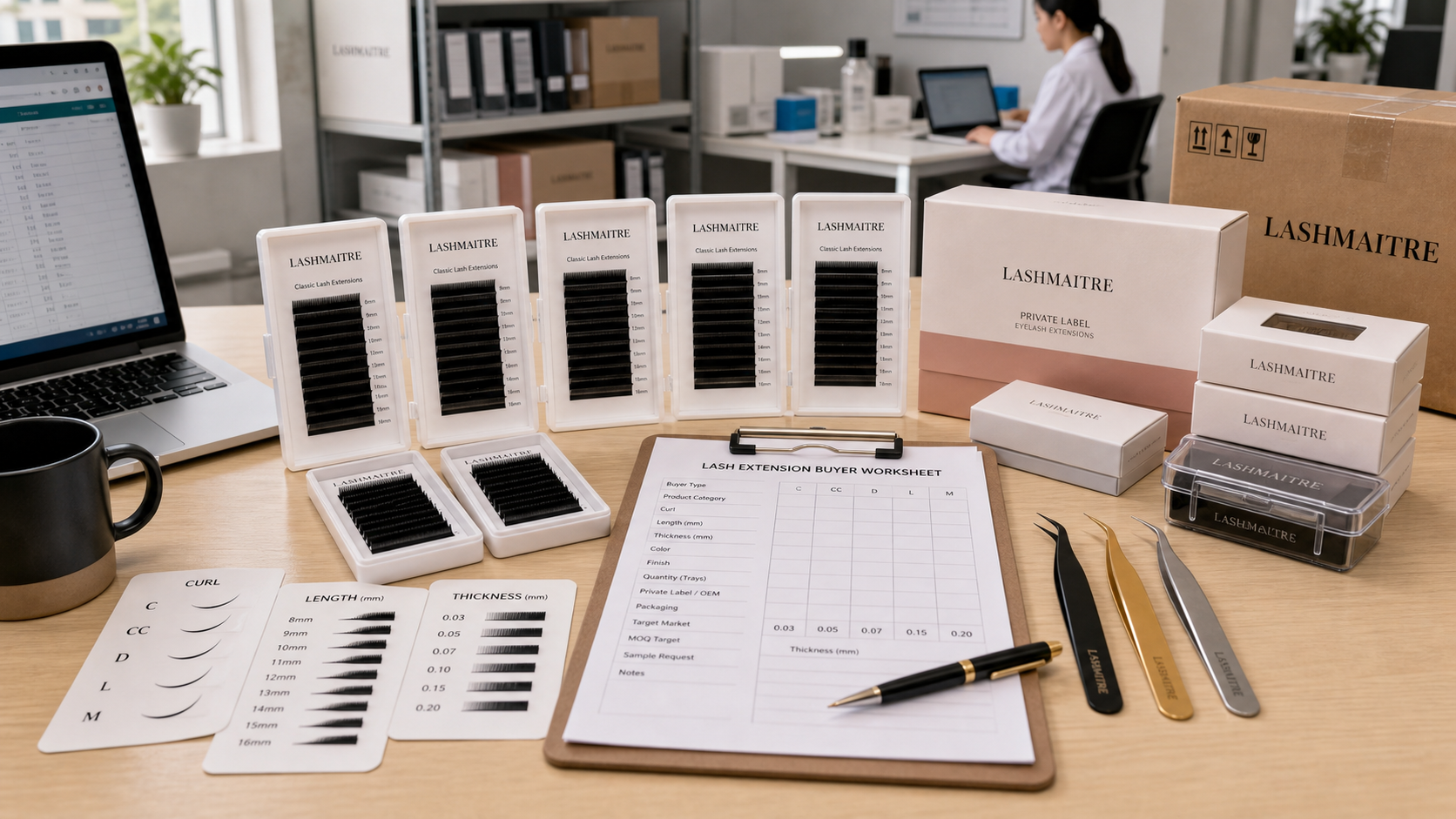
This guide is written for B2B buyers, not consumers booking a lash appointment. The goal is to help salons, lash brands, distributors, and importers decide which classic lash trays to test, how to compare specs, and how to avoid overbuilding inventory before demand is proven. For buyers who already understand the classic lash category and need to choose curls, thicknesses, length coverage, and reorder files, use the classic lash core range planning guide as the next planning step.
For broader planning, review the wholesale eyelash extensions buying guide and the eyelash extension trays buying guide.
The B2B Buying Problem: Too Many Specs Too Early
Classic lash trays appear simple, but the spec matrix can become large very quickly. A buyer may ask for every curl, length, thickness, and tray format before knowing which products the market actually reorders.
This creates three problems. First, inventory becomes harder to manage. Second, packaging and labeling become more complex. Third, sales teams struggle to explain the product line because the catalog has more options than the market needs.
A strong classic lash range is not the biggest range. It is the range that salons can understand, test, and reorder.
The best approach is to start with a controlled tray selection, collect sample feedback, and expand based on real demand.
Where Classic Eyelash Extensions Fit in a Product Line
Classic lashes usually sit at the center of a professional lash extension line. They can support: When buyers are deciding whether a flatter fiber belongs beside regular classic trays, the ellipse lashes vs classic lashes comparison gives the practical B2B checks.
- Natural salon services
- Beginner lash artist training
- Lash academy kits
- Private label starter collections
- Distributor core inventory
- Mixed tray sample programs
- Cross-selling into volume, premade fans, brown lashes, and colored lashes
Once classic tray specs are stable, the buyer can add volume trays, premade fans, brown lash extensions, colored lash extensions, and retail-friendly kits.
For category planning, use the types of eyelash extensions B2B guide.
Explore LASHMAITRE’s wholesale eyelash extensions category for related product options.
Table 1: Classic Lash Tray Planning by Buyer Type
| Buyer Type | Best Classic Lash Use Case | Recommended Starting Range | Main Risk |
|---|---|---|---|
| Salon owner | Natural sets and daily services | Core curls, medium lengths, practical thickness | Buying rare specs before client demand is clear |
| Lash brand | Starter product line and private label trays | Mixed trays plus selected single lengths | Packaging too many SKUs too early |
| Distributor | Core wholesale stock | High-demand tray specs with clear labels | Large catalog with weak reorder focus |
| Academy / trainer | Training kits and beginner practice | Mixed classic trays and practical curls | Using low-quality trays that hurt training experience |
| Ecommerce seller | Professional tray category | Clear product education and visuals | Selling professional products without enough explanation |
This planning table shows why classic eyelash extensions should be simple at the beginning. The buyer can always expand after confirming which tray specs produce repeat demand.
Choosing Classic Lash Specs: Curl, Length, Thickness, and Finish
Classic lashes need clear specs because professional buyers compare details carefully. A tray that looks fine in a photo may still fail if pickup feel, strip release, curl consistency, or label accuracy is poor.
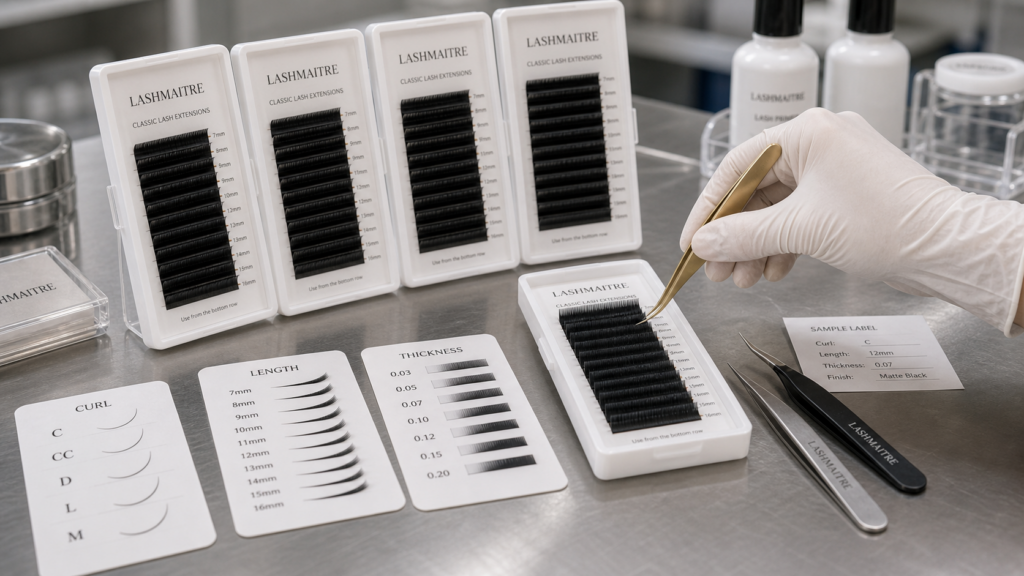
Curl
C and CC curls are often practical starting options because many salons understand them. D curl may be useful for more lifted styles. Specialty curls should be introduced only when the buyer has a clear salon menu or market reason.
Length
A buyer does not need every length at the start. Mixed trays are useful for sampling, training, and testing. Single-length trays are better after the buyer knows which lengths salons reorder most often.
Thickness
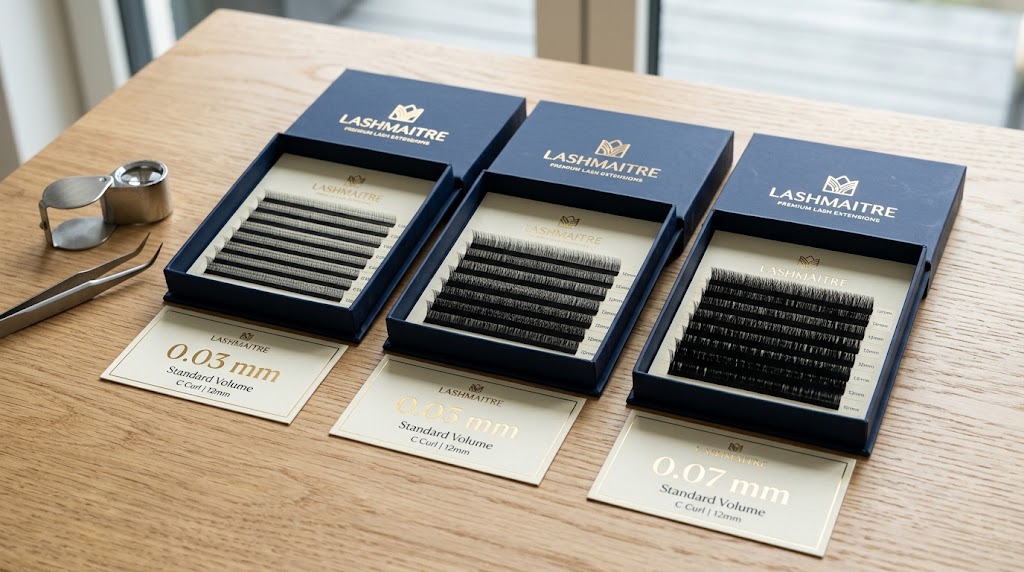
Thickness selection should match the service style and buyer education level. Natural classic sets usually need a different thickness strategy from dramatic sets. Avoid choosing thickness only because it looks strong in a product photo.
Finish
The finish should match the brand promise. Some buyers prefer a soft matte look, while others want a deeper black appearance. The finish should be approved with samples before packaging design is finalized.
For color-adjacent SKU planning, review the brown eyelash extensions wholesale SKU guide.
Classic vs Volume vs Premade Fans
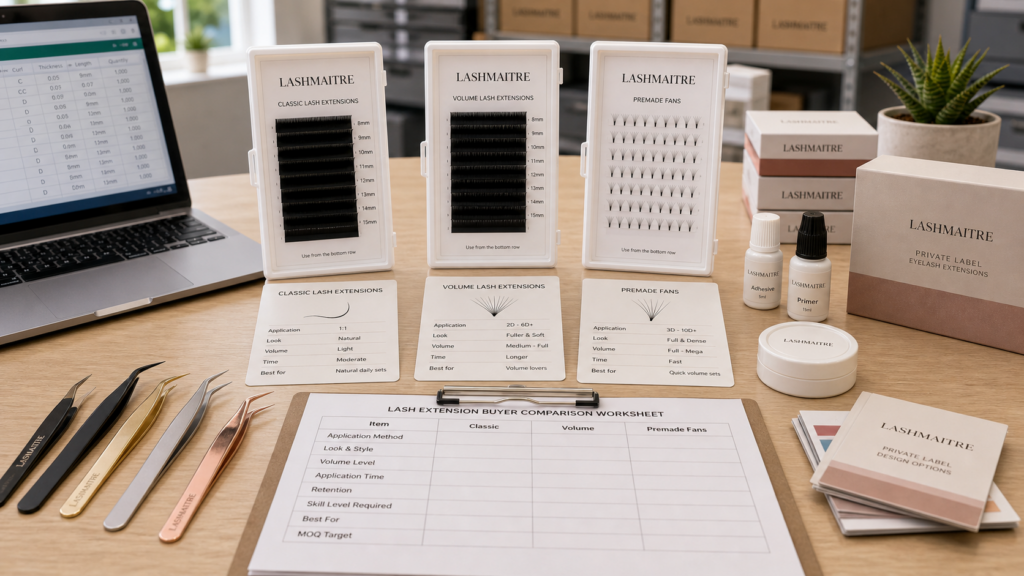
Classic lashes, volume lashes, and premade fans are related, but they serve different buyer needs. Classic lashes support natural one-to-one application. Volume lashes allow trained artists to create fans. Premade fans help speed up application and provide consistent fan shape.
| Product Type | Main Use | Buyer Fit | First Order Advice |
|---|---|---|---|
| Classic lash extensions | One-to-one natural sets | Salons, academies, brands, distributors | Start as core tray category |
| Volume lash extensions | Handmade fan work | Advanced artists and professional salons | Test after core specs are clear |
| Premade fans | Faster fan application | Salons needing speed and consistency | Compare fan base, symmetry, and pickup |
| Brown classic lashes | Softer natural looks | Natural-style salons and premium brands | Add after black classic trays are tested |
| Colored lash trays | Creative or seasonal sets | Ecommerce, creative salons, limited collections | Test in smaller quantities first |
This comparison helps buyers avoid treating every lash type as equal in the first order. Classic lashes usually deserve the most stable planning because they support the rest of the product line.
Private Label Classic Lash Extensions
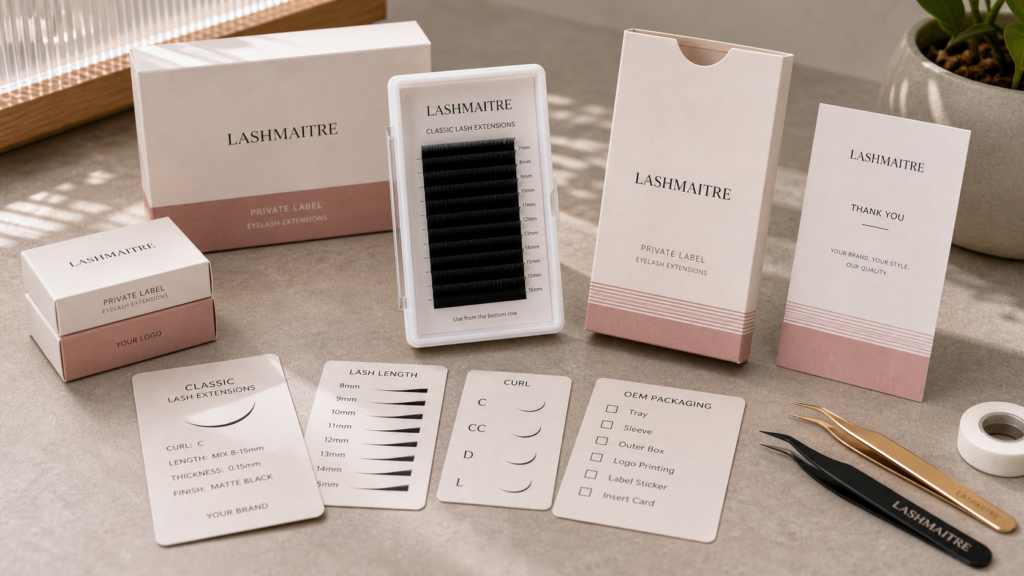
Private label classic lashes are often a good starting point for brands because the product category is familiar to professional buyers. The packaging should be clear, practical, and easy to reorder.
A strong private label tray should show:
- Brand name
- Product category
- Curl
- Length
- Thickness
- Finish or material description if relevant
- Tray format
- Barcode or SKU if needed
- Country and compliance details as required by the buyer’s market
Avoid unsupported claims. Do not use medical language, guaranteed retention claims, or compliance claims that cannot be documented. Safer product copy focuses on specs, packaging, professional use, and sourcing details.
To request samples, MOQ details, or private label support, send your specs through the wholesale lash extensions inquiry form.
Sample First: What to Check Before Bulk Orders
Classic lash samples should be tested like a real sourcing project. The buyer should record the tray name, curl, length, thickness, finish, packaging option, and tester feedback.
Check these points:
- Does the curl match the label?
- Is the length consistent across the strip?
- Does the strip release feel smooth?
- Does the lash fiber feel too stiff or too soft for the target buyer?
- Is the tray label clear enough for reorder?
- Does the packaging protect the tray during shipping?
- Can the same spec be repeated in future production?
For a MOQ 50 starter order, buyers can test a narrow classic lash range before expanding into more lengths, private label packaging, or additional categories.
How to Structure a First Classic Lash Order
A practical first classic lash order can include a mix of testable and reorder-friendly products. A new brand does not need to start with a full professional catalog.
A controlled starter structure may include:
- One or two core curls
- A limited medium length range
- One or two thickness options
- Mixed trays for testing
- A small number of single-length trays
- Stock packaging first if artwork is not final
- Private label packaging after samples are approved
This structure gives the buyer enough variety to test the market without creating too much inventory complexity.
Product Page Copy for Classic Lash Extensions
Classic lash copy should be precise. It should not sound like a consumer appointment page. B2B buyers need to see product specs, sample availability, MOQ, packaging options, and reorder logic.
Useful copy angles include:
- Core professional lash tray category
- Natural lash extension sets
- Training and academy support
- Private label classic lash trays
- Wholesale tray specs and sample testing
- Supplier consistency for repeat orders
For Google SEO and AI GEO, define the product clearly, connect it to related terms, and explain the buyer decision process. Classic eyelash extensions should appear naturally in the title, definition, headings, FAQ, and important body sections, but the article should still read like a professional buyer guide.
Supplier Evaluation: What Makes Classic Trays Reliable
Classic lash extensions are a repeat-order product, so buyers should evaluate the supplier beyond the first sample. A nice sample is only the beginning. The more important question is whether the supplier can keep the same curl, tray label, packaging, and fiber feel consistent across repeat orders.
Before choosing a supplier, compare communication quality, spec confirmation, sample labeling, packaging options, and how clearly the factory documents the order. A reliable supplier should help the buyer avoid spec confusion. If the quote only says “classic lashes” without curl, length, thickness, finish, packaging, and tray format, the order is not specific enough for a serious B2B purchase.
Buyers should also ask how samples are matched to bulk production. If a salon or brand approves a sample tray, the final order should use the same confirmed spec language. This matters for private label buyers because packaging artwork, tray labels, and reorder SKUs all depend on accurate spec control.
For distributors, reliability is even more important. When multiple salon accounts reorder the same tray, small changes in curl or label clarity can create customer service problems. That is why classic lash trays should be treated as operational inventory, not only beauty products.
When to Expand Beyond Classic Lash Extensions
After a buyer has a stable classic lash range, expansion becomes easier. Volume lashes can serve advanced artists, premade fans can support speed and consistency, brown lashes can create a softer natural category, and colored lashes can support creative campaigns. The classic range gives the buyer a reference point for quality and labeling before adding more complicated SKUs.
A practical rule is to expand only after the buyer knows which classic tray specs are being requested again. If the market is still unclear on classic curls and lengths, adding too many advanced categories can make the catalog harder to manage. If classic reorder patterns are clear, the buyer can add new categories with more confidence.
Common Mistakes When Buying Classic Lash Trays
The first mistake is ordering too many specs before testing demand. A large catalog looks impressive, but it can create slow-moving inventory.
The second mistake is ignoring tray labels. If labels are unclear, salons and distributors may reorder the wrong specs.
The third mistake is focusing only on price. Low price is not useful if the product is inconsistent, difficult to pick up, or hard to reorder.
The fourth mistake is mixing unrelated images into the product page. A classic lash article should use classic lash tray images, spec cards, private label packaging, and professional sourcing visuals.
FAQ: Wholesale & OEM – classic eyelash extensions
Are classic lash extensions still important for wholesale buyers?
Yes. Classic lash extensions remain a core SKU because they support natural salon services, training, private label starter lines, and distributor inventory.
What specs should a new lash brand test first?
Start with a narrow range of common curls, medium lengths, practical thickness options, and mixed trays. Expand only after sample feedback and reorder demand are clear.
Are classic lash trays suitable for private label packaging?
Yes. Classic lash trays are often one of the best categories for private label because professional buyers understand the product and reorder by clear specs.
How do I compare classic lash suppliers?
Compare sample quality, curl consistency, strip release, label accuracy, packaging options, MOQ, lead time, and whether the supplier can repeat the same specs in future orders.
References
- FDA cosmetics guidance and MoCRA information: https://www.fda.gov/cosmetics
- ISO 22716 cosmetics good manufacturing practice overview: https://www.iso.org/standard/36437.html
- U.S. Federal Trade Commission advertising guidance: https://www.ftc.gov/business-guidance/advertising-marketing
Conclusion: Build the Lash Line Around a Reliable Classic Range
Classic eyelash extensions are not the newest trend, but they are one of the most important B2B product categories. A reliable classic tray range gives salons, lash brands, academies, distributors, and private label buyers a stable foundation for future growth.
If you are planning classic lash trays, mixed tray samples, or private label classic lash packaging, send your target market, preferred curl and length range, packaging plan, and estimated quantity to LASHMAITRE at https://www.lashmaitretrade.com. Our team can help you compare sample options, MOQ 50 starter orders, private label packaging, and wholesale production planning.

Lash Maitre: Your Trusted Partner in Eyelash extension Solutions
Lash Maitre is dedicated to providing professional insights and tips in the eyelash extension industry. Sharing the latest trends, techniques, and product knowledge, Lash Maitre helps lash artists and enthusiasts enhance their skills, stay inspired, and achieve the perfect lash experience.