C vs CC vs D Curl Lashes: 8 Core Range Checks
Share
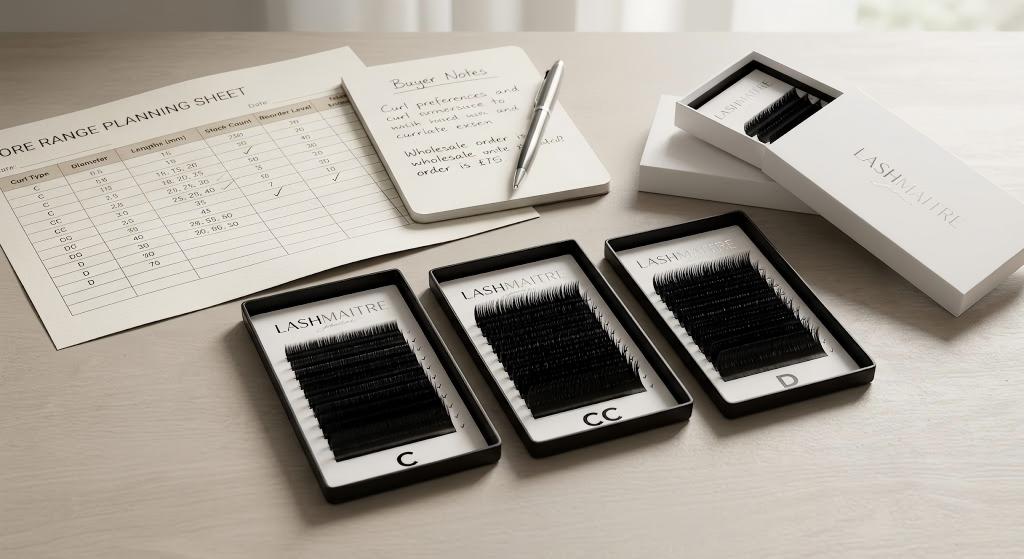
C vs CC vs D curl lashes is one of the most practical decisions in a wholesale lash range. These curls often form the buyer's core catalog before specialty curls are added. If the core range is too narrow, the buyer may not serve enough salon needs. If it is too wide, the first order can become expensive and hard to reorder.
C vs CC vs D Curl Lashes Buyer Summary
C vs CC vs D curl lashes should be compared as a controlled core range before a buyer confirms tray labels, first order quantities, private label packaging or reorder files.
For a private label startup, salon chain, distributor or ecommerce lash brand, the goal is not to copy another catalog. The goal is to build a core curl range that is easy to sample, easy to label, easy to explain and easy to reorder.
Use C, CC and D as a controlled decision set. Keep thickness, length format, product family and finish stable during sample testing. Then choose the range based on buyer type, service menu, launch budget and reorder plan. If you need the broader product family strategy first, use LASHMAITRE's classic lash core range planning and volume lash range planning guides before finalizing curls.
Why C vs CC vs D Curl Lashes Become the Core Range
C, CC and D are useful because they create a simple range ladder. A buyer can position them from softer to stronger curl without creating too many specialty names in the first launch.
| Curl | Planning role | Buyer use case |
|---|---|---|
| C curl | Natural core option | Starter ranges, broad salon use, conservative catalogs |
| CC curl | Middle core option | Brands that want more lift without making D the only stronger option |
| D curl | Stronger core option | Bolder catalog positioning and buyers that need a more dramatic curl option |
This does not mean every buyer needs all three in every thickness and length. It means the buyer should compare the three under a clean sample plan before deciding what belongs in the first wholesale assortment.
Compare the Curls Without Changing Every Variable
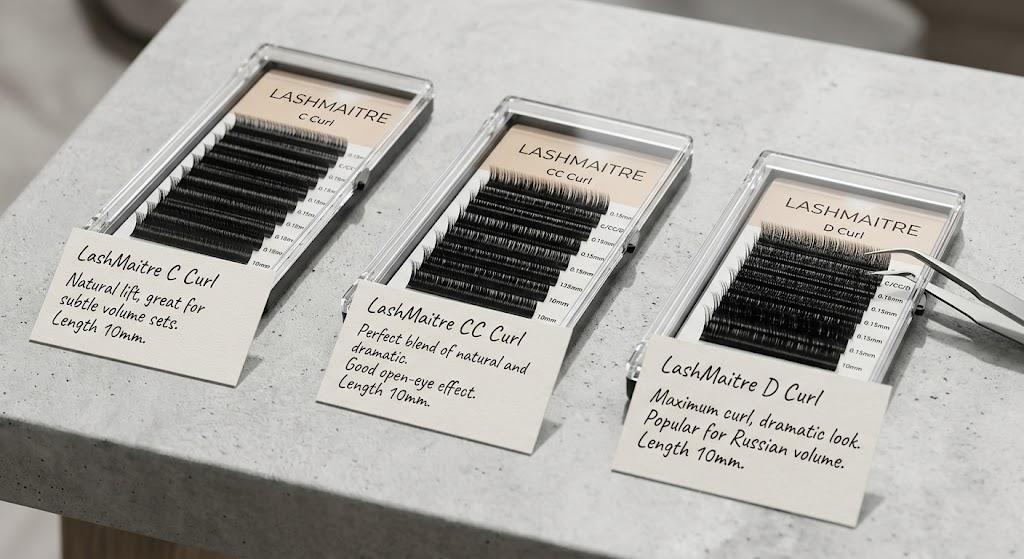
The easiest way to make a bad curl decision is to compare different products at the same time. If the C curl sample is classic 0.15 mixed length and the D curl sample is volume 0.07 single length, the buyer is not judging curl alone.
Use the same conditions for the first C/CC/D sample comparison:
| Variable | Control it this way |
|---|---|
| Product family | Compare classic to classic or volume to volume |
| Thickness | Keep one thickness for the first curl test |
| Length | Use the same length or same mixed-length format |
| Finish | Keep finish stable during curl approval |
| Tray label | Label each sample clearly as C, CC or D |
| Feedback | Record artist notes and buyer photo review separately |
If thickness is still open, use the lash thickness chart first. A buyer who changes curl and thickness together may approve the wrong reason.
When C Curl Fits the Core Range
C curl usually works well when the buyer needs a natural or broad-use option. It can be a good first curl for salons that want a familiar tray, academies that need clear training examples, or ecommerce brands that want a conservative product page.
Wholesale planning notes for C curl:
- Keep the product name simple.
- Pair it with the most reliable starter thicknesses.
- Use clear tray labels such as Classic C 0.15 Mixed.
- Avoid making C curl the only option if the buyer's market expects more visible curl choices.
C curl can also help buyers avoid overbuilding. If the first order budget is limited, C and D may be tested first, with CC added when the buyer wants a middle option.
When CC Curl Becomes the Bridge
CC curl often works as the bridge between C and D. For buyers, that middle role matters. A catalog with only C and D may feel too divided: one natural option and one stronger option. CC gives buyers a way to offer more range without adding specialty curls too early.
CC curl may fit:
- Salon chains that want a flexible core option.
- Private label brands that want a more complete starter range.
- Distributors that need a middle curl for customer comparison.
- Buyers who want to expand from a two-curl launch without adding M or L yet.
In SKU planning, CC should be named clearly. Do not hide it inside a vague "medium curl" label if the buyer needs repeatable reorders.
When D Curl Fits the First Launch
D curl can be a strong core option when the buyer wants a more lifted catalog position. It may be important for brands whose customers expect a bolder look. The wholesale decision is whether D belongs in the first range or should be sampled after C and CC are stable.
Planning questions for D curl:
- Does the buyer's target market ask for a stronger curl?
- Will D be offered in every thickness or only selected products?
- Is the D curl label clear enough for warehouse and customer service teams?
- Does the sample keep the same product family as the C and CC comparison?
- Is the first order quantity realistic for demand?
The lash extension samples path is useful when a buyer wants to compare D curl beside C and CC before confirming bulk production.
Plan the First Wholesale Assortment

A core curl range should match the buyer's first order budget. A buyer does not need every curl in every thickness and length on day one. The range should be narrow enough to manage and broad enough to sell.
Example planning options:
| Launch type | Curl plan | Why it works |
|---|---|---|
| Lean starter | C and D | Simple contrast, fewer SKUs |
| Balanced starter | C, CC and D | Clear core range with a middle option |
| Salon chain core | C and CC, then D by demand | Keeps service menu focused |
| Distributor core | C, CC and D in selected best lengths | Gives customers comparison without too much stock |
For new lash brands, connect curl planning to the broader launch checklist. LASHMAITRE's lash brand launch checklist can help buyers keep product range, packaging, samples and inquiry details in one path.
Keep SKU Names Operational
Strong product names are useful for marketing, but warehouse and reorder files need clear codes. C vs CC vs D curl lashes should be named in a way that survives sample approval, label printing, ecommerce setup and repeat purchasing.
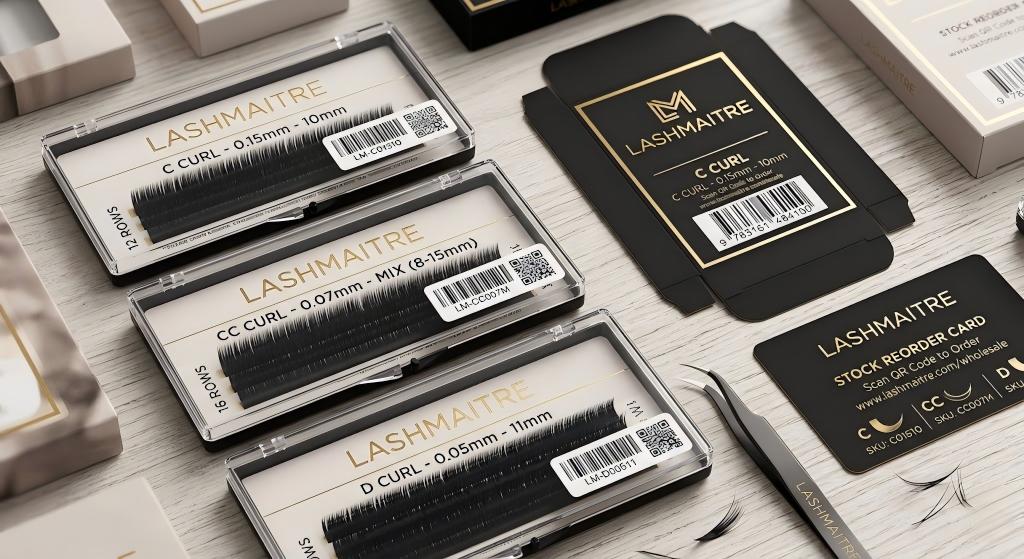
Use a simple structure:
| Field | Example |
|---|---|
| Product family | Classic |
| Curl | CC |
| Thickness | 0.15 |
| Length | Mixed 8-15mm |
| Finish | Matte black |
| SKU | CLS-CC-015-MIX |
| Label text | Classic CC 0.15 Mixed |
| Sample version | Approved sample V1 |
The ISO 9001 quality management systems standard is useful context for why documentation matters. In lash sourcing, a clear SKU and approved sample record help the buyer avoid reorder confusion.
Supplier and Sample Communication
The Shopify wholesale suppliers guide and Shopify manufacturer and supplier guide both reinforce a useful point for buyers: supplier selection should include communication, process and samples, not only price. For curl planning, that means sending a specific sample request.
A clear C/CC/D sample request can include:
- Product family.
- Three curl names: C, CC and D.
- One thickness for first comparison.
- One length format.
- Finish direction.
- Tray label draft.
- Private label packaging level.
- First order quantity range.
- Destination country and launch timing.
This makes the sample conversation faster and reduces the risk of comparing mismatched products.
Common Core Curl Mistakes
Avoid these mistakes before bulk ordering:
- Choosing only one curl because it is cheaper to start.
- Launching C, CC, D, M and L without demand data.
- Comparing different thicknesses and lengths during curl approval.
- Printing packaging before sample curls are confirmed.
- Using unclear curl labels that customer service cannot reorder.
- Treating curl as separate from product family.
The better process is controlled and boring in the best way: sample, compare, record, label, order, and then expand.
CTA
Send LASHMAITRE your target core curl range, product family, thicknesses, length format, sample plan, packaging level, first order quantity and launch date through the wholesale lash extensions inquiry path. We can prepare a controlled C/CC/D sample comparison before wholesale production.
C vs CC vs D Curl Lashes Quick Review
- Use C vs CC vs D curl lashes planning to create a focused first curl range.
- Use C vs CC vs D curl lashes planning to avoid too many slow-moving curl SKUs.
- Use C vs CC vs D curl lashes planning to keep tray labels and reorder files simple.
FAQ: C vs CC vs D Curl Lashes
Should I start with C, CC and D curl lashes?
Many buyers can start by testing C, CC and D because the three curls create a clear core range. A smaller launch may begin with two curls, but the buyer should still understand the role of each option.
Is CC curl necessary?
CC curl is useful when the buyer wants a middle option between C and D. It may not be necessary for every lean launch, but it can make a core range easier to explain.
Should D curl be in the first order?
D curl can belong in the first order if the buyer's target market needs a stronger curl option. It should still be tested under the same thickness and length conditions as C and CC.
How many curls should a private label startup launch?
A private label startup should keep the first curl range focused. Two or three core curls are often easier to manage than a wide curl catalog with uncertain demand.
What should I send when requesting curl samples?
Send product family, curl names, thickness, length format, finish direction, tray label wording, packaging level, sample quantity, first order range and destination country.
Buyer next step: Before turning C, CC and D curl selections into branded trays, review the private label lash extensions path for tray-card wording, packaging proofs and SKU consistency.
Buyer next step: C, CC and D curl comparisons should be tied to LASHMAITRE lash quality control so curl shape, row alignment, retention of curve and approved sample records stay consistent.

Lash Maitre: Your Trusted Partner in Eyelash extension Solutions
Lash Maitre is dedicated to providing professional insights and tips in the eyelash extension industry. Sharing the latest trends, techniques, and product knowledge, Lash Maitre helps lash artists and enthusiasts enhance their skills, stay inspired, and achieve the perfect lash experience.