EU Prostaglandin Lash Serum Safety: 2026 Private Label Buyer Guide
Share
Reviewed by the LASHMAITRE Sourcing & Quality Team · 29 August 2026
Quick Answer
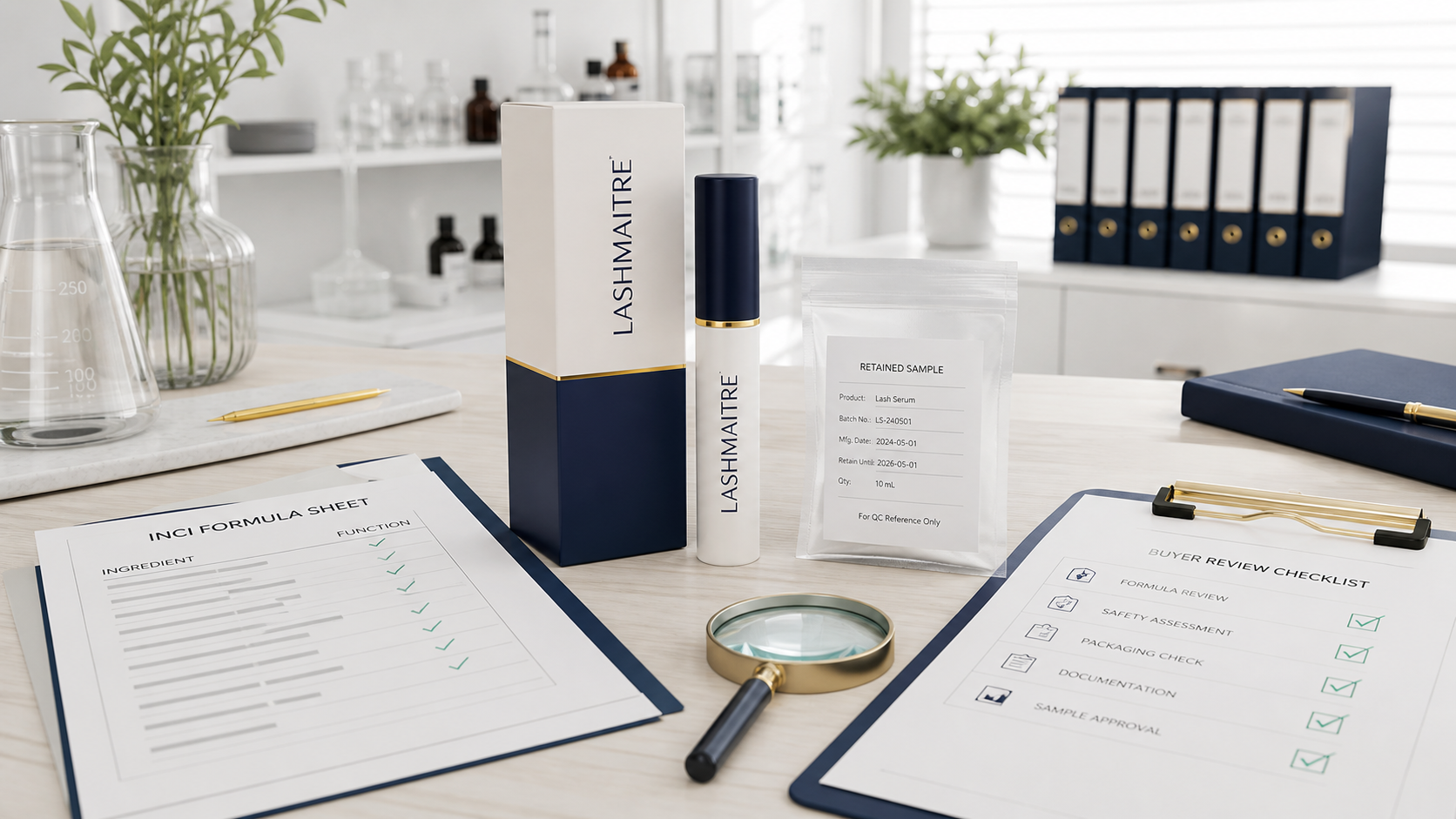
Prostaglandin lash serum EU safety is now a priority for private label buyers. The EU Scientific Committee on Consumer Safety concluded in final Opinion SCCS/1680/25 that none of the three assessed prostaglandin analogues could be considered safe for cosmetic products intended to promote eyelash or eyebrow growth. For private label lash serum buyers, this is a reason to pause formula approval, verify the complete INCI list and ask the EU Responsible Person or safety assessor to review the latest evidence before samples, labels or bulk production are approved.
The opinion is an expert scientific assessment. It should not be described as an automatic EU-wide ban or as proof that every lash serum is unsafe. The commercial action is more precise: identify the exact formula, screen the ingredients, document intended use and claims, and keep the safety and packaging file aligned with the product that will actually be sold.
What Did the EU SCCS Conclude in 2026?
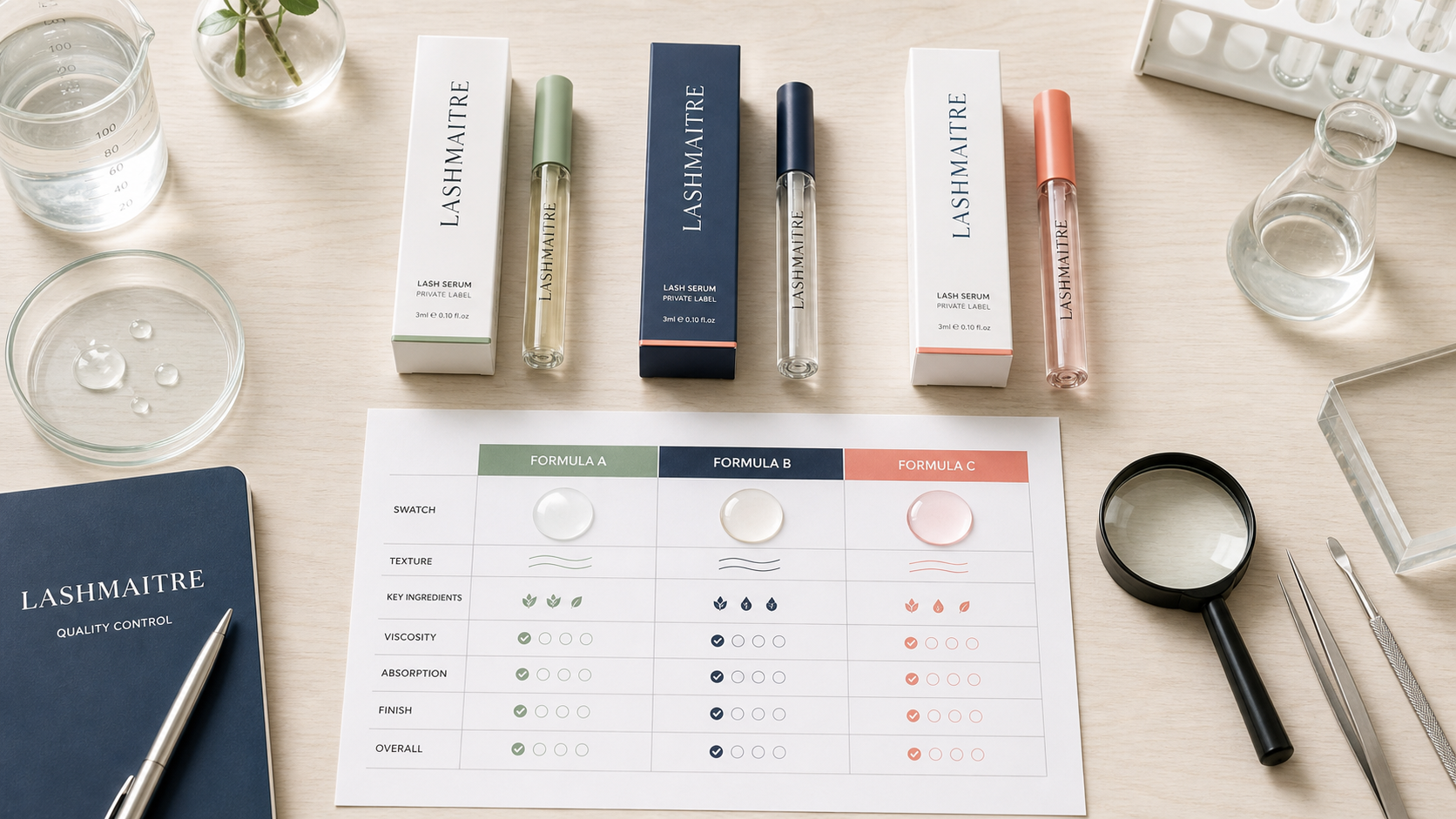
The European Commission published the final SCCS opinion on 10 February 2026 after it was adopted on 2 February 2026. The committee assessed three prostaglandin analogues used in cosmetic products intended to promote eyelash or eyebrow growth:
| Assessed substance | Common abbreviation | Private label buyer action |
|---|---|---|
| Methylamido-Dihydro-Noralfaprostal | MDN | Check the complete INCI and formula declaration rather than relying on a marketing name. |
| Isopropyl Cloprostenate | IPCP | Ask the safety assessor to review the exact concentration, exposure and intended use. |
| Dechloro Dihydroxy Difluoro Ethylcloprostenolamide | DDDE | Confirm ingredient identity, formula version and target-market assessment before approval. |
The SCCS stated that none of the three could be considered safe for the intended cosmetic use. Its reasoning referenced potent pharmacological activity, including at low concentrations, and insufficient evidence to exclude certain potential adverse effects. The committee also said it could not establish an alternative maximum concentration considered safe for the assessed use.
Read the European Commission's final SCCS opinion SCCS/1680/25 and the official SCCS opinions index.
Does the SCCS Opinion Mean Prostaglandin Lash Serums Are Already Banned?
Not by the opinion alone. The SCCS provides independent scientific advice to the European Commission. Its opinion is highly relevant to formula assessment and future regulatory decisions, but a buyer should not rewrite the conclusion as an enacted restriction without checking the applicable legislation and current annexes.
This distinction matters in supplier communication. Statements such as “EU approved,” “EU compliant” or “EU banned” should be supported by the exact legal and product context. A private label brand should ask its EU Responsible Person or qualified regulatory adviser to confirm the current status of the specific formula and the markets where it will be sold.
The EU Cosmetics Regulation requires a cosmetic product to have an appropriate safety assessment and an up-to-date Product Information File. The Regulation also gives particular attention to products used around the eyes and requires the Responsible Person to ensure compliance before market placement.
Why Prostaglandin Lash Serum EU Safety Matters for Private Label Buyers
Private label buyers often review a product name, sample performance, packaging appearance and quoted MOQ before seeing the controlled formula file. That sequence is risky for an eye-area cosmetic. A product can look commercially ready while the ingredient identity, claims, safety assessment or market status remains unresolved.
For a controlled prostaglandin lash serum EU sourcing decision, the 2026 SCCS opinion creates four immediate procurement questions:
- Does the proposed formula contain one of the assessed prostaglandin analogues or another ingredient with a similar identity?
- Does the supplied INCI list match the exact sample and formula version being quoted?
- Has a qualified assessor reviewed the finished product for its intended eye-area use and claims?
- Can the supplier support a different formula direction if the buyer or Responsible Person places the current formula on hold?
A general promise that a serum is “prostaglandin-free,” “natural,” “peptide-based” or “compliant” is not enough. The buyer still needs a complete formula review, safety substantiation and accurate claims for the finished product.
Private Label Lash Serum Formula Review Checklist
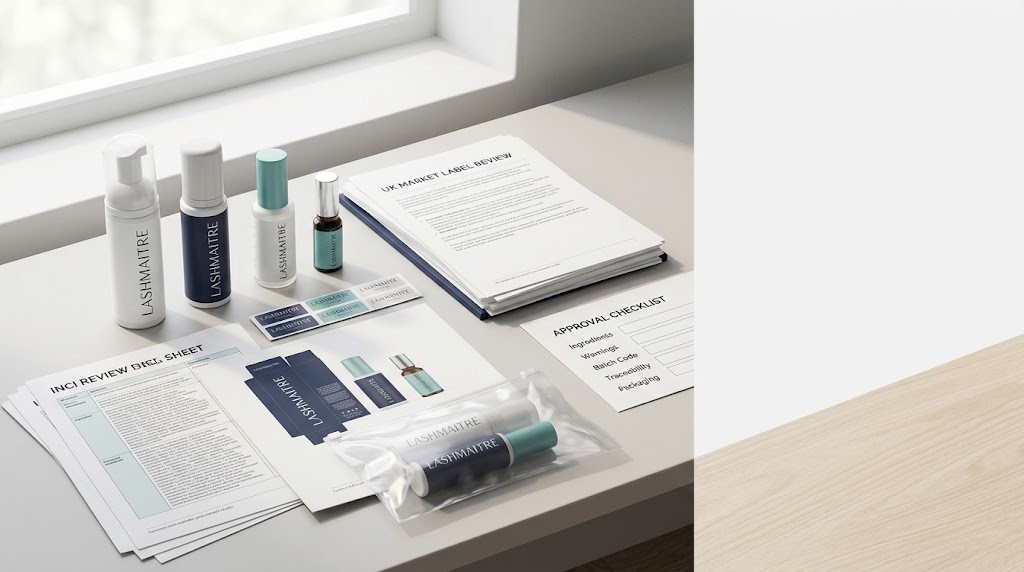
Use this prostaglandin lash serum EU review checklist before approving a sample, label proof or bulk production order.
1. Lock the exact formula version
Give the proposed formula a controlled code and version date. The physical sample, INCI declaration, safety documents, stability evidence and production order should all refer to that same version.
Do not approve a sample described only as “our standard lash serum.” If the supplier changes an active, preservative, extract, solvent or use level, the change should be recorded and reviewed before the sample remains approved.
2. Request the complete INCI list
Ask for the full ingredient list for the finished formula, not a partial marketing list. Check spelling, order and ingredient identity. Where an ingredient has multiple commercial or chemical names, the supplier should help connect the raw-material documentation to the finished-product declaration.
The buyer should not independently decide that a similar-looking name is or is not a prostaglandin analogue. Escalate uncertain ingredient identities to the Responsible Person, safety assessor or qualified regulatory specialist.
3. Define the intended use and claims
Record where the product is applied, how often it is used, whether it is intended to remain on the lash line and what the label promises. Claims such as “promotes growth,” “supports fuller-looking lashes,” “conditions” and “reduces breakage” are not interchangeable from a regulatory or evidence perspective.
The final claims should match the evidence reviewed for the actual formula. Packaging artwork should not introduce stronger claims after the safety and compliance review is complete.
4. Connect the safety file to the sample
The Cosmetic Product Safety Report and Product Information File should identify the same finished product that the buyer sampled. The file should reflect the quantitative and qualitative composition, intended use, exposure, physical and chemical characteristics, stability, microbiological quality, packaging and supporting claim evidence required for the specific product.
The European Commission's Cosmetics Regulation page provides the primary legal framework. Final responsibilities must be confirmed for the intended EU market.
5. Keep a retained sample and change log
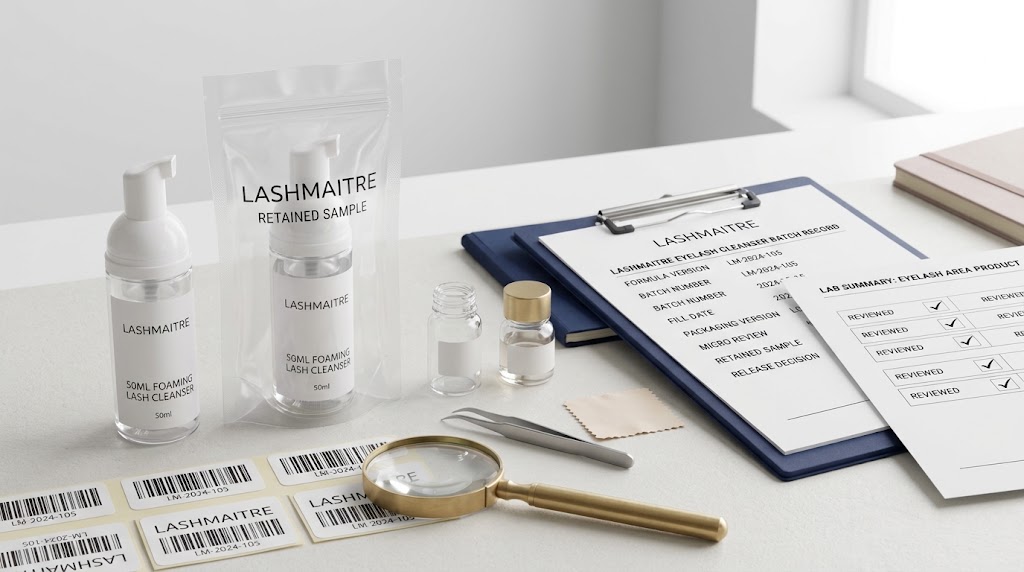
Retain an approved physical sample with the formula code, lot reference and approval date. Record every change to the formula, applicator, fill volume, primary container, label, carton and instructions.
This makes a reorder review possible. Without version control, a buyer cannot reliably confirm that the next batch matches the formula and presentation previously assessed.
Documents to Request From a Lash Serum Supplier
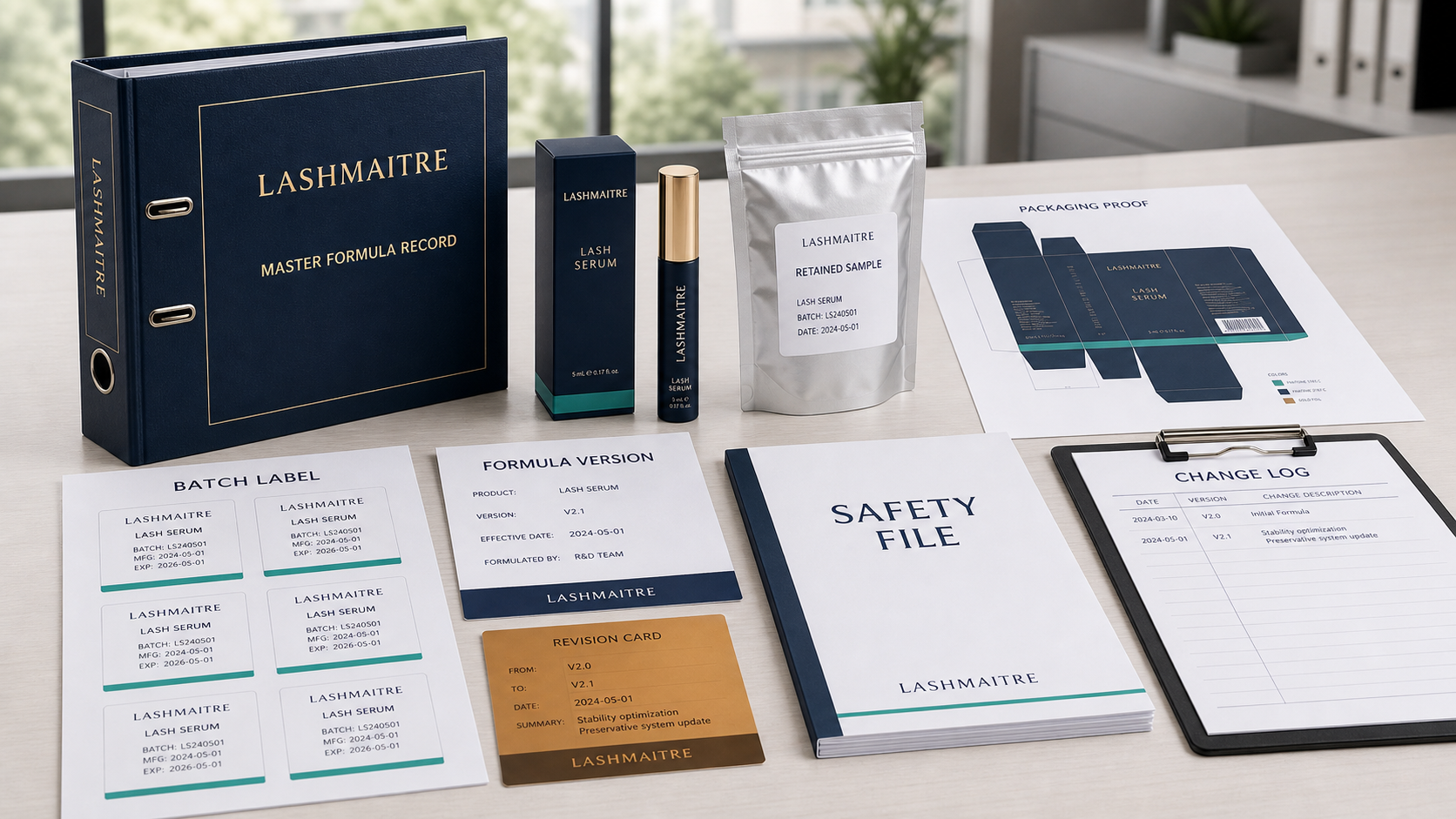
A prostaglandin lash serum EU documentation file should connect the exact sample to the formula, safety assessment, packaging and claims reviewed for the intended market.
| Evidence | What the buyer should verify | Stop condition |
|---|---|---|
| Formula declaration | Exact formula code and version | Formula is unnamed, partial or different from the sample |
| Complete INCI list | Finished-product ingredient declaration | Supplier provides only featured ingredients |
| Raw-material identity support | Trade name connects to chemical and INCI identity | An active ingredient cannot be clearly identified |
| Safety assessment support | Finished product and intended use are covered | Document applies to a different formula or use |
| Stability and compatibility evidence | Formula, applicator and container are assessed together | Packaging or formula changed after testing |
| Claim evidence | Label language matches available support | Growth or safety claims exceed the evidence |
| Retained sample reference | Sample, lot and approval date are traceable | No physical or batch-linked reference exists |
| Change log | Formula and packaging revisions are controlled | Old and new versions cannot be separated |
How to Compare a Prostaglandin and Non-Prostaglandin Formula Direction
The decision should not be reduced to “effective” versus “safe.” A non-prostaglandin formula still requires a complete safety assessment, compatible packaging, microbiological control and support for its claims. Likewise, a supplier should not present an ingredient as acceptable merely because it appears in products already sold online.
Use the following buyer comparison:
| Decision area | Formula containing an assessed PGA | Alternative formula direction |
|---|---|---|
| Ingredient review | Escalate identity and current regulatory status | Review every active and supporting ingredient |
| Claims | Check whether growth claims affect classification and evidence needs | Keep conditioning or appearance claims within available support |
| Safety assessment | Require specific eye-area and exposure review | Require the same finished-product safety discipline |
| Sample approval | Hold until the Responsible Person accepts the review path | Approve only after formula and claim evidence match |
| Packaging | Do not print while formula status is unresolved | Freeze artwork after formula, claims and warnings are approved |
This comparison helps a buyer avoid replacing one unsupported claim with another. The objective is a controlled, reviewable product file rather than a fashionable ingredient story.
Approve, Revise or Hold the Project
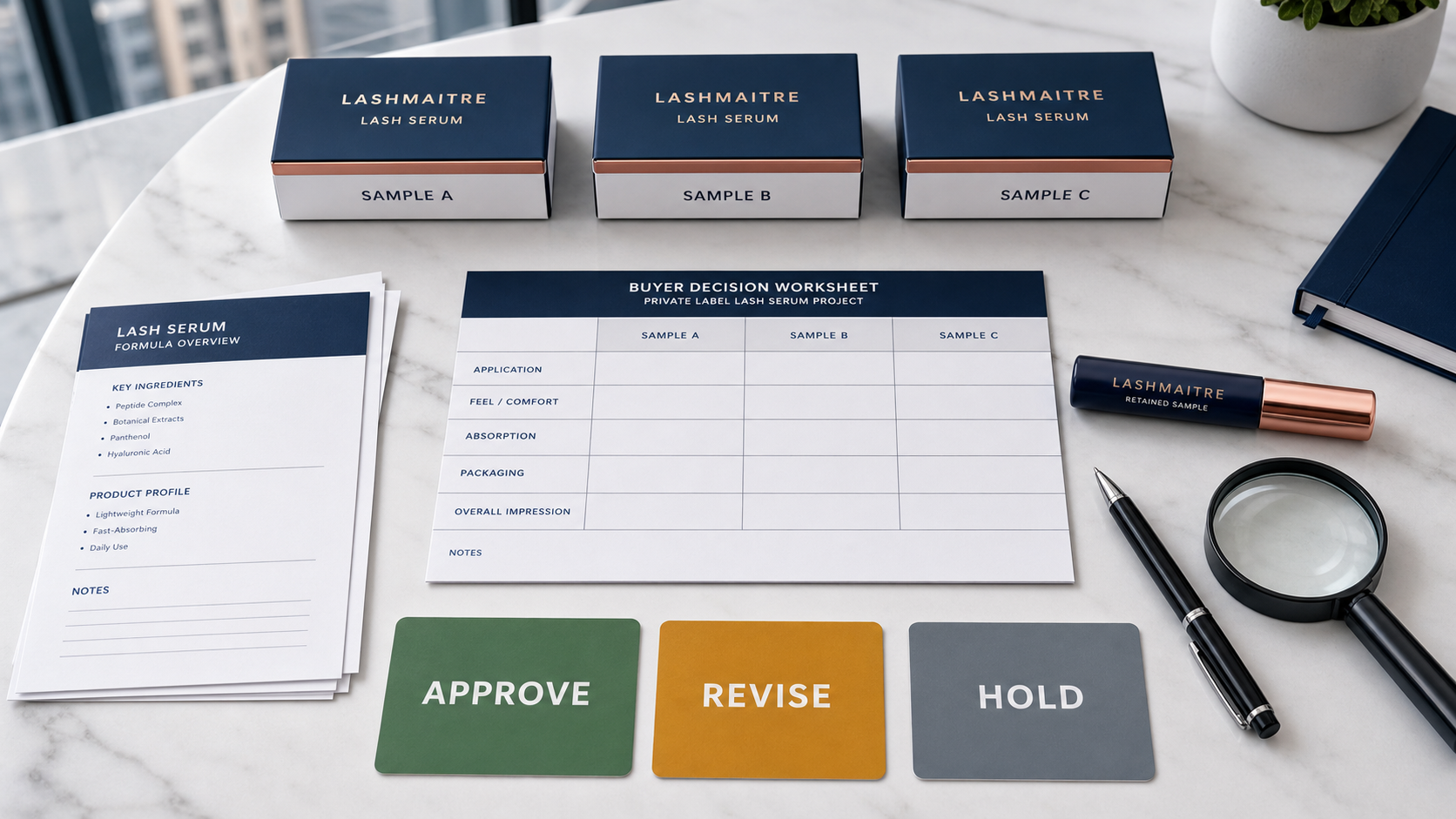
Approve when the exact formula, complete INCI, intended use, claims, safety assessment, packaging and retained sample all match, and the Responsible Person accepts the market path.
Revise when the supplier can provide a clearly identified alternative formula or correct missing documentation before artwork and materials are committed.
Hold when the ingredient identity is unclear, the sample does not match the documentation, the safety file covers a different formula, or the marketing claims exceed the available evidence.
For a wider sourcing review, compare this process with LASHMAITRE's private label lash extensions, lash glue and liquids and EU lash cleanser labeling guide.
Request a Private Label Formula and Documentation Review
Share your target market, intended claims, draft INCI list, packaging format and estimated quantity. LASHMAITRE can organize the sample, formula-version and supplier-document questions for your sourcing review.
Frequently Asked Questions
What did the EU SCCS say about prostaglandin lash serums in 2026?
SCCS Opinion SCCS/1680/25 concluded that none of the three assessed prostaglandin analogues could be considered safe for cosmetic products intended to promote eyelash or eyebrow growth.
Which prostaglandin analogues were assessed?
The final opinion assessed Methylamido-Dihydro-Noralfaprostal, Isopropyl Cloprostenate and Dechloro Dihydroxy Difluoro Ethylcloprostenolamide.
Did the SCCS opinion automatically ban every lash serum containing a prostaglandin analogue?
No. It is a scientific safety opinion, not by itself an enacted blanket ban. The Responsible Person or qualified adviser should confirm the current legal status and assessment of the specific formula.
Is a prostaglandin-free lash serum automatically compliant?
No. The finished formula still needs appropriate safety assessment, evidence for its claims, accurate labeling, compatible packaging and market notification where required.
What should a private label buyer request before approving a lash serum?
Request the controlled formula version, complete INCI list, ingredient identity support, finished-product safety evidence, stability and packaging compatibility records, claim support, retained sample reference and change log.
Official Sources
- European Commission: SCCS final Opinion SCCS/1680/25
- European Commission: SCCS opinions
- EUR-Lex: Regulation (EC) No 1223/2009
- European Commission: Cosmetics Regulation background
This article is a B2B procurement planning resource, not legal or medical advice. Product classification, safety assessment, Responsible Person duties, notification, claims and final labeling must be confirmed for the intended market and finished formula.

Lash Maitre: Your Trusted Partner in Eyelash extension Solutions
Lash Maitre is dedicated to providing professional insights and tips in the eyelash extension industry. Sharing the latest trends, techniques, and product knowledge, Lash Maitre helps lash artists and enthusiasts enhance their skills, stay inspired, and achieve the perfect lash experience.