12 Row vs 16 Row Lash Trays: 20 Row Buyer Guide
Share
Direct answer
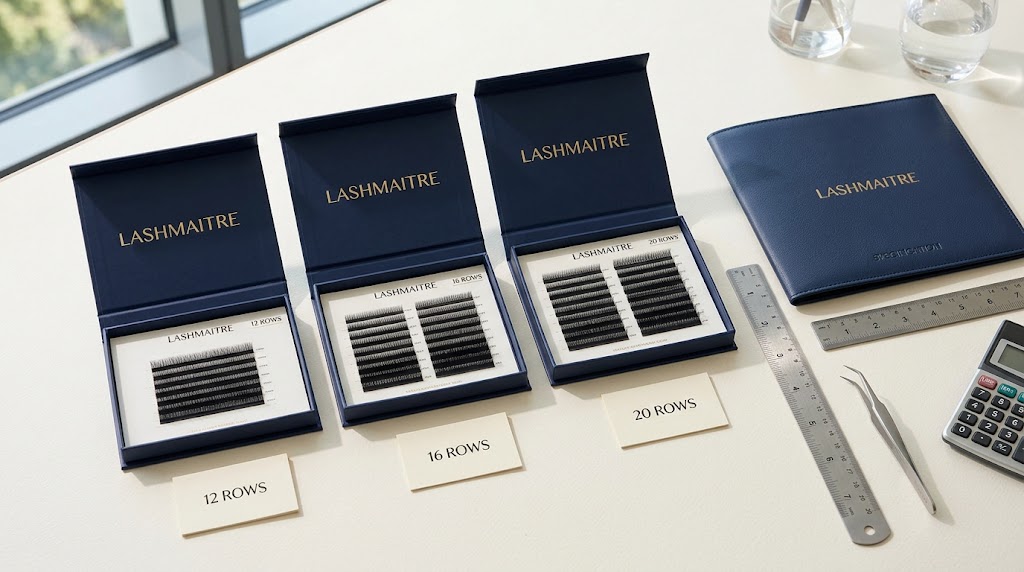
A lash tray row count is the number of adhesive lash strips supplied inside one eyelash extension tray. In a 12 row vs 16 row lash trays decision, 12 rows often suit focused tests, 16 rows balance capacity and pack size, and 20 rows maximize product per tray. Wholesale buyers should compare usable rows, cost per usable row, strip release, packaging fit, SKU labels and reorder consistency—not tray price alone.
Quick buyer verdict
- Choose 12 rows when a compact format or lower product quantity per SKU supports controlled testing.
- Choose 16 rows when you want a practical middle format for validated retail and salon SKUs.
- Choose 20 rows when the SKU is proven and added product capacity fits the packaging, shipping and price plan.
The right format is the one with the best cost per usable row after sample approval.
What does lash tray row count mean?
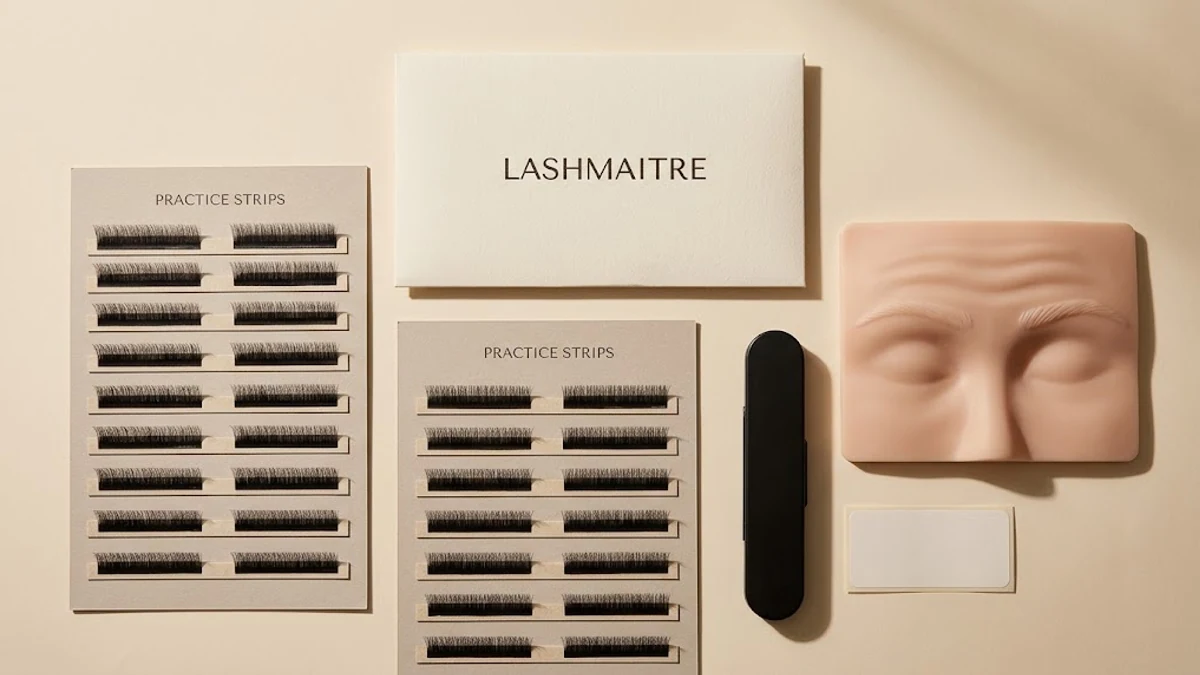
Lash tray row count describes how many horizontal lash strips are fitted to the tray card. It does not by itself confirm the number of fibers, fan count, usable product, strip length or overall value. Two trays labeled “16 rows” can still differ in strip fill, gaps, adhesive performance and defective rows.
For that reason, buyers sourcing wholesale eyelash extensions should record row count together with curl, diameter, length mix, fiber finish, strip type, tray dimensions, packaging version and approved sample code. A row-count choice should be treated as one line in the product specification, not as the whole specification.
12 row vs 16 row lash trays—with a 20 row option
| Buyer question | 12-row tray | 16-row tray | 20-row tray |
|---|---|---|---|
| Typical planning role | Controlled test or compact range | Balanced core format | High-capacity proven SKU |
| Product capacity | Lowest of the three | Middle | Highest of the three |
| Packaging space | Can support a smaller presentation | Requires a mid-size tray plan | Must be checked for depth, weight and closure |
| Inventory exposure per SKU | Lower | Medium | Higher |
| Best calculation | Landed tray cost ÷ confirmed usable rows | ||
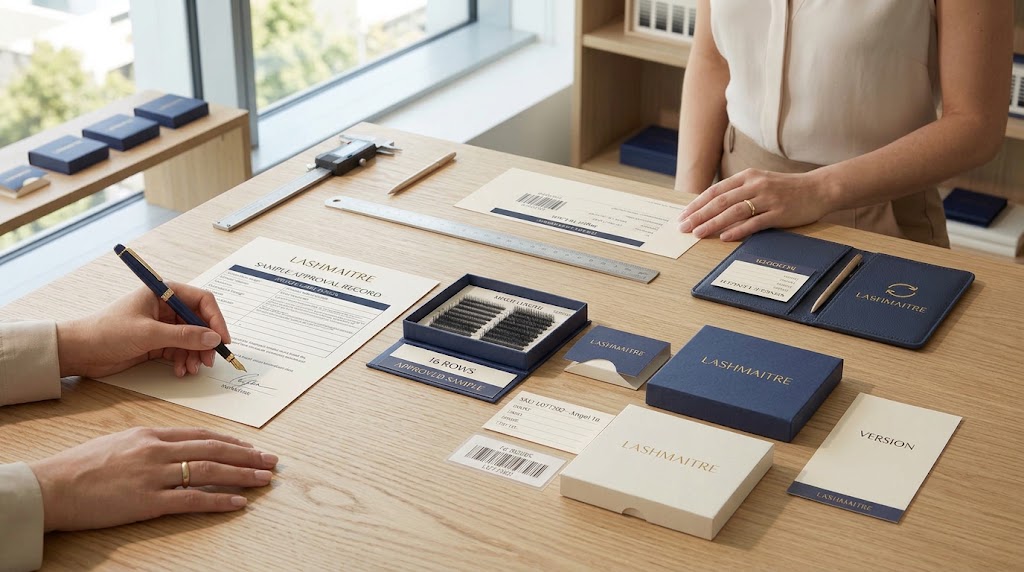
| Best approval evidence | Signed sample code, row count, strip test, artwork version and carton specification | ||
A 12-row tray is not automatically cheaper after freight, packaging and unusable strips are considered. Likewise, a 20-row tray is not automatically the best value if the larger pack raises dimensional weight, changes shelf presentation or ties up cash in slow-moving lengths.
For a new range, pair the comparison with an eyelash extension SKU planning guide. This prevents row count from being chosen independently of curl, diameter and length demand.
Calculate cost per usable row—not only cost per tray
The simplest buyer formula is:
Cost per usable row = landed cost per tray ÷ number of rows that pass inspection.
“Landed cost” should use the same scope for every supplier comparison. Depending on your quotation stage, that scope may include the tray, private label packaging, labels, inland transport, international freight and applicable import costs. “Usable rows” should exclude rows that fail the agreed specification or cannot be cleanly used.
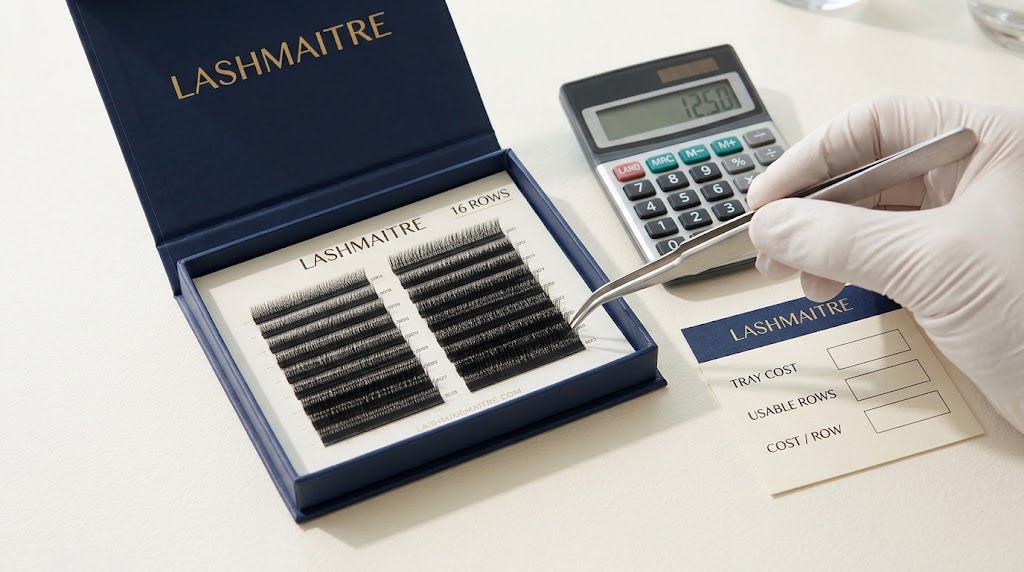
Example: if a tray is quoted with 16 rows but only 15 rows pass the agreed inspection, divide the landed tray cost by 15—not 16. Use the same method for 12-row and 20-row options. This gives a comparable decision metric without inventing a universal “best” tray format.
When comparing suppliers, place this formula beside the full quotation fields in a wholesale lash tray quote comparison.
Mixed-length and single-length trays use rows differently
Row count has different commercial meaning for a mixed-length tray and a single-length tray. A 16-row mixed tray divides its capacity across multiple lengths, while a 16-row single-length tray concentrates all rows in one length. The same printed row count can therefore support different inventory and service workflows.
For mixed-length trays
- Record the exact number of rows assigned to each length.
- Check whether high-use lengths receive enough rows.
- Keep the length map stable between the approved sample and reorder.
- Avoid vague labels such as “mixed” without a row allocation table.
For single-length trays
- Use sales or salon usage data to choose reorder depth.
- Separate fast-moving lengths from slow-moving lengths.
- Confirm that the tray label, SKU code and master carton use the same length.
- Set a reorder point before increasing from 12 to 16 or 20 rows.
Private label packaging, barcode and shipping checks
A higher row count can change the tray card, inner box and carton arrangement. Before approving a 20-row format, request the packed dimensions and gross weight rather than comparing an open sample alone. DHL explains that transport charges can use volumetric weight derived from package dimensions, so a larger retail pack may affect freight even when the product itself is light (DHL dimensional weight guidance).
Keep the SKU identity consistent across the tray card, retail box, barcode proof and carton label. GS1 distinguishes the data identifier from the barcode used to represent it; buyers should decide which product level needs its own identifier and barcode with their retail or logistics partner (GS1 barcode guidance).
Use the private label lash extensions workflow to lock packaging version, artwork proof and reorder reference after the physical sample passes.
Five sample checks before approving a row count
- Count the rows. Confirm the physical tray matches 12, 16 or 20 rows and record any incomplete strip.
- Inspect strip fill. Check gaps, alignment and whether the delivered assortment matches the approved length allocation.
- Test strip release. Remove strips from the tray card and check whether the backing releases cleanly and can be repositioned as required by the intended workflow.
- Verify fiber pickup. Test representative rows at the beginning, middle and end of the tray for consistent handling.
- Match every label. Compare curl, diameter, length, row count, SKU, barcode and artwork version across tray, box and carton.
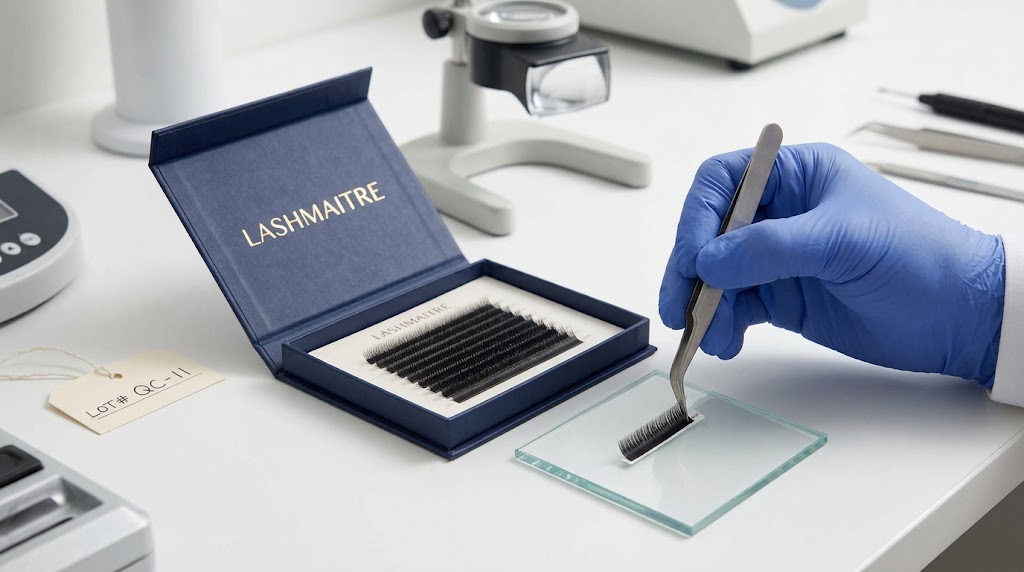
For incoming inspection, a buyer may define a documented sampling plan rather than checking units arbitrarily. ISO 2859-1:2026 describes acceptance sampling procedures by attributes; using the standard as a reference does not itself mean a product or supplier is ISO certified (ISO 2859-1:2026 overview).
Use a traceable lash extension sample and the lash quality control checklist to record the result before bulk approval.
Which row count should each wholesale buyer choose?
New lash brand or first supplier test
Start with the smallest format that still demonstrates the intended customer experience. A 12-row tray can be useful, but only if the sample uses the final fiber, strip, tray card and packaging specifications. A temporary sample format cannot validate a different production format.
Salon, academy or lash artist supply store
A 16-row format can balance working capacity and pack size when the SKU is already validated. For mixed trays, prioritize the length allocation used most often by the target customer instead of distributing rows evenly without evidence.
Established distributor or proven hero SKU
A 20-row format can improve capacity per retail unit when sell-through, package dimensions and unit economics support it. Confirm the larger format will not create slow stock across low-demand curls or lengths.
MOQ 50 private label launch
Use MOQ 50 wholesale lash extensions as a structured validation batch. Split the plan by approved SKU and business purpose; do not expand every test SKU to the highest row count at the same time.
What to send with a wholesale lash tray inquiry
- Product type: classic, volume, premade fan or other format
- 12, 16 or 20 row preference
- Mixed-length allocation or single length
- Curl, diameter, length range and fiber finish
- Strip backing and release requirements
- Tray card, retail box and carton dimensions
- SKU and barcode plan
- Target quantity, MOQ plan and destination country
- Approved sample or reference code, if available
Send these fields through the wholesale lash extensions inquiry page. A complete brief allows the supplier to compare tray formats against the same specification.
Frequently asked questions
Are 20 row lash trays always better value?
No. A 20-row tray carries more rows, but value depends on usable rows, strip quality, packaging cost, freight, sell-through and SKU demand. Compare landed cost per usable row and approve the physical sample before choosing the highest-capacity format.
What is the best lash tray row count for samples?
There is no universal sample row count. A 12-row tray can limit test quantity, but the sample must still match the proposed production fiber, strip, tray card and packaging. If the production order will use 16 or 20 rows, confirm that format before final approval.
Can I mix 12, 16 and 20 row trays in one wholesale order?
Potentially, if the supplier accepts the SKU and packaging plan. Use smaller formats for controlled tests and higher-capacity formats for proven SKUs, then confirm MOQ allocation, packaging dimensions, SKU codes and carton labels before quotation.
How do I compare two lash trays with the same row count?
Count usable rows, inspect gaps and strip fill, test release and pickup, verify the length allocation, and compare landed cost per usable row. Also confirm tray dimensions, label accuracy, packaging version and the approved sample reference.
Should mixed-length and single-length trays use the same row count?
Not necessarily. Mixed trays distribute rows across several lengths, while single-length trays concentrate every row in one SKU. Choose the format using expected demand by length, customer workflow, reorder frequency and the physical packaging specification.
Final recommendation
Use the 12 row vs 16 row lash trays comparison as a starting point, then add the 20-row option only after checking usable-row economics and packaging fit. For wholesale buying, the safest decision is the format that passes the sample test, matches the SKU plan and can be reordered from a locked specification.
Next step: request a physical tray sample and send your row count, length allocation, packaging and target quantity through the LASHMAITRE inquiry form.

Lash Maitre: Your Trusted Partner in Eyelash extension Solutions
Lash Maitre is dedicated to providing professional insights and tips in the eyelash extension industry. Sharing the latest trends, techniques, and product knowledge, Lash Maitre helps lash artists and enthusiasts enhance their skills, stay inspired, and achieve the perfect lash experience.