Lash Packaging Sleeves Wholesale: 8 Buyer Checks
Share
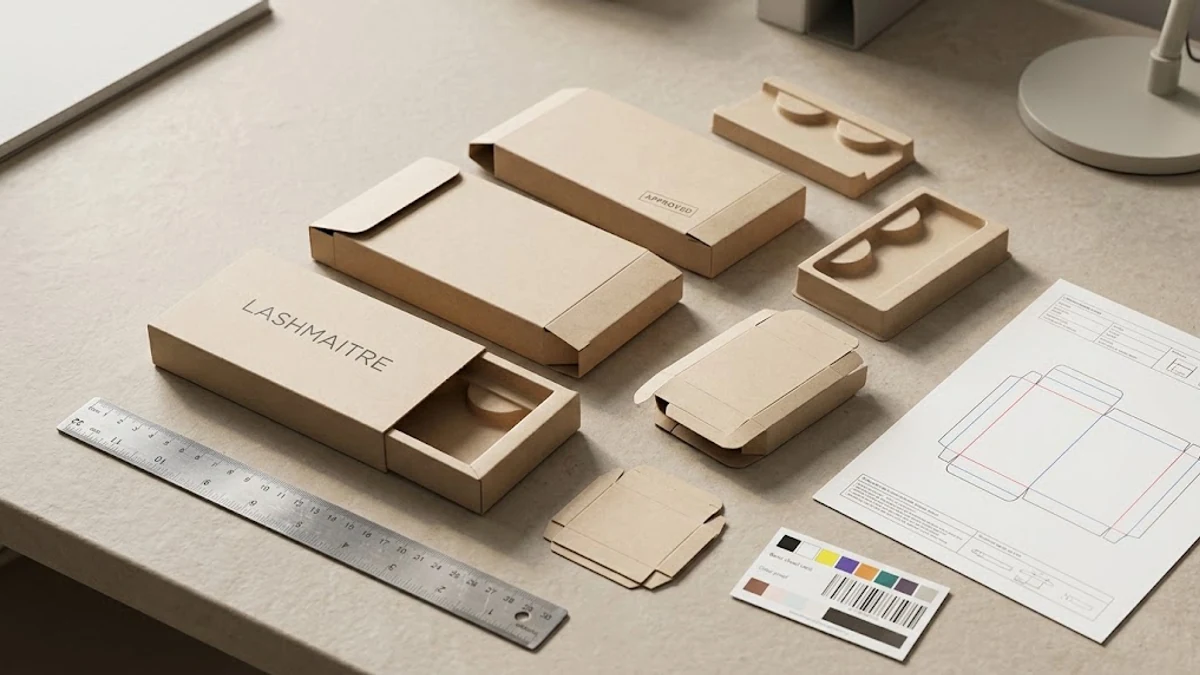
Lash packaging sleeves wholesale orders should be approved by the inner pack they fit, the sleeve structure, finished dimensions, material, print file, retail data area, physical proof, transit pack and reorder version. A sleeve can add a branded retail face to a stock tray or inner box, but it works only when the assembled product slides, closes, displays and ships as intended.
This guide is for lash brands, distributors, salons and ecommerce sellers sourcing custom lash box sleeves. It owns the narrow outer-sleeve specification and approval task. The broader Custom Lash Packaging page remains the parent guide for complete boxes, inserts, labels and product-packaging programs.
Lash packaging sleeves wholesale: quote-ready specifications
| Buyer field | What to define | Sample check | Approval record |
|---|---|---|---|
| Inner pack | Exact tray, carton or drawer code | Fit the real production-equivalent item | Inner-pack reference |
| Sleeve style | Open ends, partial wrap or named structure | Assemble and remove as intended | Structure drawing |
| Dimensions | Finished inside width, depth and height | Measure the assembled sample | Dimension sheet |
| Material | Board or paper reference and color | Compare stiffness, surface and opacity | Material code |
| Artwork | Dieline, panels, orientation and revision | Match proof to released file | Signed artwork proof |
| Retail data | Product name, SKU and barcode zone | Read and scan the final print | Data matrix |
| Pack-out | Units per inner and master carton | Count and inspect arrival condition | Packing instruction |
| Reorder | Sleeve SKU, version and change notice | Compare with retained sample | Reorder record |
A lash packaging sleeves wholesale specification must describe the finished object around the approved inner pack. A flat dieline alone does not prove fit, opening force, panel alignment or protection in distribution.
1. Name the sleeve's job and sales channel
Decide whether the sleeve provides branding around a plain tray, groups an inner drawer, carries retail data or creates a temporary campaign version. Record the intended channel: salon shelf, distributor sample room, ecommerce parcel or another named route. That decision controls which panels must remain visible and how the pack will be handled.
Keep the sleeve separate from the product and inner pack in the specification. A change to tray depth, insert height or carton coating can change the sleeve fit even when the artwork stays the same. Assign separate codes to the inner pack, sleeve and completed sales unit.
2. Define the structure before artwork
Describe which ends are open, where seams and folds sit, which panel is the retail front and how the buyer opens the pack. Ask for a structural drawing or dieline that identifies cut lines, crease lines, glue areas and panel names. Confirm which dimensions are finished inside dimensions and which belong to the flat blank.
For lash packaging sleeves wholesale sourcing, do not select a sleeve only from a rendered image. Two structures can look similar on screen but assemble differently or hide different parts of the inner pack. Use the intended lash tray, box or drawer during structural approval.
3. Measure the actual product-and-pack combination
Measure representative inner packs at several points and note any lid, tab, label or wrap that increases the maximum profile. Define the desired fit by observed use: the sleeve should stay in place during normal handling while still opening without crushing the inner pack. The supplier should propose production tolerances against the actual material and structure rather than an invented universal gap.
Review lash packaging sleeves wholesale samples after the inner pack is fully loaded. An empty carton can flex differently from a completed retail unit. Check panel bowing, corner damage, scraping, accidental opening and whether the product identity remains readable.
4. Release production-ready artwork on the approved dieline
Build artwork only after the structure and panel orientation are confirmed. Record the production file name, revision, color references, finish, print sides and any window or cutout. Ask the printer for its current file, bleed, safe-area, font and image requirements instead of copying dimensions from another supplier.
Mark every variable field, including product name, curl or style family, SKU, country-specific information and version code. Use the Lash Packaging Artwork Proof Checklist to compare the released file with the printed proof before bulk approval.
5. Reserve and verify retail data space
Decide whether the sleeve or the inner pack carries the product identifier, barcode, lot or other operational data. Avoid placing essential data across a fold, seam or highly reflective area. Confirm the exact data owner so a supplier does not invent, reuse or silently change a code.
GS1 US recommends checking barcode print quality, placement, contrast and size on the actual package. Reserve a smooth area with clear space around the symbol and test the printed result. Use the official GS1 US barcode placement and printing guidelines with the buyer's approved data and retailer requirements.
6. Approve a physical assembled proof
Approve a production-equivalent sleeve around the intended inner pack. Inspect fit, squareness, folds, seams, edge condition, color, finish, text, barcode, opening sequence and panel alignment. Photograph all sides, record measurements and sign the exact sample or sample code.
| Release checkpoint | Pass evidence | Hold reason | Owner |
|---|---|---|---|
| Inner-pack identity | Correct approved item is fitted | Substitute or old version | Purchasing |
| Fit and opening | Repeated assembly and opening work | Crush, slip or excessive friction | Packaging |
| Dimensions | Measurements match released sheet | Unexplained deviation | QC |
| Copy, orientation and color match proof | Wrong panel or version | Brand | |
| Barcode/data | Final printed code and text verify | Scan or data mismatch | Data owner |
| Surface | Named finish is clean and repeatable | Rub, scuff or glue mark | Packaging |
| Pack count | Inner and master counts agree | Mixed or short pack | Logistics |
| Version | Unit and carton carry released code | Obsolete sleeve mixed in | Purchasing |
7. Test the completed pack for its distribution route
Inspect the product, inner pack, sleeve and shipping carton as one completed system. Define the expected route and the damage or appearance limits that cause a hold. A sleeve that looks good on a desk may still scuff, slide or deform when units rub inside a carton.
Select any formal transport test according to the actual packaged product and distribution environment. ISTA notes that procedures range from screening tests to general simulations and that the correct procedure depends on the intended outcome. Use the official ISTA test-procedure guidance with a qualified packaging partner when formal testing is required; do not attach packaged-product certification wording to a material alone.
8. Send a controlled quote and reorder brief
For a lash packaging sleeves wholesale quote, send the inner-pack sample or code, structure drawing, finished dimensions, material and finish, artwork revision, variable-data matrix, quantity, pack-out, destination and requested sample stage. Ask the supplier to disclose any proposed substitution before production and state how change approval will be recorded.
Use Wholesale Lash Extension Samples to review the sleeve with the real product, connect the brand system through Private Label Lash Extensions, and send the controlled brief through the wholesale inquiry. Current availability, sample cost, MOQ, price and lead time must be confirmed for the exact project.
FAQ
What should a lash packaging sleeve specification include?
Include the inner-pack code, sleeve structure, finished inside dimensions, material, finish, artwork revision, retail-data zone, physical-proof method, pack count and reorder version.
Is a sleeve the same as a complete lash box?
No. A sleeve is the outer wrap or sliding component around a tray, drawer or inner carton. The completed sales unit may contain several separately controlled packaging components.
Should buyers approve the sleeve before the lash tray or inner box?
Approve the product and inner-pack dimensions first, then test the sleeve around a production-equivalent completed pack. A later inner-pack change can require a sleeve fit review.
What should be retained for a sleeve reorder?
Keep the structural drawing, dimension sheet, material and finish codes, released artwork, data matrix, signed physical sample, packing instruction, carton marks and change history.
Approve the sleeve as part of a completed sales unit
A repeatable lash packaging sleeve links one inner pack to one structure, one artwork version and one physical approval record. That gives the brand a visible retail layer without losing control of fit, data or reorders.

Lash Maitre: Your Trusted Partner in Eyelash extension Solutions
Lash Maitre is dedicated to providing professional insights and tips in the eyelash extension industry. Sharing the latest trends, techniques, and product knowledge, Lash Maitre helps lash artists and enthusiasts enhance their skills, stay inspired, and achieve the perfect lash experience.