Volume vs Mega Volume Lash Extensions: What Buyers Are Comparing
Share
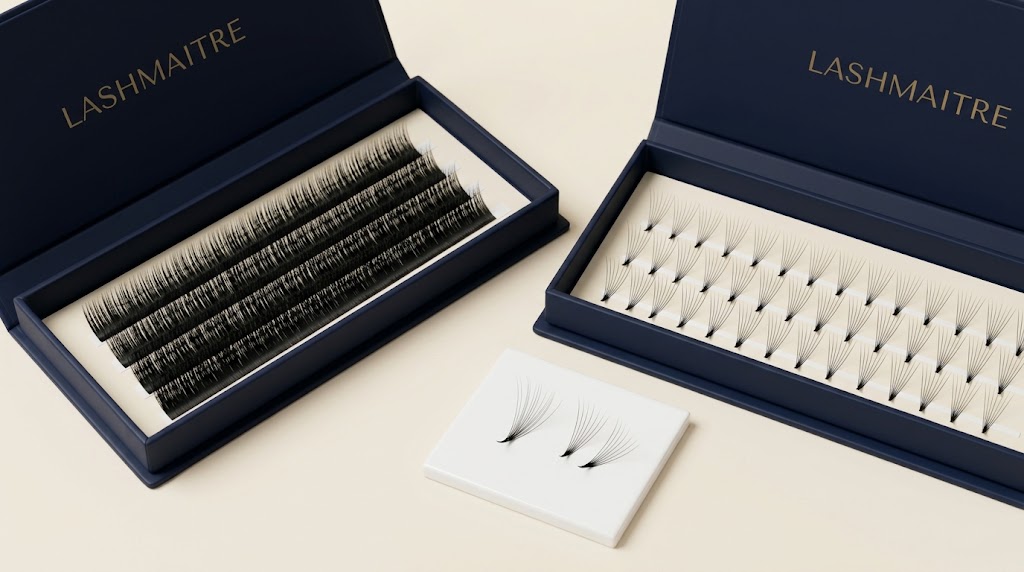
Volume vs mega volume lash extensions is primarily a comparison of density positioning within volume lashing, but the names alone do not specify what comes in a tray. A wholesale buyer should separate the intended look from the supplied format, then compare fiber diameter, length, curl, fan construction and quantity on the same basis.
Images in this guide are AI-generated illustrations, not production or QC records. Confirm actual product specifications with your supplier.
Ordering a product called “mega volume” does not, by itself, tell you whether you will receive individual fibers for handmade fans or ready-made fans. It also does not establish a universal D-count, application method or suitability for a particular natural lash. Those are separate questions.
This guide is for buyers comparing product listings and sample requests—not a treatment or application guide. Start with the existing wholesale eyelash extension range when you need the broader product categories.
What does volume vs mega volume mean in a catalog?
In typical product language, mega volume refers to a denser volume look. It is not enough information to identify a purchasable SKU. London Lash’s volume supplies guide discusses fine fibers for volume work, while its Chelsea 0.05 mega volume product is sold as lash fibers in trays. That manufacturer example shows why the word “mega” should not be read as “premade.”
Do not turn one manufacturer’s naming convention into a rule for every supplier. Ask each supplier what its label means and have that explanation tied to the sample code. Two catalogs may position similar products differently; comparing the actual specification is more useful than comparing the category headline.
Use two axes: intended density and supplied format
The first axis describes the intended look. The second describes the product the buyer receives. Keep them separate in your purchasing file.
| Decision | What it tells you | What it does not tell you |
|---|---|---|
| Volume or mega-volume positioning | How the range is described to the target audience | Exact fiber diameter, D-count or quantity |
| Individual fibers for handmade fans | Fans are not supplied as completed units | A guaranteed finished density or application outcome |
| Premade fans | Completed fan units are supplied | Whether the brand calls them volume or mega volume |
| Curl, length and diameter specification | The nominal dimensions being requested | That different suppliers’ samples will look identical |
| Fan construction and tray quantity | What must be compared and counted for a fan product | A universal measure of quality or treatment suitability |
If you are still deciding between standard volume fibers, easy-fanning products and premade fans, use the separate standard volume tray buying guide. Do not use “mega volume” as a substitute for making that format decision.
Does a higher D-count settle the comparison?
No. D-count identifies how many fibers make up a fan. It does not capture every feature of that fan or a finished set. For a volume vs mega volume procurement comparison, ask for the D-count alongside nominal fiber diameter, length, curl, spread and base description.
A photograph of a narrow fan and a photograph of a wider fan are not a controlled comparison simply because their D-counts match. Different lengths, lighting, camera angles and backgrounds can also make a sample appear more or less dense. Request consistent photographs, then inspect the actual samples rather than approving a range from the darkest-looking image.
Keep the detailed decision about which D-counts to stock in the premade fan D-count selection guide. Here, the purpose is narrower: prevent a marketing name from replacing the order specification. Neither D-count nor diameter alone establishes a safe application load; application decisions belong with appropriately trained professionals and applicable product instructions.

Volume vs mega volume: seven quotation checks
Use one row per proposed SKU. Write “not specified” where information is missing rather than filling gaps from the product name.
| Field | What to record | Why the comparison needs it |
|---|---|---|
| Supplier and sample code | Identifiable product reference | Connects a quotation to the correct physical sample |
| Supplied format | Individual fibers or completed fans | Prevents comparing unlike units |
| Nominal dimensions | Diameter, curl and length or length mix | Makes specification differences visible |
| Fan details, when applicable | D-count, spread and base description | Separates fan structure from density branding |
| Sale unit | Trays, rows or stated fan count | Identifies what the quoted price actually covers |
| Packaging scope | Stock pack or a separately quoted customization | Prevents packaging differences hiding in the comparison |
| Unresolved items | Any specification awaiting confirmation | Stops an assumption becoming an approved order |
For example, a hypothetical Quote A might offer one tray of individual fibers under a “mega volume” label. Quote B might offer a counted tray of premade fans under a “volume” label. Dividing both prices by one tray would not create an equivalent comparison: the contents and the preparation work are different. This is an illustration, not a LASHMAITRE price or product offer.
Write a sample request that can be answered
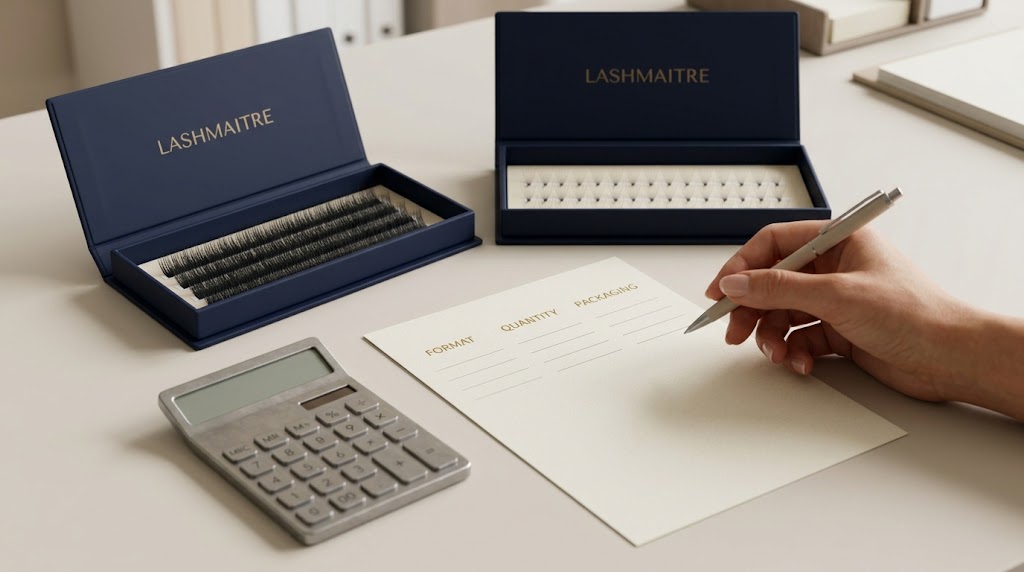
Replace “send your best mega volume” with a defined request. State the supplied format you want, the intended range position, nominal dimensions and the quantity basis you need confirmed. If you want to compare two options, identify which variable changes and which specifications should remain the same.
A concise buyer request could read:
Please confirm available volume products in our requested format. For each candidate, provide the sample code, diameter, curl, length format and tray quantity. For premade fans, also identify D-count and base construction. List any differences from our request before quoting samples and packaging separately.
Use the lash extension samples page to organize the next step. Available configurations, sample charges, minimum quantities and lead times must be confirmed for the actual request; the density name does not establish those terms.
For buyers comparing two commercial density positions, use the light volume vs full volume lash extensions buyer checklist to define format, fan construction, D-count, spread, base, tray quantity and sample code.
Buyer FAQs: volume vs mega volume
Is mega volume always a premade fan?
No. Mega volume can describe a density position for products supplied as individual fibers as well as completed fans. Confirm the supplied format separately from the range name.
Is there one D-count that defines mega volume for every supplier?
Do not assume a universal cutoff. Ask the supplier to define its naming and provide the actual fan specification, rather than using the word “mega” as the order specification.
Can I compare volume and mega volume by price per tray?
Only after identifying what each tray contains. Format, nominal dimensions, quantity and packaging scope may differ. A tray of loose fibers and a tray of completed fans are not interchangeable quote units.
What should be included in a volume lash sample request?
Include supplied format, intended range position, diameter, curl, length format and quantity basis. Add fan construction details for premade products and identify any packaging requirements separately.
Next step in volume vs mega volume sourcing
Send your required format and proposed specifications through the wholesale lash extensions inquiry. Ask for availability and comparable sample options before choosing a volume or mega-volume product label for your catalog.

Lash Maitre: Your Trusted Partner in Eyelash extension Solutions
Lash Maitre is dedicated to providing professional insights and tips in the eyelash extension industry. Sharing the latest trends, techniques, and product knowledge, Lash Maitre helps lash artists and enthusiasts enhance their skills, stay inspired, and achieve the perfect lash experience.



