Eyelash Extension Swatch Book Wholesale: 8 Buyer Checks
Share
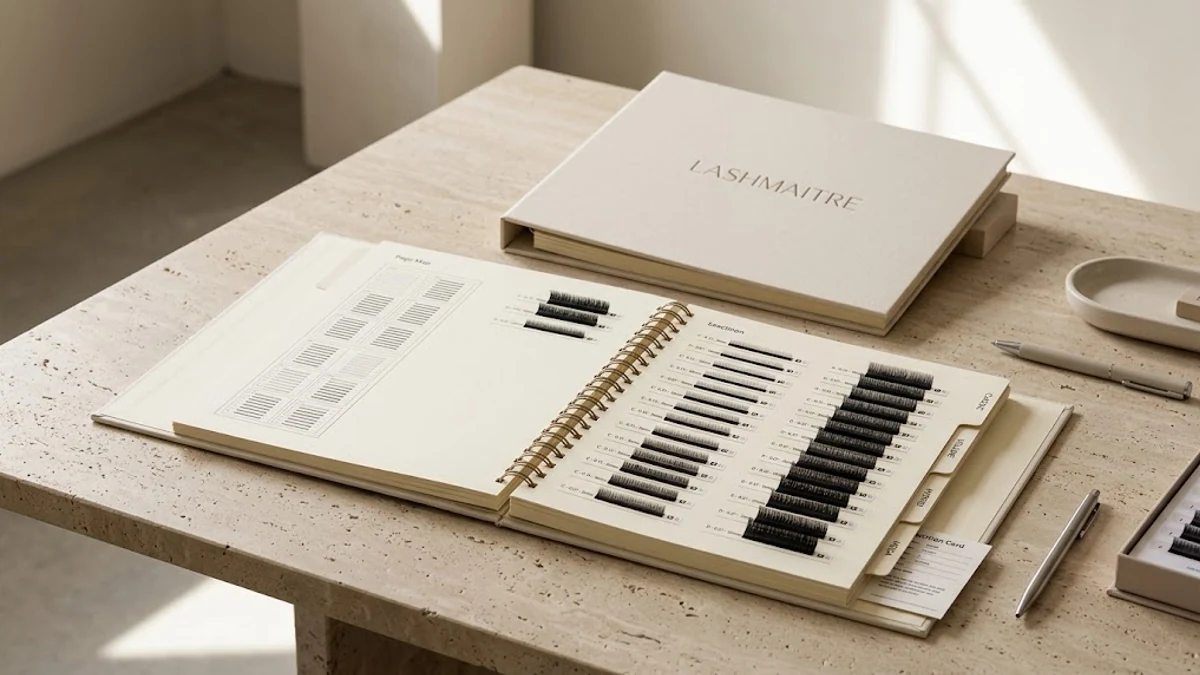
An eyelash swatch book wholesale order should be approved as a controlled sales-sample system: define the product range, specimen identity, page sequence, mounting method, labels, protection, physical sample, replacement rules and reorder version. The book helps a buyer present and compare a range, but it does not replace tray testing or decide which curl, diameter or length is suitable for a client.
This guide is for lash manufacturers, brands, distributors and academies building a physical lash extension sample book. It owns the book, its mounted specimens and its revision record. The existing curl guide and sample-set pages continue to own product-selection and curl-comparison intent.
Eyelash swatch book wholesale: quote checklist
| Buyer field | What to define | Sample check | Approval record |
|---|---|---|---|
| Audience | Distributor, sales team, academy or brand buyer | User can find the intended range | Use statement |
| Range map | Families, curls, diameters, lengths and colors included | Every specimen has a source SKU | Range matrix |
| Page sequence | Sections, tabs and comparison order | Navigate the physical book | Page map |
| Specimen | Exact lash sample and retained source | Compare with approved tray | Specimen code |
| Mounting | Card, strip, pocket or other named method | Handle pages without release or damage | Mounting record |
| Label | Display name, specs, SKU and version | Text matches product master | Label matrix |
| Protection | Cover, closure, sleeves and transit pack | Inspect after handling and shipment | Pack specification |
| Reorder | Book code, edition and replacement method | Reconcile pages to active range | Revision history |
An eyelash swatch book wholesale sample is not useful when the displayed lash cannot be traced to an active SKU. Build the range matrix first, then design the object around it.
1. Define the user's decision task
Write what the book helps a user do: introduce a brand range, compare visible product families, support a distributor meeting or organize academy references. Identify who carries it, where it is opened and whether customers may touch the pages. These conditions affect size, closure, page stiffness and replaceability.
Keep the promise narrow. The swatch book presents controlled specimens and identifiers. It should not claim that visual inspection alone proves pickup, strip release, curl retention or application performance. Those decisions belong in a product sample and test record.
2. Build a range and page architecture
For an eyelash swatch book wholesale brief, create a page map before artwork. Group the range by a buyer-friendly hierarchy such as product family first, then curl, diameter, length or color. Avoid mixing several classification systems on the same page unless the comparison purpose is explicit.
Assign every page, panel and specimen position a stable reference. Leave planned space for expansion rather than crowding late additions into an approved layout. A replaceable-page format may suit a changing range, while a fixed edition may suit a stable launch collection; choose based on change frequency, not appearance alone.
3. Tie every specimen to a controlled source
Record the source tray SKU, lot or sample reference, declared specifications, preparation date and person who mounted each specimen. The display name in the book must reconcile with the product master and current retail or wholesale naming. Do not mount visually similar leftovers without traceability.
Use a retained source tray or coded specimen envelope so the book can be checked later. The Lash Extension Samples process provides the product approval path; this page adds the physical presentation and replacement record.
4. Specify mounting, spacing and protection
Define how lash fibers, strips or mini samples attach to the page and what contact the user is allowed to make. Record card stock, page surface, specimen spacing, adhesive or fixture system, protective overlay and any pocket or removable component. The chosen method should keep adjacent specimens from touching or transferring residue during expected handling.
Test eyelash swatch book wholesale samples with the actual specimen and page material. Inspect alignment, release, page flex, cover pressure and whether labels remain visible when the book is open. If a specimen is meant to be removed, define how it is replaced and how an empty position is marked.
5. Control labels, terminology and edition data
Build one data table for all visible labels. Include only fields that can be maintained accurately, such as product family, curl, diameter, length, color, finish and SKU. Use the same names and units found in the approved product record. Add the book edition and page version where staff can verify them.
Do not use an unqualified specimen to support a product-performance or safety claim. If a page contains technical or marketing copy, name its evidence owner and approval date. Connect brand presentation to Private Label Lash Extensions while keeping each specimen tied to its own SKU.
6. Approve handling, navigation and appearance
Ask intended users to find several named specimens without coaching. Check tab order, label readability, page turning, closure, carrying comfort, surface marks and whether the book remains flat enough for comparison. Review the same sample under the normal meeting or showroom lighting.
Photograph each approved spread in page order. Those images become an assembly and incoming-inspection reference, not a substitute for the physical sample. Record permitted appearance variation and the defects that trigger replacement.
7. Inspect a representative sample and the completed pack
Define the inspection unit: one completed book, one page, one label or one mounted specimen. Set objective defect categories for missing items, wrong identity, damaged fibers, detached specimens, unreadable labels, page-order errors and cover defects. When a lot sampling plan is used, record the standard, inspection level and acceptance decision instead of writing only "AQL passed."
ISO describes ISO 2859-1:2026 as a lot-by-lot attribute inspection system using AQL-indexed sampling schemes. Use the official ISO 2859-1 record with qualified quality staff when that standard is specified. It does not decide the product specification or make every defect acceptable.
Place the receiving result in the Lash Extension Quality Control Checklist so the book edition, sampled units, defect record and release decision remain connected.
| Release checkpoint | Pass evidence | Hold reason | Owner |
|---|---|---|---|
| Range | Every position maps to an active SKU | Missing or obsolete item | Product |
| Identity | Specimen matches retained source | Untraceable substitution | QC |
| Page order | Physical book matches page map | Duplicate or misplaced spread | Assembly |
| Mounting | Specimens remain positioned in normal handling | Release, contact or damage | Packaging |
| Labels | Text matches approved data matrix | Wrong name, unit or version | Data owner |
| Appearance | Book matches signed sample | Unapproved color or finish | Brand |
| Count | Pages and specimens are complete | Missing component | QC |
| Protection | Completed pack arrives as approved | Crush, rub or moisture damage | Logistics |
8. Define replacement pages, rollout and reorder control
State whether the supplier delivers complete books, loose approved pages, labels, specimens or an assembly kit. Define component counts, assembly sequence, protective packing, master-carton marks and destination. For a revised range, state which pages become obsolete and how teams identify the current edition.
Send the range matrix, page map, specimen references, label data, artwork, material direction, quantity and destination through the wholesale inquiry. Current feasibility, sample cost, MOQ, price and lead time must be confirmed for the exact book and range.
Eyelash swatch book wholesale FAQ
What should an eyelash extension swatch book include?
Include only traceable specimens from the approved range, a clear page sequence, accurate specification labels, a book edition, protective construction and a replacement or reorder record.
Is a lash swatch book the same as a product sample kit?
No. A swatch book organizes visual and physical range presentation. A product sample kit supports handling and performance tests on the actual saleable or production-equivalent product.
How should lash specimens be labeled in a sample book?
Use the approved product family, relevant curl, diameter, length, color or finish fields, SKU and page or edition code. The label should reconcile with the source tray and product master.
Should a swatch book use fixed or replaceable pages?
Choose from the expected rate of range changes, field use and replacement logistics. Whichever format is used needs controlled page identities and an edition record.
Approve the range record and the physical book together
A reliable eyelash extension swatch book connects every visible specimen to a source SKU, a defined page position and a controlled edition. That lets sales teams present the range while purchasing can replace and reorder it with evidence.

Lash Maitre: Your Trusted Partner in Eyelash extension Solutions
Lash Maitre is dedicated to providing professional insights and tips in the eyelash extension industry. Sharing the latest trends, techniques, and product knowledge, Lash Maitre helps lash artists and enthusiasts enhance their skills, stay inspired, and achieve the perfect lash experience.