Lash Supplier Change Notice: 7 Critical Reorder Checks
Share
Lash Supplier Change Notice Buyer Summary
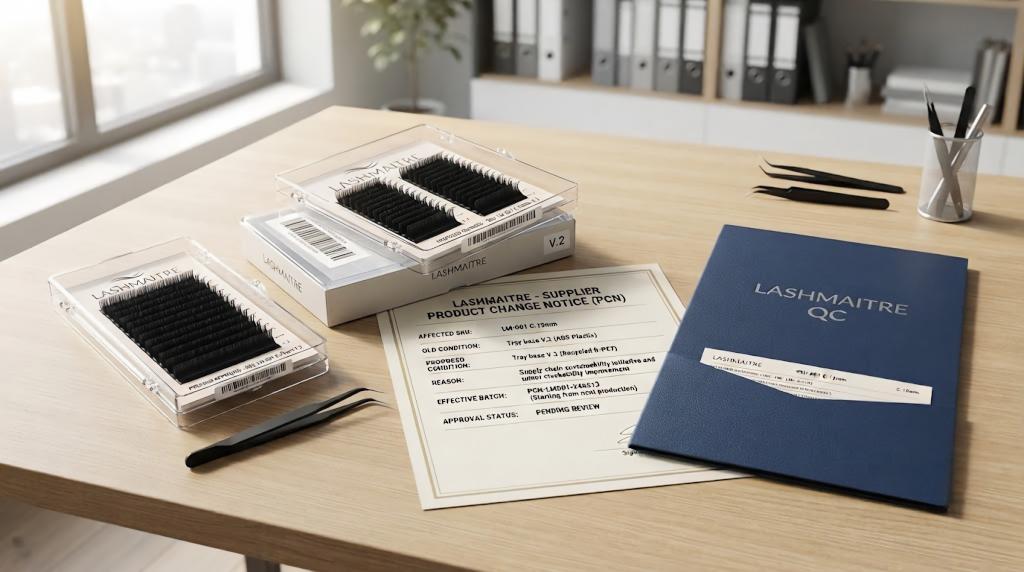
A lash supplier change notice should identify the affected SKU, previous approved reference, proposed change, reason, effective batch, expected impact, and required quote, sample, proof, or buyer re-approval before the reorder enters production.
Supplier Product Change Notice Buyer Summary
A supplier product change notice should identify the affected lash SKU, previous approved reference, proposed change, reason, effective batch, expected impact, and required quote, sample, proof, or buyer re-approval before the reorder enters production.
Direct Answer
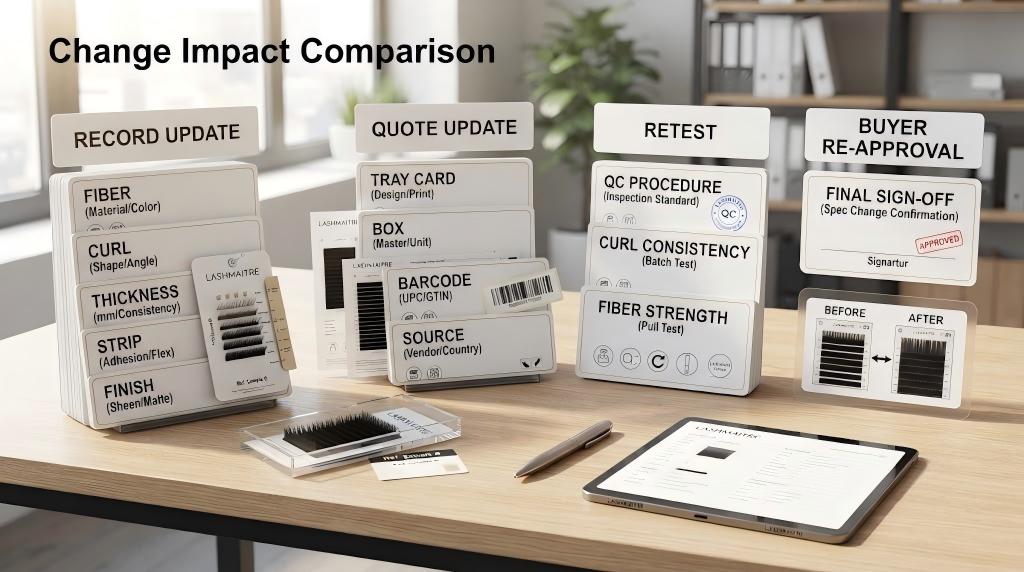
A lash supplier change notice should reach the buyer before implementing any material, specification, process, packaging, label, or source change that could alter the approved product or its reorder traceability. The notice should identify the affected SKU, previous approved reference, proposed change, reason, effective batch, expected impact, and whether a new sample, quote, proof, or buyer approval is required.
A repeat purchase order is not permission to silently change the product. Reorders normally depend on the buyer receiving the same controlled specification, or receiving enough information to approve a documented change before production.
Supplier Change Notice vs Buyer Change Request
These are different controls:
- A buyer change request starts when the buyer asks to change a curl, quantity, packaging design, destination, or other order field.
- A supplier product change notice starts when the supplier proposes or must disclose a change to material, process, equipment, source, specification, packaging, label, or production location.
The buyer should not learn about a supplier-originated change from the finished batch or carton label.
Changes That Should Trigger a Notice
| Change category | Example in a lash reorder | Typical buyer action |
|---|---|---|
| Product specification | Curl calibration, thickness tolerance, length map, finish | Review impact and retest when product performance may change |
| Material or component | Fiber, strip, adhesive base, tray, paper card, box material | Compare against approved reference and assess sample need |
| Production process | New forming, cutting, curing, strip-setting, or inspection method | Request evidence or a validation sample when output can change |
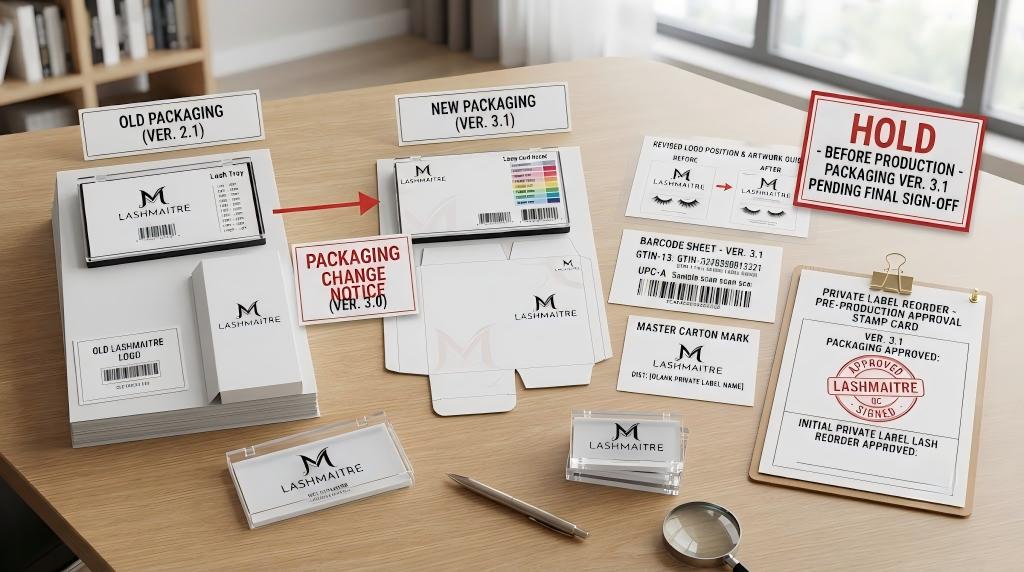
| Packaging or artwork | Tray card, logo position, unit box, barcode, carton mark | Review a new proof before printing or packing |
| Supplier or source | New material source, subcontractor, packaging vendor, or production site | Review traceability and quality risk |
| Administrative record | Contact name or internal document format with no product impact | Record update; product re-approval may not be necessary |
What a Useful Change Notice Contains
A usable supplier change notification should include:
- affected product and SKU;
- previous approved sample, specification, and packaging version;
- precise description of the old and new condition;
- reason for the change;
- affected material, process, source, label, or document;
- expected effect on performance, appearance, packaging, lead time, price, or traceability;
- first proposed production batch and effective date;
- available comparison evidence;
- recommended validation path;
- named supplier owner and buyer approval status.
The general quality-system principle is simple: changes should be controlled, dated, authorized, and traceable. The ISO auditing guidance on digital processes and change control supports that documentation logic. It is referenced as a general process principle, not as a claim that a lash order is governed by a specific ISO certification.
Change Impact and Approval Matrix
| Impact level | Example | Quote update | Sample or proof | Buyer approval |
|---|---|---|---|---|
| Administrative only | Contact or internal form layout | Usually no | No | Record acknowledgement |
| Commercial only | Price, MOQ, lead time, or shipping scope | Yes | Usually no | Yes before PO revision |
| Packaging or label | Box material, logo position, barcode, carton mark | Maybe | New proof | Yes before printing |
| Product performance | Fiber, curl, thickness, strip, finish, length map | Maybe | Retest or new sample | Yes before production |
| Source or process risk | New vendor, process, equipment, or production site | Maybe | Risk-based comparison | Yes before affected batch |
This matrix is a starting point. The buyer and supplier should decide based on the actual effect, not only the supplier's label for the change.
When a New Sample Is Necessary
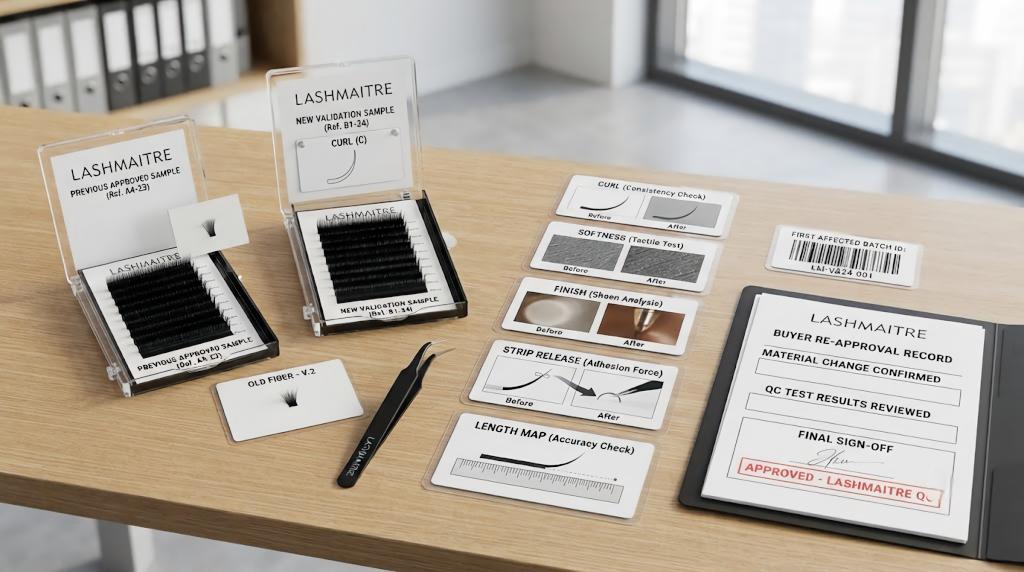
Retest when the change can affect curl retention, thickness, softness, finish, strip release, lash removal, mapping, tray alignment, or other buyer-approved performance. A sample is also useful when the new source or process does not have enough comparable production history.
Use the LASHMAITRE sample process to define what is tested and what approval code becomes the new reference.
When a New Packaging Proof Is Necessary
Require a new proof when the change touches the tray card, box dieline, paper stock, finish, logo position, text, barcode, carton mark, label size, or print method. The proof should show a version number and replace, not merely sit beside, the old production reference.
For private label orders, the private label lash extension page shows why packaging proofs and production files must stay tied to the approved SKU.
Do Not Approve the Reorder Until the Effective Batch Is Clear
The change notice should state whether the next reorder uses the old condition, the new condition, or a transition lot. Record the first affected batch ID and confirm how old and new inventory will be separated. If a supplier cannot identify the effective batch, the buyer cannot reliably inspect or investigate the change later.
Lash Supplier Change Notice FAQ
Which supplier changes require buyer notification?
Notify the buyer about changes that may affect product specification, performance, appearance, packaging, labels, traceability, price, lead time, or the approved production source.
Does every supplier change require a new lash sample?
No. Administrative changes may only need a record update. Product, material, process, or source changes should be assessed for retesting based on their possible effect.
Can the supplier implement a packaging change before approval?
Not when the packaging is part of the approved private label scope. The buyer should review the revised proof and its commercial or timing impact before production.
What should happen to the old approved sample?
Keep its reference in the change record. Mark whether it remains valid, is superseded, or applies only to earlier batches.
How should a change be handled during an active reorder?
Place the affected scope on hold, identify the effective batch, assess quote and schedule impact, complete required sample or proof review, and obtain documented approval before continuing.
Control the Change Before the Reorder
Use the MOQ 50 planning page when a limited validation batch is the safest way to test a proposed change.
Review the LASHMAITRE lash quality-control process and ask the supplier to reference the affected SKU, previous approved sample, proposed change, effective batch, and validation plan before authorizing the reorder.
Send the supplier notice, affected SKU, previous approval code, and proposed validation plan through the wholesale lash inquiry page when a documented review is needed before the next production batch.

Lash Maitre: Your Trusted Partner in Eyelash extension Solutions
Lash Maitre is dedicated to providing professional insights and tips in the eyelash extension industry. Sharing the latest trends, techniques, and product knowledge, Lash Maitre helps lash artists and enthusiasts enhance their skills, stay inspired, and achieve the perfect lash experience.