Wholesale Lash Purchase Order: 9 Critical Items to Confirm
Share
Wholesale Lash Purchase Order Buyer Summary
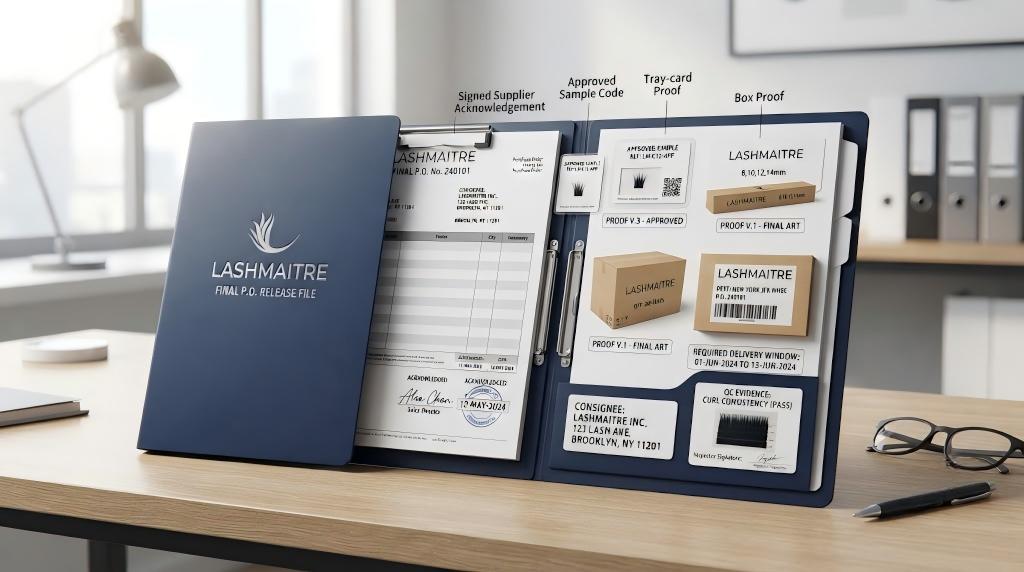
A wholesale lash purchase order should give every SKU its own line and connect it to the approved specification, sample code, quantity, unit price, packaging version, delivery requirement, destination, and acceptance evidence. The supplier should acknowledge the final PO before production starts.
Direct Answer
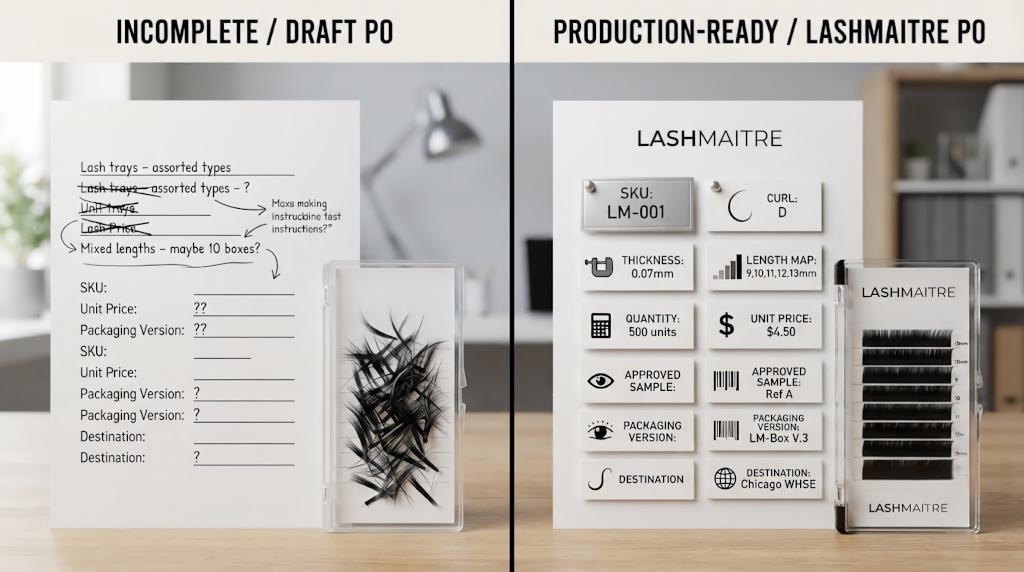
A wholesale lash purchase order should give every SKU its own line item and connect that line to the approved specification, quantity, unit price, packaging version, required delivery date, destination, and acceptance evidence. The PO should also identify the approved sample reference so production is not based on an old quote, a chat message, or staff memory.
A quote explains what the supplier is offering. A purchase order records what the buyer is authorizing. When these documents do not carry the same SKU, sample code, packaging version, price, and delivery scope, the risk of producing the wrong lash order rises before manufacturing even begins.
Why a Lash PO Needs More Than Product Names
Descriptions such as "C curl mix trays" or "private label lashes" are not enough for a production record. Two trays can share the same general name while differing in thickness, length map, row count, strip release, finish, tray card, box artwork, or barcode.
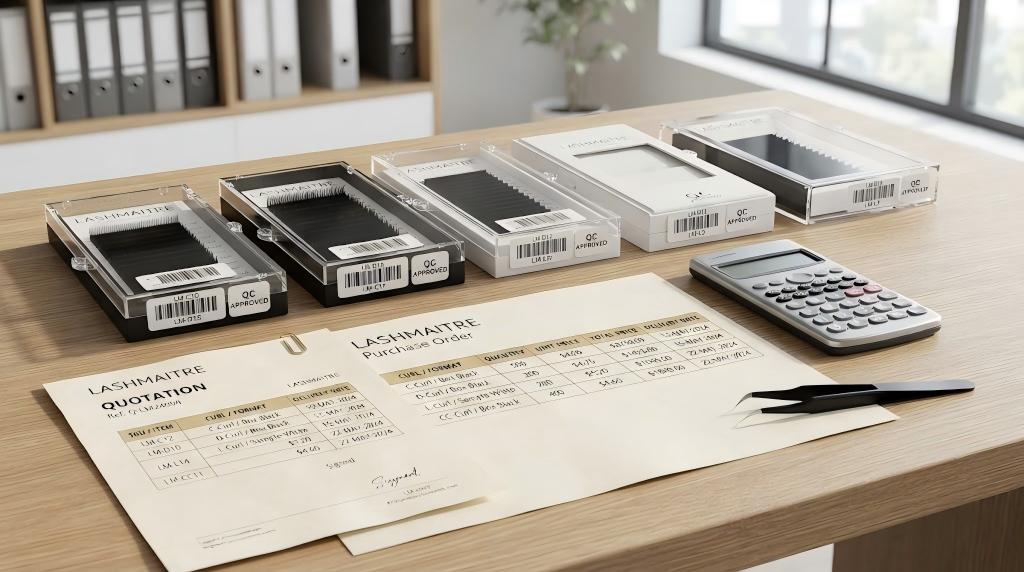
General procurement practice also treats item identification, description, quantity, unit, price, delivery, and destination as separate order data. The Acquisition.gov line-item guidance is referenced here for that documentation principle, not because its government purchasing rules govern every commercial lash order.
Nine Purchase Order Line Items to Confirm
| PO field | What the buyer should record | Risk if omitted |
|---|---|---|
| 1. SKU | One stable code for each tray or packaging combination | Similar products can be mixed |
| 2. Specification reference | Curl, thickness, length map, finish, tray format, and row count or a locked spec code | Production may follow an outdated description |
| 3. Approved sample reference | Approval code, date, and version | A test sample may be mistaken for the approved reference |
| 4. Quantity and unit | Trays, boxes, cartons, or another clearly defined unit | Quote and packing quantities may be interpreted differently |
| 5. Unit price and currency | Price per stated unit, currency, and approved quote version | Invoice and PO totals may not reconcile |
| 6. Packaging version | Tray card, unit box, logo label, barcode, and carton-mark version | Old artwork or labels may be used |
| 7. Delivery requirement | Required date or approved dispatch window | Lead-time expectations remain informal |
| 8. Destination and shipping scope | Consignee, destination, shipping method or agreed term | Freight may be quoted against the wrong route |
| 9. Acceptance evidence | QC record, photo evidence, packing list, carton count, or other agreed release record | The shipment may leave without the expected proof |
Give Each SKU a Separate PO Line
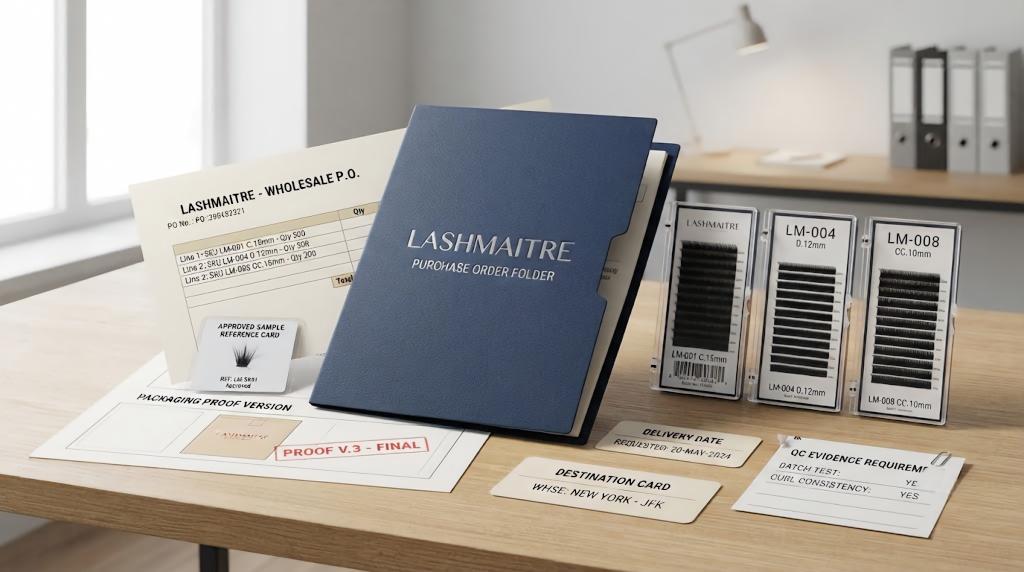
Do not combine different curls, thicknesses, length maps, finishes, or packaging formats into one vague line when they have different production or inventory identities. A separate line makes it easier to verify the quote, approve the production file, inspect the batch, prepare barcode labels, and receive the shipment.
For example, a mixed-length C curl 0.07 tray in a standard box and the same lash tray in a private label box should not automatically share one line. The packaging version changes the item being purchased, even if the lash fiber is identical.
Connect the PO to the Approved Sample
The purchase order should name the sample that controls production. Include the approved sample code, approval date, and specification or packaging version. If the buyer approved the lash tray and box at different times, record both references.
Before issuing the PO, review the lash extension sample process and confirm that the approved sample is not merely an early test unit.
Confirm MOQ and Quantity Logic
MOQ may apply by style, size, SKU, tray format, packaging design, or total order. The PO should state which rule controls each line. A total order of 500 trays does not necessarily mean every SKU satisfies its own minimum.
Use the MOQ 50 wholesale lash planning page to separate hero SKUs from test SKUs before converting a quote into a PO.
Lock Packaging and Private Label Versions
Private label orders need more than a logo file. Record the approved tray-card proof, unit-box proof, logo placement, barcode sheet, carton mark, and version number. Link the PO to the current production file rather than attaching several unmarked revisions.
The private label lash extension process explains how samples, proofs, labels, and production records should connect before scaling.
Purchase Order Release Gate
Release the PO only when the buyer can answer yes to these questions:
- Does every line have a unique SKU and defined unit?
- Does the PO reference the approved lash sample and current packaging proof?
- Do quantity, MOQ, unit price, currency, and total match the approved quote?
- Is the delivery requirement a date or defined window?
- Is the consignee and destination complete?
- Are required QC, photo, packing, and carton records stated?
- Is the supplier expected to confirm the PO before production?
After confirmation, store the supplier acknowledgement with the PO. If a field changes later, issue a controlled revision instead of replacing the record without a change history.
Wholesale Lash Purchase Order FAQ
Is a supplier quote the same as a purchase order?
No. The quote states the supplier's proposed price and scope. The purchase order states what the buyer authorizes after reviewing that offer.
Should approved sample codes appear on the PO?
Yes when the sample controls production. The reference reduces ambiguity and links the commercial order to the quality standard the buyer approved.
Can several lash styles share one PO line?
Only when they truly share one SKU, specification, unit, price, and packaging scope. Different production or inventory identities should use separate lines.
What happens if the packaging proof changes after the PO?
Record the new version, confirm whether price or timing changes, and obtain approval before production. Do not rely on an untracked message attachment.
Should QC evidence be listed on the PO?
List any evidence required before shipment, such as batch inspection, photo evidence, carton count, packing list, or approved-sample comparison.
Confirm the Order Record Before Production
Use the lash quality-control process to define the release evidence expected from the production batch.
Send the final PO, approved sample code, packaging version, destination, and delivery requirement through the wholesale lash inquiry page for order confirmation before production starts.
Confirm the permitted lash order quantity tolerance by SKU before the purchase order is released, including overrun, underrun, billing and exception approval rules.
After issuing the PO, require a written lash order acknowledgment that confirms SKU, quantity, price, packaging, promised dates and any supplier exception before production.
After the purchase order is confirmed, use lash supplier invoice reconciliation to match the PO, receipt, QC acceptance, quantity, price, credits and payment evidence.

Lash Maitre: Your Trusted Partner in Eyelash extension Solutions
Lash Maitre is dedicated to providing professional insights and tips in the eyelash extension industry. Sharing the latest trends, techniques, and product knowledge, Lash Maitre helps lash artists and enthusiasts enhance their skills, stay inspired, and achieve the perfect lash experience.