Lash Packaging Transit Test: 10 Proven Shipment Checks
Share
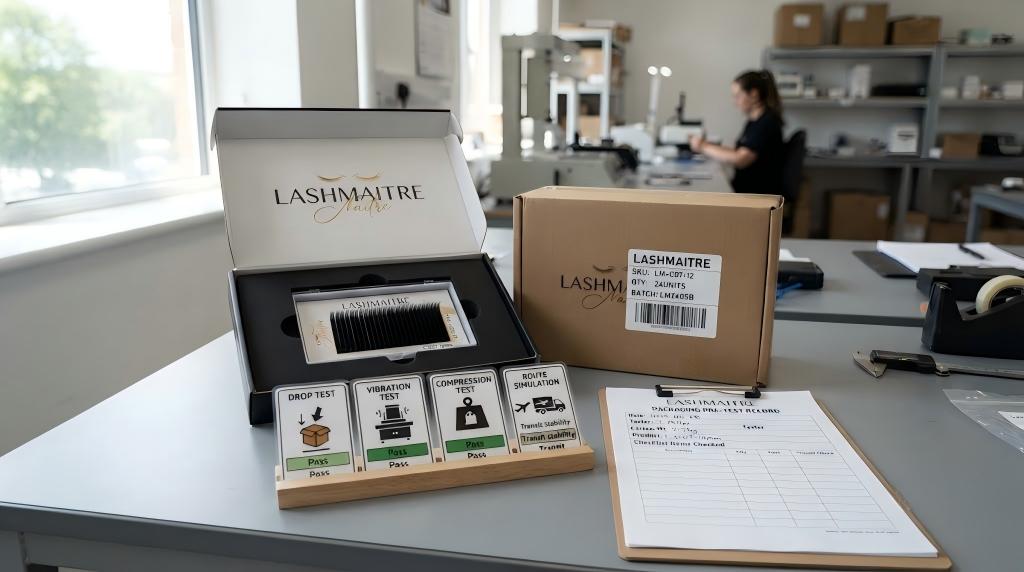
A lash packaging transit test should evaluate the actual product, tray, inner box, inserts, master carton, packing quantity and intended distribution route. The lash packaging transit test record should identify the tested configuration and release decision. Record the test method, package weight, drop or vibration condition, visible damage, product movement, label readability and pass or rework decision. A single unrecorded drop is not a transport-test program.
Lash Packaging Transit Test Buyer Summary
- Test the complete packaged-product system, not an empty box.
- Match the test direction to parcel, air, sea, pallet or mixed handling risk.
- Use production-equivalent tray, box, inserts, labels, carton and packing quantity.
- Define acceptable cosmetic and functional damage before the test.
- Keep photos, video, measurements, result notes and the final packaging version.
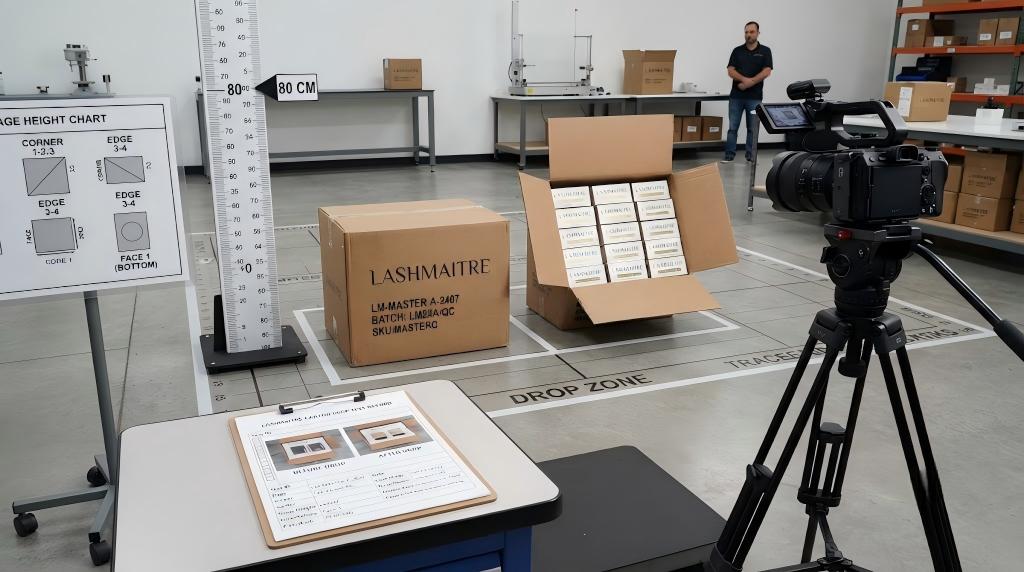
The International Safe Transit Association guidance says test selection should reflect the actual distribution environment. Formal ISTA procedures also require defined sequences and intensities. A buyer-defined factory check may still be useful, but it must not be described as ISTA certification unless the formal requirements are met.
Why a Packaging Proof Is Not a Transit Test
An artwork proof confirms color, text, dieline, barcode space and visual layout. It does not show whether the complete package survives distribution.
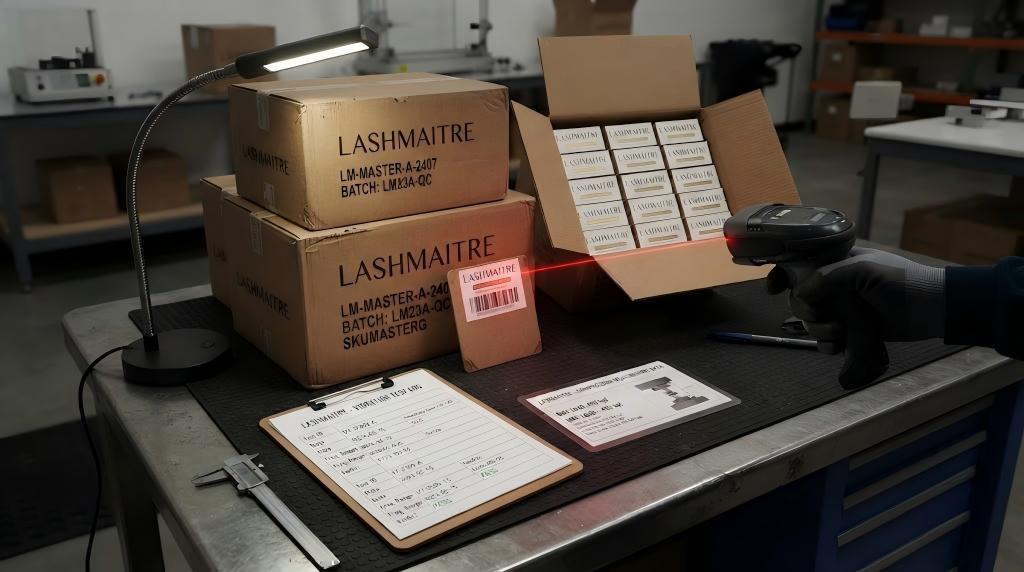
A transit test asks different questions:
- Does the tray move inside the box?
- Do corners crush or lids open?
- Does foil, print or lamination rub?
- Do barcode and SKU labels remain readable?
- Does the master carton deform under stacking?
- Do inner boxes shift after vibration or repeated handling?
Keep artwork approval in the private label lash production file, then add the transit-test record as a separate release document.
For the wider packaging and branding workflow, review the LASHMAITRE private label lash extensions program.
Match the Test to the Distribution Route
| Route risk | Packaging question | Evidence to record |
|---|---|---|
| Parcel or courier | Can one carton survive repeated manual handling? | Drop orientation, height basis, corner/edge/face damage |
| Air freight carton | Does low weight packaging resist compression and movement? | Carton condition, internal void, label adhesion |
| Sea or long consolidation | Can cartons tolerate longer stacking and humidity exposure? | Compression, moisture observation, carton strength |
| Palletized shipment | Does the unit load remain stable? | Stack pattern, wrap, corner protection, pallet movement |
| Mixed last mile | Does retail packaging remain sellable after outer-carton handling? | Inner-box scuffing, tray movement, barcode readability |
The table helps choose questions; it does not prescribe a certified protocol. A formal laboratory should select the applicable method when certification or a customer-specific standard is required.
Build a Traceable Lash Carton Test Record
Record at least:
- packaging version and approval date;
- product SKU, tray and inner-box configuration;
- master-carton dimensions and packed weight;
- units per inner box and carton;
- inserts, dividers, void fill and sealing method;
- intended route and handling mode;
- test sequence or buyer-defined method;
- damage observations by packaging layer;
- product, label and barcode condition;
- pass, conditional approval or rework decision.
Use photos before and after each relevant stage. One final photo of an intact carton does not show how the result was produced.
Inspect the Tray, Box and Master Carton Separately
The outer carton can look acceptable while the retail box is scuffed or the lash tray has shifted. Check three levels:
Record these checks within the supplier's lash quality control system so packaging damage can be traced to the tested configuration and release decision.
Product and tray
Confirm lash rows, strip position, tray closure and product cleanliness remain acceptable.
Retail or private label box
Check corners, surface finish, foil, print, insert fit, opening resistance and barcode readability.
Master carton
Check deformation, puncture, seam and tape performance, carton marks and internal movement.
Decide Pass, Rework or Retest
Define failure before testing. A buyer may reject product damage, unreadable labels or opened retail boxes while accepting limited master-carton scuffing. The decision must match the intended sales channel and agreed packaging specification.
If the package fails, identify which layer needs change: tray restraint, insert, box board, surface finish, divider, carton grade, sealing or packing quantity. Update the version record, rebuild the production-equivalent sample and retest before bulk release.
Lash Packaging Transit Test FAQ
Is a carton drop test enough for lash packaging?
Not always. Drops address impact, but the route may also involve vibration, compression, abrasion, moisture or pallet movement. Choose checks from the real distribution environment and record what the test does and does not cover.
Should the test use an empty carton?
No for a final packaging decision. Use the actual or production-equivalent product, inner packaging, inserts, quantity, carton and sealing method because the test evaluates the packaged-product system.
Does an in-factory drop test count as ISTA testing?
Only when the applicable ISTA procedure, equipment, sequence, intensity, documentation and other requirements are followed. Otherwise describe it accurately as a buyer-defined factory handling or drop check.
When should private label lash packaging be retested?
Retest after a material, box, insert, carton, packing-quantity or route change that may affect performance. Record the new version so the result is not applied to an untested configuration.
Release Packaging With Evidence
A useful lash packaging transit test connects the real product and packing configuration to the intended route, documented conditions and a clear release decision. Share the tray, box, insert, carton quantity, destination and shipping method through the wholesale lash inquiry page when LASHMAITRE reviews a private label packaging plan.
—
Draft Self-Check
| Check | Article 1 | Article 2 | Article 3 |
|---|---|---|---|
| Keyword in SEO title, H1, intro and conclusion | Pass | Pass | Pass |
| Direct answer in first 80 words | Pass | Pass | Pass |
| Decision table or practical tool | Pass | Pass | Pass |
| 3-5 natural internal links | Pass | Pass | Pass |
| Tested authority link | Pass | Pass | Pass |
| 4 FAQ questions | Pass | Pass | Pass |
| Evidence boundary stated | Pass | Pass | Pass |
| Consumer tutorial avoided | Pass | Pass | Pass |
Open blockers before WordPress:
- Use the 10 approved user/Gemini-supplied images. Per the user's instruction, permanently omit
7.14.7.jpgand7.14.12.jpg; Article 1 uses 4 images, and Articles 2 and 3 use 3 images each. - Preserve the completed image branding and duplicate-scene QA record.
- Create WordPress drafts only after all authority URLs remain HTTP 200.
- Confirm real visible Rank Math score of at least 85 for every draft.

Lash Maitre: Your Trusted Partner in Eyelash extension Solutions
Lash Maitre is dedicated to providing professional insights and tips in the eyelash extension industry. Sharing the latest trends, techniques, and product knowledge, Lash Maitre helps lash artists and enthusiasts enhance their skills, stay inspired, and achieve the perfect lash experience.