Cat Eye Lash Extensions Map: 8 Tray Planning Checks for Wholesale Buyers
Share
A cat eye lash extensions map is not only a styling idea. For wholesale buyers, it is a product specification that must be translated into tray lengths, curl choices, thickness, tray format, labels, sample approval notes and reorder records.
The search demand around cat eye lash extensions is often visual and salon-focused. Buyers may see outer-corner maps, dramatic examples, or service tutorials. LASHMAITRE takes a different angle: how a brand, distributor, salon chain or academy can turn the cat-eye look into a repeatable wholesale tray range.
Direct answer: A cat eye lash extensions map is a length and curl distribution plan that places shorter lengths toward the inner corner and longer lengths toward the outer corner. For wholesale buyers, the map should be treated as a tray specification: approve the length range, curl, thickness, tray format, label wording, sample record and reorder file before adding it to a product line.
Buyer note: For general eye-area cosmetic context, buyers can review the FDA eye cosmetic safety page. Keep the wholesale decision focused on product specs, sample feedback, QC records and reorder control rather than medical, safety or performance claims.
What a Cat Eye Lash Extensions Map Means in Wholesale Planning
In service content, a cat-eye map often describes how lengths move from shorter inner corners to longer outer corners. In wholesale planning, the same idea has to become a product file.
A buyer needs to know:
- which length range will be sampled
- whether the tray is mixed length or single length
- which curl family is used
- which thickness belongs to the approved sample
- whether the tray supports classic, volume or premade use
- what the tray card and carton label will say
- how the approved sample will be reordered
If those details are missing, the style name is too loose for repeat orders. Buyers can use the LASHMAITRE lash extension lengths guide and lash extension curl guide to narrow the first sample plan before opening too many variations.
1. Define the Target Style Before Choosing Tray Specs
"Cat eye" can mean different things to different buyers. Some buyers want a soft retail-friendly range. Some want a stronger outer-corner direction. Others want cat-eye trays for training kits or salon-chain service consistency.
Before asking for samples, define the commercial role:
| Buyer type | Cat-eye need | Better first sample |
|---|---|---|
| Private label brand | A clear style story for a tray range | One mixed cat-eye tray with approved packaging wording |
| Distributor | A sellable style category | Controlled length range plus carton label record |
| Salon chain | Repeatable service menu support | Limited curl and length options for staff consistency |
| Academy buyer | Teaching map logic | Labeled trays and length cards for class use |
The product should be easy to explain, sample and reorder. If the buyer is still building a core range, start with lash extension samples before expanding into several cat-eye variations.
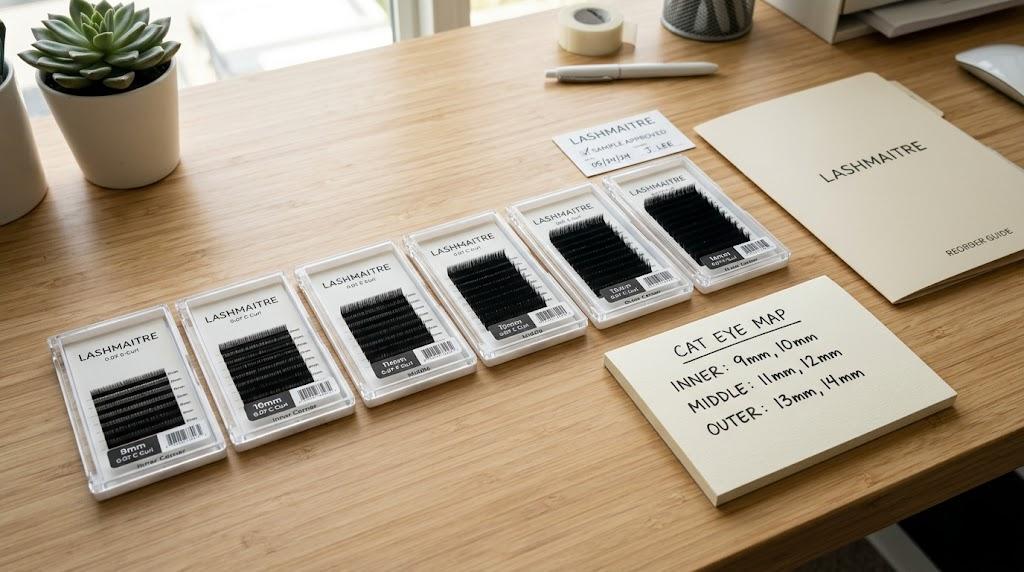
2. Set the Inner-to-Outer Length Range
The length map is the center of the article and the center of the product decision. A typical cat-eye structure moves from shorter inner-corner lengths toward longer outer-corner lengths, but wholesale buyers should avoid copying a random map without checking catalog fit.
| Map zone | Wholesale spec decision | Buyer note |
|---|---|---|
| Inner corner | Shorter lengths, clear starting point | Keep labels easy to read and avoid overloading the first sample |
| Middle section | Transition lengths | Record whether the tray uses mixed lengths or single lengths |
| Outer corner | Longer lengths and curl choice | Avoid making the outer section too hard to reorder consistently |
| Approved sample | Final curl, thickness, tray card and label | Save the approved sample with the reorder file |
For a first sample, the buyer can test one clear length range instead of several competing maps. A clean first record is easier to approve than a complicated style board.
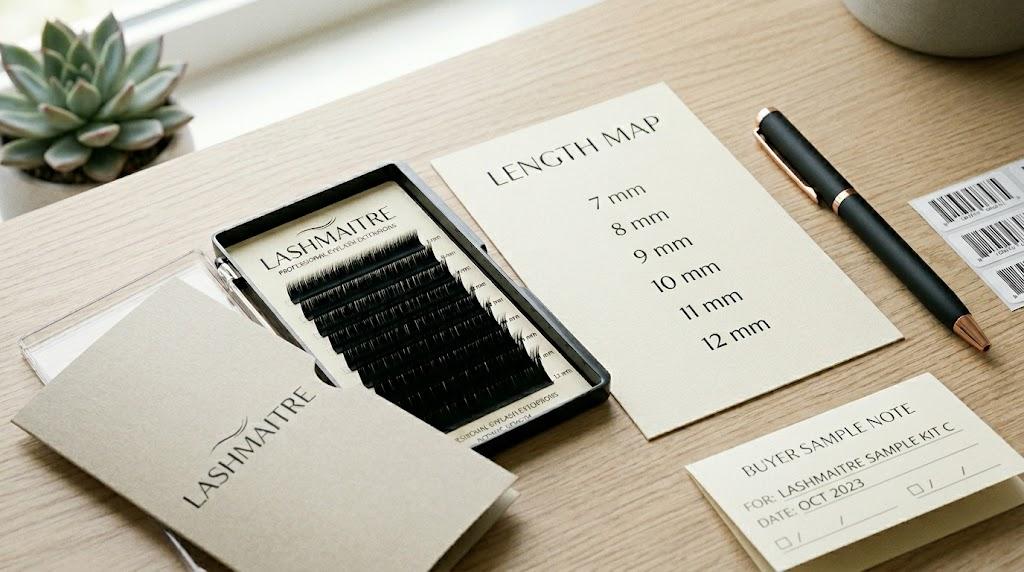
3. Choose Curl Based on Buyer Demand and Sample Feedback
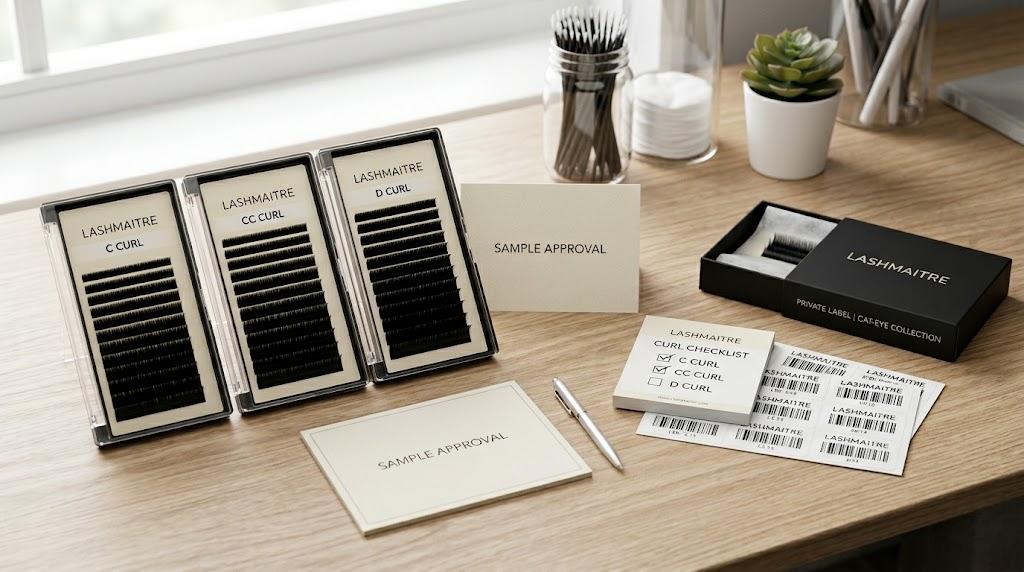
Curl changes the way a cat-eye tray reads in the catalog. A buyer may consider C, CC, D, J, M or L curl depending on market, service menu and existing stock.
For a controlled sample, avoid changing length, curl and thickness all at once. If the buyer wants to compare curl, keep the length range and thickness stable. If the buyer wants to compare length maps, keep curl stable.
LASHMAITRE buyers can review J curl lash extensions for natural curl planning and M curl and L curl lashes for lifted curl options. The goal is not to declare one curl best for everyone. The goal is to approve one repeatable product spec.
4. Keep Thickness Consistent During the First Sample Round
Thickness should support the intended tray role. A cat-eye range for classic services, volume fans, premade options or training kits may require different thickness decisions.
The simplest first round is:
- one style direction
- one length map
- one curl
- one thickness
- one tray format
- one sample record
After the first sample is approved, the buyer can add support variants. If the first request contains too many combinations, it becomes harder to understand which spec created the approved result.
5. Decide Whether the First Sample Should Be Mixed Tray or Single Length
Mixed trays are often useful for style-map testing because they show the full direction in one tray. Single length trays are useful when demand is already proven and the buyer knows which lengths reorder most often.
For a new cat-eye range, a mixed tray may reduce early SKU risk. For a mature salon chain or distributor, single lengths may support deeper stock control.
| Tray format | Better for | Risk |
|---|---|---|
| Mixed cat-eye tray | First sample, style demonstration, training | The exact mix must be clearly recorded |
| Single length trays | Proven demand, larger catalogs, repeat service menus | Too many slow SKUs if demand is untested |
| Kit format | Academy or private label launch packs | Packaging and tray labels must stay aligned |
If MOQ is the concern, use the MOQ 50 wholesale lash extensions route to keep the first order narrow before expanding the full cat-eye range.
6. Separate Classic, Volume and Premade Cat-Eye Options
A cat-eye map can be used across classic, volume and premade product families, but they should not be mixed loosely in one reorder file.
For example:
- classic cat-eye trays need clear curl, thickness and length labels
- volume cat-eye planning may include fan/density decisions
- premade cat-eye support may need fan type and base quality records
- training kits may need labeled examples rather than deep stock
If a buyer also plans wispy cat eye lash extensions, keep the wispy/spike structure separate from the basic cat-eye length map. The more trend language appears in the product name, the more important the technical record becomes.
7. Make the Tray Card and Carton Label Match the Approved Map
Many reorder problems begin with labels. A buyer may approve a sample tray, but if the tray card, box label and carton mark do not match the final spec, the next reorder can drift.
A useful cat-eye tray label should include:
- style name
- curl
- thickness
- length range
- tray format
- SKU or reorder code
- packaging version if private label is used
For private label buyers, connect the style name to real specs. A name like "Soft Cat Eye" may be useful for retail, but the reorder file still needs the technical details. LASHMAITRE can connect that planning with private label lash extensions support.
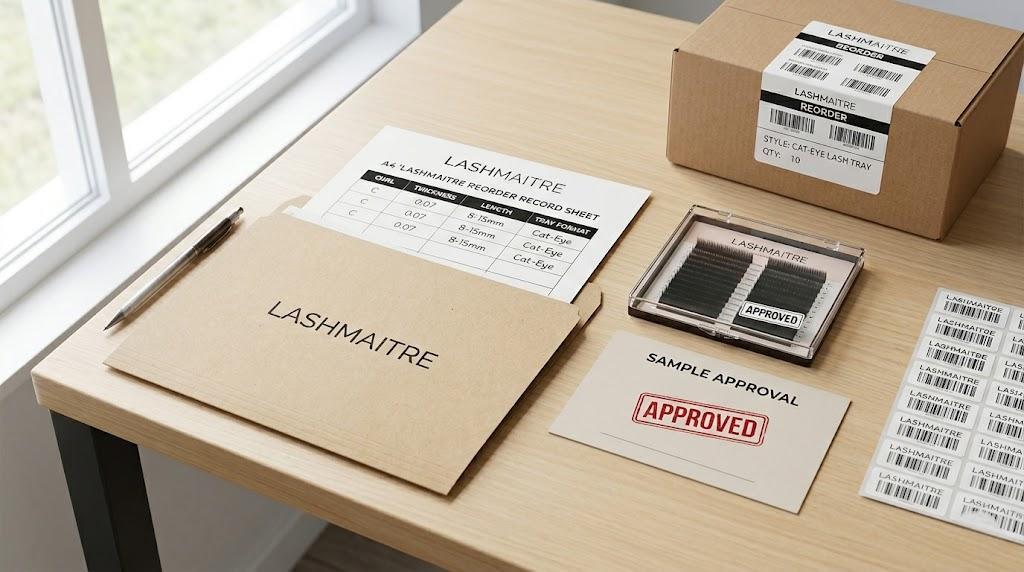
8. Save the Approved Sample, Packaging Proof and Reorder Record Together
The approved sample is not just a nice product photo. It is the control point for future orders.
Before scaling the range, buyers should keep:
- Approved physical tray.
- Length map record.
- Curl and thickness notes.
- Tray card proof.
- Packaging proof.
- Carton label or barcode record.
- QC feedback.
- Reorder code.
LASHMAITRE's lash quality control process should connect the visible tray, label accuracy and reorder file so the same cat-eye range can be produced again.
Cat-Eye Lash Extension Sample Inquiry Checklist
When contacting a supplier, send a focused request rather than a broad style description. A useful inquiry can include:
- target style: cat eye, soft cat eye, volume cat eye or wispy cat eye
- intended buyer type: salon chain, distributor, academy or private label brand
- length range
- curl
- thickness
- tray format
- quantity or first MOQ target
- tray card and packaging needs
- label or barcode requirements
- reference sample notes if available
Buyers can use the wholesale lash extensions inquiry page to send the planned specs and ask for a controlled sample path.
For buyers comparing cat eye with other style maps, the lash mapping styles guide shows how to turn cat eye, doll eye, fox eye, wispy and anime maps into sample trays, labels, QC notes and reorder files.
For a center-focused alternative, compare open eye vs cat eye lash extensions by peak position, taper, length use and salon tray replenishment.
FAQ
What is a cat eye lash extensions map?
A cat eye lash extensions map is a length and curl distribution plan that usually moves from shorter inner-corner lengths to longer outer-corner lengths. In wholesale planning, the map should become a tray specification with recorded length range, curl, thickness, tray format, label wording and reorder code.
Which lengths should wholesale buyers test for cat-eye trays?
Buyers should start with one controlled inner-to-outer range that fits their market and catalog. The exact range depends on the buyer's service menu, product family and customer demand. The important point is to record the approved range clearly before MOQ.
Should a cat-eye lash range use mixed trays or single length trays?
Mixed trays are often better for first sample testing because they show the style map in one product. Single length trays can work after demand is proven and the buyer knows which lengths need deeper stock.
Which curl works best for cat-eye lash extension samples?
There is no single curl that works for every buyer. The first sample should use a curl that matches the buyer's existing catalog and service menu. Buyers can test curl separately while keeping length and thickness stable.
What should buyers include in a cat-eye lash extension inquiry?
Send the target map, length range, curl, thickness, tray format, sample quantity, private label needs, label requirements and expected first-order quantity. Clear specs help the supplier quote and sample the tray accurately.
Soft CTA
If you are planning a cat-eye tray range for a lash brand, salon chain, distributor or training academy, send LASHMAITRE your target map, length range, curl, thickness, tray format and packaging needs. The team can help turn the style idea into a sampleable, labelable and reorderable wholesale product file.

Lash Maitre: Your Trusted Partner in Eyelash extension Solutions
Lash Maitre is dedicated to providing professional insights and tips in the eyelash extension industry. Sharing the latest trends, techniques, and product knowledge, Lash Maitre helps lash artists and enthusiasts enhance their skills, stay inspired, and achieve the perfect lash experience.