M Curl and L Curl Lashes: 8 Specialty Range Checks
Share
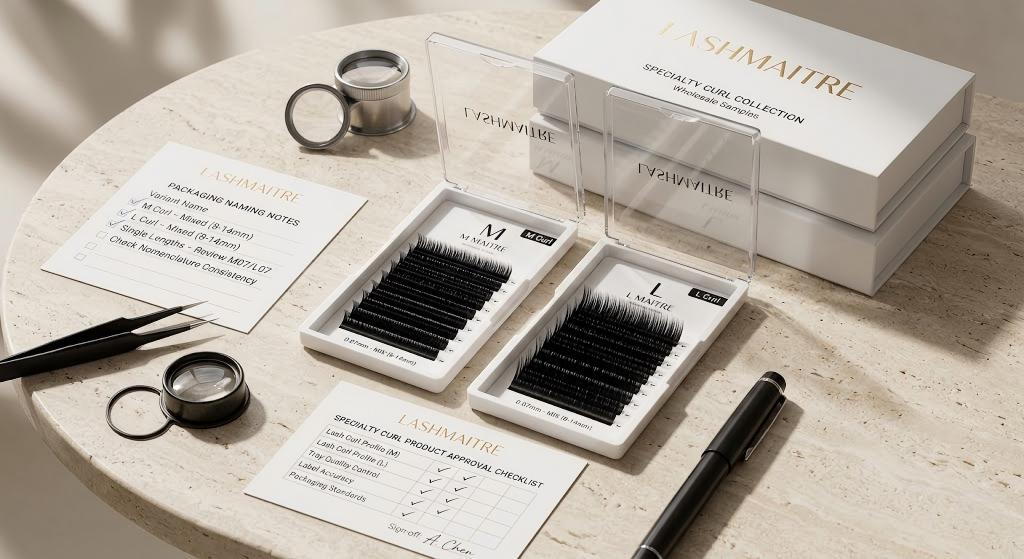
M curl and L curl lashes can make a lash catalog feel more advanced, but they are not always the right first SKUs for a wholesale buyer. Specialty curls should be added when the buyer has a clear reason: salon demand, artist feedback, product positioning, private label range expansion, or a specific catalog gap.
M Curl and L Curl Lashes Buyer Summary
M curl and L curl lashes should be treated as specialty range additions after the core curl range is stable, with separate sample approval, label naming and reorder tracking.
The mistake is adding specialty curls because they look interesting in a competitor catalog. If a buyer has not proven C, CC or D demand yet, adding M and L can create packaging complexity, slow-moving stock and unclear reorder files.
Use M and L as controlled expansion curls. Test them after the core range is stable, compare them under clean sample conditions, name them carefully on tray labels and packaging, then track demand before increasing quantities. If the buyer is still planning the basic range, start with LASHMAITRE's lash extension curl sample set and lash extension samples paths.
Why M Curl and L Curl Lashes Are Range Expansion
M curl and L curl lashes should usually sit after the core curl decision. They are not wrong for a new brand, but they need a stronger reason than "more SKUs look premium."
Use this simple range logic:
| Range stage | Curl focus | Planning decision |
|---|---|---|
| Core launch | C, CC and/or D | Build a reliable first catalog |
| Sample expansion | M or L | Test specialty demand before packaging |
| Private label expansion | Best specialty performer | Add clear names and SKU records |
| Reorder scale | Proven curl | Increase quantity only after demand is visible |
This keeps the catalog easier to manage. It also gives the buyer a cleaner story when explaining specialty curls to customers.
When M Curl May Fit
M curl may fit a buyer who wants a specialty curl direction that feels different from the core range. The exact product decision depends on product family, thickness, length and sample behavior. The buyer should not approve M curl from photos alone.
M curl may be worth sampling when:
- The buyer already has a stable C/CC/D core range.
- Salons or customers ask for a more specialized curl option.
- The buyer wants a product line that feels more advanced than the starter catalog.
- The packaging plan can explain the curl clearly.
- The first quantity can stay modest until demand is proven.
M curl should be recorded as a specification. A private label file should show product family, thickness, length, finish, tray label, sample code and approved packaging wording.
When L Curl May Fit
L curl may fit buyers who need a distinct specialty curl option and can explain it clearly in their catalog. It should be sampled with the same discipline as any core product. Do not add L curl only because it expands the product menu.
L curl may be worth testing when:
- The buyer has customer demand for specialty curl choices.
- The buyer's artists or customers understand how the curl will be used.
- The catalog has enough education to prevent confusion.
- Packaging and tray labels can name the curl clearly.
- The buyer can track sales and reorder data separately.
If the buyer is still building a private label foundation, connect the specialty curl plan to the broader private label lash extensions path before printing packaging.
Do Not Add Specialty Curls Too Early
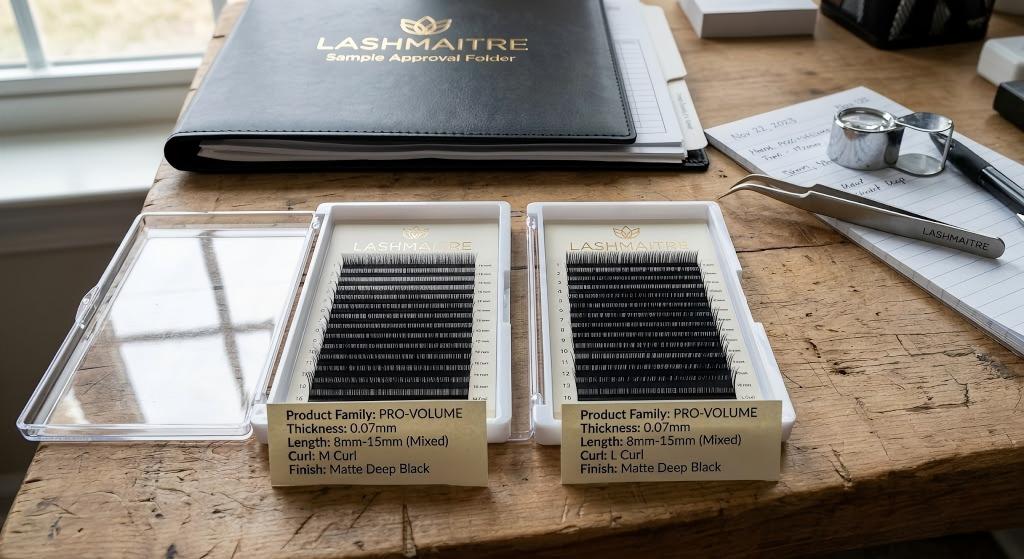
Specialty curls can be exciting, but they create operational cost. Each added curl can require more sample checks, tray labels, product photos, SKU records, box wording, warehouse slots and reorder decisions.
Avoid early expansion if:
- The buyer has not approved core curls yet.
- The first order quantity is already stretched.
- The brand has no clear product education for specialty curls.
- The team cannot track specialty curl demand separately.
- Packaging names are not final.
- Sample feedback is based only on appearance, not product handling and reorder fit.
A specialty curl is more useful when it answers a real buyer need. It is less useful when it only makes the catalog longer.
Sample M and L Under Controlled Conditions
A buyer should compare M and L curls under controlled conditions. If M is sampled as one product family and L is sampled as another, the buyer may approve the wrong variable.
Use a controlled sample setup:
| Sample variable | Recommended control |
|---|---|
| Product family | Compare the same family first |
| Thickness | Keep one thickness for the first specialty curl test |
| Length | Keep one length format for the first comparison |
| Finish | Avoid changing finish while testing curl |
| Label wording | Show exact M and L names on sample labels |
| Notes | Record artist feedback, photo review and buyer decision |
If finish is also part of the decision, use the lash fiber finish checklist separately. Curl and finish can work together, but they should not be mixed in the first approval test.
Prepare Private Label Curl Names
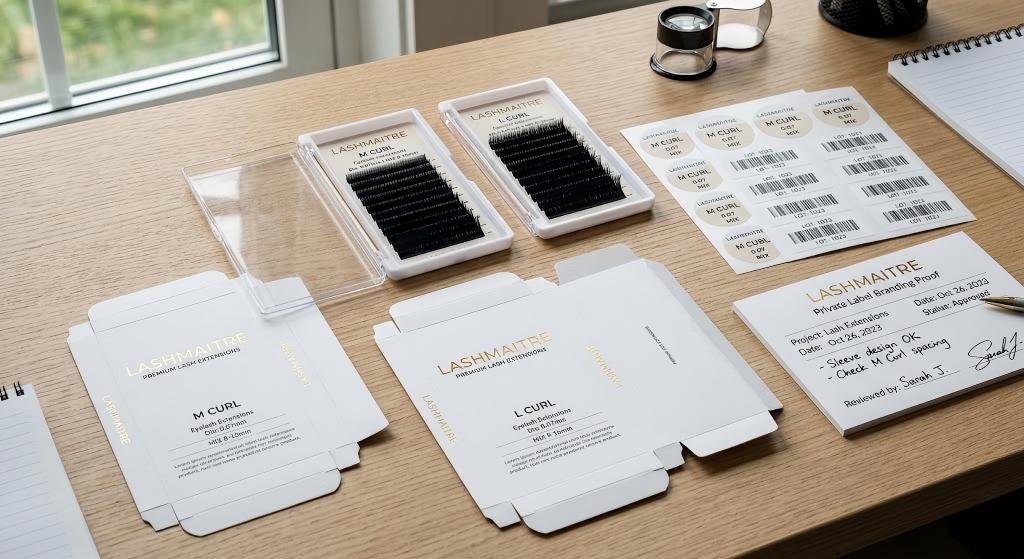
M curl and L curl lashes need clear catalog names. A private label buyer may want creative product names, but the operational file still needs simple curl wording.
A practical naming file can include:
| Field | Example |
|---|---|
| Public product name | Specialty M Curl Lash Tray |
| Operational curl | M |
| Product family | Classic or volume |
| Thickness | 0.07 or 0.15, depending on family |
| Length format | Mixed or single length |
| Tray label | M Curl 0.07 Mixed |
| Packaging version | Box proof V1 |
| Sample record | Approved sample code and photo |
The FDA cosmetics labeling guide is useful general context for careful product wording. In this workflow, the practical point is to keep packaging claims aligned with the approved product file and avoid confusing or unsupported language.
Connect Specialty Curls to Reorder Control
Specialty curl success should be measured separately. If M and L are hidden inside a broad SKU file, the buyer cannot see whether customers actually reorder them.
Track:
- Sample approval date.
- First order quantity.
- Product family.
- Curl.
- Thickness.
- Length format.
- Packaging version.
- Sales or buyer feedback.
- Reorder requests.
- Slow-moving stock notes.
The ISO 9001 quality management systems standard gives useful context for documented repeatability. For specialty curls, documentation helps the buyer avoid changing the product between sample approval and reorder.
Supplier Communication for Specialty Curls
The Shopify manufacturer and supplier guide is a useful reminder that supplier decisions should include samples, communication and production planning. For M and L curls, send a focused request instead of asking for every possible specialty curl.
A clear request can say:
- Current core curl range.
- Which specialty curl to test first.
- Product family.
- Thickness.
- Length format.
- Finish direction.
- Tray label wording.
- Sample quantity.
- Packaging level.
- First order estimate.
- Destination country.
If the buyer wants a checklist before sampling, the Wholesale Lash Samples Checklist can help organize sample approval and reorder questions.
Make the Specialty Curl Decision
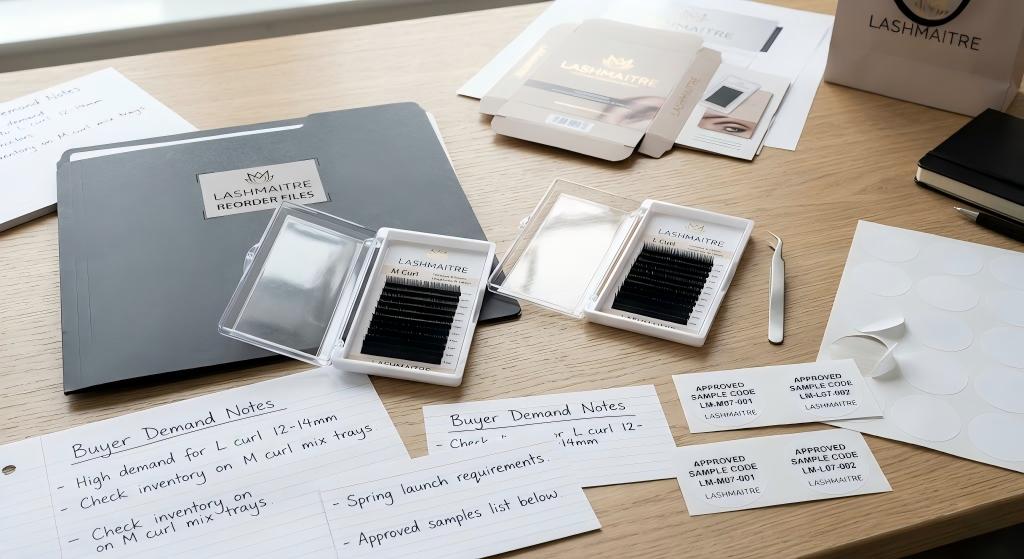
After sample testing, the buyer can decide whether M, L, both or neither belongs in the catalog.
Use this decision table:
| Result | Decision |
|---|---|
| Strong sample feedback and clear buyer demand | Add the specialty curl with modest first quantity |
| Good sample but unclear demand | Keep it as a test SKU or wait |
| Confusing label or catalog fit | Fix naming before packaging |
| Weak feedback or no demand | Do not add it yet |
| Good demand after first order | Increase quantity and add reorder controls |
This keeps specialty curls useful. The goal is not to look complex. The goal is to sell and reorder a product the buyer can explain.
CTA
Send LASHMAITRE your current core curl range, target specialty curl, product family, thicknesses, length structure, sample quantity, packaging wording, first order estimate and reorder plan through the wholesale lash extensions inquiry path. We can prepare an M/L curl sample review before bulk packaging.
M Curl and L Curl Lashes Quick Review
- Use M curl and L curl lashes planning after core curls are already approved.
- Use M curl and L curl lashes planning to test specialty demand before bulk packaging.
- Use M curl and L curl lashes planning to keep private label names and reorder files clear.
FAQ: M Curl and L Curl Lashes
Should a new lash brand launch M curl and L curl lashes?
Usually not as the first priority. A new lash brand should normally approve core curls first, then test M and L when there is buyer demand or a clear catalog reason.
Are M and L curls better than C, CC or D?
No curl is universally better. M and L are specialty options that may fit certain catalog strategies. Core curls are often easier for first ranges and repeat orders.
How should I sample M and L curls?
Sample them under controlled conditions. Keep product family, thickness, length format and finish stable so the buyer can judge the specialty curl itself.
What should private label packaging say for specialty curls?
Packaging should use clear curl names and match the approved sample record. Avoid vague claims and keep operational labels simple enough for reorder control.
How do I know whether a specialty curl should stay in the catalog?
Track sample feedback, first order sell-through, reorder requests, customer questions and slow-moving stock. Keep the curl if demand and catalog fit are clear.
Buyer next step: Specialty M and L curl samples should be reviewed through LASHMAITRE lash quality control so curl geometry, base lift, row alignment and repeat-order notes are documented before bulk orders.

Lash Maitre: Your Trusted Partner in Eyelash extension Solutions
Lash Maitre is dedicated to providing professional insights and tips in the eyelash extension industry. Sharing the latest trends, techniques, and product knowledge, Lash Maitre helps lash artists and enthusiasts enhance their skills, stay inspired, and achieve the perfect lash experience.