Lash Extension Lengths: 8 Tray Planning Checks for Wholesale Buyers
Share
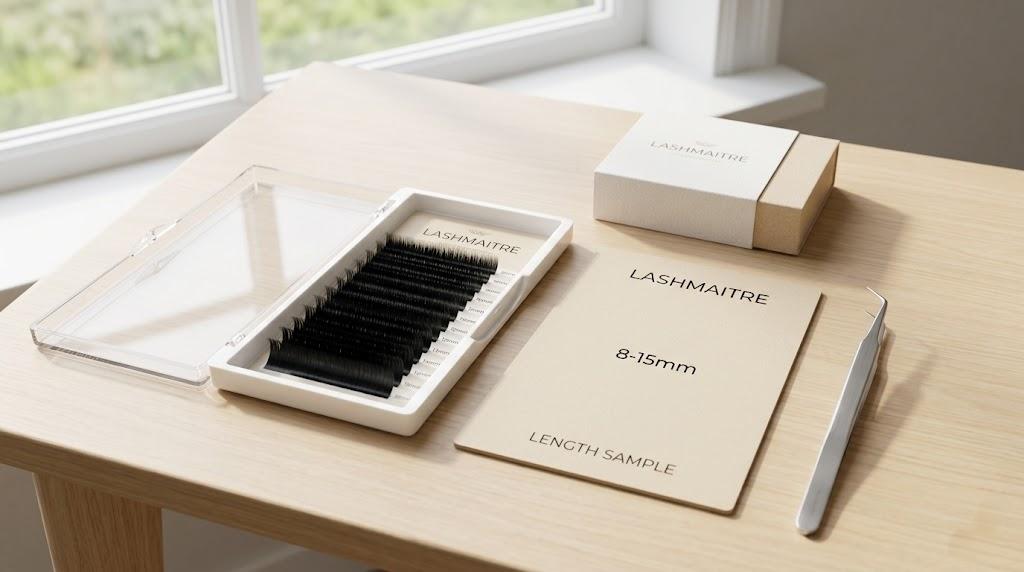
Lash extension lengths affect more than the final look of a lash set. For a wholesale buyer, the length range decides how many trays to sample, how many SKUs to launch, what should appear on tray labels, how MOQ is used, and how repeat orders are recorded.
If a buyer chooses too many lengths too early, the first order can become hard to test and slow to reorder. If the range is too narrow, salons or distributors may not have enough coverage for their customers. A practical lash extension lengths plan should connect product family, curl, thickness, tray type, sample approval, label wording, and reorder files before bulk production.
Direct answer: For wholesale buyers, lash extension lengths should be planned as a tray range, not only as a beauty style choice. A starter sample range often covers short, medium, and long lengths such as 8-15mm or 8-16mm, then expands into single length trays only after buyer demand and reorder data are clear.
What a Lash Extension Length Chart Should Show
A useful lash extension length chart should do more than list numbers. It should help the buyer connect every length decision with a real tray, label, sample card, and reorder record.
At minimum, the chart should show:
| Field | Why it matters for wholesale buyers |
|---|---|
| Product family | Classic, flat, volume, premade fan, YY, W, or another tray type |
| Length range | Helps decide whether the tray is mixed length or single length |
| Curl | Changes how long or lifted the same length may appear in a sample |
| Thickness | Affects weight, darkness, density, and buyer approval |
| Tray type | Mixed tray, single length tray, sample tray, or reorder tray |
| Row map | Helps buyers confirm whether the tray structure matches the approved sample |
| Label text | Keeps customer-facing tray labels aligned with internal SKU records |
| Approved sample ID | Prevents reorder confusion after the first bulk order |
For B2B planning, a length chart should be connected with the buyer's real order path. A private label startup may use the chart to keep the first range small. A salon chain may use it to identify which lengths need deeper stock. A distributor may use it to decide which lengths should be single length trays and which can remain mixed trays.
Start With Buyer Type Before Choosing Lengths
Different buyers need different lash extension lengths. The right range depends on how the buyer sells, who uses the trays, and how quickly the buyer expects to reorder.
| Buyer type | Starter length plan | Main risk to control |
|---|---|---|
| New private label brand | Mixed 8-15mm or 8-16mm sample tray | Too many SKUs before demand is clear |
| Salon buyer | Core lengths artists use every week | Running out of repeat lengths |
| Distributor | Broader mix plus proven single lengths | Confusing warehouse and reorder records |
| Academy or training buyer | Controlled shorter range for repeat practice | Inconsistent student tray use |
A new brand usually benefits from a focused test range. The goal is not to show every possible length in the first order. The goal is to collect useful sample feedback without building a catalog that is too wide to manage.
Salon and distributor buyers may need more depth, but they should still separate sample testing from reorder expansion. First confirm which lengths are approved. Then decide which lengths deserve their own single length trays.
Buyers who are still building the first product line can review LASHMAITRE's wholesale eyelash extensions page for product category context before turning the range into samples.
Group Lengths Into Short, Medium, Long, and Extended Ranges
Length planning becomes easier when the buyer groups tray options before choosing exact SKUs. The groups below are not fixed styling rules. They are a practical way to organize sample and reorder decisions.
| Length group | Common range | Wholesale planning use |
|---|---|---|
| Short | 6-8mm or 7-9mm | Inner-corner coverage, training sets, natural range support |
| Medium | 10-12mm | Core salon and starter range demand |
| Long | 13-15mm | Popular longer range for many buyer catalogs |
| Extended | 16mm+ | Add only when buyer demand supports it |
Many starter sample plans can begin with an 8-15mm or 8-16mm range. This gives the buyer enough coverage to compare short, medium, and long rows without creating too many single length SKUs.
Extended lengths should be handled more carefully. Longer lengths can be useful, but they also increase the importance of curl, thickness, fiber finish, and customer demand. If a buyer adds 16mm, 17mm, or longer lengths before demand is proven, those trays may become slow-moving inventory.
Mixed Length Trays vs Single Length Trays
Mixed length trays and single length trays solve different problems.
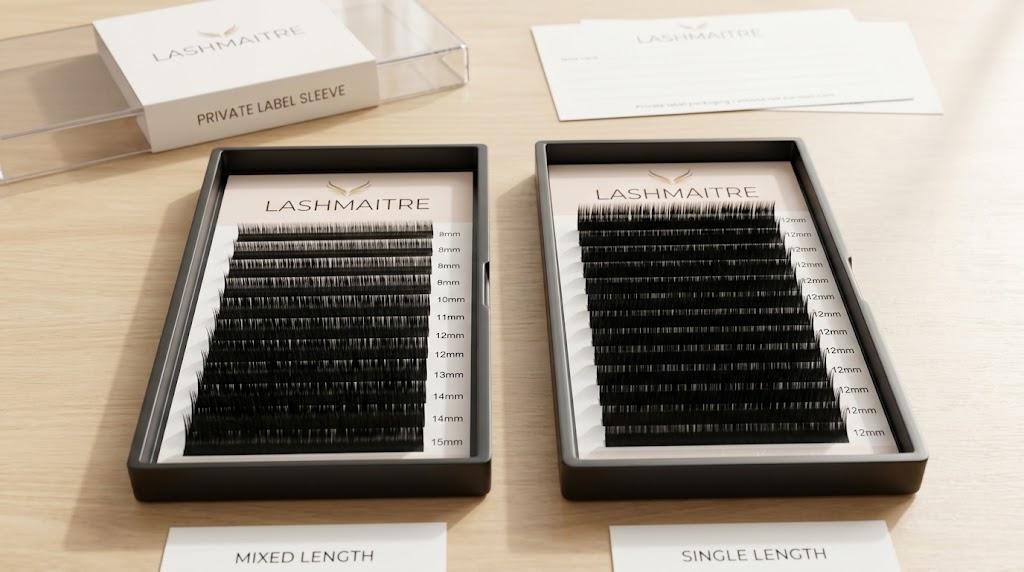
Mixed length trays are usually stronger for first sample tests and smaller starter ranges. A buyer can test multiple lengths in one tray, compare artist feedback, and learn which lengths customers request most often.
Single length trays are stronger after demand is proven. They help salons, distributors, and repeat buyers restock exact lengths without buying a full mixed tray every time.
| Tray format | Best use | Buyer risk |
|---|---|---|
| Mixed length tray | First sample range, new product test, smaller MOQ plan | Length demand may be unclear after the first test |
| Single length tray | Proven reorder demand, salon replenishment, distributor stock | Too many single length SKUs can slow inventory |
| Sample tray | Early buyer approval before first bulk order | May not reflect full reorder depth |
| Reorder tray | Stable length and label after approval | Requires clear sample and batch records |
For a deeper comparison, buyers can use the LASHMAITRE guide to mixed length vs single length lash trays. This article should support that decision, not replace the full tray-format comparison.
Match Length With Curl and Thickness
Lash extension lengths cannot be planned alone. The same length can feel different when curl and thickness change. A 13mm tray in a soft curl may not be judged the same way as a 13mm tray in a stronger curl. A long length in a heavier thickness may also create a different buyer impression than the same length in a lighter thickness.
Before approving a length range, buyers should confirm:
- Which curls belong in the first sample range.
- Which thicknesses support the target product family.
- Whether the length range is meant for classic, volume, flat, premade fan, YY, or W trays.
- Whether the sample should use mixed lengths or single lengths.
- Whether the final label should show length range, single length, or internal SKU.
Use the LASHMAITRE lash extension curl guide when curl decisions need to be compared before the sample order. Use the lash thickness chart when thickness needs to be matched with length and tray type.
Record Lengths on Sample Approval Cards
A length range is only useful if it can be repeated. After the buyer approves samples, the approved length information should be saved in a clear sample record.
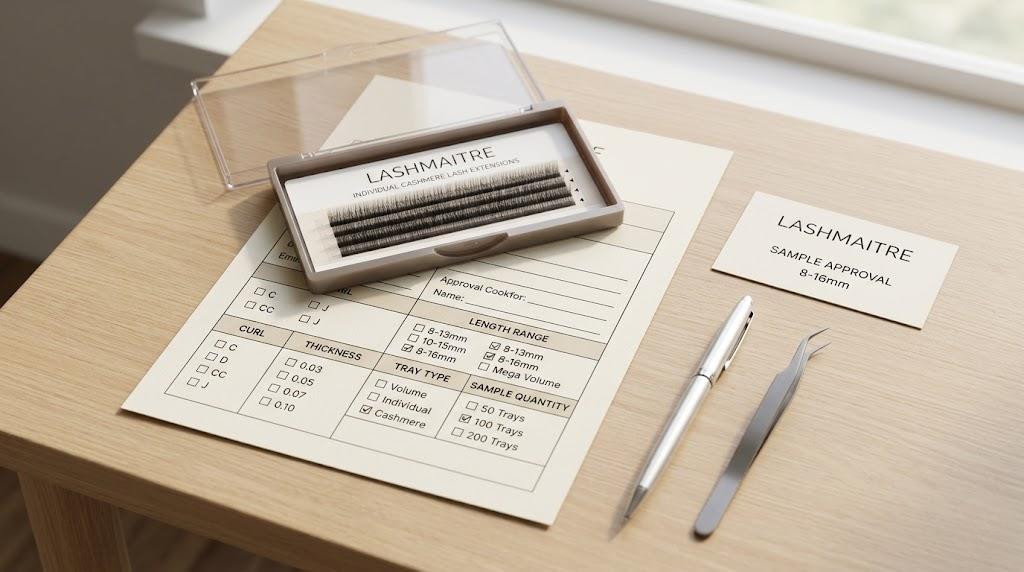
A good lash length sample record should include:
- Product family
- Curl
- Thickness
- Length range or single length
- Tray type
- Row map
- Sample ID
- Batch note
- Packaging version
- Buyer approval date
- Any correction before reorder
This record matters because chat history is not a reliable reorder system. If the first approved sample is described only in messages, a later reorder may miss the exact length range, row structure, label text, or packaging version.
For repeat orders, the sample record should be connected with LASHMAITRE lash quality control so length accuracy, row consistency, curl memory, and sample-to-bulk comparison can be checked together.
Use MOQ 50 to Test Length Demand
MOQ planning should match the stage of the buyer's product line. A first order does not need to cover every length as a deep single length inventory plan.
For many new buyers, MOQ 50 can support a tighter first test when the buyer wants to validate product family, curl, thickness, length range, and packaging direction before scaling. This is especially useful when the buyer is still deciding whether mixed length trays are enough or whether single length trays should be added later.
Use a smaller first range when:
- The buyer is testing a new product family.
- Length demand is not yet proven.
- Private label packaging is still being refined.
- The buyer wants to compare sample feedback before adding more SKUs.
- The brand has not yet built a reorder file.
Use a deeper order when:
- Salons already request exact lengths.
- Distributor demand is proven.
- The buyer has reliable reorder history.
- Label and packaging versions are stable.
- Warehouse records can separate each length clearly.
Buyers can review the MOQ 50 wholesale lash extensions option when they want a controlled first order before expanding slow-moving lengths.
Private Label Tray Labels Need Length Clarity
Private label buyers should decide how length appears on tray labels before packaging is printed. A tray label does not need to show every internal note, but it should be clear enough for customers, warehouse teams, and reorder conversations.
A private label tray card may show:
- Brand name
- Product family
- Curl
- Thickness
- Length range or single length
- Tray type
- SKU or style code
- Packaging version if needed internally
For example, an internal reorder file might say "Classic C 0.07 Mixed 8-15mm, matte black, tray card V1." The visible customer label may be shorter, but the internal file should preserve the full spec.
If length wording changes after artwork is approved, the buyer may need to revise tray cards, box labels, carton labels, and reorder files. This is why length planning should happen before private label artwork approval.
Buyers preparing brand labels can review LASHMAITRE private label lash extensions before moving length ranges into packaging design.
Quality Checks Before Bulk Approval
Before a bulk order is approved, length should be checked as part of the full sample quality process. The buyer should not only ask whether the tray "looks good." The buyer should confirm whether the tray can be repeated.
| Quality check | What to confirm |
|---|---|
| Length accuracy | Rows match the approved length range or single length |
| Row consistency | The tray layout is clean and easy to inspect |
| Curl memory | The selected length keeps the expected curl shape |
| Thickness match | Length and thickness support the intended product family |
| Label match | Tray label matches the sample record |
| Packaging version | Tray card, box, sleeve, or label version is recorded |
| Sample-to-bulk comparison | Bulk trays match the approved sample file |
| Reorder notes | Any correction is written before the next order |
LASHMAITRE's lash extension samples page can help buyers prepare a sample-first process before committing to bulk orders. The lash quality control page should be used when length, curl, thickness, row quality, and packaging notes need to be reviewed together.
FDA treats false eyelashes, eyelash extensions, and related adhesives as eye-area cosmetic products, so buyers should keep product information, labels, and supplier documentation organized when planning sample ranges. Reference: FDA Eye Cosmetic Safety.
Build a Reorder File Before Expanding Lengths
Length expansion should follow reorder evidence. If a buyer adds many lengths before knowing which ones sell, the product line can become wide but weak. A reorder file helps the buyer decide which lengths deserve more stock.
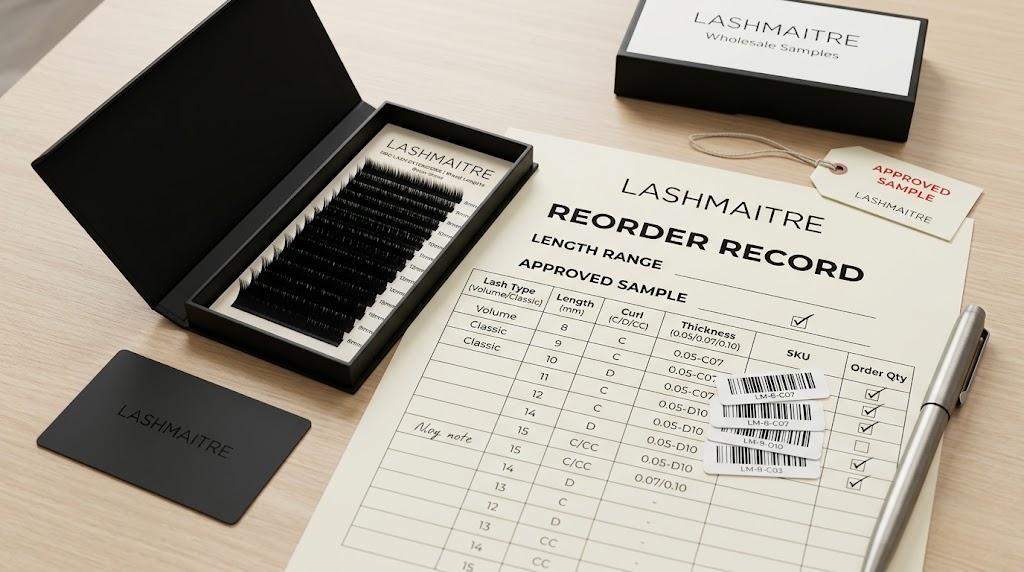
A reorder file should answer:
- Which sample was approved?
- What exact length range was approved?
- Was the tray mixed length or single length?
- Which curl and thickness were used?
- Which tray card or packaging version was approved?
- What quantity was ordered first?
- Which lengths sold fastest?
- Which lengths should be added, removed, or converted to single length trays?
This is also where the buyer should connect length decisions with the single length reorder plan. Single length trays become more useful when the buyer knows which lengths need stable replenishment.
How LASHMAITRE Helps Buyers Build a Length Range
LASHMAITRE helps wholesale buyers turn a loose length idea into a sample-ready product plan. If you are not sure whether to start with 8-15mm, 8-16mm, mixed length trays, or single length trays, begin with the buyer type and sales channel.
For the first discussion, send:
- Product family
- Target curl
- Target thickness
- Length range
- Mixed tray or single length preference
- Buyer type
- Estimated first order quantity
- Private label packaging needs
- Destination country
- Any approved sample or reference already used
From there, LASHMAITRE can help prepare a cleaner sample path, label plan, and reorder record before the order becomes too complex. Buyers can start from lash extension samples or send order details through the wholesale lash extensions inquiry page.
When the range needs shorter inner-corner or lower-lash options, use these short lash extensions tray checks to confirm length cards, curl and thickness notes, sample approval and reorder labels before scaling.
When a buyer turns length planning into a shaped style, the cat eye lash extensions map guide shows how to connect inner, middle and outer lengths with curl choices, samples, labels and reorder records.
When the longest lengths sit near the center, the doll eye lash extensions checklist helps buyers record center length, curl, thickness, sample approval and reorder data before MOQ.
FAQ: Lash Extension Lengths
What lash extension lengths should wholesale buyers sample first?
Most buyers should start with a controlled range that covers short, medium, and long lengths before adding many single length SKUs. A mixed 8-15mm or 8-16mm tray can be a practical first sample range for many buyer types.
Is 8-15mm enough for a first lash tray sample range?
For many starter ranges, 8-15mm is enough to test demand across short, medium, and longer rows. Some buyers may choose 8-16mm if their customers often request longer looks, but extended lengths should be added only when demand is clear.
When should a buyer choose single length lash trays?
Single length trays fit better after reorder data shows which lengths sell repeatedly. They are useful for salons and distributors that need exact replenishment, but they can create too many SKUs if added too early.
Should length be planned before private label artwork?
Yes. Length range, curl, thickness, tray type, and label wording should be confirmed before tray cards, box labels, sleeves, or reorder files are finalized.
What should a lash length sample record include?
A lash length sample record should include product family, curl, thickness, length range, tray type, row map, sample ID, packaging version, buyer approval date, and any correction notes before reorder.
Conclusion: Plan Lash Extension Lengths Before the First Bulk Order
Lash extension lengths should be treated as part of the buyer's product system. The right range affects samples, MOQ, labels, packaging, quality checks, and repeat orders. A focused starter range is usually easier to test than a wide catalog, and single length trays are strongest when demand is already proven.
Send LASHMAITRE your product family, curl, thickness, target length range, tray type, buyer type, quantity range, and packaging needs. We can help turn the length plan into a cleaner sample and wholesale order path.

Lash Maitre: Your Trusted Partner in Eyelash extension Solutions
Lash Maitre is dedicated to providing professional insights and tips in the eyelash extension industry. Sharing the latest trends, techniques, and product knowledge, Lash Maitre helps lash artists and enthusiasts enhance their skills, stay inspired, and achieve the perfect lash experience.