Lash Thickness Chart for Wholesale Buyers: 0.03 to 0.15 Range Planning
Share
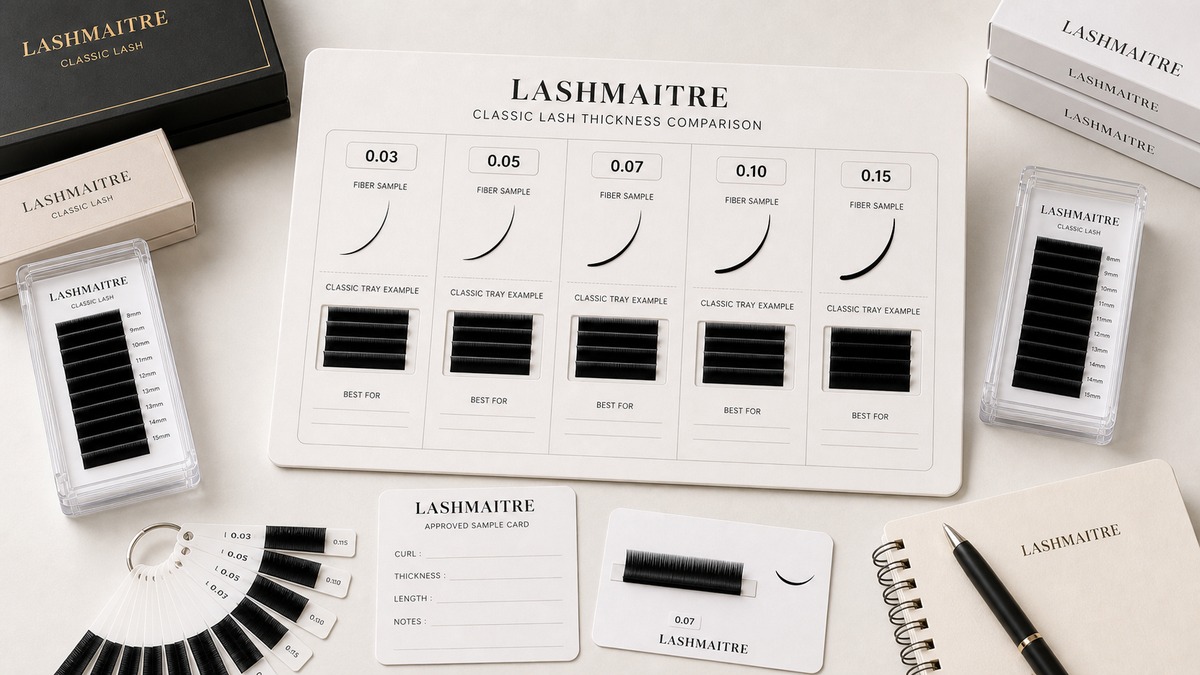
A lash thickness chart is useful only when it helps the buyer make a better product decision. For wholesale buyers, private label brands, salon chains, and distributors, thickness is not a simple ranking from thin to thick. It is a planning field that affects product role, tray label, sample testing, training requirements, packaging, inventory depth, and reorder control.
This guide compares 0.03, 0.05, 0.07, 0.10, and 0.15 from a B2B planning perspective. It does not treat every thickness as part of one universal classic range. A buyer should connect each number to the product family, target user, sample feedback, and reorder file.
If you need broader tray purchasing context, start with LASHMAITRE's wholesale lash trays article. This guide focuses on thickness planning before wholesale orders.
Read Thickness as a Product Role
The first mistake is treating thickness numbers as a quality ladder. A 0.03 tray is not automatically "better" or "worse" than a 0.15 tray. It serves a different purpose and often belongs to a different product context.
Use this buyer-side lash thickness chart as a planning starting point:
| Thickness | Common planning context | Buyer check before ordering |
|---|---|---|
| 0.03 | Fine volume or mega-volume planning | Confirm training level, fan-making method, and product family |
| 0.05 | Fine volume or lighter volume planning | Confirm whether the market has demand for fine fibers |
| 0.07 | Volume or hybrid planning context | Confirm pickup, finish, and label wording |
| 0.10 | Lighter classic planning example | Test classic tray feel, curl consistency, and demand |
| 0.15 | Common classic planning example | Check comfort expectations, visual density, and reorder depth |
This table is not a final prescription. Buyer type, local training habits, service menu, and sample feedback decide the final range. The table helps keep the first conversation clear.
Do Not Copy a Competitor Range Blindly
Many buyers send a competitor product page and ask for the same thickness list. That may be fast, but it can create inventory problems. A competitor's range may be built for a different market, artist training level, or product family.
Before copying a range, ask:
- Which thicknesses are already selling for the buyer?
- Which product family does each thickness belong to?
- Are the buyer's customers classic, volume, hybrid, or training-kit users?
- Does the buyer need every thickness in the first order?
- Can the tray labels, box labels, ecommerce listings, and reorder files use the same naming?
The Shopify wholesale suppliers guide is a useful general reference because it reminds buyers to compare supplier fit and business needs before inventory commitment. In lash wholesale planning, thickness choice should be tied to tested product roles, not copied lists.
Separate Fine Fiber Planning From Classic Planning
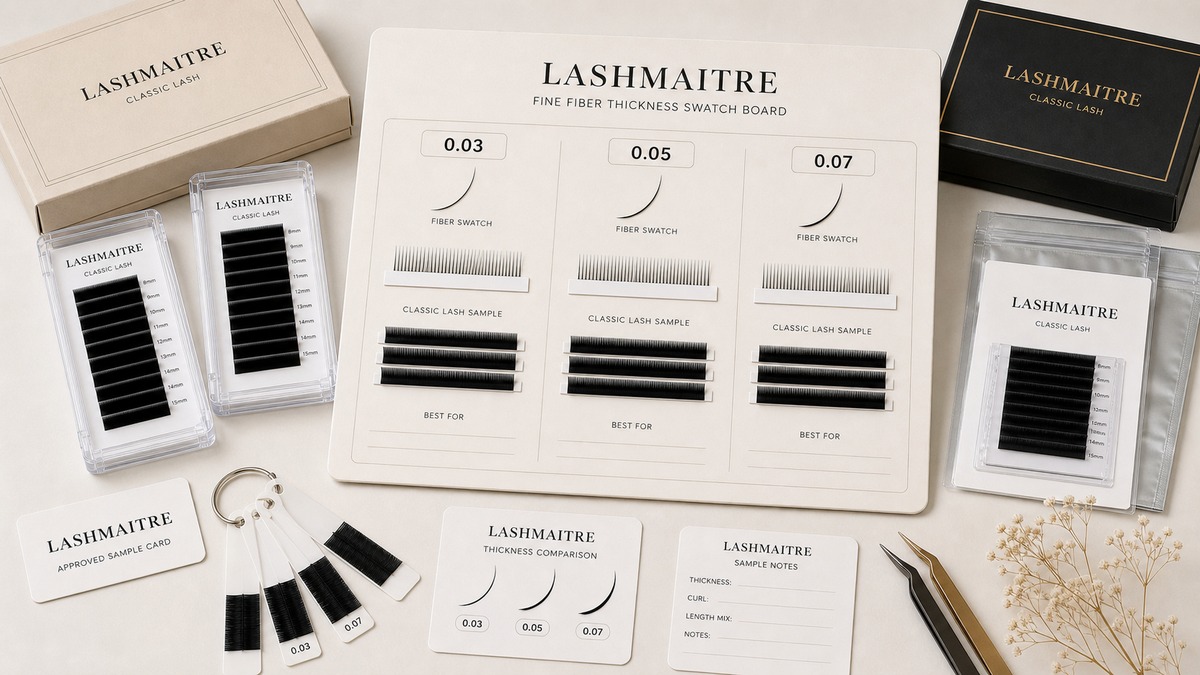
The 0.03 and 0.05 range often belongs to fine volume or mega-volume planning contexts. These products require a buyer to think about training level, customer expectation, fan creation method, and how the product will be explained.
For 0.03 and 0.05, check:
- Whether the buyer's customers understand fine fiber use.
- Whether the product will be sold as volume, mega-volume, or another defined range.
- Whether sample testers can evaluate pickup and handling correctly.
- Whether tray labels clearly separate the product from classic lash trays.
- Whether the buyer has enough demand to hold inventory depth.
If a buyer adds 0.03 and 0.05 only because the numbers appear on a competitor chart, the range may become difficult to sell and reorder. Fine fiber planning should have a clear product purpose.
Compare 0.10 and 0.15 for Classic Range Planning
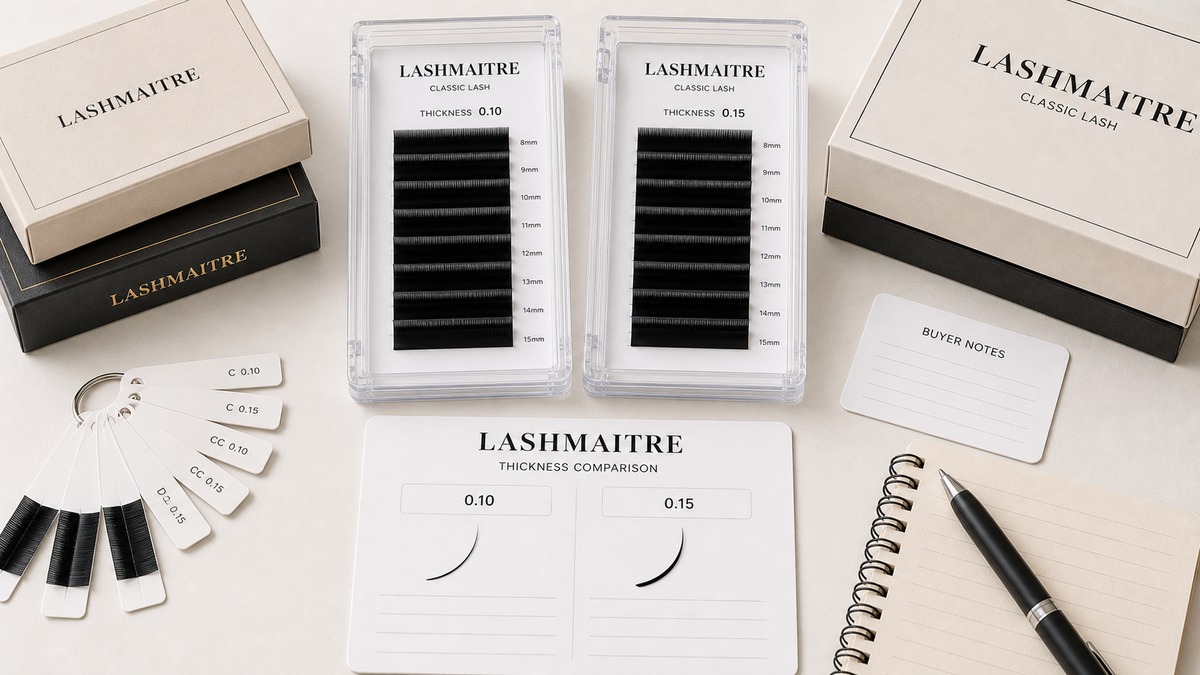
0.10 and 0.15 are common classic lash planning examples, but they should still be sampled instead of assumed. A buyer may prefer a lighter classic feel in one market and a stronger visual line in another. The tray should support the buyer's service menu, customer expectations, and repeat orders.
During sample testing, compare:
- Curl stability in the selected curl, such as C, CC, or D.
- Pickup control from the strip.
- Row alignment and fiber consistency.
- Finish and visual density.
- Artist feedback.
- Customer-facing product description.
- Label clarity for thickness, curl, and length.
The existing classic eyelash extensions guide can support broad product education. For wholesale planning, the thicker or thinner option should win only if the buyer can test it, label it, stock it, and reorder it reliably.
Keep Thickness Labels Consistent Across the Whole Buyer File
A lash thickness chart should not live only in a spreadsheet. The chosen thickness must appear consistently across the tray card, box label, ecommerce listing, sample record, carton label, and reorder file.
Inconsistent labeling creates practical risk. A tray card may say 0.10, a box may say 0.15, and the buyer's reorder message may only say "classic C curl." That is how the wrong product gets repeated. Private label buyers should connect thickness choices to the broader private label lash extensions file before tray cards, sleeves, or boxes are printed.
Use this label consistency checklist:
| Location | Thickness field needed? | Why it matters |
|---|---|---|
| Tray card | Yes | Artist sees the working spec |
| Box or sleeve | Yes | Buyer receives and stores the right product |
| Ecommerce listing | Yes | Sales team avoids product confusion |
| Sample record | Yes | Feedback is tied to the right tray |
| Reorder file | Yes | Supplier repeats the approved spec |
| Carton label | Often yes | Warehouse and distributor sorting is easier |
The FDA cosmetics labeling guide is a general reference for clear product information and label review. For lash buyers, the practical lesson is to keep product information accurate and consistent before printing or bulk shipping.
Test Thickness Under the Same Curl and Length Conditions
Thickness feedback is more useful when the test is controlled. If a buyer compares 0.07 D curl 14mm with 0.15 C curl 10mm, the result will mix curl, length, and thickness impressions. A better test keeps as many fields as possible the same.
For a clean sample test:
- Choose the product family first.
- Keep the same curl where possible.
- Keep the same visible length range or selected comparison length.
- Use identical sample feedback fields.
- Record pickup, finish, curl stability, row alignment, and label clarity.
- Save photos of each approved tray.
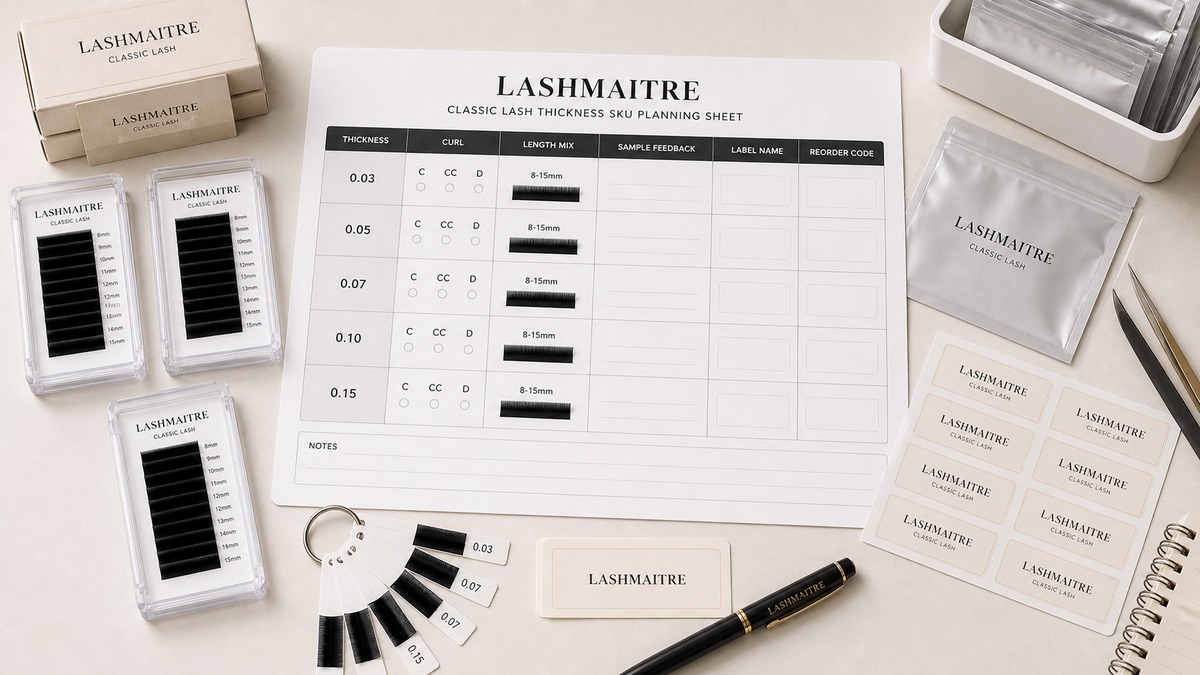
- Put the final choice into the SKU and reorder file.
The lash extension curl sample set article can support curl testing. A thickness sample test should use the same discipline: isolate the variable as much as possible, then document the buyer's decision.
For a controlled comparison between adjacent volume options, use the 0.07 vs 0.10 volume lash tray buyer checks and record matched curl, length map, pickup, strip release, usable yield and reorder code.
If the buyer has not tested the thickness range physically, start with LASHMAITRE's lash extension samples path before setting bulk quantities.
Use Thickness Planning to Control Inventory Depth
A buyer does not need every thickness in the first wholesale order. Range width can look impressive on a product page, but it can weaken inventory if each spec has too little stock or too little demand.
For first-order planning, divide thicknesses into three groups:
- Core thicknesses: likely to sell or be used repeatedly.
- Test thicknesses: useful for sample feedback but not ready for deep stock.
- Deferred thicknesses: interesting but not needed until demand is clearer.
This approach connects directly to the lash extension SKU planning guide. The buyer should not only ask "Can this thickness be made?" The better question is "Can this thickness be sampled, labeled, sold, stocked, and reordered without confusion?"
The ISO 9001 quality management systems standard is a general reference for documented and repeatable requirements. For lash buyers, the practical value is keeping approved thickness requirements visible for the next order. Reference: ISO 9001:2015.
Add Safety and Use Notes Without Overcomplicating the Product
Lash products are used around the eye area, so responsible buyer communication matters. Product pages, packaging, and training materials should avoid unclear claims and should encourage appropriate professional use and sample review.
The FDA eye cosmetic safety page is a useful general reminder for products used around the eyes. In a wholesale lash workflow, this means the buyer should keep product information clear, test samples responsibly, and avoid exaggerated promises in marketing copy.
Lash Thickness Chart Quick Review
- Use a lash thickness chart to connect each thickness to product role, not just visual weight.
- Use a lash thickness chart to separate fine fiber, volume, hybrid, and classic planning contexts.
- Use a lash thickness chart to keep tray labels, packaging, sample records, and reorder files consistent.
For a close nominal-size decision, use the 0.10 vs 0.12 classic lash extensions buyer guide to compare diameter labels while holding profile, curl, length, taper, finish and method constant.
FAQ: Lash Thickness Chart for Wholesale Buyers
What is a lash thickness chart?
A lash thickness chart compares thickness values such as 0.03, 0.05, 0.07, 0.10, and 0.15 so buyers can plan product roles, samples, labels, and reorder files.
Are 0.03 and 0.05 classic lash thicknesses?
They are usually used in fine volume or mega-volume planning contexts unless a buyer has a specific product reason. They should not be added to a classic range without clear sample validation.
Which thicknesses are common for classic lash planning?
0.10 and 0.15 are common classic lash planning examples, but buyer demand, curl choice, length range, sample feedback, and training level should decide the final range.
Should a first wholesale order include every thickness?
Usually not. A focused first order with core and test thicknesses is easier to manage than a wide range with weak inventory depth.
What should be recorded after thickness samples are approved?
Record product family, thickness, curl, length, tray label, packaging version, sample photos, buyer feedback, and reorder code.
Conclusion: Make Thickness Easy to Test and Repeat
A lash thickness chart should help a buyer make clear product decisions. It should show which thicknesses belong to classic, volume, hybrid, or fine fiber planning, and it should connect those choices to sample approval, labels, packaging, inventory depth, and reorder control.
Send LASHMAITRE your target product type, planned curls, 8mm-15mm length needs, preferred thickness range, buyer training level, sample request, packaging needs, and launch timeline through the wholesale lash extensions inquiry page. We can prepare a focused sample set before your wholesale order.
Buyer next step: Thickness planning becomes more reliable when it is tied to LASHMAITRE lash quality control, so 0.03, 0.05, 0.07, 0.10 and 0.15 samples can be compared against real batch records.

Lash Maitre: Your Trusted Partner in Eyelash extension Solutions
Lash Maitre is dedicated to providing professional insights and tips in the eyelash extension industry. Sharing the latest trends, techniques, and product knowledge, Lash Maitre helps lash artists and enthusiasts enhance their skills, stay inspired, and achieve the perfect lash experience.