Volume Lash Extensions Wholesale: How to Plan a Salon-Ready Range
Share
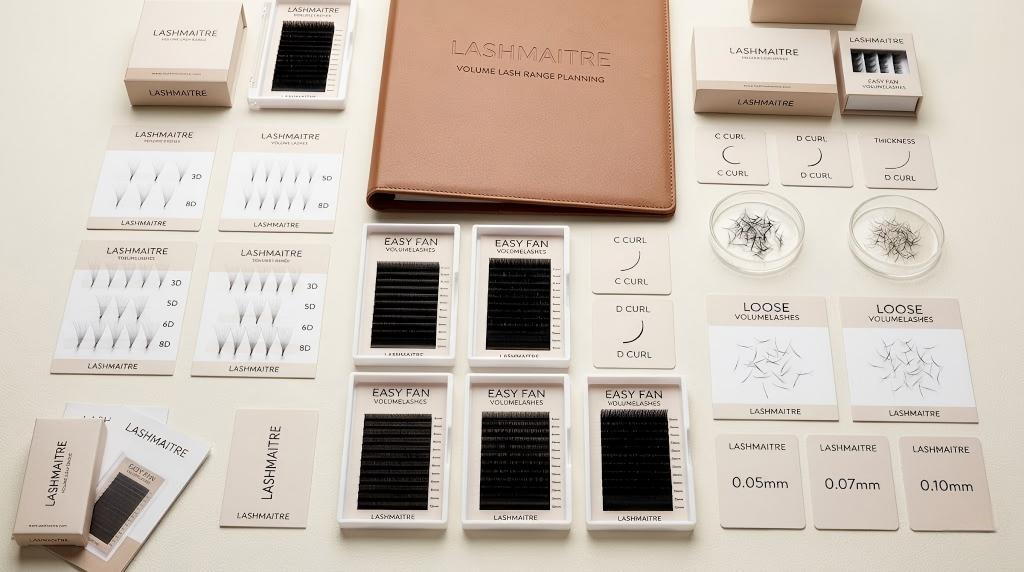
Volume lash range planning for wholesale buyers should begin before a brand asks for every curl, thickness, fan type, and length in one quote. "Volume lashes" can mean several different product paths: premade fan trays, easy fan trays, loose volume lash trays, or a mixed range built for different salon users. If the buyer does not define the product path first, the sample file becomes hard to compare and the reorder file becomes hard to repeat.
For a salon chain, distributor, academy, ecommerce brand, or private label startup, the safest first step is a small range that can be tested. The goal is not to show the biggest catalog. The goal is to build a salon-ready range that artists can understand, buyers can reorder, and packaging teams can label correctly.
If your team is still comparing product types, use LASHMAITRE's easy fan vs premade fan lashes guide first. This article focuses on range planning after the buyer knows volume products belong in the line.
Define the Volume Product Family First
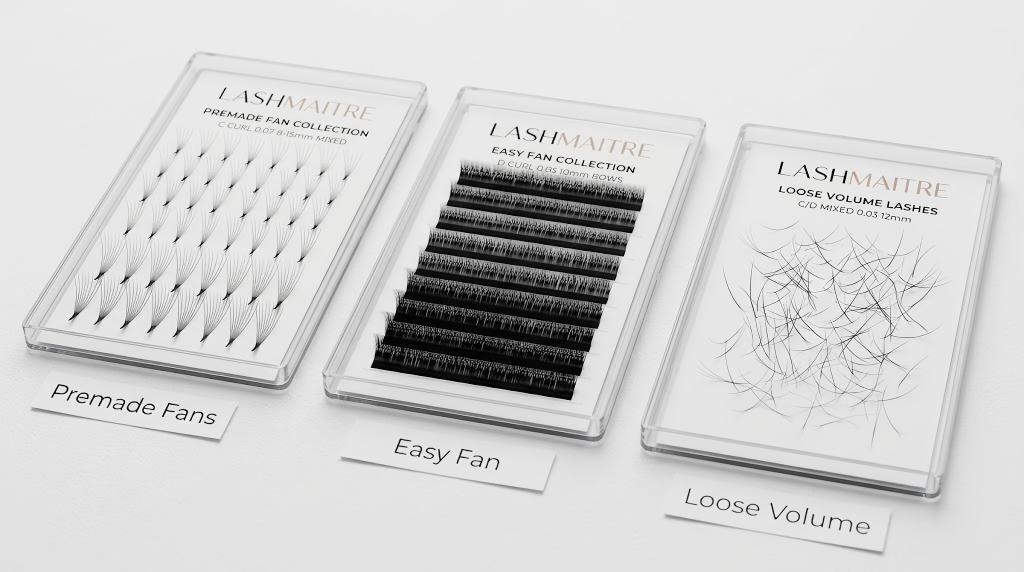
The first mistake is treating every volume product as the same tray. A buyer may ask for "volume lashes wholesale" while expecting premade fans, easy fan lashes, or loose volume fibers. These products support different users.
Use this definition before sample requests:
| Product path | Buyer use case | Planning note |
|---|---|---|
| Premade fans | Faster volume service with already formed fans | Choose D-count, curl, thickness, stem, label naming, and sample approval |
| Easy fan lashes | Artists create fans during pickup from a tray strip | Check strip release, fan opening, row density, curl, and thickness |
| Loose volume lashes | Advanced artists build fans manually | Plan curl, thickness, length, fiber finish, and training fit |
| Mixed volume range | Brand covers multiple salon levels | Keep the first range narrow so buyers understand each product role |
This definition protects the buyer from approving packaging for the wrong product name. A tray labeled as easy fan should not be treated as a premade fan reorder. A 5D premade fan should not be grouped with loose 0.07 volume trays without clear naming.
Match Volume Lash Range Planning to Buyer Type
A good volume range starts with the end buyer. A salon chain may need practical trays for daily service speed. A training academy may need products that help students learn control. A distributor may need a slightly wider range, but still needs clear naming. A private label startup usually needs fewer SKUs, better packaging proof, and repeatable samples.
Use this buyer map:
| Buyer type | First range priority | Avoid |
|---|---|---|
| Salon chain | Reliable service menu fit and repeatable trays | Too many experimental specs |
| Academy | Clear training behavior and simple labels | Products that confuse beginner artists |
| Distributor | Balanced coverage across common volume looks | Launching every D-count at once |
| Private label startup | Small branded range with strong sample approval | Custom packaging before specs are final |
| Ecommerce brand | Simple product names and clear images | Overly technical product names |
The Shopify wholesale suppliers guide is useful for thinking about supplier and inventory planning before buying products. For volume lashes, supplier planning should include sample behavior, not only price and MOQ.
Build a Starter Matrix Instead of a Full Catalog
Buyers often want a full range immediately. That can create too many samples, too many labels, and too many reorder risks. A better first range uses a starter matrix.
Start with these decisions:
| Spec area | Starter decision | Why it matters |
|---|---|---|
| Product method | Premade fan, easy fan, loose volume, or small mix | Defines the buyer's service promise |
| Curl | C, CC, D, M, or buyer's core curls | Controls the finished look and reorder logic |
| Thickness | 0.03, 0.05, 0.07, or planned weight | Affects appearance, use case, and sample comparison |
| Fan dimension | 2D, 3D, 5D, 6D, 10D, or not applicable | Keeps density aligned with buyer type |
| Length format | Mixed tray or single length | Changes inventory and SKU count |
| Label text | Product type, curl, thickness, length, fan method | Prevents private label confusion |
| Packaging level | Stock tray, logo label, custom box, insert, carton label | Connects sample approval to final presentation |
This matrix can be small. A new brand may only need two curls, one or two thicknesses, and a small number of D-counts or easy fan tray options. Expansion can come later after samples and buyer feedback.
Test Samples Before Packaging Approval
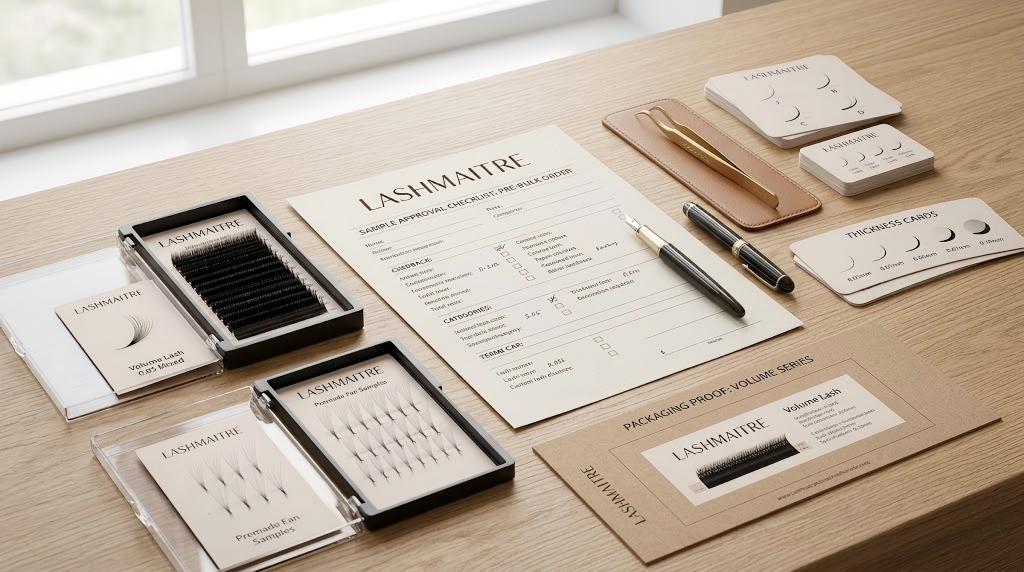
Volume lash samples should be tested before packaging is finalized. A tray can look strong in a photo but still fail in daily use if pickup, fan opening, curl consistency, row spacing, or label accuracy is not right.
During sample review, check:
- Whether the product method matches the buyer's expectation.
- Whether curls remain consistent across rows.
- Whether thickness and fan dimension match the planned service menu.
- Whether artists can use the tray without confusion.
- Whether the label text matches the physical sample.
- Whether packaging proof uses the final product name.
- Whether sample photos can be saved for future reorders.
The FDA eye cosmetic safety page is a general reminder that products used around the eye area deserve careful handling and responsible buyer checks. For wholesale planning, that means samples should be reviewed before a large launch.
Connect Volume Lash Trays to SKU Naming
A volume lash range can become confusing quickly if product names are not controlled. "Volume 5D D Curl" may not be enough if the buyer also needs thickness, length format, stem type, packaging version, or easy fan strip behavior.
Each SKU record should include:
- Product method.
- Fan dimension or tray type.
- Curl.
- Thickness.
- Length range.
- Tray label text.
- Packaging version.
- Approved sample photo.
- Buyer feedback.
- Reorder code.
The premade fans wholesale tray specs guide can help buyers who need a deeper premade fan spec matrix.
Private Label Volume Lashes Need Proof Before Bulk Orders
Private label volume lashes need packaging proof tied to the approved sample. Do not approve a box, sleeve, label, or insert card before the product name and tray specs are stable. A packaging file that says "volume lashes" may be too vague if the final product is a 5D premade fan tray or an easy fan tray.
Good packaging proof should show:
- Product method.
- Curl and thickness.
- Fan dimension where relevant.
- Length format.
- Buyer brand or LASHMAITRE sample reference.
- Label text and packaging version.
- Approval date.
- Approved sample photo.
The FDA cosmetics labeling guide is a useful general reference for careful label information handling. Lash buyers should keep product names and label details aligned with the approved tray.
Turn the Approved Range Into a Reorder File
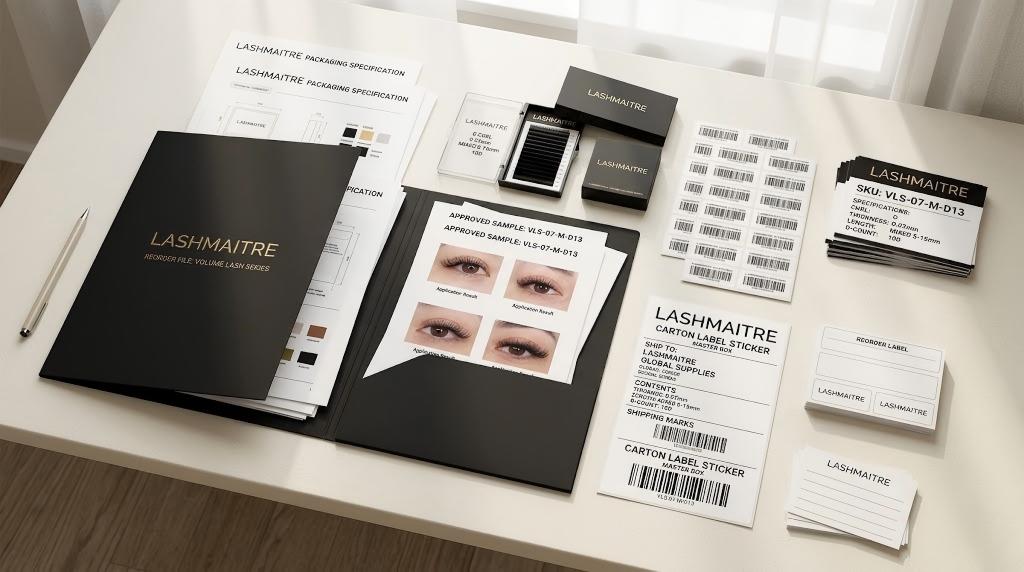
The final step in volume lash range planning is the reorder file. A buyer should be able to place a second order without rebuilding the whole conversation. The file should make the approved range easy to repeat.
Save:
- Approved sample photos.
- Tray and packaging photos.
- Product method and SKU name.
- Curl, thickness, fan dimension, and length range.
- Label text.
- Packaging proof.
- Carton label or shipment label where needed.
- Buyer corrections.
- First order quantity and reorder instructions.
The ISO 9001 quality management systems standard is a general reference for documented and repeatable requirements. A lash buyer does not need a formal audit for every tray, but written sample and reorder requirements reduce avoidable mistakes. Reference: ISO 9001:2015.
Use LASHMAITRE's lash extension samples page when you need a sample-first path before committing to a volume lash range.
FAQ: Volume Lash Range Planning
What should a wholesale volume lash range include first?
A first volume lash range should include a clear product method, core curls, selected thicknesses, a narrow fan or tray structure, sample approval notes, label text, packaging proof, and reorder records.
Should a new brand stock premade fans and easy fan lashes together?
It can, but only if each product has a clear role. Premade fans and easy fan lashes solve different product problems, so the first range should not mix them without clear labels and sample files.
How many volume lash SKUs should a buyer start with?
Most new buyers should start with a small range that can be sampled and repeated. Too many curls, thicknesses, D-counts, and length formats make packaging and reorders harder.
Why does packaging proof matter for volume lashes?
Packaging proof connects the visible product name with the approved tray specs. It helps prevent a buyer from approving one sample and reordering another product by mistake.
How can buyers avoid volume lash reorder mistakes?
Save approved sample photos, tray specs, label text, packaging proof, buyer feedback, and reorder codes in one file before bulk production.
Conclusion: Build a Range You Can Repeat
Volume lash range planning should not be a catalog dump. It should connect buyer type, product method, curls, thicknesses, fan structure, samples, packaging proof, and reorder records. A smaller approved range is easier to sell, train, and repeat than a large product line with unclear sample history.
Send LASHMAITRE your buyer type, planned volume look, preferred fan method, sample request, packaging needs, first order quantity, and destination country. We can help prepare a focused volume lash sample path before bulk production.
Buyer next step: For a first volume range, pair the planned curls and thicknesses with the MOQ 50 wholesale lash extensions route, then send the final sample list through the wholesale lash extensions inquiry page.
Buyer next step: A volume lash range should connect curl, thickness and fan density decisions with LASHMAITRE lash quality control before the buyer scales salon-ready trays.

Lash Maitre: Your Trusted Partner in Eyelash extension Solutions
Lash Maitre is dedicated to providing professional insights and tips in the eyelash extension industry. Sharing the latest trends, techniques, and product knowledge, Lash Maitre helps lash artists and enthusiasts enhance their skills, stay inspired, and achieve the perfect lash experience.