Lash GTIN Change Rules: 10 Decisions Before Reprinting Barcodes

Share
Lash GTIN change rules help a private-label brand decide whether a changed product can keep its current identifier or needs a new GTIN before barcode artwork is reprinted. Review the commercial product, declared content, dimensions, brand, case quantity, assortment and channel impact first. The brand owner or authorized identifier owner should make and document the final assignment decision under current GS1 rules and trading-partner requirements.
Lash GTIN Change Rules: Direct Answer
Do not treat every artwork edit as a new-barcode event, and do not assume the old GTIN can follow every product change. A new trade item needs a new GTIN. Certain changes to an existing item can also require one when buyers, consumers, regulators or supply-chain systems must distinguish the changed item. Record the decision before approving packaging, retailer data or production labels.
What a GTIN Decision Controls
A Global Trade Item Number identifies a trade item that may be priced, ordered or invoiced. It is not the same as an internal SKU, artwork file name, production lot or purchase order. One internal product record may therefore hold several identifiers for different sellable or shippable configurations.
For a private-label lash brand, the GTIN decision can affect:
- tray or retail-box artwork;
- marketplace and retailer listings;
- carton and case records;
- purchase orders and invoices;
- warehouse receiving and replenishment;
- launch dates and remaining old-version inventory;
- inspection samples and barcode scan tests.
The GS1 GTIN Management Standard separates a new product from a change to an existing product and describes ten change situations. It also states that applicable local legal and regulatory requirements take priority. This article turns that framework into an operational lash-buyer review, not a legal ruling or a substitute for GS1 guidance.
Ten Product Changes to Review
| Change decision | Lash example | Control before artwork release |
|---|---|---|
| 1. New product introduction | A new premade-fan line joins the range | Create a separate item record and identifier plan |
| 2. Declared formulation or functionality | A liquid accessory changes declared formulation or intended function | Check current GS1 and market rules; separate old and new evidence |
| 3. Declared net content | Unit count or declared contents change | Confirm whether the sellable item needs a new GTIN |
| 4. Dimension or gross-weight change | Retail box or packaged tray changes materially | Measure the final pack and apply the current threshold/rule |
| 5. Certification mark change | A certification mark is added or removed | Verify authorization and identifier impact before printing |
| 6. Primary brand change | The same physical product moves to a different primary brand | Treat brand ownership and listing continuity as controlled decisions |
| 7. Time-critical or promotional item | A limited launch or pre-priced promotion is created | Define whether it is a distinct trade item |
| 8. Pack or case quantity | A case changes from 20 to 24 retail boxes | Review the higher packaging level and assign the correct case identity |
| 9. Predefined assortment | A mixed lash set changes its included styles | Control the assortment as a defined item, not an informal bundle |
| 10. Price printed on pack | A fixed printed price is introduced or changed | Confirm the GTIN rule and retire obsolete artwork |
Use the standard itself for the exact rule, examples and exceptions. Do not convert this summary into an automatic “yes/no” engine without checking the actual product and target market.
Separate the Consumer Item From the Shipping Case
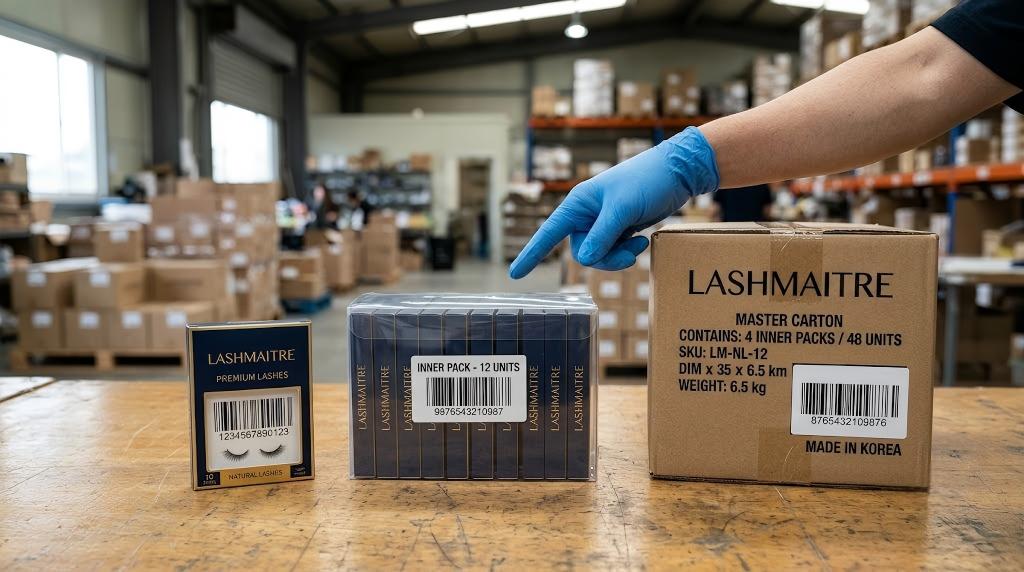
A lash tray sold to a customer and a master case used only for shipping are different packaging levels. A case may need its own higher-level identity even when the retail item is unchanged.
GS1 US explains that a shipping case containing one child GTIN can use a GTIN-14 and an ITF-14 barcode for shipping and receiving. It also notes that after a case is set to “In Use,” changing the contained item or quantity requires a new case and GTIN. Review the current GS1 US shipping-case instructions for the applicable setup.
Build a GTIN Change Request
Before anyone edits the barcode area, create one controlled request with these fields:
| Field | Required evidence |
|---|---|
| Existing item | Product name, SKU, GTIN and packaging level |
| Proposed change | Exact before/after description |
| Reason | Commercial, quality, supplier, regulatory or channel driver |
| Effective date | Planned production and listing transition dates |
| Physical evidence | Approved sample, dieline, measurements and pack count |
| Rule review | Current rule used and reviewer |
| Channel impact | Retailer, marketplace, distributor and warehouse systems |
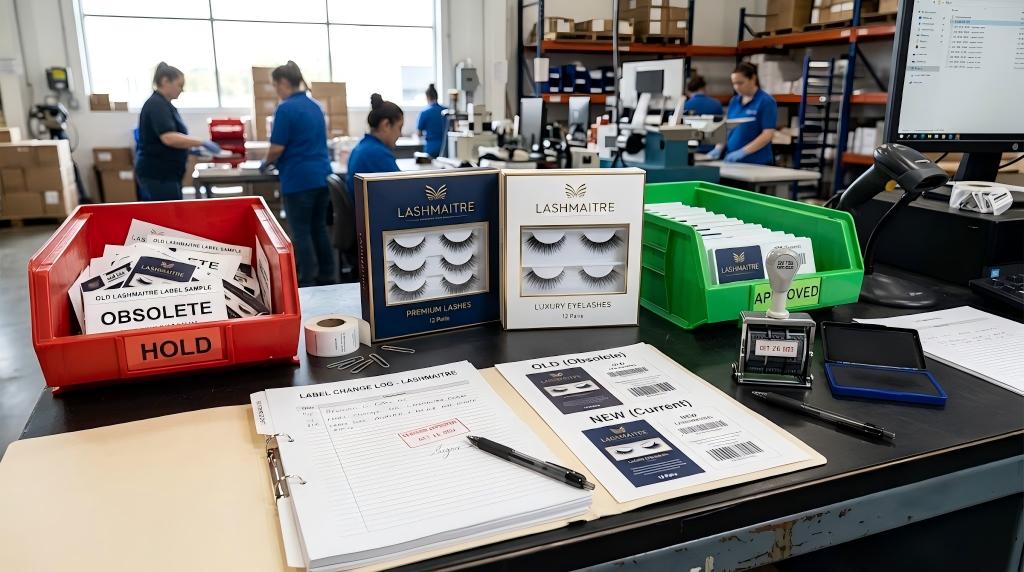
| Inventory disposition | Use-through, relabel, hold, return or destroy decision |
| Approval | Brand owner and required functional approvers |
| Verification | Barcode, artwork, listing and production checks |
Link this request to the authoritative lash product master data record. The master should preserve the old value, new value, revision, effective date and decision owner.
Use a Four-Gate Workflow
Gate 1: Define the trade item
Confirm what is actually priced, ordered or invoiced. A single tray, a two-pack sold together, an inner pack and a master case should not be blurred into one label decision.
Gate 2: Compare the change with current rules
Record the relevant GS1 rule and any retailer or market requirement. If the case is uncertain, obtain guidance from GS1, the trading partner or a qualified adviser before assigning or reusing an identifier.
Gate 3: Control the transition
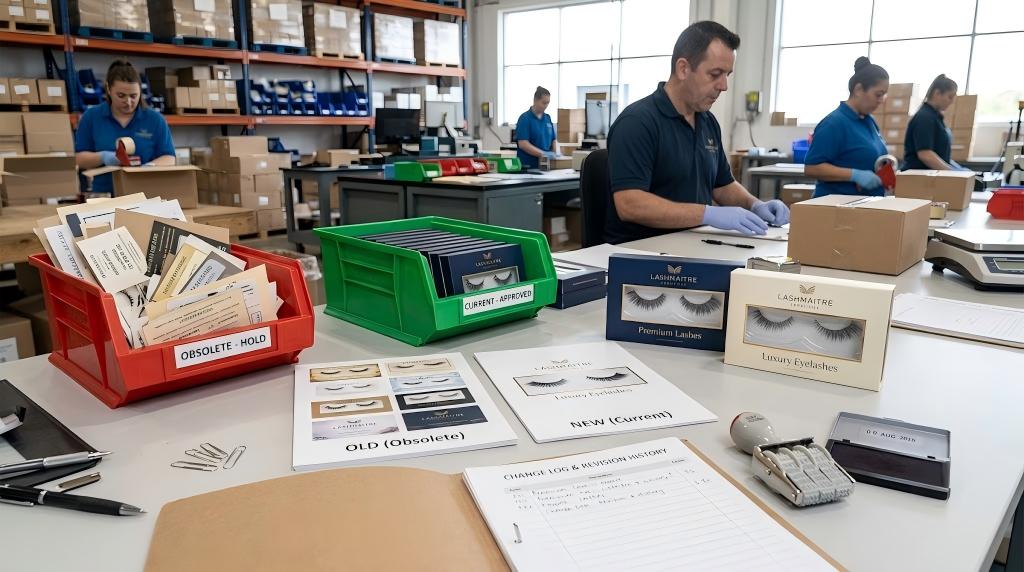
Decide when old production stops, when the new identifier becomes active and how remaining inventory will be handled. Never allow two materially different products to circulate under one uncontrolled identity.
Gate 4: Verify every downstream use
Check the GTIN in the master record, barcode artwork, printed package, case label, retailer portal, invoice, packing list and warehouse system. Apply the lash barcode verification checks to the real production symbol, and use LASHMAITRE quality control to connect the approved change with sample and shipment evidence.
Common GTIN Change Failures
- Reusing a GTIN because the marketing name looks similar.
- Assigning a new GTIN for a minor design edit without reviewing the underlying item.
- Changing case quantity but leaving the old case barcode active.
- Updating the printed barcode but not the retailer item record.
- Launching a new identifier before product attributes and packaging are final.
- Failing to separate old and new inventory during the effective-date transition.
- Allowing the supplier to invent identifiers without confirming brand-owner authority.
- Treating an internal SKU as if it were a globally unique trade-item identifier.
Buyer Release Checklist
Before reprinting barcodes, confirm:
- The existing GTIN and packaging level are documented.
- The proposed change is described as exact before/after values.
- The current GTIN rule has been reviewed.
- The identifier owner has approved the decision.
- Product and case records agree.
- Obsolete artwork is blocked from production.
- Retailer and warehouse records have a transition plan.
- A production barcode sample will be scanned.
- Old and new inventory can be distinguished.
- Final evidence will be retained with the release record.
Lash GTIN Change Rules FAQ
Does every packaging redesign require a new GTIN?
No. The decision depends on what changed, whether the trade item is new, and whether current GS1, market or trading-partner rules require the changed item to be distinguished. Review the actual change before reusing or replacing the identifier.
Does changing the case quantity require a new identifier?
It can. A different fixed quantity changes the shipping configuration. Review the current pack/case-quantity rule and the higher packaging-level record before producing a new case label.
Can a lash supplier assign the GTIN?
The responsible brand owner or authorized identifier owner should control assignment. Clarify ownership in writing before a private-label supplier builds artwork or retailer files around a number.
Is a SKU the same as a GTIN?
No. A SKU is an internal inventory code. A GTIN is a standardized trade-item identifier used across trading partners. Keep both in the product master and map them explicitly.
Should old barcodes be deleted after a change?
Preserve historical evidence and follow the applicable retirement process. Block obsolete artwork from new production, but retain the old identifier, dates, affected inventory and disposition in the controlled record.
Conclusion: Decide Before You Print
Reliable lash GTIN change rules turn a product change into a documented identifier decision before artwork, inventory and retailer systems diverge. Define the trade item, review the current rule, control the effective date and verify every downstream record.
For a private-label review, compare the approved product with LASHMAITRE lash extension samples, then explore LASHMAITRE private-label lash extensions and send an inquiry with the current SKU/GTIN, proposed change, packaging level, artwork revision and target sales channels.

Lash Maitre: Your Trusted Partner in Eyelash extension Solutions
Lash Maitre is dedicated to providing professional insights and tips in the eyelash extension industry. Sharing the latest trends, techniques, and product knowledge, Lash Maitre helps lash artists and enthusiasts enhance their skills, stay inspired, and achieve the perfect lash experience.