Lash Nonconforming Product Control: 8 Proven Disposition Checks

Share
Lash Nonconforming Product Control Buyer Summary
Lash nonconforming product control should identify the failed requirement, preserve product and batch identity, segregate affected units, define scope and risk, authorize disposition, verify the result and release product only through a documented quality decision.
Lash nonconforming product control means identifying and segregating any product, component or packaging that fails an approved requirement, preserving its batch identity, assessing the affected scope, selecting an authorized disposition, verifying the result and releasing it only through documented approval.
What Is a Nonconforming Lash Product?
A nonconforming product is any lash tray, premade fan, adhesive-area component, insert, label, carton or finished pack that does not meet the current approved requirement. The issue may involve curl, length, thickness, fan construction, quantity, cleanliness, tray identity, artwork, barcode, packaging condition or another documented specification.
Nonconforming does not automatically mean unusable. It means the product cannot move forward as conforming until an authorized decision is made and supported by evidence.
FDA's cosmetics GMP inspection checklist states that materials not meeting acceptance specifications should be identified and controlled to prevent their use, and that rejected-material disposition records should be maintained. This article applies those control principles to an operational lash-order workflow; it does not claim one universal legal procedure for every product or market.
Why a Red Tag Alone Is Not Enough
A hold card can stop immediate movement, but it does not establish the size of the problem, the correct revision, the affected orders or the final decision. If product stays physically mixed with approved stock, loses its lot identity or receives an informal verbal release, the original issue becomes harder to reconstruct.
Buyers should ask for a complete control chain: detection, identification, segregation, assessment, disposition, execution, verification and release.
8 Disposition Checks Before Release
1. Identify the Exact Requirement
Record the specification, approved sample, artwork, packaging instruction or order term that was not met. Avoid vague statements such as “quality issue” when the real failure is a 12 mm tray labeled as 11 mm.
2. Preserve Product and Batch Identity
Keep the purchase order, SKU, lot or batch, quantity, date, supplier and revision linked to the affected product. If identity is uncertain, widen the hold until traceability is restored.
3. Physically Segregate the Material
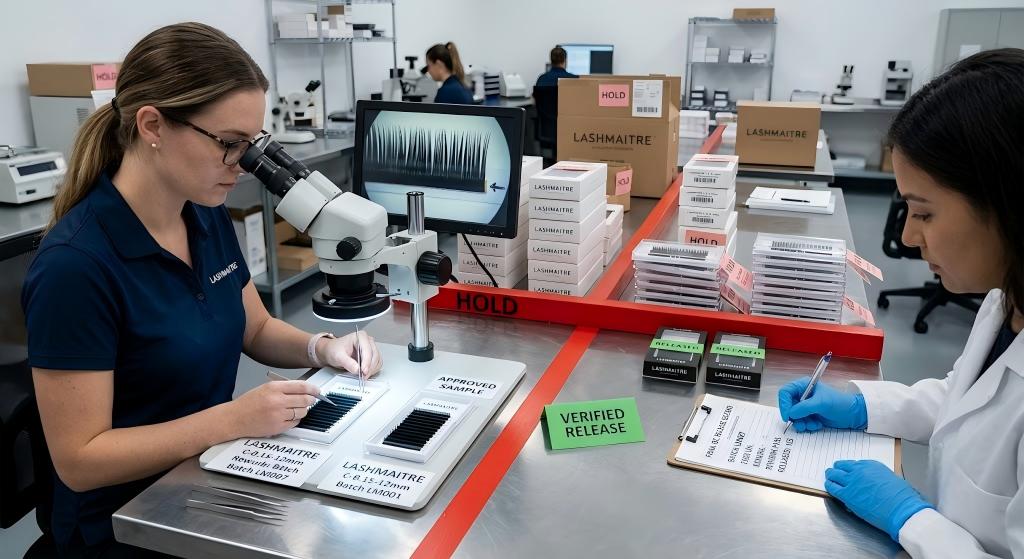
Move affected units to a controlled area or clearly bounded container. Use a status label that cannot be confused with released inventory, and restrict access to authorized staff.
4. Define the Affected Scope
Determine whether the issue affects one tray, one carton, one packing station, one production time window or the entire batch. Review adjacent units and related records instead of assuming the first visible defect is isolated.
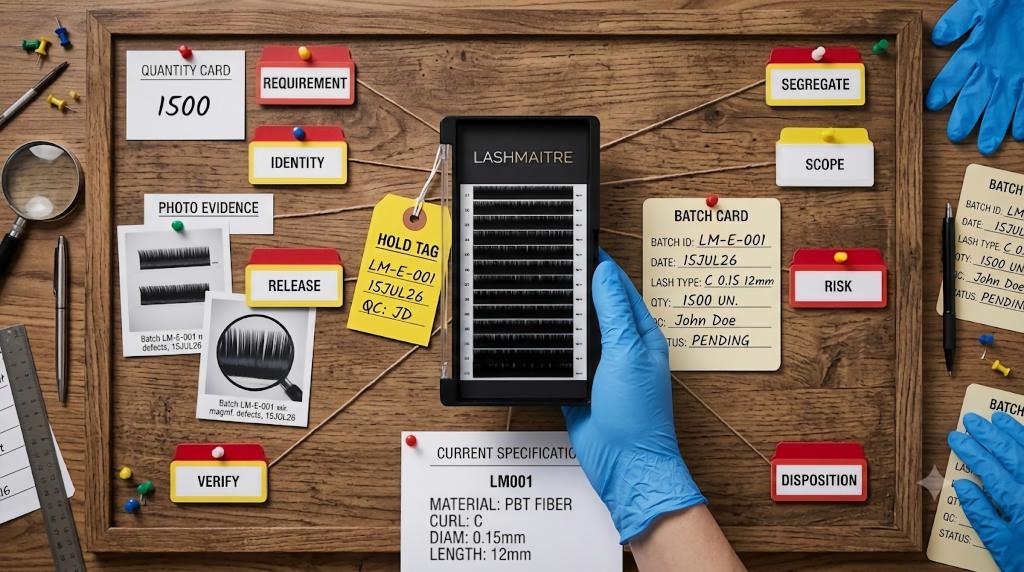
5. Assess Product and Buyer Risk
Consider function, appearance, labeling, customer promise, traceability and the chance that affected units have already moved. A minor packaging scuff and a wrong-SKU label require different containment.
6. Select an Authorized Disposition
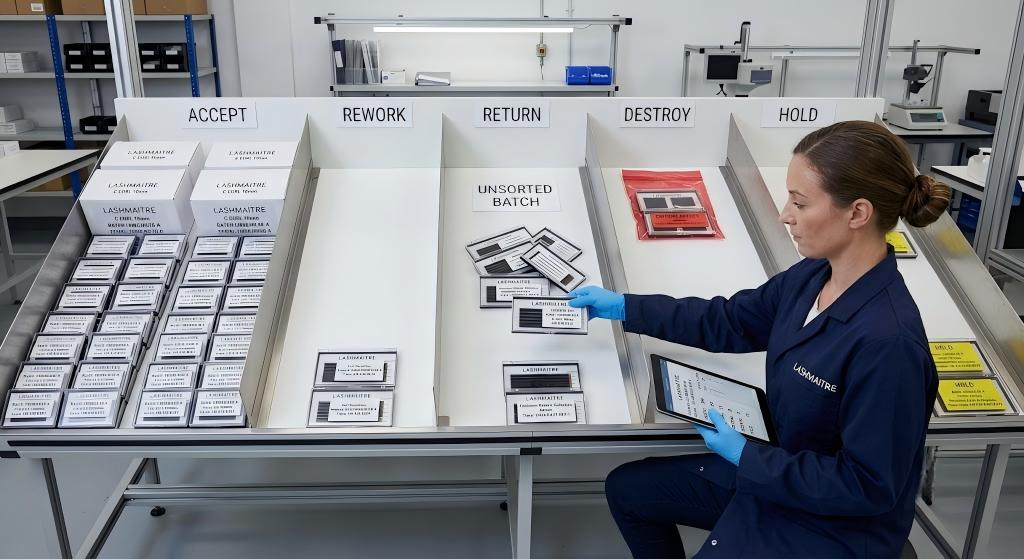
Choose from defined options such as accept under approved concession, rework, return to supplier, destroy or continue to hold. The reason, quantity and approver should be recorded.
7. Verify the Disposition Result
Reworked units need reinspection against the original acceptance requirement. Returned or destroyed quantities need count evidence. A concession needs defined limits and buyer authorization where required.
8. Release Through a Controlled Record
Only authorized quality personnel should change the status from hold to released. Link the release to the completed disposition, inspection result and final quantity.
Product Disposition Decision Table
| Disposition | Use when | Required evidence | Do not release when |
|---|---|---|---|
| Accept | Product fully meets the approved requirement after review | Inspection result and authorization | Requirement or identity remains uncertain |
| Concession | A defined deviation is accepted by authorized parties | Written limit, quantity, reason and approval | Safety, legality or customer identity is compromised |
| Rework | A controlled method can restore conformity | Rework authorization and reinspection | Method, components or verification are undefined |
| Return | Supplier must recover or replace affected material | Quantity, shipment and supplier acknowledgment | Product can re-enter stock without control |
| Destroy | Product must be made unusable and removed | Count, method, date and witness or approval | Destruction quantity cannot be reconciled |
| Hold | Evidence or decision is incomplete | Hold identity, location, owner and review date | Never release by elapsed time alone |
What Should the Record Contain?
At minimum, record the detection date, product identity, order and batch, affected quantity, requirement, observed condition, photographs or sample references, scope check, risk assessment, disposition, approver, execution evidence, verification result and final status.
The record should also link to any related supplier communication or corrective action without turning every isolated defect into an unsupported systemic claim.
Common Control Failures
- Leaving held trays on the normal production or packing table.
- Using a red label without recording the affected quantity.
- Separating product from its batch or specification revision.
- Accepting a verbal rework instruction with no method or verification.
- Releasing part of a lot while the affected scope remains unknown.
- Destroying material without reconciling the final quantity.
- Treating a buyer concession as permanent specification approval.
Lash Nonconforming Product Control FAQ
What is a nonconforming lash product?
It is a lash product, component or package that does not meet a current approved requirement and therefore needs controlled assessment and disposition before use or release.
Does every nonconforming product need to be destroyed?
No. Depending on evidence and authorization, the decision may be accept, concession, rework, return, destroy or continued hold.
Who should approve disposition?
The factory should define authorized quality roles, and buyer approval should be obtained when the decision changes an agreed product, packaging or order requirement.
Can held product be released after reinspection?
Yes, but only when the reinspection verifies the applicable requirement and the authorized disposition and release are documented.
Control the Decision, Not Just the Defect
Build nonconforming-product control into documented lash quality control, approved lash samples, a defined private label lash program and a traceable wholesale lash inquiry.
Authority reference: FDA cosmetics GMP guidelines and inspection checklist.
When a nonconformance affects buyer requirements, shipped product or multiple lots, apply a defined lash quality escalation matrix to set notification timing, decision ownership and the next update.
When product is suspected or confirmed as nonconforming, a controlled lash quality hold procedure should define identification, segregation, investigation, disposition authority and final verification before release.

Lash Maitre: Your Trusted Partner in Eyelash extension Solutions
Lash Maitre is dedicated to providing professional insights and tips in the eyelash extension industry. Sharing the latest trends, techniques, and product knowledge, Lash Maitre helps lash artists and enthusiasts enhance their skills, stay inspired, and achieve the perfect lash experience.