Lash Supplier Performance Scorecard: 8 Proven Reorder Metrics
Share
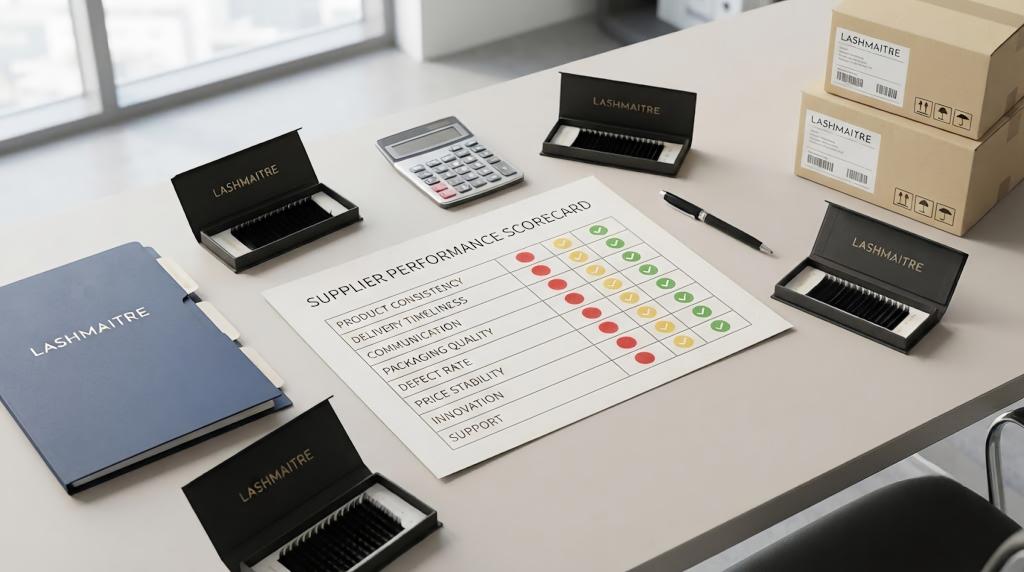
A lash supplier performance scorecard should turn completed order records into a repeatable reorder decision. Score quality, on-time delivery, quantity accuracy, lead-time reliability, packaging accuracy, communication, corrective-action response and commercial consistency from evidence—not catalog claims or one successful sample.
Lash Supplier Performance Scorecard Buyer Summary
- Use the same metric definitions for every supplier and review period.
- Measure performance by SKU, order and agreed due date.
- Separate supplier-caused delay from buyer changes or carrier delay.
- Keep quality and delivery more important than a small unit-price difference.
- Review evidence with the supplier before changing future order allocation.
- Treat a new supplier with limited history as “not yet rated,” not automatically poor.

Why a Supplier Review Needs More Than Price
The lowest quoted tray price may not remain the lowest landed cost. A late order can create stockouts, urgent freight or missed campaigns. A quantity mismatch can disrupt receiving and marketplace inventory. A packaging error can force relabeling. A repeated quality problem can consume inspection time and customer-service capacity.

The buyer therefore needs a scorecard that connects price to actual performance. Acquisition.gov describes supplier performance systems that use quality and delivery data when assessing supplier risk. That government framework is not a lash-industry rule, but it illustrates a useful procurement principle: past performance should be measured from completed orders rather than assumed from a quotation. See the Acquisition.gov supplier performance evaluation guidance and its discussion of quantifiable quality and delivery history.
Eight Metrics for a Lash Supplier Performance Scorecard
| Metric | Example measure | Evidence to keep | Suggested weight |
|---|---|---|---|
| Quality conformity | Accepted units or lots against agreed criteria | Inspection report, defect log, approved reference | 25% |
| On-time delivery | Orders ready or dispatched by the agreed date | PO acknowledgement, production update, booking record | 20% |
| Quantity accuracy | Accepted and shipped quantity against PO tolerance | Packing list, receiving count, discrepancy record | 10% |
| Lead-time reliability | Actual cycle against acknowledged lead time | Order timeline and change approvals | 10% |
| Packaging accuracy | Correct artwork, labels, inserts and carton marks | Packaging proof, photos, receiving check | 10% |
| Communication | Timely, complete and actionable updates | Email log, issue notice, escalation record | 10% |
| Corrective action | Containment, root cause and verified prevention | Complaint file and corrective-action response | 10% |
| Commercial consistency | Invoice, price and agreed terms match | Quote, PO, invoice and approved revisions | 5% |

These weights are a buyer-designed example, not a universal standard. A distributor with a launch deadline may increase the delivery weight. A private-label brand with complex boxes may increase packaging accuracy. A buyer should document the selected weights before reviewing suppliers so the result is not changed to justify a preferred answer.
Define Every Metric Before Scoring
Ambiguous metrics produce arguments. “On time” could mean production completed, inspection passed, carrier collected or goods delivered. Define the event and date in advance.
For example, an on-time production metric can compare the supplier-confirmed readiness date with the date the lot became available for inspection. A shipping metric can separately compare booking instructions with carrier collection. This prevents a factory delay from being confused with a buyer-requested hold or a carrier disruption.
Quality scoring also needs a stable reference. Use the approved sample code, specification, packaging proof and agreed inspection rule. The lash specification tolerance guide helps define measurable product and packaging limits, while the lash AQL inspection plan explains how to define a lot, sample and disposition rule before inspection.
Score Supplier-Caused and Buyer-Caused Events Separately
A supplier should not lose points when the buyer changes artwork after approval, delays the balance payment or moves the requested ship date. Equally, a revised promise should not erase an avoidable supplier delay unless the buyer formally accepted the change before the original deadline.
Use an exception column with three classifications:
- Supplier controlled.
- Buyer controlled.
- External or shared.
Record the reason and approval reference. The scorecard should be credible enough for both parties to review, not a one-sided complaint list.
Use a Red, Yellow and Green Reorder Rule
A simple decision band makes the score actionable:
| Result | Buyer interpretation | Possible action |
|---|---|---|
| Green | Performance is stable and evidence is complete | Maintain or gradually increase allocation |
| Yellow | One or more material gaps need a dated improvement plan | Continue conditionally, increase verification or limit risk |
| Red | Repeated or critical failures threaten quality, delivery or brand control | Hold new allocation, require corrective action or qualify an alternative |
| Not rated | Too little completed-order evidence | Use sample-first or limited initial orders and review again |
Do not let one total score hide a critical problem. A supplier with acceptable average performance may still require escalation if there is an uncontained safety issue, unauthorized specification change, serious traceability failure or repeated major defect.
Review the Scorecard With Evidence
Schedule the review after a meaningful period, such as several completed orders or a quarter of regular activity. Bring the PO acknowledgements, inspection results, receiving discrepancies, invoices and issue records. Ask the supplier to correct factual errors and explain exceptions.
If repeated defects appear, use a documented supplier corrective action request rather than reducing the score without a recovery path. Use the LASHMAITRE quality control process to align inspection evidence, then improve the supply relationship or make a defensible allocation decision.
How to Use a Lash Supplier Performance Scorecard
- Define each lash supplier performance scorecard metric before the first scored order.
- Populate the lash supplier performance scorecard from inspection, delivery and quantity records.
- Review the lash supplier performance scorecard with the supplier and resolve disputed evidence.
- Keep a critical-failure rule outside the lash supplier performance scorecard total.
- Compare the lash supplier performance scorecard across several completed orders before increasing allocation.
Lash Supplier Performance Scorecard FAQ
What is a good score for a lash supplier?
There is no universal number. Define the metrics, weights, minimum quality and delivery thresholds, and critical-failure rules before scoring. Compare the supplier against the buyer's actual requirements and evidence, not an arbitrary public benchmark.
How many orders are needed before rating a supplier?
Use enough completed orders to observe normal performance across relevant SKUs, packaging and delivery conditions. One order may reveal a serious problem but rarely proves long-term consistency. Mark limited history clearly rather than inventing a precise rating.
Should price be included in the supplier scorecard?
Yes, but price should be evaluated with quality, delivery, corrective costs and commercial consistency. A small unit-price saving should not outweigh repeated rework, urgent freight or lost selling time.
How often should a wholesale lash supplier be reviewed?
Review frequency should match order volume and risk. A quarterly review can suit active suppliers, while a lower-volume supplier may be reviewed after a defined number of completed orders. Trigger an additional review after a major defect, repeated delay or significant change.
Turn the Next Reorder Into a Measured Decision
Use the wholesale lash supplier red flags guide for initial screening, then use a lash supplier performance scorecard once real order history exists. Send LASHMAITRE your SKU list, expected order cadence, packaging plan and supplier-review priorities through the wholesale lash inquiry page to discuss a measurable supply plan.
Use the supplier scorecard with documented lash supplier delivery performance metrics for promised date, received date, quantity, OTIF, lead-time spread, recovery and recurring causes before allocating the next reorder.

Lash Maitre: Your Trusted Partner in Eyelash extension Solutions
Lash Maitre is dedicated to providing professional insights and tips in the eyelash extension industry. Sharing the latest trends, techniques, and product knowledge, Lash Maitre helps lash artists and enthusiasts enhance their skills, stay inspired, and achieve the perfect lash experience.