Supplier Corrective Action Request for Lash Order Defects
Share
Direct Answer
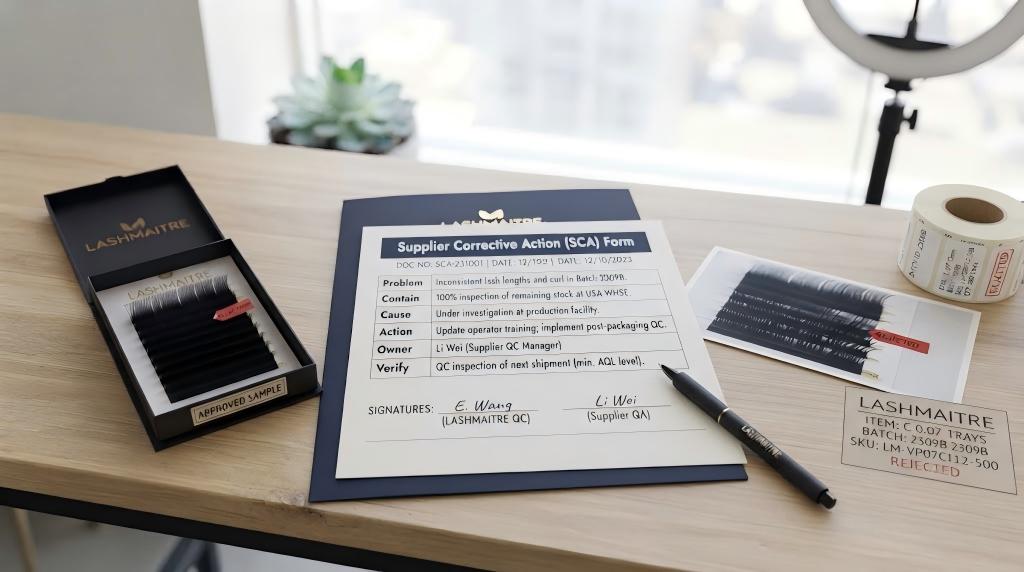
A supplier corrective action request should identify the affected lash SKU and batch, contain the immediate defect, require root-cause analysis, assign a permanent corrective action, set an owner and deadline, and verify that the fix prevents recurrence. It is stronger than a complaint email because it creates a traceable decision before replacement or reorder production begins.
Supplier Corrective Action Request Buyer Summary
A supplier corrective action request turns a lash quality complaint into a traceable recovery process. It should identify the affected SKU and batch, contain current stock, document the defect, require root-cause analysis, assign a permanent action and owner, and verify the fix before replacement or reorder production is approved.
Use a formal corrective-action request for repeated, material, widespread, or business-critical nonconformities. A single minor issue may only need correction, but a recurring defect needs evidence of why it happened and why it should not return.
What Is a Supplier Corrective Action Request?
A supplier corrective action request, often shortened to SCAR, is a structured request from a buyer to a supplier after a product or process fails an agreed requirement.
It separates three jobs:
- Correction: fix or contain the detected problem.
- Cause analysis: determine why the problem occurred.
- Corrective action: remove or control the cause so the problem does not recur.
ISO/IAF guidance on reviewing nonconformities uses the same distinction and emphasizes verifying the effectiveness of the action taken. For a lash buyer, this means that replacing one tray does not automatically prove that the next carton will be correct.
When Should a Lash Buyer Issue One?
A formal request is useful when the issue is more serious than a one-off cosmetic concern.
| Situation | Suggested Buyer Response |
|---|---|
| One isolated, low-impact issue | Record and request correction |
| Repeated defect across trays or cartons | Formal corrective action request |
| Wrong curl, thickness, length map, or product identity | Hold affected stock and investigate batch scope |
| Label, barcode, or carton mismatch affecting traceability | Contain shipment and correct records |
| Defect returns after a previous correction | Escalate root-cause and effectiveness review |
| Safety, regulatory, or major customer impact | Immediate containment and specialist review |
The decision should reflect severity, quantity affected, recurrence, traceability, customer impact, and whether the supplier's process appears uncontrolled.
The Six Fields Every Request Needs
1. Problem Definition
Describe the defect without vague language. Include:
- purchase order or order number
- SKU and product description
- batch or lot ID
- carton number
- quantity inspected and quantity affected
- expected requirement
- observed result
“Lashes are bad” cannot be investigated. “SKU LM-C07-MIX, batch B2407, 8 of 20 sampled trays show the wrong length sequence” can be investigated.
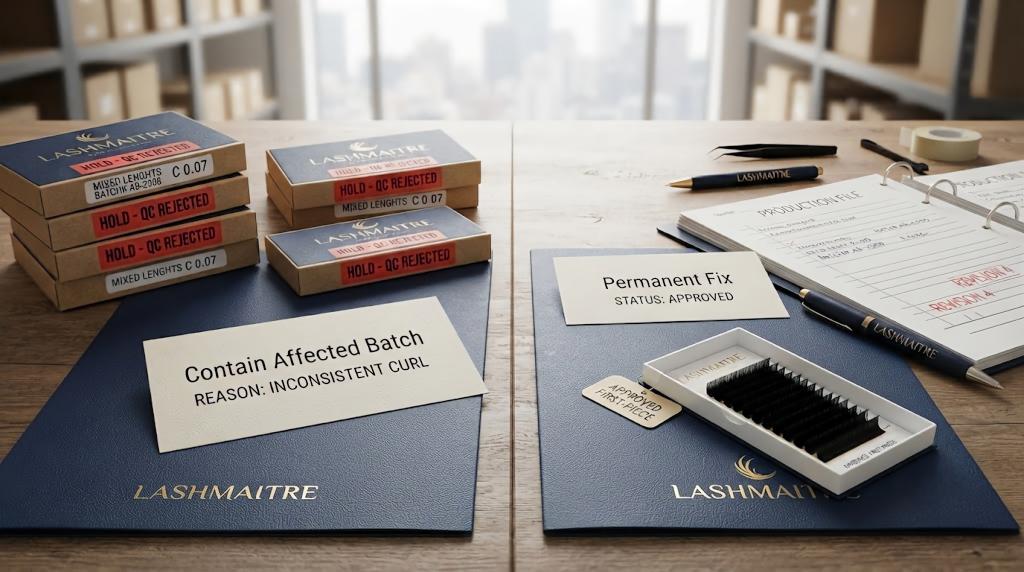
2. Immediate Containment
Containment protects the buyer while the root cause is still unknown.
Possible actions include:
- hold unshipped cartons
- identify affected batch IDs
- separate suspect inventory
- stop using incorrect labels
- inspect remaining stock
- prevent the same material from entering the next order
Containment is temporary protection, not proof of a permanent fix.
3. Root-Cause Analysis
The supplier should explain why the defect occurred, not only who noticed it.
Useful questions include:
- Was the approved sample or specification unclear?
- Was the wrong material, tray card, barcode file, or artwork version used?
- Did the production setup drift?
- Was inspection skipped or ineffective?
- Did a change occur without re-approval?
- Could the same cause affect other SKUs or batches?
4. Corrective Action
The action should address the cause. Examples may include updating the production file, separating label versions, changing an inspection step, adding a first-piece check, retraining the responsible team, or requiring approval before a file is released.
5. Owner and Deadline
Every action needs a named owner and target date. Otherwise the response can remain an open promise without a verified completion point.
6. Effectiveness Evidence
Evidence may include:
- corrected sample or first-piece record
- revised production or packaging file
- inspection result from a new batch
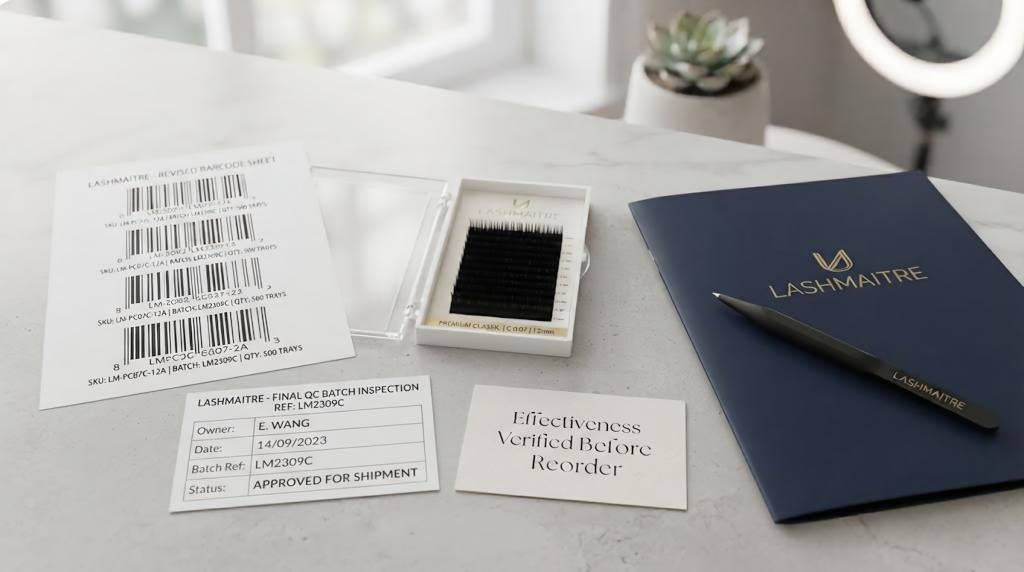
- barcode or label verification
- before-and-after photos
- batch and carton traceability
- buyer re-approval
The LASHMAITRE quality control process gives wholesale buyers a practical path from approved sample to batch, label, carton, and reorder records.
What Evidence Should the Buyer Send?
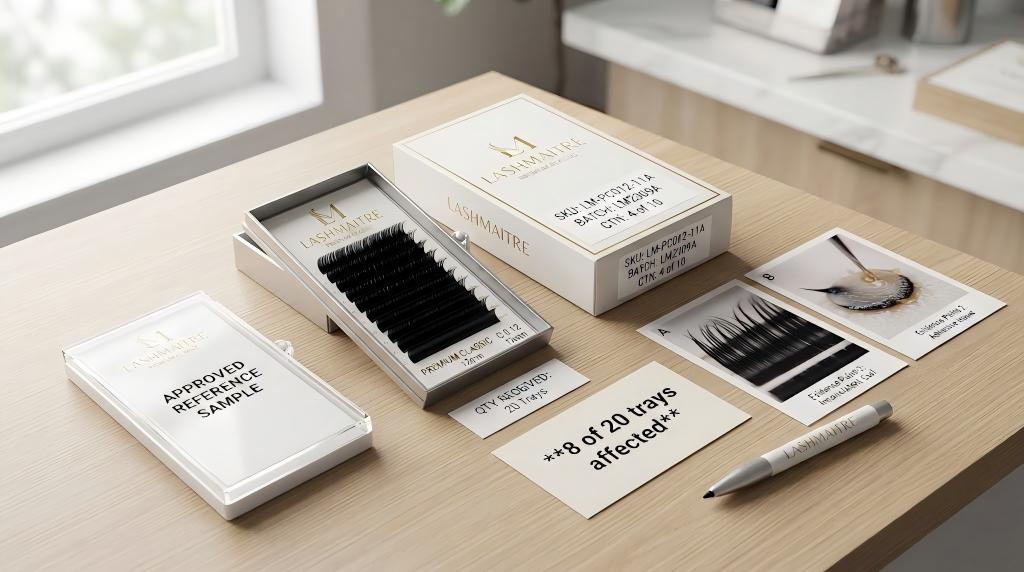
Send evidence that helps the supplier reproduce and isolate the problem:
- clear product photos without filters
- photo of tray card and product together
- SKU, batch ID, and carton label
- number inspected and number affected
- comparison against the approved sample
- short video where movement or handling matters
- receiving date and storage conditions when relevant
- description of the business impact
Do not remove the label information before documenting the issue. Traceability is often what turns a complaint into a solvable production problem.
Correction Is Not Corrective Action
Consider a carton with the wrong barcode.
- Printing a new barcode is a correction.
- Identifying that two artwork versions shared the same filename is cause analysis.
- Adding controlled revision numbers and a release check is corrective action.
- Verifying the next batch against the approved barcode sheet is effectiveness evidence.
This distinction prevents a fast replacement from hiding a process problem.
How to Close the Request Before Reordering
A corrective action should not be closed only because the supplier replied.
Before the next order, confirm:
- The affected batch and quantity were identified.
- Immediate containment was completed.
- The cause explains the observed defect.
- The permanent action addresses that cause.
- The action owner and date are recorded.
- New evidence demonstrates the fix.
- The approved sample, SKU, proof, and reorder record are aligned.
Supplier Corrective Action Request FAQ
What is the difference between a complaint and a supplier corrective action request?
A complaint reports a problem. A corrective action request also requires containment, cause analysis, permanent action, responsibility, timing, and evidence that the action worked.
Should every minor defect trigger a formal request?
No. The response should match risk, recurrence, quantity affected, traceability, and customer impact. Minor isolated issues may only require correction and monitoring.
What should a buyer do with affected inventory?
Identify and separate the affected SKU, batch, and cartons while the scope is investigated. Do not mix suspect inventory with approved stock or the next reorder.
How can a buyer verify a corrective action?
Review a corrected sample, revised file, new batch inspection, traceability record, or other evidence connected to the stated cause. Verification should show that recurrence risk has been reduced.
Can a replacement order close the issue?
Not by itself. A replacement solves supply pressure, but the buyer still needs to know why the defect occurred and what changed before the next production run.
Request a Traceable QC Response
Use the LASHMAITRE wholesale inquiry path to identify the product, batch, evidence, replacement need, and next-order requirement that must be reviewed.
—

Lash Maitre: Your Trusted Partner in Eyelash extension Solutions
Lash Maitre is dedicated to providing professional insights and tips in the eyelash extension industry. Sharing the latest trends, techniques, and product knowledge, Lash Maitre helps lash artists and enthusiasts enhance their skills, stay inspired, and achieve the perfect lash experience.