Volume Lash Starter Range: What New Lash Brands Should Stock First
Share
A volume lash starter range should help a new lash brand launch with confidence, not overwhelm the buyer with every possible curl, thickness, D-count, and packaging option. The first range should be small enough to test, simple enough to explain, and clear enough to reorder.
Many new brands try to stock too much too early. They request premade fans, easy fan lashes, loose volume lashes, multiple curls, several thicknesses, mixed and single lengths, custom packaging, and a large first order in the same project. That approach creates sample confusion and packaging risk.
The better path is to stock the first volume range like a controlled test: choose buyer type, product method, sample plan, packaging proof, and reorder records first. Then expand after the range has real buyer feedback.
If the team has not chosen a product method yet, start with the volume lash range planning guide before finalizing the starter range.
Decide the Starter Buyer Type
The first stocking decision is not the product. It is the buyer. A salon chain, academy, distributor, ecommerce store, and private label startup need different starter ranges.
Use this buyer map:
| Buyer type | Starter priority | Stocking risk |
|---|---|---|
| Salon brand | Practical trays for daily service | Too many experimental styles |
| Academy | Easy-to-understand products for training | Confusing product names |
| Ecommerce startup | Clear product photos and simple options | Wide SKU range before demand exists |
| Distributor | Balanced coverage for different customers | Too much inventory in slow-moving specs |
| Private label brand | Packaging-ready samples and reorder files | Approving packaging before tray specs |
Once the buyer type is clear, the product range becomes easier to narrow.
Choose One Main Volume Product Method First
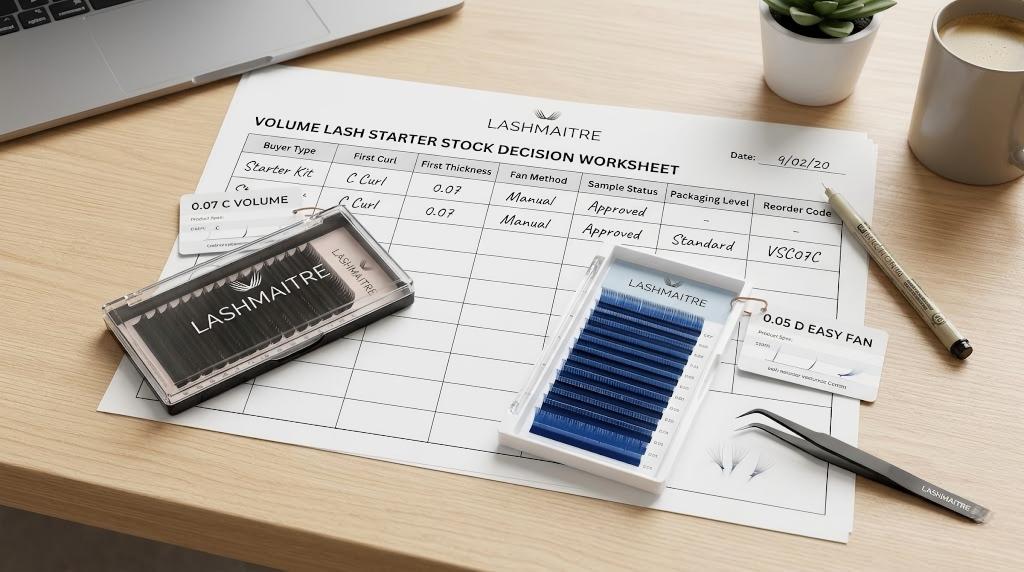
Most new brands should avoid launching every volume product method at once. Choose one main method first, then add secondary products later.
Options:
- Premade fans for ready-formed fan consistency and faster volume service.
- Easy fan lashes for artists who create fans during pickup.
- Loose volume lashes for advanced artist control.
- A small mixed range only when the buyer can explain why each product exists.
If the buyer wants premade fans first, use the premade fan D-count selection draft to choose D-counts. If the buyer is still comparing easy fan and premade fan products, use the easy fan vs premade fan lashes guide.
Build a Small First SKU Range
A starter range should be narrow. The buyer can expand after sample feedback and first sales. Start with the minimum product set that can represent the brand's volume lash direction.
Example starter logic:
| Range decision | Conservative starter choice | Why it helps |
|---|---|---|
| Product method | One main method first | Keeps samples and labels clear |
| Curl | One or two core curls | Reduces inventory complexity |
| Thickness | One core thickness per method | Keeps sample comparison clean |
| D-count or fan style | Two or three core options | Supports buyer choice without clutter |
| Length format | Mixed trays first for easier testing | Reduces single-length inventory pressure |
| Packaging | Logo label or simple proof before full custom box | Prevents packaging rework |
| Samples | Approve before bulk order | Protects first order quality |
The Shopify manufacturer and supplier guide supports evaluating supplier fit before production. For a lash starter range, supplier fit includes sample preparation, packaging proof, and repeatable reorder records.
Do Not Stock Too Many D-Counts First
D-count can make a starter range look bigger than it needs to be. A new brand may want 2D, 3D, 4D, 5D, 6D, 8D, and 10D right away. That creates more labels, more sample approvals, and more slow-moving stock.
A cleaner path:
- Choose the target volume look.
- Select one softer or beginner-friendly option.
- Select one core salon-volume option.
- Add a dense option only if the buyer's market needs it.
- Save expansion ideas for the second order.
For a deeper D-count comparison, use the premade fan D-count selection guide once that post is live.
Sample Before Private Label Packaging
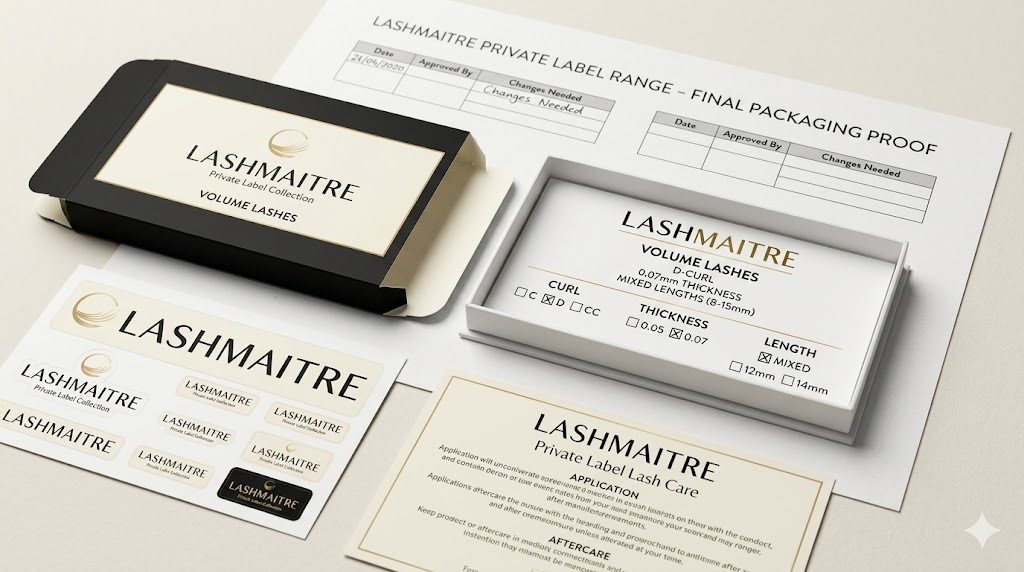
Private label packaging should follow sample approval, not lead it. A buyer may want a custom box immediately, but the package should match the final product name, tray specs, and label system.
Before approving packaging, confirm:
- Product method.
- Curl and thickness.
- D-count or easy fan tray type.
- Length format.
- Tray label text.
- Buyer brand placement.
- Sample photo.
- Packaging version.
- Reorder code.
The FDA cosmetics labeling guide is a useful general reference for careful label information handling. New lash brands should keep product names and label details aligned with approved samples.
Use LASHMAITRE's private label lash extensions page when packaging, brand presentation, and sample approval need to be planned together.
Turn the Starter Range Into a Reorder System
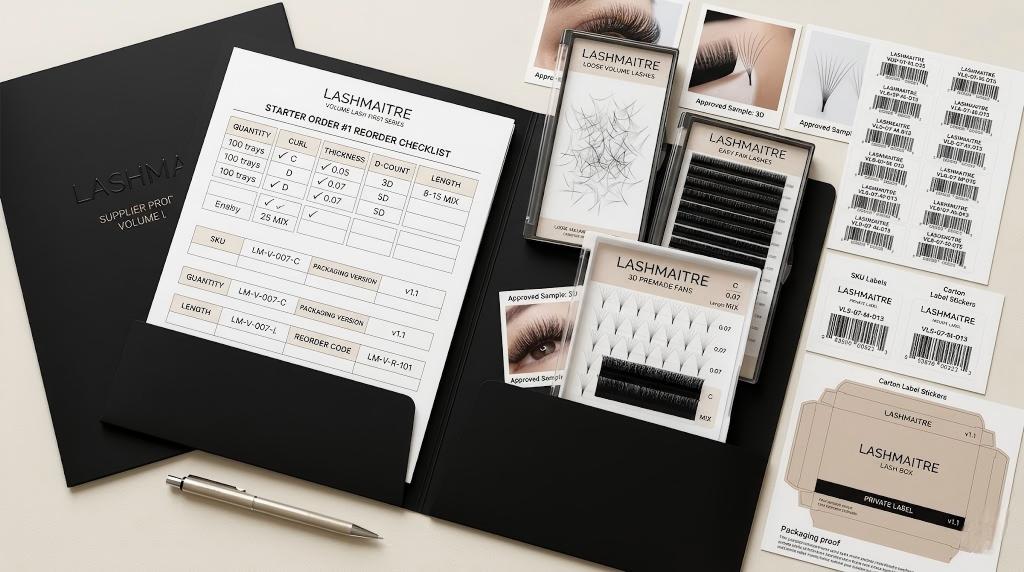
A starter range is only useful if it can be repeated. The first approved order should become a reorder system with product names, sample photos, label proofs, and buyer feedback saved in one place.
Save:
- Approved sample photos.
- Product method and SKU name.
- Curl, thickness, D-count or tray type.
- Length range.
- Packaging proof.
- Label text.
- Carton label if needed.
- Buyer corrections.
- First order quantity.
- Reorder instructions.
The ISO 9001 quality management systems standard is a general reference for documented and repeatable requirements. A new lash brand does not need a formal quality system for every starter order, but it should still keep approved requirements visible. Reference: ISO 9001:2015.
When to Expand the Starter Range
Do not expand only because the supplier can produce more options. Expand when there is a buyer reason.
Expansion signals:
- A current D-count sells faster than expected.
- Salons ask for a second curl.
- A distributor needs a denser or softer option.
- Sample feedback shows a clear gap.
- Packaging and reorder records are stable.
If none of these signals exist, keep the range focused and improve product pages, sample photos, packaging, and reorder flow before adding more SKUs.
Use LASHMAITRE's lash extension samples page when you need to compare options before committing to a full starter range.
Volume Lash Starter Range Quick Review
- Use volume lash starter range planning to keep the first product method, curl, thickness and D-count choices easy to explain.
- Use volume lash starter range planning to connect approved samples with packaging proof, labels and reorder records.
- Use volume lash starter range planning to expand only after buyer feedback and first-order demand are clear.
FAQ: Volume Lash Starter Range
What should a new lash brand stock first for volume lashes?
A new brand should usually start with one main volume product method, one or two core curls, one core thickness, a small D-count or tray-type range, simple packaging proof, and approved samples.
Should a starter range include premade fans and easy fan lashes?
It can, but only if each product has a clear buyer role. Many new brands should begin with one main method first, then add the second after feedback.
How many volume lash SKUs are enough for a first order?
There is no fixed number, but the first order should be small enough to sample, label, explain, and reorder clearly. Too many SKUs make launch and inventory management harder.
Should custom packaging be done before samples?
No. Packaging should follow sample approval so the product name, tray specs, label text, and buyer brand presentation match the approved product.
When should a brand expand the starter range?
Expand after buyer feedback, sales signals, sample results, and reorder records show a clear reason for more curls, D-counts, or product methods.
Conclusion: Stock the First Range You Can Prove
A volume lash starter range should be narrow, practical, and repeatable. New brands should choose buyer type, product method, samples, packaging proof, and reorder records before expanding. The first goal is not to stock every possible SKU. The first goal is to launch a range that buyers understand and the supplier can repeat.
Send LASHMAITRE your launch market, planned volume look, sample budget, packaging goal, first order quantity, and timeline. We can help narrow the first range before bulk production.
LASHMAITRE buyer path: For a starter volume range, buyers can keep the first launch controlled with MOQ 50 wholesale lash extensions and send approved curl, thickness, fan count and packaging notes through the wholesale lash extensions inquiry path.
Buyer next step: Starter volume ranges should be verified through LASHMAITRE lash quality control so early SKU choices can be repeated with stable curl, thickness and tray records.

Lash Maitre: Your Trusted Partner in Eyelash extension Solutions
Lash Maitre is dedicated to providing professional insights and tips in the eyelash extension industry. Sharing the latest trends, techniques, and product knowledge, Lash Maitre helps lash artists and enthusiasts enhance their skills, stay inspired, and achieve the perfect lash experience.