CBP Form 7501 Entry Summary: 8 Fields Lash Importers Should Verify

Share
A CBP Form 7501 entry summary should be checked against the broker entry data, commercial invoice, packing list, purchase records, and receiving file before a lash importer treats it as final. At minimum, verify the importer identity, entry number and type, port and dates, HTS classification, country of origin, entered value, quantity, and duty or fee calculations. A mismatch should be clarified with the customs broker and documented rather than silently accepted.
This guide is for U.S. lash brand owners, procurement teams, and import operations staff reviewing a formal entry. It is an operational checklist, not legal advice or a substitute for instructions from U.S. Customs and Border Protection (CBP), a licensed customs broker, or trade counsel.
CBP Form 7501 Entry Summary Quick Answer
The entry summary is the record CBP uses to assess duties, collect trade statistics, and determine whether applicable requirements have been met. CBP's ACE Entry Summary Instructions explain the data used in electronic entry summaries, while CBP's entry summary process guidance explains where the summary fits after cargo release.
For a lash shipment, use this lash import entry summary as a three-way CBP 7501 review checklist rather than reading the broker form in isolation:
- Compare the broker's entry data with the commercial invoice and packing list.
- Compare both sets with the approved product specification and receiving record.
- Mark each critical field as match, clarify, or hold before closing the file.
What a CBP Form 7501 Does in a Lash Import File
A CBP Form 7501 entry summary, or its electronic equivalent, organizes the importer, shipment, classification, value, origin, quantity, and duty information for an entry. For a wholesale lash brand, it should connect back to real business records: the supplier invoice, approved SKU list, packaging configuration, freight documents, broker instructions, payment support, and received quantities.
The importer should not use the form as the first place where product facts are decided. Material description, construction, country of origin, unit quantities, and commercial value should already be supported by the purchasing and product files. The entry summary is where those controlled facts are reported and reconciled.
Eight CBP Form 7501 Entry Summary Fields to Verify
| Field group | Compare against | Practical stop condition |
|---|---|---|
| 1. Importer identity | Importer master file, CBP registration, broker POA | Legal entity or importer number does not match |
| 2. Entry number and type | Broker entry notice, shipment file | Entry reference or entry type is unexplained |
| 3. Port and dates | Arrival notice, bill of lading, release notice | Port or event date conflicts with the shipment |
| 4. HTS classification | Approved classification record and product specs | Code differs from the approved SKU evidence |
| 5. Country of origin | Supplier declaration, manufacturing records, marking approval | Origin is unsupported or differs by line |
| 6. Entered value | Commercial invoice, valuation worksheet, adjustments | Value or currency basis cannot be reproduced |
| 7. Quantity and units | Packing list, SKU carton map, receiving count | Quantity or reporting unit does not reconcile |
| 8. Duty and fees | HTS rate support, broker calculation, payment record | Rate, base, or calculation is unexplained |
1. Importer Identity and Importer Number
Confirm that the importer name and identification number belong to the entity that is acting as importer of record for the transaction. Check the legal name rather than a shortened brand name. If the purchasing company, brand owner, consignee, and importer are different entities, the file should explain each role.
The broker's power of attorney and importer setup records should point to the same controlled identity. An unexpected name or number is a stop condition because it can disconnect the entry from the company's bond, records, and compliance ownership.
2. Entry Number and Entry Type
The ACE instructions describe the entry number as an 11-character code made from the filer code, entry number, and check digit. Operationally, the importer should use that entry number as the primary key across the broker email, duty payment, shipment folder, receiving record, and any later correction.
Also confirm that the entry type fits the transaction described by the broker. Do not change or guess an entry type internally. Ask the broker to explain any unexpected type and retain the response in the entry file.
3. Port, Entry Date, and Import Date
Match the reported port and dates to the carrier arrival notice, bill of lading or air waybill, cargo release message, and broker timeline. Similar shipment numbers can make it easy to attach the wrong entry summary to a purchase order, especially when several lash shipments arrive during the same week.
Use dates as reconciliation points, not as interchangeable labels. Entry date, import date, release date, and entry-summary filing date can represent different events. If your internal tracker uses only one “arrival date,” add separate fields so the team does not overwrite the sequence.
4. HTS Classification
Compare every reported HTS line with the approved classification record for the actual imported article. Different products in one shipment—lash extensions, strip lashes, trays, tools, or packaging components—may require different descriptions or classifications. Do not copy one line across dissimilar products simply because the supplier used one invoice label.
The evidence should include product photographs, materials, construction, function, packaging configuration, and the reasoning used for the selected code. For the full evidence workflow, use the lash HTS classification guide.
5. Country of Origin
Verify origin at the entry-line level against manufacturing evidence and approved packaging marking. Supplier address, shipping country, and country of origin are not automatically the same. A shipment consolidated in one country may contain goods originating elsewhere.
If products within the same purchase order have different manufacturing origins, the commercial records and entry lines should preserve that distinction. Do not use a carton routing label as the only origin evidence.
6. Entered Value and Currency Support
Reproduce the entered value from the commercial invoice and any documented valuation adjustments. Confirm invoice number, currency, line values, assists or other relevant adjustments identified by the broker, and the relationship between product, packaging, and freight charges.
For private-label lash orders, keep the value logic connected to packaging plates, custom boxes, labels, samples, credits, and other charges when they are relevant to the transaction. The importer should be able to explain how the reported value was built without relying on one person's memory.
7. Quantity and Reporting Units
Match entry quantities with the commercial invoice, packing list, carton map, and receiving count. “Tray,” “box,” “pair,” “piece,” and “carton” are not interchangeable. A carton may contain dozens of retail or wholesale units, while the applicable reporting unit may use a different measure.
Create a conversion record for every SKU: purchase unit, pack size, carton quantity, total units shipped, and the unit used in the entry. This is especially important when a lash collection contains mixed lengths, curls, or tray configurations under similar product names.
8. Duty, Taxes, and Fees
Check the reported duty rate, calculation base, fees, and total against the classification and value support. The invoice classification and duty information should not contradict the entry summary. If the broker calculation changes, retain both the prior version and the explanation for the revision.
Confirm that the payment record is linked to the correct entry number. A paid amount alone does not prove the underlying fields are accurate; it proves only that a payment was made.
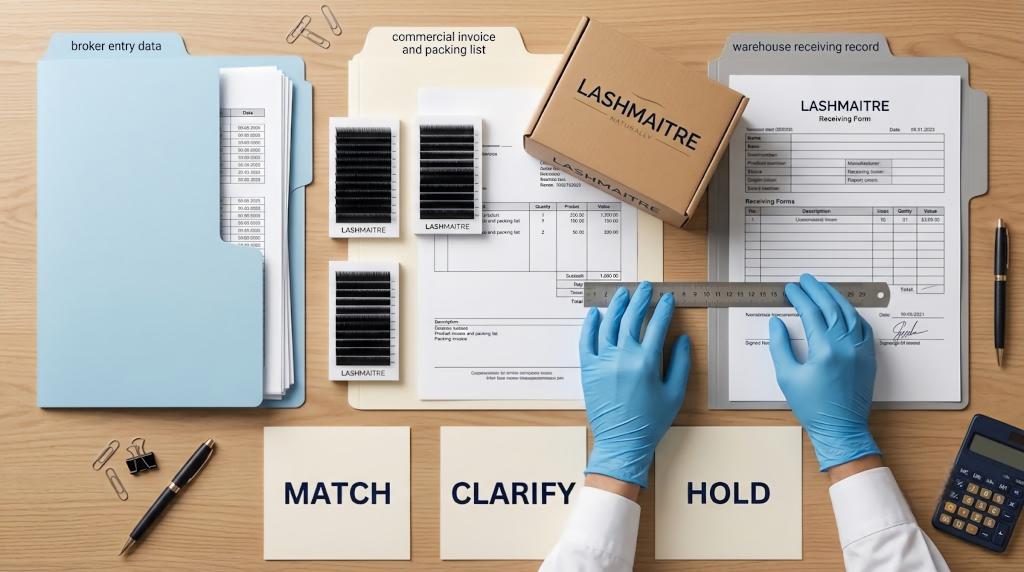
Use a Three-Way Entry Summary Verification
The strongest review compares three independent record groups rather than checking the form in isolation.
| Record group | What it proves | Owner |
|---|---|---|
| Broker entry data | What was transmitted or prepared for CBP | Import compliance / broker contact |
| Commercial file | What was ordered, invoiced, packed, and shipped | Procurement / finance / logistics |
| Product and receiving file | What specification was approved and what arrived | Product QC / warehouse |
Mark every material difference. “Clarify” means the information is not yet supported; “hold” means the team should not close the record or rely on it for future reorders until the discrepancy is resolved.
What to Do When a Field Does Not Match
- Freeze the current record version. Save the entry summary, invoice, packing list, and broker message with a timestamp.
- Name the exact conflict. State the entry number, line, field, reported value, expected value, and evidence source.
- Ask the broker for the transmitted data and explanation. Avoid vague requests such as “please recheck everything.”
- Determine whether a correction is required. Follow the broker's and CBP's applicable process; do not edit a PDF and treat it as the official record.
- Record the resolution. Keep the revised record, approval, payment impact, and internal preventive action together.
- Update the product or supplier file when the root cause is upstream. A recurring invoice description or unit error should be fixed before the next shipment.

Build the Entry File for Retention and Reorders
The final package should connect the CBP Form 7501 entry summary to the invoice, packing list, transportation document, broker correspondence, product specification, origin support, classification record, payment evidence, and receiving variance record. The lash import recordkeeping guide explains how to assign an owner, storage location, retention control, and retrieval test.
Also link the entry to the applicable customs bond decision. The bond and entry summary serve different purposes, but both should identify the controlled importer and transaction consistently.
CBP Form 7501 Entry Summary FAQ
Who is responsible for reviewing CBP Form 7501?
The importer of record remains responsible for the entry information even when a licensed customs broker prepares or transmits it. A practical internal review assigns one owner to compare the entry summary with commercial, product, and receiving records and to document questions or corrections with the broker.
Should a lash importer keep the broker worksheet with the entry summary?
Yes, when available and relevant. A broker worksheet, transmission confirmation, calculation support, and correction correspondence help explain how the reported classification, value, quantities, duties, and fees were produced. Keep them under the same entry number as the final summary.
What should be done when the HTS code or value appears wrong?
Do not silently overwrite the file. Preserve the current version, identify the disputed line and supporting evidence, and ask the customs broker to explain the transmitted data and applicable correction process. Record the final resolution and update the upstream product or invoice controls that caused the mismatch.
Conclusion: Verify Before You Close the Entry File
A CBP Form 7501 entry summary is reliable only when its key fields can be traced to controlled commercial and product evidence. Verify the eight field groups, resolve differences with the broker, retain the final record, and feed recurring issues back into supplier instructions.
Before a future private-label shipment, use LASHMAITRE lash extension samples and lash quality control planning to lock product identity, packaging, and counts before production. For a documented wholesale order review, contact LASHMAITRE.
If entry-summary review identifies a supported discrepancy after filing, preserve the accepted version and prepare the controlled evidence, authorization and broker handoff for a possible lash Post Summary Correction.

Lash Maitre: Your Trusted Partner in Eyelash extension Solutions
Lash Maitre is dedicated to providing professional insights and tips in the eyelash extension industry. Sharing the latest trends, techniques, and product knowledge, Lash Maitre helps lash artists and enthusiasts enhance their skills, stay inspired, and achieve the perfect lash experience.