2D, 3D, 5D and 10D Premade Fans: Wholesale Selection Guide
Share
Premade fan D-count selection is one of the most visible choices in a volume lash product line. A buyer may ask for 2D, 3D, 5D, or 10D premade fans because those labels are easy to understand. But D-count alone does not tell the full product story. The buyer still needs to match density with service menu, artist level, curl, thickness, sample approval, label naming, and reorder records.
For wholesale buyers, the question is not "which D-count is best?" The better question is: which D-counts make sense for the buyer's first customer group, and which ones can be repeated accurately after samples?
If the buyer still needs a broad premade fan matrix, use LASHMAITRE's premade fans wholesale tray specs guide first. This article focuses only on D-count and fan dimension selection.
What D-Count Means for Wholesale Buyers
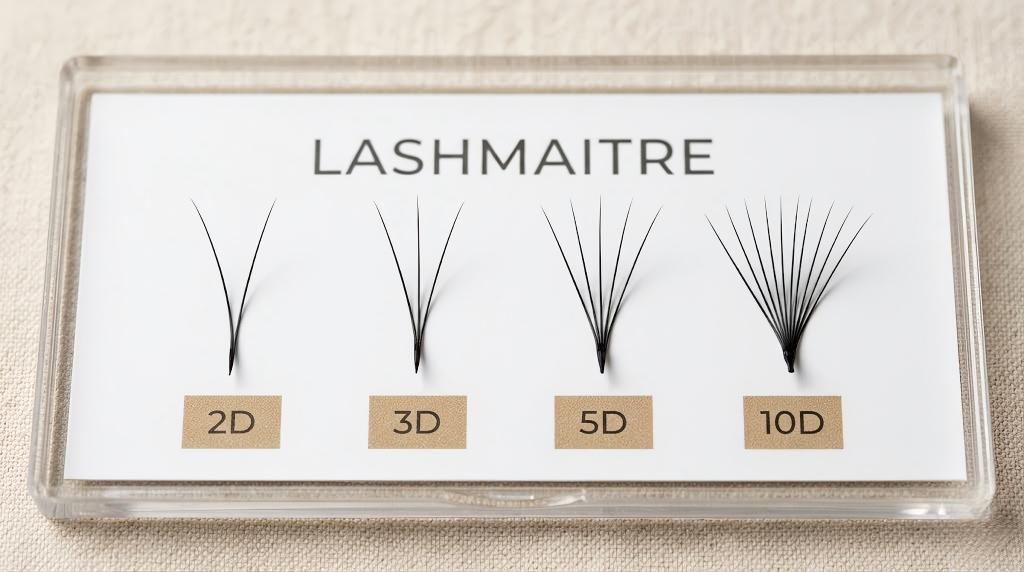
D-count describes how many lash fibers form one premade fan. A 2D fan has two fibers. A 3D fan has three. A 5D fan has five. A 10D fan has ten. Higher D-count usually creates a denser look, but it also changes how buyers should think about thickness, artist level, service menu, and customer expectations.
Do not choose D-count only by photo impact. A dramatic 10D image may look strong online, but a salon-ready range may need 3D and 5D first. A distributor may need multiple D-counts, while a new brand may need fewer options with clearer naming.
Premade Fan D-Count Selection Matrix
Use a small selection matrix before requesting samples:
| D-count | Common buyer role | Planning note |
|---|---|---|
| 2D | Light volume or natural volume positioning | Useful when the buyer wants a softer look |
| 3D | Beginner-friendly salon volume | Often easier to explain in a starter range |
| 5D | Core volume menu option | Strong middle option for many salon buyers |
| 6D | Fuller volume extension of a 5D line | Use after the buyer knows the core range |
| 10D | Dense or mega-volume positioning | Needs careful sample checks and clear buyer demand |
This matrix is not a rule that every buyer must follow. It is a way to prevent the first sample request from becoming too wide.
Start With Service Menu Fit
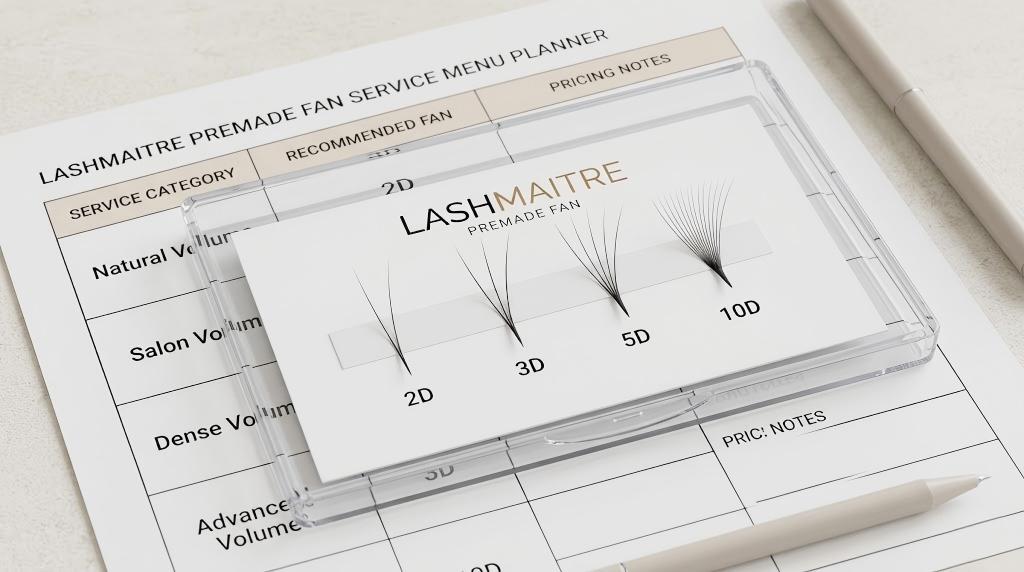
A salon-focused buyer should match D-count to the service menu. If the service menu is soft volume, 2D and 3D may be more useful than 10D. If the buyer serves dense-volume clients, 5D, 6D, or higher options may be relevant. If the buyer sells to academies, simpler D-counts may be easier for students to understand.
Ask:
- What finished look does the buyer need?
- Are the trays for beginner artists, experienced volume artists, or mixed teams?
- Will the products be sold in salons, online, academies, or distributor channels?
- Does the buyer need a starter line or a full catalog?
- Can the buyer explain the D-count difference clearly on labels and product pages?
The Shopify wholesale suppliers guide supports thinking through buying requirements before inventory decisions. For premade fans, those requirements should include D-count role and sample testing.
Compare Density Without Changing Every Other Spec
When comparing D-counts, keep other variables controlled. A 3D CC curl 0.07 tray should not be judged against a 10D D curl 0.05 tray if the buyer wants a clean D-count decision. Too many variables make feedback unclear.
For a controlled comparison, keep stable:
- Curl.
- Thickness.
- Length range.
- Tray format.
- Sample packaging.
- Artist test method.
- Feedback questions.
Then compare only the D-count. This helps the buyer understand whether 2D, 3D, 5D, or 10D fits the intended product line.
The FDA eye cosmetic safety page is a general reminder that products used around the eye area need careful buyer attention and responsible use information. For wholesale buyers, density choices should be checked with samples before bulk orders.
2D and 3D Premade Fans: When Softer Volume Fits
2D and 3D premade fans can fit buyers who want a softer or beginner-friendly volume product. They can also help a brand offer a natural volume option without jumping straight to dense fan names.
Use 2D or 3D when:
- The buyer wants soft volume positioning.
- The buyer sells to salons with many beginner or intermediate artists.
- The catalog needs a simple entry point.
- The buyer wants a lower-density option beside a fuller 5D tray.
The main risk is under-positioning. If a buyer's audience expects dramatic volume, 2D may not feel strong enough. This is why buyer type and service menu should come before sample approval.
5D Premade Fans: The Core Middle Option
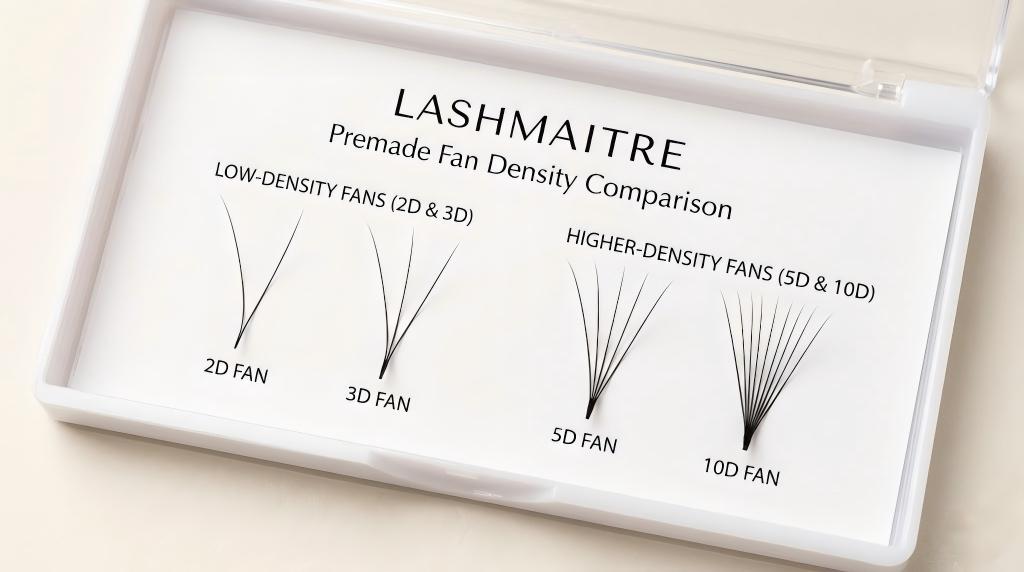
5D premade fans often work as a core comparison point because they sit between softer volume and high-density volume. They can be useful for salon menus, ecommerce product lines, and private label starter ranges.
Use 5D when:
- The buyer wants a visible volume look without starting too high.
- The buyer needs a central product for sample testing.
- The buyer wants a simple product name for private label packaging.
- The buyer is not ready to stock many D-counts.
This does not mean every buyer should start with 5D only. Some markets prefer softer options, while others ask for denser fans. 5D is simply a useful middle point for controlled comparison.
10D Premade Fans: Use Only With a Clear Reason
10D premade fans should not be added only because the number looks stronger. They need a clear buyer reason: dense volume positioning, advanced salon demand, or a product line that already has softer D-counts.
Before adding 10D, confirm:
- The buyer's audience actually wants dense volume.
- The curl and thickness plan makes sense with the fan dimension.
- Artists or customers understand the look.
- The packaging clearly names the D-count.
- The sample is approved with photos and notes.
If the buyer is a new private label brand, 10D may belong in a later expansion instead of the first order.
Label and Reorder D-Counts Clearly
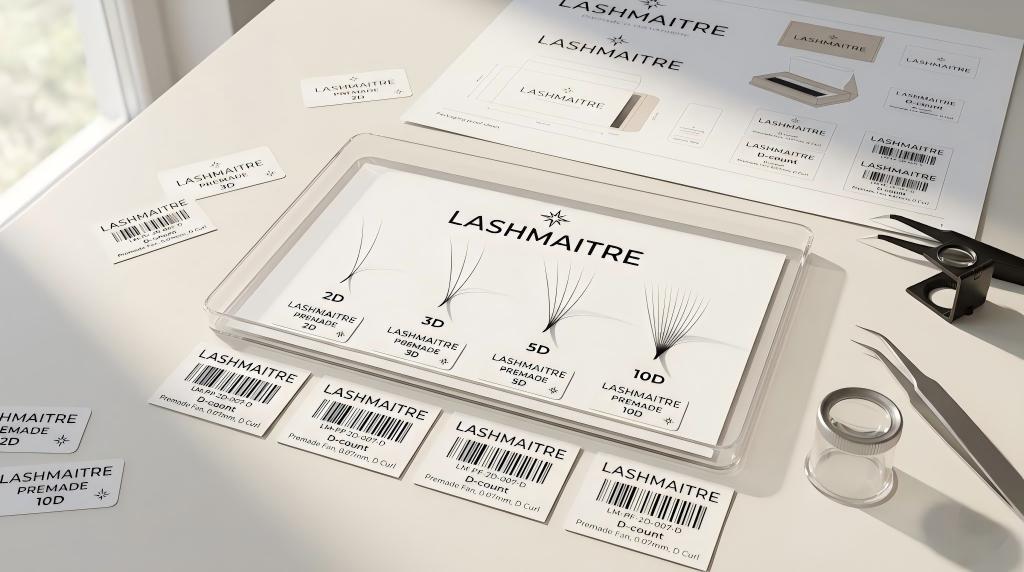
Private label premade fans need clear label names. A reorder team should not have to guess whether the approved tray was 3D, 5D, or 10D. The product name, tray label, box, insert, and reorder file should all use the same D-count.
Save:
- D-count.
- Curl.
- Thickness.
- Length format.
- Sample photos.
- Tray label text.
- Packaging version.
- Buyer feedback.
- Reorder code.
The FDA cosmetics labeling guide is a useful general reference for careful label information handling. For lash buyers, the practical lesson is simple: product information should match the approved sample.
The ISO 9001 quality management systems standard is also a general reference for documented and repeatable requirements. Use the principle of clear records when saving approved D-count samples. Reference: ISO 9001:2015.
FAQ: Premade Fan D-Count Selection
What is premade fan D-count?
D-count describes how many lash fibers are in one premade fan. For example, 2D has two fibers, 3D has three, 5D has five, and 10D has ten.
Which D-count should a new lash brand start with?
Many new brands should start with a small range, often around softer and core volume options such as 3D and 5D. The best choice depends on buyer type, artist level, service menu, and sample feedback.
Are 10D premade fans better than 5D?
No. 10D is denser, but not automatically better. It should be chosen only when the buyer's market, service menu, and sample results support a high-density product.
Should D-count be tested with the same curl and thickness?
Yes. A buyer should compare D-counts with the same curl, thickness, length format, and test method whenever possible. Otherwise, the feedback may reflect multiple variables at once.
How should private label buyers name premade fan D-counts?
The D-count should appear consistently in the product name, tray label, packaging proof, sample file, and reorder code.
Conclusion: Choose the D-Counts You Can Explain and Repeat
Premade fan D-count selection should be a buyer decision, not a number race. A strong wholesale range connects D-count with service menu, artist level, curl, thickness, sample approval, label naming, and reorder records. A focused 2D, 3D, 5D, or 10D plan is easier to sell and repeat than a wide catalog with unclear sample history.
Send LASHMAITRE your target D-count range, curl, thickness, artist level, packaging plan, and sample quantity. We can prepare a controlled premade fan sample set before bulk production.
LASHMAITRE buyer path: After selecting the D-count range, buyers can confirm lash extension samples, plan private label lash extensions for tray and box wording, and send approved fan specs through the wholesale lash extensions inquiry path.
Buyer next step: D-count selection should be verified through LASHMAITRE lash quality control so root shape, fan spread, curl, density and batch repeatability are checked before larger premade fan orders.

Lash Maitre: Your Trusted Partner in Eyelash extension Solutions
Lash Maitre is dedicated to providing professional insights and tips in the eyelash extension industry. Sharing the latest trends, techniques, and product knowledge, Lash Maitre helps lash artists and enthusiasts enhance their skills, stay inspired, and achieve the perfect lash experience.