Lash Supplier Delivery Performance: 8 Metrics Before Reordering

Share
Lash Supplier Delivery Performance Buyer Summary
Lash supplier delivery performance should be judged with confirmed date, actual receipt date, ordered quantity, accepted quantity, lead-time spread, acknowledgment speed, recovery evidence and recurring cause data. A reorder is safer when the supplier repeatedly delivers on time and in full, explains exceptions and closes recovery actions with records.
Lash supplier delivery performance should be measured against the confirmed purchase-order date and quantity, not the latest revised promise. Before reordering, buyers should review on-time rate, in-full rate, OTIF, actual lead-time spread, acknowledgment speed, recovery performance and repeated delay causes by SKU and order.
What Is Lash Supplier Delivery Performance?
Lash supplier delivery performance is the record of how reliably a supplier converts confirmed order promises into complete receipts. It is not the same as a quoted lead time. A quote describes a plan; delivery performance shows what actually happened across real purchase orders.
For a wholesale lash buyer, one average can hide costly variation. Five orders delivered in 30, 31, 32, 55 and 27 days may average 35 days, but the 55-day order can still miss a launch or leave a best-selling curl out of stock. Review consistency as well as the average.
SAP Business Network defines delivery execution through on-time, in-full and perfect-delivery measures by comparing receipt dates and quantities with purchase-order requirements. Those definitions are useful for a buyer scorecard, but this article does not prescribe one universal target for every lash program.
Why Revised Dates Can Hide Poor Reliability
If a supplier moves the promise date after production begins and the buyer overwrites the original date, the final delivery may look on time. Preserve three dates instead: requested date, supplier-confirmed date and actual receipt date. Record any approved buyer change separately.
The fairest operational baseline is usually the last supplier-confirmed date accepted before the agreed freeze point. Later recovery dates remain useful for planning, but they should not erase the original miss.
8 Metrics Before Reordering
1. On-Time Delivery Rate
Count orders or lines received by the confirmed date and divide by the total due. Define whether early delivery is acceptable and which receipt event closes the measure.
2. In-Full Delivery Rate
Compare accepted quantity received with confirmed quantity. Separate authorized split shipments from unexplained shortages, substitutions and rejected units.
3. On-Time In-Full (OTIF)
An order passes OTIF only when it meets both date and quantity requirements. This prevents a small early shipment from making an incomplete order look successful.
4. Actual Lead-Time Median
Measure from the agreed start trigger to accepted receipt. Use a median as well as an average so one extreme order does not distort the normal result.
5. Lead-Time Spread
Track the shortest, longest and typical duration. A stable 35-day supplier may be easier to plan than a 30-day average that swings between 20 and 55 days.
6. Order Acknowledgment Speed
Measure how quickly the supplier confirms SKU, quantity, pack multiple, price, artwork status and delivery date. Slow acknowledgment delays the point at which a reliable promise exists.
7. Recovery Performance
When a delay occurs, record notice timing, revised plan, partial-delivery logic and actual recovery. Good recovery does not erase the miss, but it shows whether the supplier protects the buyer's priority SKUs.
8. Recurring Delay Cause
Classify delays by material, packaging approval, capacity, quality hold, buyer change, documentation, logistics or force majeure. Repeated causes deserve corrective action rather than another optimistic promise.
A Practical Delivery Scorecard
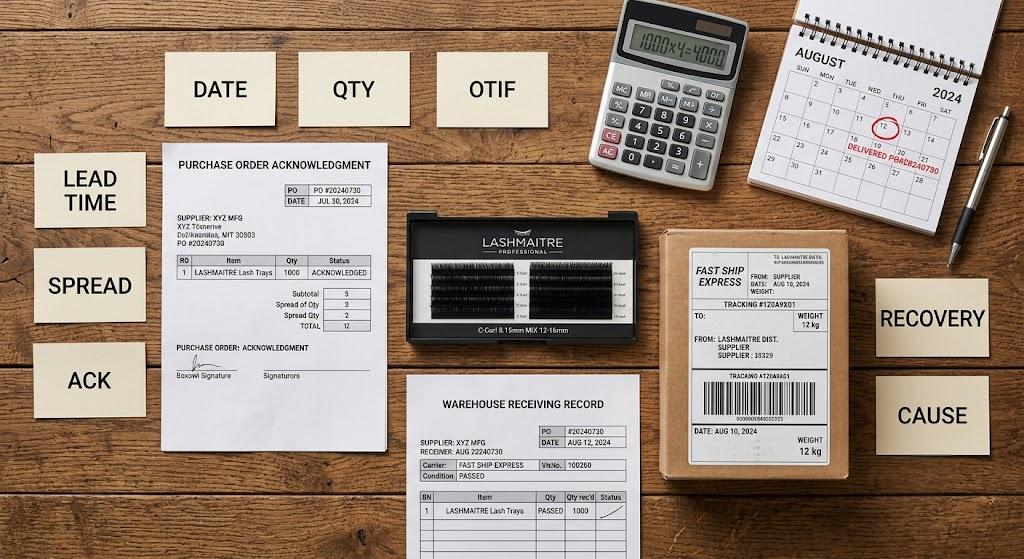
| Metric | Evidence | Buyer question |
|---|---|---|
| confirmed date | PO acknowledgment or approved update | what was the supplier's committed date? |
| actual receipt | carrier and receiving record | when did usable goods arrive? |
| confirmed quantity | accepted PO line | what quantity was promised? |
| accepted quantity | receiving and QC result | how much usable stock arrived? |
| cause and notice | issue log and message | was the risk disclosed early? |
| recovery | revised plan and actual result | did the recovery protect priority demand? |
Score by order line when mixed SKUs have different dates. Keep buyer-caused holds visible but separate so they do not unfairly reduce supplier performance or disappear from planning history.
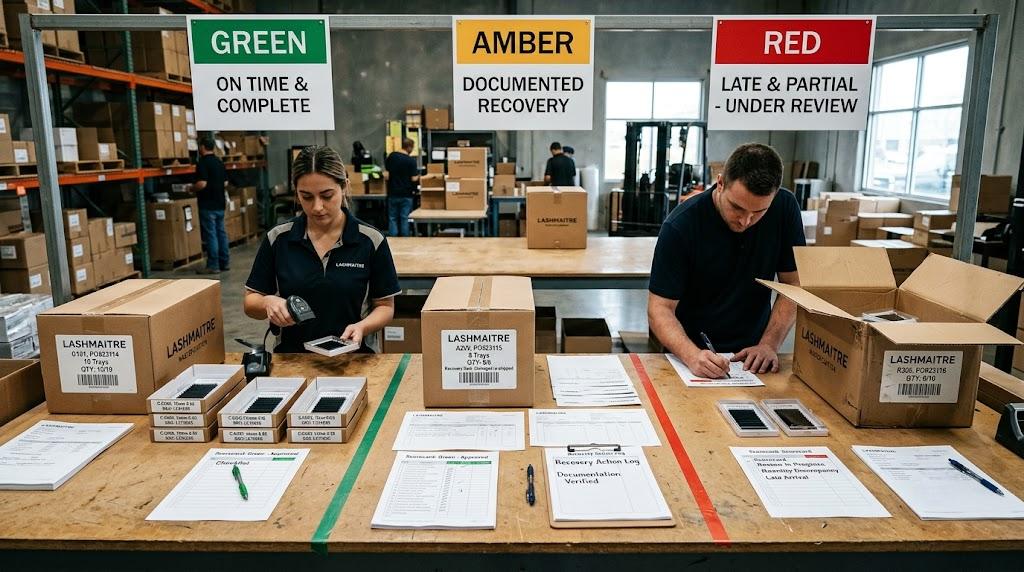
ON TIME / LATE / RECOVERED / EXCUSED
ON TIME: accepted quantity met the confirmed date and quantity rule.LATE: the supplier missed the agreed date or quantity without an accepted exception.RECOVERED: the original promise was missed, but the documented recovery plan was achieved.EXCUSED: a buyer-approved scope change or defined external event changed the baseline; preserve both the original record and the approval.
Do not use EXCUSED as a general cleanup category. It needs evidence, owner and date.

Common Measurement Mistakes
- Replacing the original promise date every time the supplier revises it.
- Measuring shipment date when the contract requires delivery or accepted receipt.
- Treating rejected goods as delivered in full.
- Combining sample, packaging and commercial production orders without segmentation.
- Reporting only an average and ignoring variation.
- Counting a buyer-approved quantity split as a supplier shortage.
- Reviewing delays without assigning recurring causes and actions.
Use Samples to Verify Delivery Recovery
When a delivery miss involves product condition, compare the received lot with approved lash extension samples before accepting recovery stock or allocating the next reorder.
Lash Supplier Delivery Performance FAQ
What is a good on-time delivery rate for a lash supplier?
There is no universal rate that fits every product and route. Define the target in the supplier agreement, measure it consistently and tighten the threshold for launches, promotional windows and critical replenishment SKUs.
Should early deliveries count as on time?
Only if the buyer accepts early receipt. Early delivery can create storage, cash-flow or artwork-version risk, so define an acceptable delivery window rather than assuming earlier is always better.
How many orders are needed before judging reliability?
Use every available order, but show the sample size. A three-order result is directional; a longer history segmented by product family, packaging complexity and season supports a stronger decision.
What should happen after repeated late deliveries?
Confirm the recurring cause, request a dated recovery or corrective-action plan, adjust safety stock or launch dates where appropriate, and decide whether to limit, dual-source or transition the affected scope.
Turn Delivery History Into a Better Reorder
Use your delivery scorecard with the MOQ 50 wholesale lash program, lash quality control, private label lash options and wholesale lash inquiry. Ask LASHMAITRE to confirm the order baseline, approval cutoff and delivery window before the next PO is released.
Authority reference: SAP Business Network predefined delivery-execution stories.
For cross-border reorders, confirm lash Incoterms 2020 responsibilities for the named place, freight, risk, insurance, customs and documents before using delivery performance data to approve the next order.

Lash Maitre: Your Trusted Partner in Eyelash extension Solutions
Lash Maitre is dedicated to providing professional insights and tips in the eyelash extension industry. Sharing the latest trends, techniques, and product knowledge, Lash Maitre helps lash artists and enthusiasts enhance their skills, stay inspired, and achieve the perfect lash experience.