Lash Incoterms 2020: 8 Responsibilities Before International Shipping

Share
Lash Incoterms 2020 Buyer Summary
Lash Incoterms 2020 should be selected with the exact rule and named place written into the sales contract. Buyers should confirm who controls delivery, carriage, insurance, export, import, cost, risk transfer and notice records before an international lash shipment is released.
For an international wholesale lash order, an Incoterms 2020 rule should identify the delivery point, risk-transfer point and division of transport-related responsibilities. Write the three-letter rule and exact named place into the sales contract, then separately confirm carriage, insurance, customs clearance, duties, documents and notices before releasing the shipment.
What Do Incoterms Mean for a Lash Order?
Incoterms are standardized trade rules published by the International Chamber of Commerce. They help a buyer and seller state who handles specified delivery tasks, costs and risks. ICC's current edition contains 11 rules and guidance for selecting the appropriate rule.
They are not a complete purchase agreement. An Incoterms rule does not, by itself, set product specifications, payment timing, ownership transfer, warranty, remedies or the law governing a dispute. Those points still belong in the quotation, purchase order, sales contract and quality agreement.
Why the Named Place Matters in Lash Incoterms 2020
Writing only FCA, DAP or DDP leaves a major gap. The named place identifies where a delivery obligation or risk point applies. FCA supplier warehouse, exact address, Incoterms 2020 is more operational than FCA China because the factory, forwarder and buyer can identify the handover location.
Use the current official rule name, exact facility or terminal and the words Incoterms 2020. If an order uses multiple legs or buyer-arranged consolidation, identify who books each leg and which evidence proves handover.
8 Lash Incoterms 2020 Responsibilities to Confirm
1. Delivery Point
Define where the seller completes the delivery obligation under the selected rule. Distinguish factory availability, handover to the buyer's carrier, loading at a terminal and arrival at the buyer's premises.
2. Risk Transfer
Record the event at which transit loss or damage risk passes from seller to buyer. Risk transfer may occur before the buyer physically receives the goods, so do not assume the party paying freight always carries every risk.
3. Main Carriage
State who selects and contracts the forwarder, express carrier, airline or ocean service. Confirm service level, routing restrictions, consolidation, delivery window and approval for substitutions.
4. Cargo Insurance
Identify whether either party must arrange insurance under the chosen rule and whether the agreed coverage is adequate for the shipment. If the rule does not impose an insurance obligation, the parties can still contract for coverage separately.
5. Export Clearance
Confirm who prepares export declarations, supplies product descriptions and obtains any required export authorization. Avoid assigning a task to a party that cannot legally or practically complete it in the exporting country.
6. Import Clearance and Duty
State who acts as importer of record, classifies the goods, pays import duty and tax, and responds to customs questions. A rule that places import responsibility on the seller can create problems if the seller cannot register or clear goods in the destination country.
7. Transport Documents
List the evidence needed for payment, customs and receiving: commercial invoice, packing list, carrier document, proof of delivery, origin information and any agreed inspection or insurance certificate. Align names, SKU, quantity and shipment references across the set.
8. Notices and Exceptions
Define shipment-ready notice, carrier appointment, delay notice and delivery confirmation. Record what happens when the buyer's carrier misses collection, customs delays clearance or an address change adds cost.
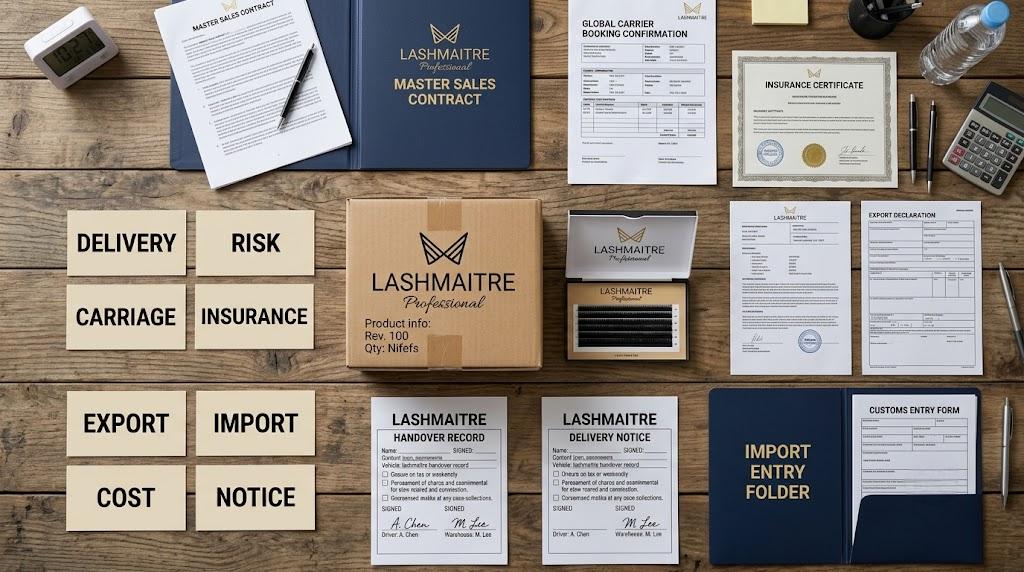
An Eight-Responsibility Matrix
| Control | Contract evidence | Buyer question |
|---|---|---|
| rule and place | signed quotation or PO | is the location exact? |
| delivery | shipping instruction | what event completes delivery? |
| risk | contract clause | when does transit risk pass? |
| carriage | carrier booking | who selects and pays the carrier? |
| insurance | policy or certificate | who insures what value and route? |
| export | export file | who clears the goods out? |
| import | customs instruction | who imports and pays duty or tax? |
| documents and notices | document list | what evidence and timing are required? |

TERM / NAMED PLACE / COST / RISK / DOCUMENT
Use this five-part confirmation before the supplier books transport:
TERM: the official three-letter Incoterms 2020 rule.NAMED PLACE: the precise facility, terminal, port or destination.COST: a written allocation of freight, handling, clearance, duty and exceptional fees.RISK: the handover event and evidence that marks risk transfer.DOCUMENT: the carrier, customs, insurance and receiving records required from each party.
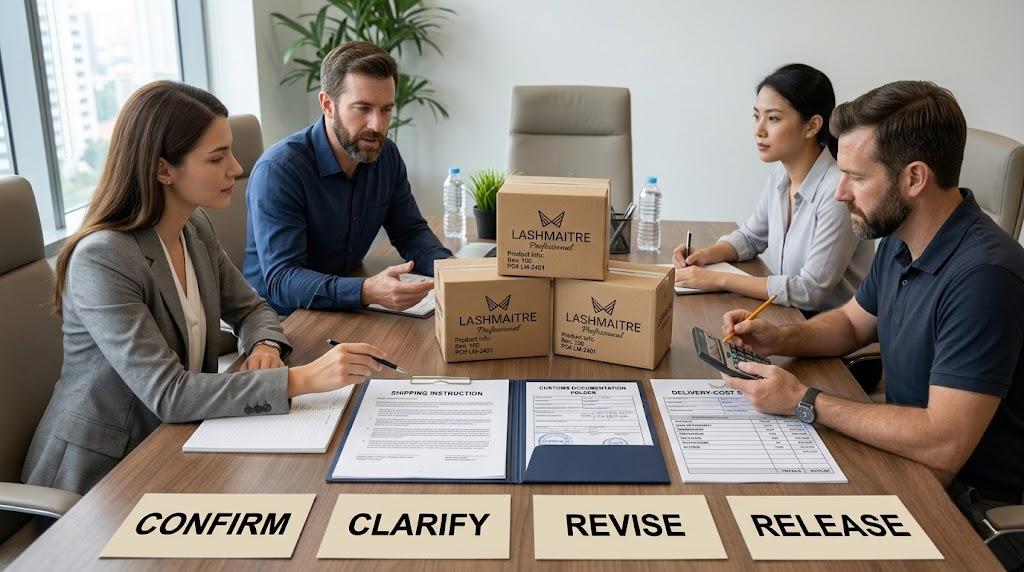
Common Lash Incoterms 2020 Mistakes in Sourcing
- Using
FOBfor every shipment without considering container or air-cargo handling. - Writing a rule without a named place or version.
- Assuming Incoterms define product ownership or payment terms.
- Accepting
DDPwithout confirming the seller can complete import clearance. - Letting the freight payer, risk bearer and importer of record remain inconsistent across documents.
- Failing to state who pays storage, redelivery or inspection charges caused by an exception.
- Copying a prior order's term when the destination, carrier control or customs model has changed.
Lash Incoterms 2020 FAQ
Which Incoterm is best for wholesale lash orders?
There is no universal best rule. Choose based on who can control the carrier, complete export and import clearance, manage insurance and absorb transit risk. Confirm the exact named place for every order.
Do Incoterms transfer ownership of the lashes?
Not by themselves. Ownership or title transfer should be written separately in the sales contract along with payment, warranty and remedies.
Does DDP always make importing easier for the buyer?
It can reduce the buyer's logistics tasks, but only when the seller can lawfully and reliably handle destination import clearance, duty and tax. Verify that ability before using DDP.
Should samples and commercial orders use the same term?
Not necessarily. A courier sample and a commercial pallet can use different routes, values and customs models. Confirm the rule, place and documents for each shipment type.
Confirm Shipping Responsibility Before the PO
Connect the trade term to your private label lash specifications, MOQ 50 wholesale lash program, lash quality-control requirements and wholesale lash inquiry. Ask LASHMAITRE to state the proposed Incoterms 2020 rule, named place, shipment responsibility and required documents in the quotation.
Authority reference: ICC Incoterms 2020.
Before assigning shipment responsibility, keep the approved product reference in the buyer file; the lash extension samples workflow shows how to turn sample approval into a controlled production reference.

Lash Maitre: Your Trusted Partner in Eyelash extension Solutions
Lash Maitre is dedicated to providing professional insights and tips in the eyelash extension industry. Sharing the latest trends, techniques, and product knowledge, Lash Maitre helps lash artists and enthusiasts enhance their skills, stay inspired, and achieve the perfect lash experience.