Lash Approved Supplier List: 9 Fields Buyers Should Control

Share
A lash approved supplier list should tell purchasing exactly which legal supplier, factory and product scope may be used. At minimum, record the supplier identity, approved location, permitted products or processes, reference specifications, approval status, effective date, restrictions, next review date and record owner.
What Is a Lash Approved Supplier List?
A lash approved supplier list, or ASL, is a controlled procurement record. It is not a directory of factories that once sent a good sample. It is the current decision record showing which source is authorized for a defined purchasing scope.
ISO 9001 Auditing Practices Group guidance on external providers describes checking documented information about approved providers, purchasing against defined criteria, monitoring performance and verifying requirements. Buyers can apply that logic without assuming that every supplier or buyer is ISO certified.
Why a Supplier Name Alone Is Not Enough
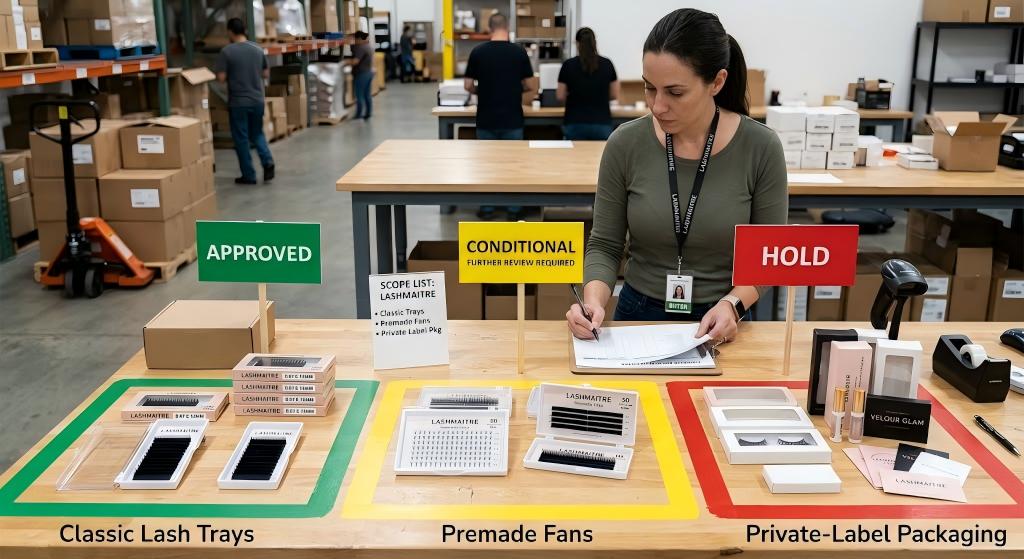
One supplier may operate multiple factories, sell several lash categories and subcontract selected processes. Approval for classic lash trays at one location does not automatically approve premade fans, printed packaging or work performed elsewhere.
A useful list therefore controls both identity and scope. It also shows whether approval is unrestricted, conditional, on hold or removed, so a buyer does not rely on an outdated spreadsheet or message history.
9 Fields for an Approved Eyelash Supplier
1. Legal Supplier Identity
Record the legal company name, trading name and supplier code. Match the record to the approved contracting and invoice entity; independently verify changes to payment details.
2. Approved Factory Location
Identify the manufacturing site covered by the decision. If production moves, require review before treating the new site as approved.
3. Product or Process Scope
List the permitted lash types, packaging processes or services. Use specific scope statements such as classic trays, premade fans, tray-card printing or final packing.
4. Controlled References
Link approved specifications, master samples, artwork and packaging revisions. Purchasing should be able to trace an ordered SKU to the same approved references.

5. Approval Status
Use a small status set with clear meanings: APPROVED, CONDITIONAL, HOLD or REMOVED. Avoid ambiguous colors without written definitions.
6. Effective Date
Record when the current approval became valid. A revision should preserve prior history rather than silently overwrite it.
7. Restrictions and Conditions
State limits such as pilot-order only, approved SKU list, maximum order size, buyer inspection requirement or pending corrective action.
8. Review or Expiry Date
Set the next review based on risk, performance and change. The date should trigger evaluation, not automatic approval without evidence.
9. Owner and Evidence Link
Assign the person or function authorized to maintain the list and link the audit, sample, agreement, performance or corrective-action evidence supporting the status.
Approval Status Decision Table
| Status | Evidence condition | Purchasing rule |
|---|---|---|
| APPROVED | Identity, scope and required evidence are current | Buy within the stated scope |
| CONDITIONAL | A controlled limitation or action remains | Buy only within written limits |
| HOLD | Critical evidence, performance or change is unresolved | Do not place or release new orders |
| REMOVED | Approval has been withdrawn | Block the source and retain history |
How to Keep the List Current
Review the ASL when a legal entity, factory, subcontractor, product scope, specification, master sample, ownership, quality result or commercial route changes. Connect supplier complaints and delivery performance to the next approval decision.
Control editing rights and preserve revision history. Purchasing may view the list, but only designated owners should change status or scope.
Common Approved-Supplier List Mistakes
- Listing a sales contact instead of the legal supplier and factory.
- Approving the company without defining the product scope.
- Treating sample approval as permanent supplier approval.
- Leaving a supplier active after a critical unresolved change.
- Deleting old status instead of keeping an audit trail.
- Allowing a PO to reference specifications outside the approved scope.

FAQ: Lash Approved Supplier List
What belongs on a lash approved supplier list?
Include the legal supplier, factory, approved products or processes, controlled references, status, effective date, restrictions, review date and record owner.
Is approval product-specific?
It should be scope-specific. Evidence for one lash construction, packaging process or factory may not support a different product or location.
When should a supplier be placed on hold?
Use hold when a critical identity, specification, quality, change or corrective-action issue makes new purchasing unsafe or uncontrolled.
Is an approved supplier list the same as onboarding?
No. Onboarding collects and assigns the working supplier file. The ASL is the controlled purchasing decision showing the permitted scope and current status.
Build a Controlled Purchasing Route
Connect the approved-source decision with a measurable lash sample request, documented lash quality control, a controlled private label lash program and a clear wholesale lash inquiry.
Authority reference: ISO 9001 Auditing Practices Group guidance on external providers.
Keep approval scope and review frequency proportional to exposure by linking each supplier record to a documented lash supplier risk assessment based on product, process, quality, delivery, traceability and continuity evidence.

Lash Maitre: Your Trusted Partner in Eyelash extension Solutions
Lash Maitre is dedicated to providing professional insights and tips in the eyelash extension industry. Sharing the latest trends, techniques, and product knowledge, Lash Maitre helps lash artists and enthusiasts enhance their skills, stay inspired, and achieve the perfect lash experience.