Lash Supplier Risk Assessment: 8 Factors for Review Frequency

Share
Lash Supplier Risk Assessment Buyer Summary
A lash supplier risk assessment should rate product criticality, process complexity, customization, quality history, delivery dependence, change history, traceability strength and business continuity, then connect the documented result to approval limits, monitoring and review frequency.
A lash supplier risk assessment turns product and supplier evidence into a documented oversight level. Rate product criticality, process complexity, customization, quality history, delivery dependence, change history, traceability and business continuity, then connect the result to approval limits, monitoring and review frequency.
Why a Lash Supplier Risk Assessment Should Set the Schedule
A supplier providing standard outer cartons does not create the same exposure as a factory producing custom lash fibers, assembled premade fans and buyer-specific printed packaging. Reviewing both suppliers on the same calendar wastes effort on one and may under-control the other.
ISO 9001 Auditing Practices Group guidance on external providers discusses risk-based thinking when determining external-provider controls, documented approved-provider information and evaluation of performance. It does not assign a universal score or certify a supplier. Buyers still need a method suited to their products and markets.
Risk Assessment, Audit and Scorecard
The risk assessment decides how much control is needed. An audit examines systems and evidence at a point in time. A supplier scorecard summarizes actual performance. The approved supplier list records the current authorized scope and status.
These tools should inform one another without being collapsed into one vague rating.
8 Lash Supplier Risk Factors
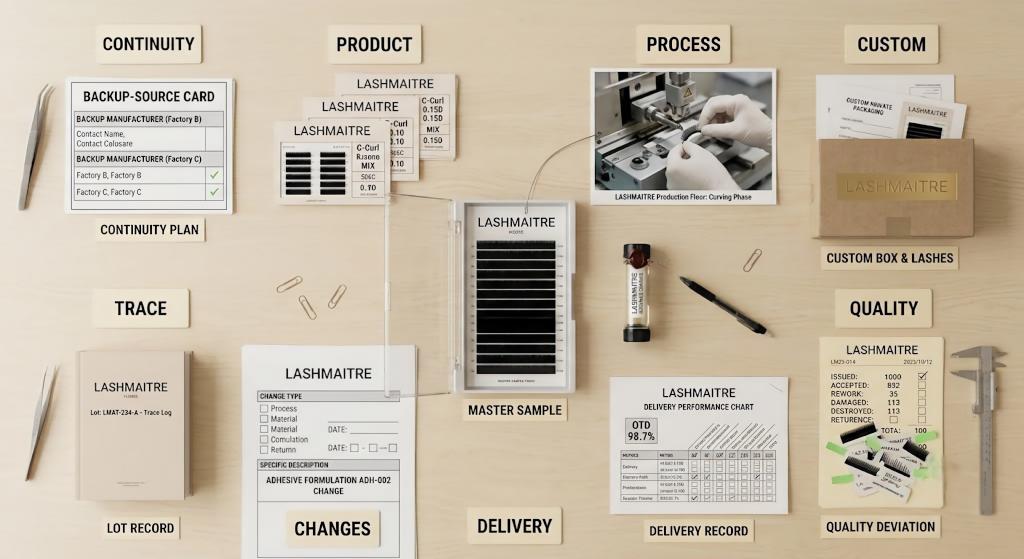
1. Product Criticality
Consider how supplier output can affect lash performance, appearance, safe intended use, labeling and brand claims. Components close to the finished product usually need stronger control.
2. Process Complexity
Assess manual steps, special tools, in-process controls, subcontracting and the ability to detect errors before release.
3. Customization and Revision Exposure
Private-label artwork, bespoke fibers, mixed-length designs and custom packaging increase the number of controlled interfaces and revision risks.
4. Quality History
Use defects, complaints, rework, corrective actions, audit results and repeat deviations. Separate one isolated event from a persistent pattern.
5. Delivery and Capacity Dependence
Measure lead-time reliability, capacity constraints, sole-source exposure, seasonal demand and the time required to qualify an alternative.
6. Change History
Review unannounced material, process, factory, equipment, artwork or packaging changes and the supplier's effectiveness in communicating approved changes.
7. Traceability and Record Strength
Assess whether orders, materials, batches, inspections, packing and distribution can be linked quickly with attributable and retrievable records.
8. Business Continuity
Consider geographic concentration, critical equipment, financial or organizational instability, logistics disruption and tested recovery options.
Simple Scoring Method
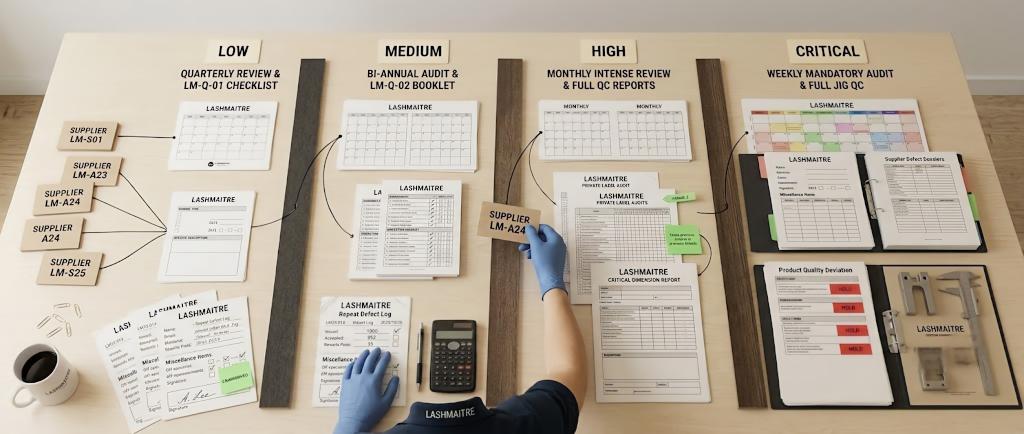
Score each factor from 1 to 4: 1 = low, 2 = moderate, 3 = high, 4 = critical. Add written evidence and a short rationale. Weight factors only when the rule is defined in advance.
| Total example | Risk class | Typical oversight |
|---|---|---|
| 8-12 | LOW | routine performance review and change monitoring |
| 13-20 | MEDIUM | scheduled review plus targeted evidence updates |
| 21-27 | HIGH | more frequent review, tighter incoming controls and continuity plan |
| 28-32 | CRITICAL | executive ownership, restricted scope, contingency source and defined hold triggers |
The ranges are an operational example, not an ISO requirement. A single critical issue may justify a high-risk classification even when the total score is lower.
Triggers for Immediate Reassessment
Do not wait for the next calendar review when there is a serious complaint, repeat defect, missed corrective action, unapproved change, ownership or factory change, prolonged delivery failure, lost certification relevant to the agreed scope, traceability failure or major continuity event.
Record who owns the reassessment, what evidence is required and whether current orders remain approved, conditional or on hold.
Common Risk-Rating Failures
- Giving every supplier the same medium rating.
- Scoring reputation instead of evidence and scope.
- Treating a certificate as a substitute for product control.
- Ignoring sole-source and capacity exposure.
- Lowering risk after one good shipment without enough history.
- Reviewing performance but not changes or traceability.
- Failing to connect the rating to real monitoring actions.

FAQ: Lash Supplier Risk Assessment
How do you assess a lash supplier's risk?
Rate documented factors such as product criticality, process complexity, customization, quality, delivery, changes, traceability and continuity, then record the rationale and controls.
Which suppliers need more frequent review?
Suppliers with higher product impact, weak performance, complex or changing processes, limited traceability or high supply dependence generally need closer and more frequent oversight.
Is an ISO certificate enough to classify a supplier as low risk?
No. Certification can be evidence, but the buyer still needs to evaluate scope, product risk, actual performance, changes and continuity.
What should trigger immediate reassessment?
Serious complaints, repeat defects, failed corrective actions, unapproved changes, traceability failures, factory changes and major delivery or continuity events.
Match Oversight to Exposure
Use supplier risk to protect a controlled private label lash program, documented lash quality control, approved lash samples and a clear wholesale lash inquiry.
Authority reference: ISO 9001 Auditing Practices Group guidance on external providers.

Lash Maitre: Your Trusted Partner in Eyelash extension Solutions
Lash Maitre is dedicated to providing professional insights and tips in the eyelash extension industry. Sharing the latest trends, techniques, and product knowledge, Lash Maitre helps lash artists and enthusiasts enhance their skills, stay inspired, and achieve the perfect lash experience.