6D Premade Lash Fans: 8 Wholesale Sample Checks
Share
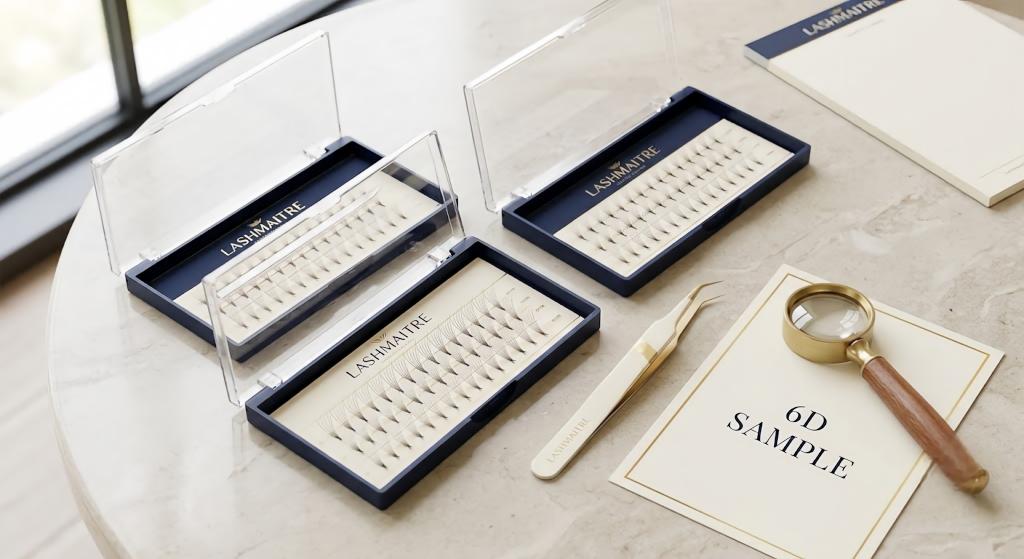
6D premade lash fans should be approved as a complete specification, not from the 6D label alone. A wholesale buyer should verify that each sampled fan contains six separate fine fibers, then compare the approved diameter, curl, length, spread, base, stem, strip release, tray configuration, and reorder record. The purpose is repeatability: the production lot should match the signed reference that the brand and its qualified lash professional actually tested.
What Do 6D Premade Lash Fans Mean?
In a premade-fan specification, 6D normally identifies a fan made from six individual extension fibers joined at one base. It does not, by itself, define the fiber diameter, total profile, curl, length, spread, base type, stem length, finish, or tray count. Those attributes must appear separately on the purchase specification and sample approval.
Current professional product ranges illustrate this distinction. Suppliers sell 6D fans in more than one curl, diameter, length, stem, and pack configuration. For example, EBL lists 6D premade fans with separate curl, diameter and length choices, while other professional ranges pair 6D with their own tray counts and base constructions. The shared 6D name therefore does not make two supplier samples interchangeable.
For wholesale sourcing, use 6D as one field in the SKU master—not as the full product definition.
Wholesale buyers comparing 6D premade fans or 6D volume lash fans should therefore hold every non-count attribute constant and approve one traceable physical reference.
6D Premade Fans: Which Specifications Must Stay Separate?
| Specification | What it defines | Buyer check |
|---|---|---|
| Fan dimension | Six individual fibers per fan | Count fibers under magnification |
| Fiber diameter | Diameter of each individual fiber | Match label, order and signed sample |
| Curl | Approved curvature profile | Compare with the retained curl reference |
| Length | Nominal fiber length | Verify row by row, especially in mixed trays |
| Fan spread | Narrow, regular or wide geometry | Approve separately from the 6D count |
| Base and stem | Joined area and handling geometry | Inspect shape, closure and consistency |
| Tray format | Rows, mix, fan quantity and labels | Count and reconcile with the purchase order |
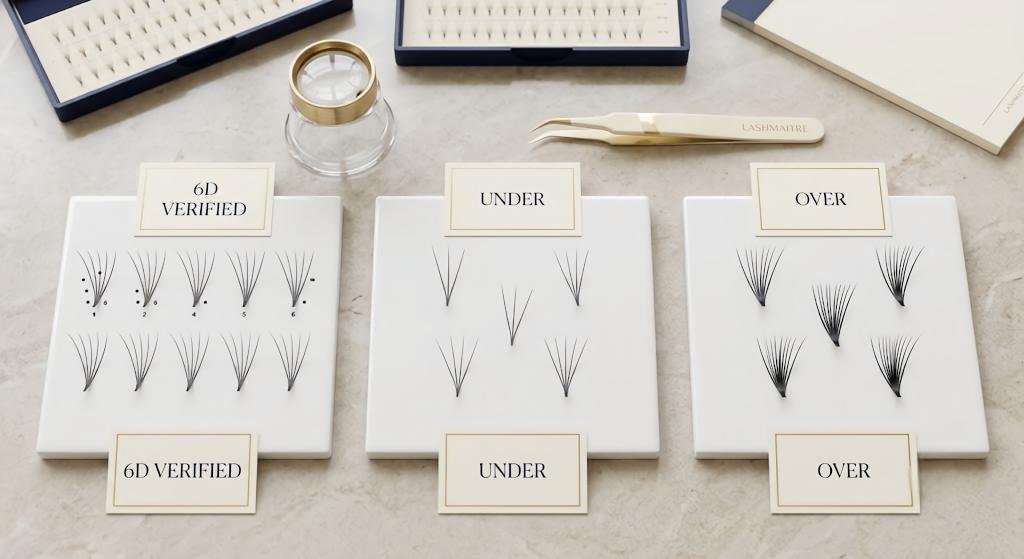
The table matters because a fan may contain six fibers and still be the wrong product. A changed diameter, curl or base can alter handling and appearance even when the D count remains correct.
8 Checks Before Approving 6D Premade Lash Fans
1. Verify Six Separate Fibers
Select fans from the beginning, middle and end of several strips or sections. Under consistent lighting and magnification, confirm six distinct fibers in each sampled unit. Record the number inspected and any under-counted, over-counted, crossed or inseparable units.
Define the sampling method before approval. A clean featured photograph is not enough evidence for a production standard.
2. Match Fiber Diameter to the Dimension
Verify the individual fiber diameter stated on the tray, purchase order and sample card. Do not infer it from visual fullness. Two 6D fans made with different fiber diameters are different specifications and should have distinct SKU codes.
The qualified lash professional evaluating the sample remains responsible for determining whether the complete construction is appropriate for the intended professional service. This article does not set a universal application rule.
3. Compare Spread and Symmetry
Place candidate fans beside the signed reference. Compare the widest part of the spread, the spacing between fibers, left-right symmetry and the silhouette across multiple rows. Record intentional geometry such as narrow or wide separately.
For a dedicated width-control method, use the companion guide to narrow premade lash fans.
4. Inspect the Base and Stem
Check whether the base is pointed, rounded, flat, heat-bonded or adhesive-bonded as ordered. Look for split bases, excessive bonding material, loose fibers and inconsistent stem length. Compare with a retained physical reference rather than relying on a description such as thin base.

5. Confirm Curl and Length Row by Row
Verify curl and nominal length across the tray. In mixed-length trays, reconcile the printed sequence with the actual rows and the approved mix. Similar packaging can hide a wrong curl or one shifted length row, so inspect the physical product and label together.
6. Test Pickup and Strip Release
Have a qualified professional test the intended tweezer, pickup method and strip. Sample multiple tray locations. Record whether a fan releases individually and retains the approved geometry without an unacceptable base change or residue.
Treat this as a controlled handling observation. It is not proof of universal retention or service speed, which also depend on technique, adhesive system and working conditions.
7. Reconcile Fan Quantity and Tray Mix
Count or verify the agreed counting method for rows, fans per row and total pack quantity. For mixed trays, record the length allocation. Compare the physical sample with the purchase order, packing specification and sellable label.
Buyers can request lash extension samples using the same fields before a bulk decision.
8. Lock the SKU and Reorder Evidence
Connect the approved fan to its SKU master, sample code, supplier batch, packaging version, artwork proof and approval date. Define which changes trigger reapproval: material, diameter, D count, curl, length, spread, base, strip, tray mix, supplier or manufacturing method.
For a private-label order, keep product and packaging approvals separate but linked. The private label lash extensions process should not allow an old label or tray mix to be paired silently with a revised fan.
A Practical 6D Premade Lash Fans Approval Record
| Record field | Evidence to keep | Release question |
|---|---|---|
| D count | Magnified sample result | Were six distinct fibers verified? |
| Physical specification | Diameter, curl, length, spread, base and stem | Does each field match the signed reference? |
| Handling result | Tweezer, strip location and pickup notes | Did sampled fans retain the approved construction? |
| Pack configuration | Rows, length mix, labels and fan quantity | Does the sellable tray match the order? |
| Traceability | Sample, batch, SKU and supplier codes | Can the approval be traced to production? |
| Change control | Version, approver and reapproval triggers | Will a later change be visible before reorder? |

Use the brand's documented defect classes and release rule. LASHMAITRE's lash quality control framework can connect approval of 6D premade lash fans to later lot inspection.
Common 6D Premade Lash Fans Buying Mistakes
- Assuming every fan contains six fibers because the tray says
6D. - Treating 6D as a complete specification while omitting diameter, curl or length.
- Approving only the center row instead of sampling across the tray.
- Confusing fan dimension with fan spread.
- Accepting a base description without a physical reference.
- Comparing pickup with different tweezers or methods and recording no conditions.
- Leaving tray quantity, mixed-length allocation or label version undefined.
- Reordering from a product name after the specification changed.
FAQ: 6D Premade Lash Fans
What does 6D mean in premade lash fans?
It normally means that one premade fan contains six individual extension fibers joined at one base. It does not define diameter, curl, length, spread, base, stem or tray configuration, so those fields still require separate approval.
Are all 6D premade lash fans the same?
No. Suppliers can offer different diameters, curls, lengths, fan widths, base constructions, stems, strip systems and pack quantities under the same 6D label. Buyers should approve 6D premade lash fans with a complete written specification and retained sample.
How should a buyer verify a 6D sample?
Count fibers under magnification across several tray locations, then compare diameter, curl, length, spread, base, stem, pickup, strip release, tray mix, labels and quantity with the purchase specification.
When should a 6D fan be reapproved?
Reapproval is appropriate when the supplier, material, D count, diameter, curl, length, spread, base, stem, strip, tray configuration or manufacturing method changes, or when a reorder no longer matches the retained reference.
Turn the 6D Label Into a Controlled Specification
A dependable wholesale decision starts with evidence: verify six fibers, keep every other attribute separate, test representative 6D premade lash fans, and connect the signed reference to the SKU and reorder record. Buyers can compare LASHMAITRE premade fans and request a sample brief built around these eight checks.
Authority reference: EBL — 6D premade fans specification example.

Lash Maitre: Your Trusted Partner in Eyelash extension Solutions
Lash Maitre is dedicated to providing professional insights and tips in the eyelash extension industry. Sharing the latest trends, techniques, and product knowledge, Lash Maitre helps lash artists and enthusiasts enhance their skills, stay inspired, and achieve the perfect lash experience.