Narrow Premade Lash Fans: 8 Wholesale Sample Checks
Share
Narrow premade lash fans should be approved by measurable sample evidence, not by a product name alone. Before a wholesale order, compare fan width, symmetry, base shape, stem length, curl and dimension, strip release, tray consistency, and the records needed to reproduce the approved sample. The goal is not to declare one fan style universally better; it is to confirm that the exact construction matches the intended set, application method, and private label specification.
What Are Narrow Premade Lash Fans?
Narrow premade lash fans are manufactured volume fans whose fibers have a tighter spread than a wide fan of the same general dimension. The tighter profile can create a denser, more defined effect, while a wider spread can create a more open or feathery effect. In its professional lash education material, Milady similarly distinguishes narrow fans as creating a fuller, thicker look and wide fans as creating a more feathery look. That is a design distinction, not a universal performance guarantee.
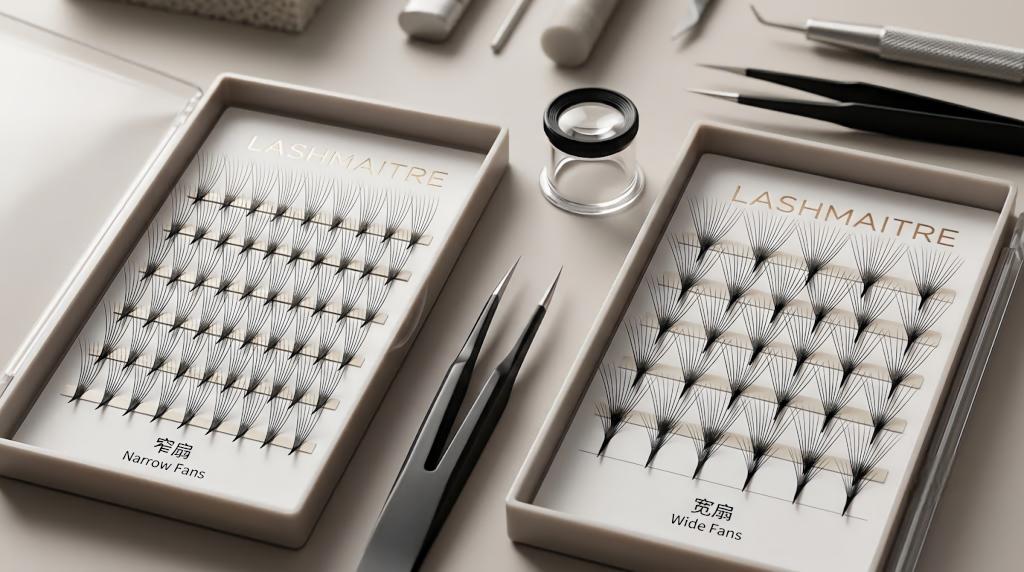
Premade fans can improve service consistency when the approved construction is repeated, but they also offer less on-the-spot customization than handmade fans. Buyers therefore need to make fan geometry, base construction, pickup behavior, and tray labeling explicit before production.
For wholesale sourcing, treat “narrow,” “super narrow,” and “wide” as comparison terms that require a physical reference or agreed measurement. Supplier naming can vary, so a signed tray card and retained sample are more reliable than a label by itself.
Narrow vs Wide Lash Fans: What Should Buyers Compare?
| Comparison point | Narrow fan | Wide fan | Buyer decision |
|---|---|---|---|
| Fiber spread | Tighter profile | More open profile | Match the desired styling effect |
| Visual density | Can appear fuller or more defined | Can appear lighter or more feathery | Approve on a completed sample set |
| Placement coverage | Concentrated | Broader | Confirm compatibility with the intended technique |
| Base and stem | Must be checked separately | Must be checked separately | Do not infer base quality from fan width |
| Naming | May also be sold as slim or narrow | May be sold as wide or open | Use a physical reference and specification |
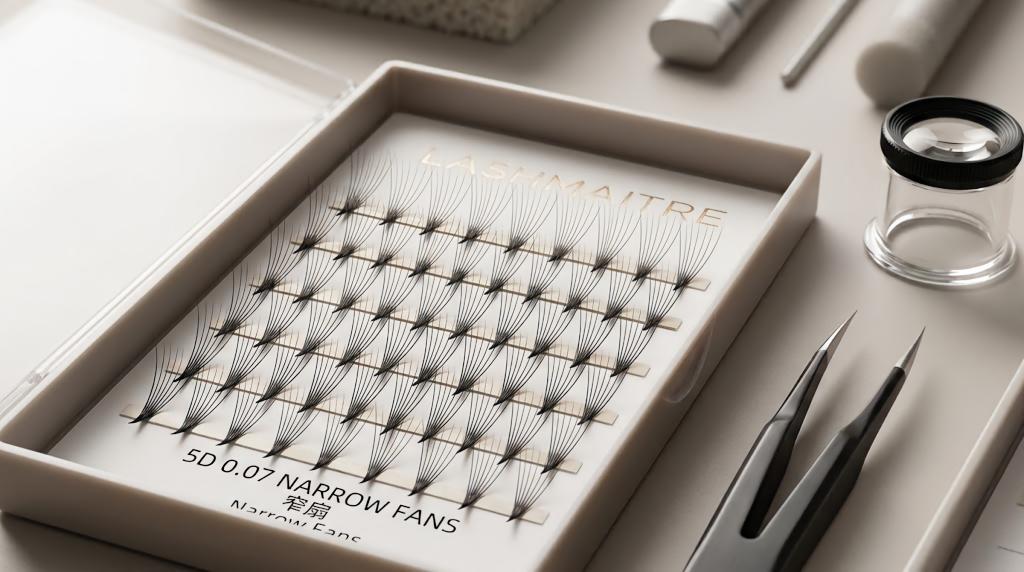
Fan width alone does not establish suitability. The same width can behave differently when the base, stem, curl, fiber diameter, strip adhesive, or manufacturing tolerance changes. The buyer should compare complete samples under the same inspection conditions.
8 Narrow Premade Fan Sample Checks
1. Confirm Fan Width With a Reference
Place the candidate sample beside the approved reference under consistent lighting and magnification. Compare the spread at the widest point and confirm whether the sample is narrow, super narrow, or outside the agreed range. If a numeric method is used, record the method and tolerance so the supplier and buyer measure the same way.
Do not approve from a product photograph alone. Camera angle, magnification, and fan rotation can make the spread look different.
2. Check Symmetry and Fiber Distribution
Inspect fans from several rows and multiple areas of the tray. The fibers should follow the approved distribution rather than leaning heavily to one side, crossing irregularly, or creating an inconsistent silhouette. Record the number inspected and the number outside the approved reference.
Symmetry should be judged against the buyer-approved sample, because intentional styling can vary by collection.
3. Inspect Base Shape and Closure
Compare the base with the signed reference. Check whether it is pointed, rounded, flat, heat-bonded, or adhesive-bonded as specified. Look for split bases, excessive bonding material, unintended thickness, or loose fibers. A narrow spread does not compensate for an unapproved base construction.
For a structured QC review, use the brand's defined defect classes and release rule rather than informal visual acceptance. LASHMAITRE's lash quality control process can be used to align the sample record with later production inspection.
4. Measure Stem Length and Consistency
The stem affects how the fan is handled and positioned. Compare stem length across a representative sample, then record both the approved range and any obvious variation. A stem that is consistently shorter or longer than the reference can change pickup and placement behavior even when the fan width appears correct.
The important result is repeatability against the approved sample, not a universal stem length for every artist or technique.
5. Match Curl, Length, Diameter, and Fan Count
Verify every printed and physical attribute: curl, fiber length, individual fiber diameter, number of fibers per fan, color, and finish. Check mixed trays row by row. Similar-looking narrow lash fans can still be the wrong SKU when only one dimension changes.
Use a written SKU structure that connects the product code to the full specification. For example, a code should not rely on “narrow” alone when curl, length, diameter, and fan count also determine the product.
6. Test Pickup and Strip Release
Ask a qualified lash professional to test pickup using the intended tweezer and normal working method. Sample from the beginning, middle, and end of multiple strips. Record whether fans release individually, retain the approved geometry, and leave unacceptable residue or damaged bases.
This is a handling check, not a medical or universal retention claim. Application quality, adhesive use, environmental conditions, and the natural lash all remain separate variables.
7. Audit Tray Mix, Row Labels, and Pack Quantity
Count rows, verify the length sequence, and compare the actual tray mix with the purchase specification. Check that removable strips, row labels, curl, diameter, fan count, and batch identification remain readable. For mixed trays, confirm the number of rows assigned to each length.
When a buyer needs evidence before committing to production, order wholesale lash samples with the exact comparison points listed in the sample brief.
8. Lock the Private Label and Reorder Record
Once the product sample is approved, connect it to the packaging version, artwork proof, tray card, SKU master, and retained reference. The approval record should identify who approved it, the date, the supplier sample or batch code, and which changes require reapproval.
For private label lash extensions, keep the product approval separate from the packaging approval but link both to the same sellable SKU. That prevents an approved fan from being paired with an outdated tray mix, label, or box version on reorder.
A Practical Wholesale Approval Record
| Record field | What to capture | Why it matters |
|---|---|---|
| Product reference | Retained tray or sealed sample | Provides a physical comparison standard |
| Fan geometry | Width category, symmetry, base, stem | Defines the construction to reproduce |
| Dimensions | Curl, length, diameter, fan count | Prevents similar SKUs from being confused |
| Handling result | Tweezer, pickup method, strip release notes | Records how the sample was evaluated |
| Tray configuration | Row count, length mix, labels, quantity | Connects the fan to the sellable pack |
| Packaging version | Artwork proof and packaging code | Controls private label changes |
| Approval status | Approver, date, conditions, reapproval triggers | Makes the decision traceable |
Keep one master reference in controlled storage and one working comparison sample where practical. If the reference is damaged, contaminated, or no longer representative, replace it through a documented reapproval rather than silently changing the standard.
Common Buying Mistakes
- Approving from the words “narrow” or “super narrow” without a physical comparison.
- Checking only the featured row instead of sampling across the tray.
- Treating width, base shape, and stem length as the same attribute.
- Testing pickup without recording the tweezer, strip, or sample location.
- Approving the fan but leaving the mixed-tray ratio or label version undefined.
- Reordering from an old product name after the approved specification changed.
FAQ: Narrow Premade Lash Fans
Are narrow premade lash fans better than wide fans?
No fan width is universally better. Narrow fans can support a fuller, more defined appearance, while wide fans can support a more open, feathery appearance. The appropriate choice depends on the intended styling result, professional technique, natural lash assessment, and the complete fan specification.
What is the difference between narrow and super narrow premade fans?
Super narrow generally describes a tighter spread than narrow, but supplier naming is not standardized across every range. Buyers should approve a physical reference or an agreed measurement and record the tolerance rather than relying only on the category name.
What should a wholesale premade fan sample include?
It should identify fan width, base shape, stem length, curl, fiber length, diameter, fan count, color, tray mix, strip behavior, product code, batch or sample code, and the packaging version if private label presentation is included.
When should a narrow premade fan be reapproved?
Reapproval is appropriate when the supplier, material, fan geometry, base method, strip, tray configuration, packaging, or agreed tolerance changes, or when a reorder no longer matches the retained reference.
Turn a Sample Into a Repeatable Specification
The safest wholesale decision is a controlled comparison: define the intended styling result, evaluate narrow premade lash fans against a retained reference, document all eight checks, and connect the approved product to its tray and private label records. Buyers preparing a new collection can start with LASHMAITRE's premade fans options and request samples built around a written approval brief.
Authority reference: Milady Advanced Services: Eyelashes, Chapter 6 preview.

Lash Maitre: Your Trusted Partner in Eyelash extension Solutions
Lash Maitre is dedicated to providing professional insights and tips in the eyelash extension industry. Sharing the latest trends, techniques, and product knowledge, Lash Maitre helps lash artists and enthusiasts enhance their skills, stay inspired, and achieve the perfect lash experience.