Lash SKU Discontinuation Plan: 9 Critical Records

Share
Lash SKU Discontinuation Plan Buyer Summary
A lash SKU discontinuation plan should control the outgoing revision, decision reason, last-order and end-availability dates, remaining stock, open orders, packaging disposition, replacement mapping, customer notice and retained evidence. Use the lash SKU discontinuation plan to approve the final buy, close supplier forecasts and prevent obsolete packaging from returning to production. Keep the lash SKU discontinuation plan open until inventory, replacement and record owners have signed the closure.
A lash SKU discontinuation plan should record the outgoing SKU and approved revision, decision reason, last-order and end-availability dates, remaining inventory and open orders, packaging disposition, replacement SKU, customer/channel notice, product-data status and record-retention owner. Stopping reorders alone does not close the product cleanly.
Buyer Summary
- Approve the discontinuation scope before placing a final order.
- Keep physical stock, supplier-held units and packaging in one reconciliation.
- Separate last-order date from end-availability date.
- Approve and sample any replacement SKU before communicating it.
- Preserve batch, artwork, barcode, complaint and sales records after the item stops selling.
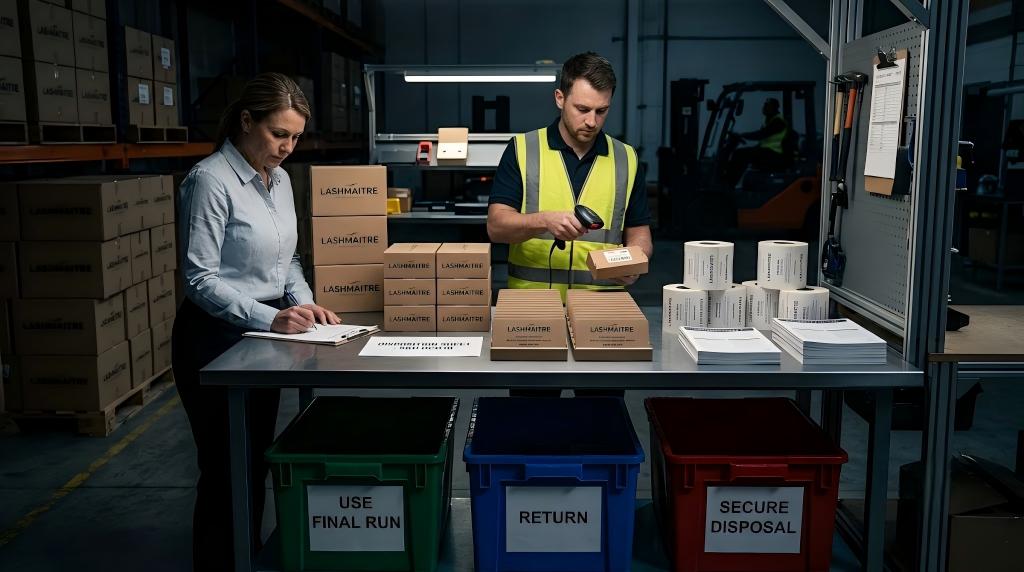
Why “Do Not Reorder” Is Incomplete
A product can remain active in many places after purchasing stops: website listings, distributor sheets, academy kits, barcode systems, warehouse locations, private-label packaging and supplier forecasts. If these records close at different times, customers may order a product that cannot be supplied or staff may use obsolete packaging on a replacement item.

The phase-out plan connects the commercial decision to inventory, supplier, packaging, product data and customer communication.
Nine Records in a Lash SKU Discontinuation Plan
| Record | Required detail | Risk controlled |
|---|---|---|
| SKU and approved revision | Product specification, tray format, artwork and barcode identity | Wrong item or version closed |
| Decision and scope | Permanent, temporary, channel-specific or packaging-only change | Ambiguous discontinuation |
| Key dates | Last-order, last-production, end-availability and listing-change dates | Conflicting timelines |
| Inventory reconciliation | Usable, held, damaged, supplier-held and in-transit quantity | Hidden stock or double ordering |
| Open-order register | Purchase orders, deposits, work in progress and customer commitments | Unsettled obligations |
| Packaging disposition | Boxes, cards, labels, inserts and cartons by revision | Obsolete branded materials |
| Replacement mapping | Approved alternative, differences and effective date | Silent substitution |
| Communication and data status | Customers, distributors, website, catalog, SKU/barcode systems | Orders after closure |
| Retained evidence and owner | Samples, batch/QC, complaints, artwork approvals and final sign-off | Lost history after phase-out |
Communicate Dates Before the Product Disappears
GS1's trade-item implementation guidance distinguishes discontinuation from cancellation and includes discontinued and last-order dates in its general product-data process. That framework does not create a universal lash requirement, but it supports a practical principle: trading partners need clear dates and replacement information before an item ends. See the GS1 Trade Item Implementation Guideline.
Use at least two separate dates:
- Last-order date: the latest date a buyer or channel can place an accepted order under the phase-out plan.
- End-availability date: when the item is no longer offered from remaining usable stock.
These dates may differ because a final production order, sell-through period or channel transfer can happen between them.
Decide Whether a Final Buy Is Justified
A final buy can protect customer continuity, but it can also create another block of aging stock. Review the decision before committing MOQ.
| Condition | Final-buy direction | Required evidence |
|---|---|---|
| Replacement approved and current stock covers transition | No or small final buy | Demand and cutover dates |
| Replacement not ready but committed demand exists | Controlled bridge quantity | Customer orders, lead time and sample plan |
| Packaging will become obsolete | Limit quantity to usable component stock | Packaging count and written disposition |
| Demand is uncertain and stock is already aging | Avoid automatic final MOQ | Aging report and channel plan |
| Contract or distributor commitment exists | Reconcile obligation first | Written scope and delivery schedule |
Do not label the decision “last time” without a quantity, owner and approval date. A supplier should know whether the request is a normal reorder, a bridge order or the final production run.
Reconcile Private-Label Packaging
Custom packaging can outlive the product. Count buyer-held and supplier-held tray cards, boxes, label sheets, inserts and master-carton labels by revision.
Use the leftover lash packaging ownership guide to decide whether components will be consumed in the final run, transferred to a replacement after authorized artwork changes, returned, credited or securely disposed of. Never apply old packaging to a new SKU without a controlled approval.
Record the closing quantity and evidence for the selected disposition. This prevents the discontinued name or barcode from reappearing on later production.
Approve the Replacement as a New Decision
A replacement can be close to the outgoing product without being identical. Compare curl, thickness, length map, fiber/finish, row structure, strip release, tray card, box and reorder code. Link the replacement to its own approved sample and effective date.
Customer communication should state the meaningful difference. Avoid saying “same product” unless the controlled records support that statement.
The private label lash extensions page can support a replacement sample and packaging discussion when the discontinued SKU is part of a branded range.
Close Product Data Without Erasing History
Update active systems at the agreed time: website, price list, distributor file, purchase templates, warehouse status and reorder forms. Keep historical records where needed for traceability, accounting, complaint handling and past-order questions.
Barcode and product-data rules vary by channel and market. Do not invent, reuse or delete identifiers solely because a SKU is discontinued. Follow the applicable platform, trading-partner and GS1 requirements for the brand's actual identifiers.
Obtain Final Supplier Closure
Ask the supplier to confirm:
- final accepted purchase order and quantity;
- remaining raw, finished or work-in-progress units;
- buyer-owned packaging and labels;
- open credits, deposits or claims;
- last shipped batch and documents;
- retained sample or production evidence;
- written closure of future forecasts or automatic reorders.
The final closure should name the person who approved it on both sides. A clean ending protects the buyer from surprise stock and protects the supplier from unclear future demand.
Lash SKU Discontinuation Plan: Five Closure Steps
- Approve the exact outgoing SKU and revision.
- Set separate last-order and end-availability dates.
- Reconcile stock, open orders and supplier-held packaging.
- Approve any replacement as a new controlled decision.
- Close forecasts while retaining quality and commercial evidence.
Lash SKU Discontinuation Plan FAQ
How do you discontinue a lash SKU?
Approve the scope and dates, reconcile all inventory and open orders, decide packaging disposition, approve any replacement, notify affected channels, update active product data and preserve the final quality and commercial records.
What happens to leftover private-label packaging?
It should be counted by component and revision, then consumed, transferred, returned, credited or disposed of only under written ownership and authorization terms.
Should a discontinued lash SKU keep its barcode?
Historical identifiers should not be casually reused or erased. Follow the applicable GS1, marketplace and trading-partner rules, and keep records that connect past orders to the discontinued item.
Is a final buy always necessary?
No. It depends on committed demand, replacement readiness, current inventory, MOQ, packaging exposure and the transition timeline. A final buy without evidence can deepen slow-moving stock.
Close the SKU Without Losing the Evidence
A lash SKU discontinuation plan turns an assortment decision into a controlled final order, replacement and record closure. Send LASHMAITRE the outgoing SKU, current and supplier-held stock, packaging quantity, open commitments and proposed replacement through the wholesale lash inquiry page to plan the phase-out.

Lash Maitre: Your Trusted Partner in Eyelash extension Solutions
Lash Maitre is dedicated to providing professional insights and tips in the eyelash extension industry. Sharing the latest trends, techniques, and product knowledge, Lash Maitre helps lash artists and enthusiasts enhance their skills, stay inspired, and achieve the perfect lash experience.