Bottom Lash Extensions Wholesale: Should Brands Stock Lower Lash Trays?
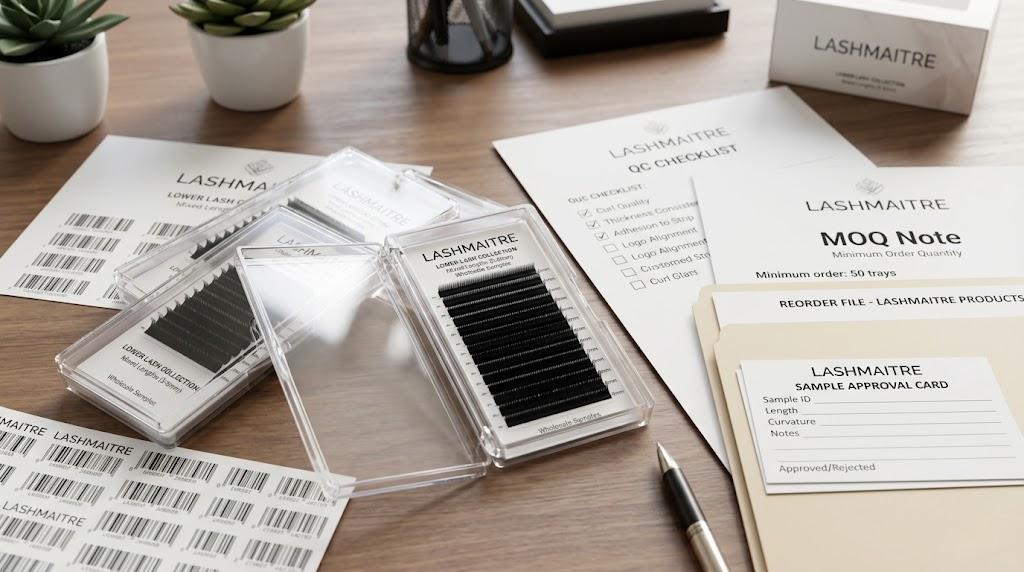
Share
Bottom lash extensions can look like a small add-on, but for wholesale buyers they are a separate product decision. A lower lash tray usually needs shorter lengths, restrained curl choices, clear labels, smaller sample tests, and a stronger reorder record than a standard upper-lash tray.
For a lash brand, distributor, salon chain, or training academy, the question is not only whether bottom lashes are trending. The real question is whether the buyer has enough product demand, service use, education need, and reorder discipline to stock lower lash trays without creating slow-moving SKUs.
Direct answer: Bottom lash extensions can be a useful wholesale add-on when a buyer already serves salons or academies that request lower-lash, inner-corner, natural, editorial, or training kit options. They should be tested as a narrow sample range first, with short lengths, controlled curl, conservative thickness, clear tray labels, QC notes, and reorder records before bulk production.
Buyer note: For general eye-area cosmetic safety context, buyers can review the FDA eye cosmetic safety page, then keep bottom lash extensions approval focused on tray specs, labels, sample feedback, QC notes and reorder records.
1. Treat Bottom Lash Trays as a Separate SKU Decision
Bottom lash trays should not be planned as a smaller version of the main lash range. The use case is different. The lengths are shorter, the tray wording must be clearer, and the buyer may need fewer units than the core classic or volume range.
For B2B buyers, bottom lash extensions may support:
- lower-lash add-on services
- inner-corner product education
- natural and understated service menus
- editorial or detail-focused styling
- lash academy practice kits
- salon chain training samples
- distributor catalog differentiation
That does not mean every buyer should stock them immediately. If the core lash range is still unproven, bottom lash trays may add complexity too early. Buyers can first review the LASHMAITRE guide to lash extension lengths and the J curl lash extensions article to understand why short natural ranges need careful planning.
2. Confirm Buyer Demand Before MOQ
The first check is demand. A lower-lash tray should not be added just because it looks interesting in a product photo. The buyer should know who will use it and how often it may be reordered.
| Buyer type | Bottom lash need | Sample recommendation | Reorder risk |
|---|---|---|---|
| Lash academy | Training and product education | Short mixed tray plus clear labels | Students confuse tray specs |
| Salon chain | Add-on service consistency | Narrow tested range | Low turnover if demand is unproven |
| Distributor | Catalog differentiation | Small MOQ trial | Too many slow-moving SKUs |
| Private label startup | Niche product story | One proofed tray first | Packaging claims drift too broad |
If the buyer cannot identify the use case, start with a lash extension samples request instead of a wide first order. Samples make it easier to test the tray with real artists or educators before committing to MOQ.
3. Start With a Narrow Short-Length Range
Most bottom lash extension planning starts with short lengths. A buyer may test a small range such as 5-8 mm, 6-9 mm, or another short range that matches the intended service and product family.
Do not open too many variations at once. If the first sample request includes multiple curls, multiple thicknesses, multiple finishes, mixed trays, single length trays, and private label packaging at the same time, it becomes difficult to identify what buyers actually approved.
A practical first sample can record:
- product family
- curl
- thickness
- length range
- tray format
- tray card wording
- sample feedback
- packaging direction
- reorder code
If the buyer wants to test bottom lashes together with a broader first order, the MOQ 50 wholesale lash extensions path can keep the launch controlled before the buyer expands into deeper stock.
4. Keep Curl and Thickness Conservative
Bottom lash extensions usually need a more restrained spec than dramatic upper-lash styles. A buyer should test curl and thickness together, not in isolation.
Use the lash extension curl guide to compare curl logic, then keep the bottom-lash test simple. If the buyer changes curl, thickness, and length all at once, the sample feedback becomes unclear.
For example:
| Spec choice | Why it matters for bottom lash trays |
|---|---|
| Curl | The tray should support the lower-lash role without overcomplicating the range |
| Thickness | The tray should feel appropriate for detail work and training use |
| Length | Short lengths should be easy to identify, label, and reorder |
| Tray format | Mixed trays may be better for testing; single length trays need proven demand |
This is a procurement control: keep the variables limited so the buyer can approve or reject the product clearly.
5. Decide Between Mixed Trays and Single Length Trays
For many first tests, a mixed bottom lash tray is easier to evaluate than several single length trays. It gives the buyer more short-length coverage in one sample and reduces early inventory risk.
Single length trays may make sense later if:
- a salon chain repeats the same lower-lash spec often
- an academy kit needs a fixed practice length
- a distributor sees repeat demand for one exact size
- a private label buyer wants a very precise product line
The key is to record the reason. A buyer should not move into single length stock just because it looks more organized. Single length trays are best when the buyer already knows which exact length sells or trains well.
6. Make Tray Labels Easy to Read
Small specs are easy to misread. Bottom lash extension labels should be simple and consistent.
Check whether the tray card clearly shows:
- product family
- bottom or lower lash use note if needed
- curl
- thickness
- length range
- tray format
- SKU or reorder code
- buyer brand name if private label
Private label buyers should connect bottom lash tray labels with their broader private label lash extensions plan. If the product name is creative, the internal SKU still needs a clear spec record so the reorder team can repeat the correct tray.
7. Save QC Notes Before Adding the Product to a Catalog
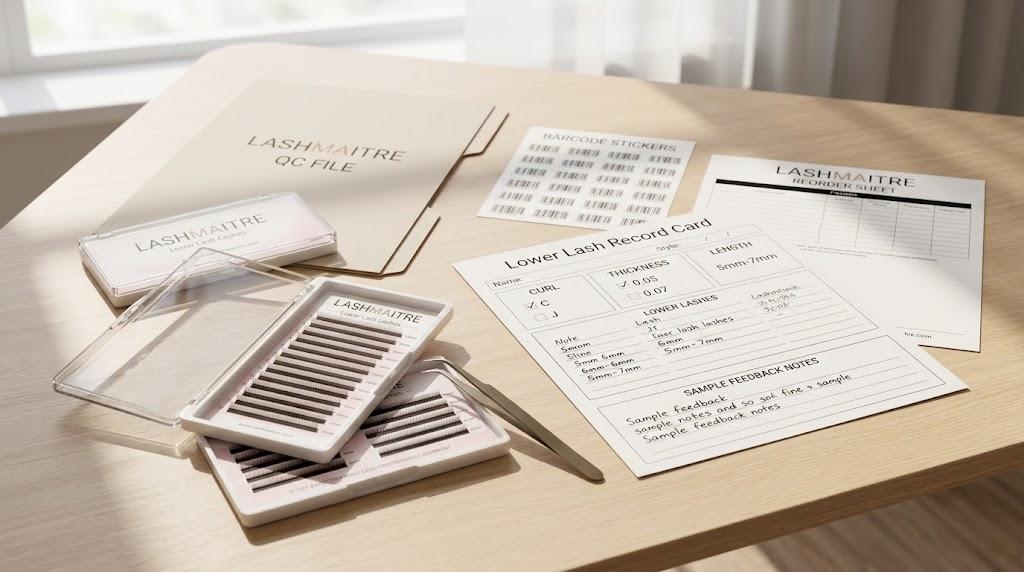
Bottom lash trays should pass the same documentation habits as larger product ranges. The buyer should not rely on memory after sample approval.
Record:
- approved sample photo
- curl and thickness
- length range
- strip release feedback
- tray label version
- packaging proof if used
- buyer comments
- reorder decision
This record should connect with the buyer's lash quality control file. A small add-on tray can still create reorder confusion if the approved sample, label, and carton reference are not saved together.
8. Know When Not to Add Bottom Lash Trays Yet
Bottom lash extensions are not always the right next product. A buyer may be better off waiting if:
- the main classic or volume range is not yet stable
- there is no clear salon or academy demand
- the buyer cannot test samples with real users
- the MOQ would create too many slow SKUs
- packaging names are not ready
- the reorder system is still weak
In that case, use bottom lash trays as a later expansion after the core range is approved. It is better to stock a narrow, clear product line than to launch a niche SKU with no reorder plan.
Inquiry Checklist for Bottom Lash Extension Samples
Before sending a bottom lash extension inquiry, prepare:
- target buyer type
- preferred product family
- curl
- thickness
- short length range
- mixed tray or single length preference
- private label needs
- sample quantity
- MOQ target
- destination country
- expected launch or reorder timing
When the specs are ready, send the details through the LASHMAITRE wholesale lash extensions inquiry page. If the product will be private label, include the tray card wording and any packaging direction with the sample request.
How LASHMAITRE Helps Buyers Plan Lower Lash Trays
LASHMAITRE helps wholesale buyers test bottom lash extensions through sample trays, short-length planning, tray label records, MOQ planning, QC notes, and private label packaging support. The goal is to keep the first lower-lash range narrow, readable, and repeatable.
If your brand is considering bottom lash trays, start with samples, compare feedback, approve one product record, and then decide whether the product belongs in a wider wholesale range.
FAQ: Bottom Lash Extensions Wholesale
Are bottom lash extensions worth stocking for wholesale buyers?
They can be worth stocking when the buyer already has salon, distributor, private label, or academy demand for lower-lash or short-length products. If demand is unproven, start with samples instead of a wide first order.
What lengths are usually tested for bottom lash trays?
Many buyers start with short ranges such as 5-8 mm or 6-9 mm, depending on the target product family and market. The exact range should be confirmed through sample testing and buyer feedback.
Should lower lash trays use the same curl as upper lash trays?
Not automatically. Lower lash trays should be tested for their own use case. Buyers should compare curl, thickness, length and label clarity before approving a wholesale reorder.
Are bottom lash extensions a good first product for a new lash brand?
Usually they are better as a narrow add-on after the core range is clear. A new brand should first prove its main classic, volume, premade, or private label range before adding too many niche SKUs.
What should buyers include in a bottom lash extension sample inquiry?
Buyers should include buyer type, product family, curl, thickness, length range, tray format, sample quantity, private label needs, MOQ target, destination, and expected timing.

Lash Maitre: Your Trusted Partner in Eyelash extension Solutions
Lash Maitre is dedicated to providing professional insights and tips in the eyelash extension industry. Sharing the latest trends, techniques, and product knowledge, Lash Maitre helps lash artists and enthusiasts enhance their skills, stay inspired, and achieve the perfect lash experience.