Lash CAPA Effectiveness Check: 7 Proof Points Before Closure

Share
Lash CAPA Effectiveness Check Buyer Summary
A lash CAPA effectiveness check should confirm implementation, test the revised control, review subsequent lots, compare recurrence data, examine side effects, challenge the change under realistic conditions and retain objective evidence before corrective action is closed.
A lash CAPA effectiveness check should verify that the action was implemented, compare affected and subsequent lots, measure recurrence, confirm document and training changes, test the revised control, check for unintended effects and require objective closure evidence.
What Is a Lash CAPA Effectiveness Check?
A lash CAPA effectiveness check is the evidence review performed after corrective actions have been implemented to determine whether the original problem was reduced or prevented from recurring. It answers a different question from “Was the task completed?”
A supplier may update a work instruction, retrain an operator or add an inspection step. Completion proves the action happened. Effectiveness requires evidence that the action changed the relevant result under real operating conditions.
FDA training materials and inspection examples for regulated quality systems emphasize implementation and verification of effectiveness. Those sources are useful quality references, but they do not create a universal cosmetic-lash CAPA form. Buyers and suppliers should scale the method to their product, agreement and market obligations.
SCAR Response Versus CAPA Effectiveness
A supplier corrective action request asks the supplier to contain a problem, investigate causes and propose actions. The CAPA effectiveness check occurs later. It verifies whether the implemented actions actually controlled the verified cause and reduced recurrence.
Closing a SCAR because every form field is filled can leave the original risk unchanged. Closure should be an evidence decision, not an administrative deadline.
7 Proof Points Before Closure
1. Implementation Is Complete and Traceable
Verify that every approved action has an owner, completion date and controlled evidence. Check the actual workstation, tool, specification, fixture, software setting or supplier record rather than relying only on a status email.
2. Affected and Subsequent Lots Are Defined
Identify the original affected lots and the first lots produced after implementation. Record SKU, batch, dates, quantity, process line and relevant material revisions. Without a defined evaluation population, “no recurrence” is difficult to defend.
3. Recurrence Is Measured With the Same Definition
Use the same defect definition, inspection method and counting unit used in the investigation, unless the approved CAPA intentionally improves the method. Compare like with like and explain any change in detection sensitivity.
4. Documents and Training Match the New Control
Confirm that specifications, work instructions, inspection forms, visual standards and training records reflect the implemented action. Remove obsolete revisions from the workplace. Training attendance alone is not proof that the new behavior is followed.
5. The Revised Control Is Challenged
Test whether the control can detect or prevent the original failure mode. Examples include verifying a label scanner with a known mismatch, checking a fixture against a calibrated reference, or observing whether an operator follows the revised inspection sequence.
6. Unintended Effects Are Reviewed
Determine whether the action shifted risk elsewhere. A stronger adhesive step could affect removal, added inspection could damage lashes, or an extra label could create a new mix-up opportunity. Review quality, capacity, delivery and packaging consequences.
7. Closure Criteria Are Met With Objective Evidence
Use predetermined criteria such as a defined number of consecutive lots, a recurrence threshold, completed challenge result, audit observation or complaint-monitoring period. If evidence is insufficient, keep the CAPA open, extend monitoring or revise the action.
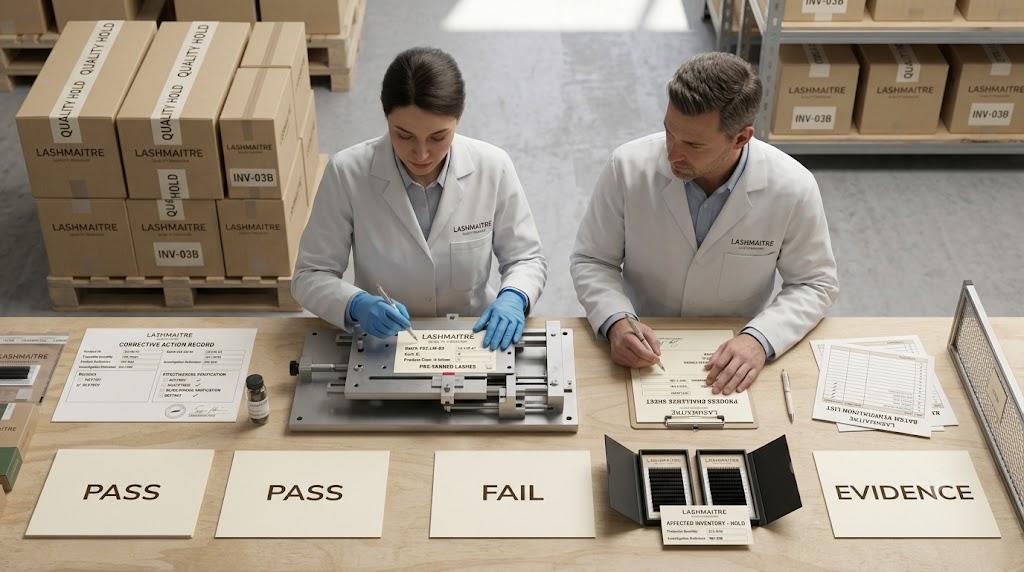
IMPLEMENTED / EFFECTIVE / INEFFECTIVE
| Decision | Meaning | Next step |
|---|---|---|
| IMPLEMENTED | the approved task is complete, but outcome evidence is not yet sufficient | continue monitoring and testing |
| EFFECTIVE | objective evidence meets the predefined closure criteria without unacceptable new risk | authorize closure and retain evidence |
| INEFFECTIVE | recurrence continues, the control fails a challenge, or new risk appears | reopen investigation and revise actions |
Choosing a Verification Window
The right window depends on production frequency and risk. Three calendar months may provide no evidence for a low-volume SKU, while three consecutive high-volume lots may be enough to observe the process. Define the window using lots, units, events or time in a way that produces meaningful data.
For rare complaints, combine internal lot results with complaint monitoring rather than claiming success simply because no complaint arrived during a short period.
Common False Closures
- Training was completed, but behavior was never observed.
- A procedure was revised, but old copies remained at the workstation.
- One good tray was inspected instead of representative subsequent lots.
- The defect definition changed, making recurrence appear lower.
- The original cause was never verified, so the action targeted only a symptom.
- Closure criteria were written after results were known.
- A corrective action created a new quality or delivery problem.
- “No complaints” was used without considering volume, time and detection delay.

Lash CAPA Effectiveness Check FAQ
When should CAPA effectiveness be checked?
Check after implementation and after enough relevant production or monitoring data exists to test the predefined closure criteria. The date should reflect production frequency and risk, not only an administrative target.
Is retraining enough to close a lash CAPA?
Usually not by itself. Verify that the intended behavior changed and that subsequent product or process results meet the effectiveness criteria.
Who should approve CAPA closure?
Use a trained role with defined authority and enough independence to challenge weak evidence. The CAPA owner may supply evidence, while quality or another designated reviewer makes the closure decision.
What happens if a corrective action is ineffective?
Keep or reopen the issue, reassess the cause and scope, revise containment and actions, and define a new effectiveness plan. Do not erase the failed result from the history.
Close CAPA With Evidence, Not a Signature
Connect corrective actions to lash quality control, controlled lash extension samples, the approved private label lash program and a traceable wholesale lash inquiry. Agree on effectiveness criteria when the action plan is approved so closure is based on evidence rather than schedule pressure.
Authority reference: FDA Compounding Quality Center of Excellence self-guided trainings. The CAPA principles are used here as general quality-system guidance, not as a statement that medical-product CAPA rules directly govern lash products.

Lash Maitre: Your Trusted Partner in Eyelash extension Solutions
Lash Maitre is dedicated to providing professional insights and tips in the eyelash extension industry. Sharing the latest trends, techniques, and product knowledge, Lash Maitre helps lash artists and enthusiasts enhance their skills, stay inspired, and achieve the perfect lash experience.