Lash Label Reconciliation: 8 Counts Before Batch Close

Share
Lash Label Reconciliation Buyer Summary
Lash label reconciliation should balance the controlled quantity issued and added against labels used on accepted or rework units, damaged, returned, destroyed and any unexplained difference. Hold batch close whenever the label identity, revision or quantity remains unresolved.
Lash label reconciliation proves what happened to every controlled printed label issued to a packaging batch. Record labels issued, used on accepted units, damaged, returned, destroyed and unused, then investigate every unexplained difference before the batch is closed or released.
What Is Lash Label Reconciliation?
Label reconciliation is a numerical and identity check at the end of a labeling or packing operation. It connects the issued label stock to accepted finished units and all documented losses or returns.
The control is especially useful when labels contain a buyer identity, barcode, lot reference, count, curl, length, warning or market-specific statement. A wrong or uncontrolled label can turn conforming lash trays into the wrong sellable SKU.
FDA cosmetics GMP guidance says labels should be examined for identity before labeling operations to avoid mix-ups. FDA's labeling summary also explains that applicable identity and net-quantity statements must be accurate. The exact reconciliation form is a factory and buyer control, not a claim that FDA prescribes this eight-count layout for false eyelashes.
Reconciliation Is Different From Line Clearance
Line clearance checks that the work area is free of prior-job materials before the next job starts. Label reconciliation accounts for controlled labels after they have been issued and used. Both controls matter, but one cannot substitute for the other.
8 Counts to Record
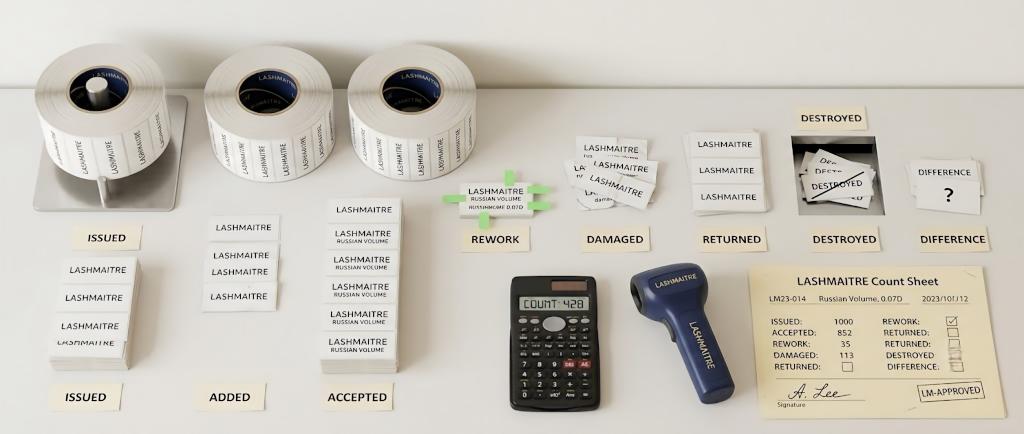
1. Opening Stock or Controlled Issue
Record the label item, revision, lot or roll identity and quantity issued to the job. Do not count mixed revisions as one stock item.
2. Additional Issue
If more labels are issued during packing, record the added quantity, time and authorizer instead of overwriting the opening count.
3. Labels on Accepted Units
Count labels applied to finished units that passed the required packing and quality checks.
4. Labels on Rejected or Rework Units
Separate labels attached to units awaiting rework, destruction or another disposition. Their status must remain visible.
5. Damaged During Use
Count torn, misprinted, contaminated, creased or otherwise unusable labels. Preserve representative evidence when required by procedure.
6. Returned Unused
Count labels returned to controlled inventory. Verify identity and revision before returning them to an available location.
7. Destroyed Labels
Record labels deliberately destroyed, including the method, quantity and witness or authorization when required.
8. Unexplained Difference
Calculate the balance. An unexplained positive or negative difference is not corrected by changing a number; it triggers search, segregation and impact assessment.
Label Reconciliation Formula
Issued + Additional Issue = Accepted Use + Rework/Reject Use + Damaged + Returned + Destroyed + Unexplained Difference
Use one unit of measure throughout. If rolls, sheets and individual labels are involved, document the conversion and verify it.
Batch-Close Decision
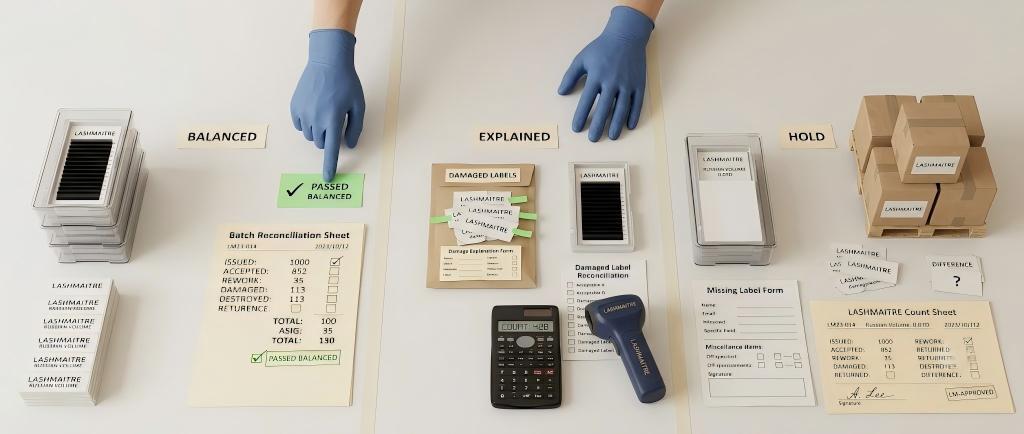
| Result | Decision | Required action |
|---|---|---|
| Counts balance and identities match | BALANCED | Sign the reconciliation and close the label operation |
| Difference is documented and impact is assessed | EXPLAINED | Approve the recorded disposition before close |
| Quantity or revision remains unexplained | HOLD | Stop batch close and search affected areas and stock |
| Wrong label may be on product | ESCALATE | Segregate affected product and assess reinspection or recall scope |
What to Check When Counts Do Not Balance
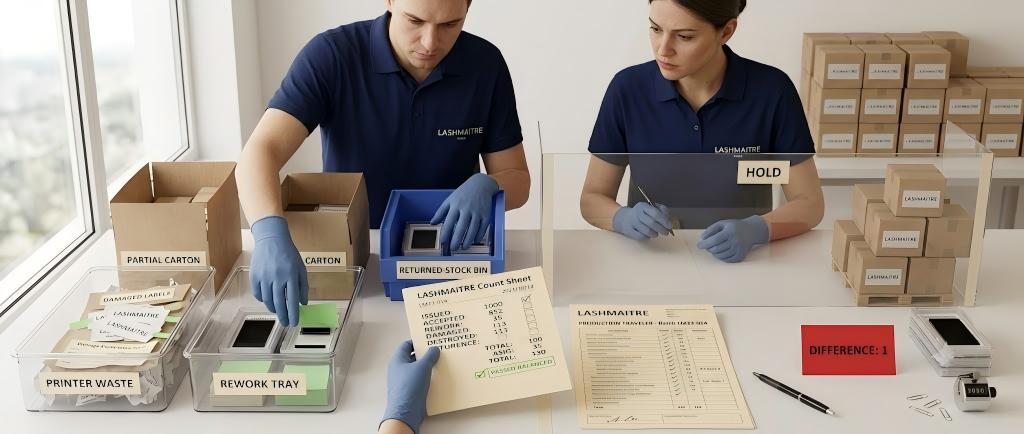
Check the printer and waste bin, packaging machines, floor, rework stations, quality samples, partial cartons, unused job kits, returned stock and adjacent jobs. Compare finished-unit counts with the production traveler and packing records.
Do not release product simply because the numerical difference is small. The risk depends on label content, ability to detect the error and whether the missing label could be attached to the wrong product.
Common Label-Control Failures
- Issuing two artwork revisions under one count.
- Estimating roll quantity without a verified conversion.
- Ignoring labels on rework units.
- Returning unused stock without checking revision identity.
- Destroying damaged labels without recording the quantity.
- Changing the issued number to force a balance.
- Closing packing before an unexplained difference is investigated.
FAQ: Lash Label Reconciliation
What is label reconciliation?
It is the recorded comparison of all controlled labels issued with labels used, damaged, returned, destroyed or otherwise dispositioned for one job.
Which lash labels should be reconciled?
Apply the rule to controlled printed items defined by the packaging procedure, especially product, SKU, lot, barcode, count and buyer-identity labels.
What happens when label counts do not balance?
Hold batch close, search likely locations, segregate potentially affected product and document the investigation and disposition.
Can unused labels be returned to stock?
Yes, if their identity, revision and condition are verified and the return quantity and controlled location are recorded.
Close the Numbers Before Release
Link label reconciliation to controlled private label lash packaging, documented lash quality control, a defined private label lash program and a traceable wholesale lash inquiry.
Authority references: FDA cosmetics GMP guidelines and inspection checklist and FDA summary of cosmetics labeling requirements.
Before approving high-volume private-label label stock, use lash extension samples to confirm the product identity, tray presentation and packaging revision that the controlled label must match.

Lash Maitre: Your Trusted Partner in Eyelash extension Solutions
Lash Maitre is dedicated to providing professional insights and tips in the eyelash extension industry. Sharing the latest trends, techniques, and product knowledge, Lash Maitre helps lash artists and enthusiasts enhance their skills, stay inspired, and achieve the perfect lash experience.