Lash Capacity Reservation: 8 Terms Before Peak Season

Share
Lash Capacity Reservation Buyer Summary
A lash capacity reservation should identify the covered SKU mix, measurable quantity, material and packaging readiness, production start and completion window, buyer freeze date, commercial release trigger, change rules and recovery plan.
Lash Production Capacity Reservation Buyer Summary
A lash production capacity reservation should identify the covered SKU mix, measurable quantity, material and packaging readiness, production start and completion window, buyer freeze date, commercial release trigger, change rules and recovery plan.
A lash production capacity reservation should identify the exact SKU mix, quantity, material and packaging readiness, production window, approval freeze date, change rules and recovery plan. A forecast, deposit or verbal promise alone does not prove that a usable factory slot has been held.
What Is Lash Production Capacity Reservation?
Lash production capacity reservation is a documented agreement to hold a defined manufacturing window for a buyer's expected order. It converts a demand forecast into a time-bound planning commitment, subject to the agreed commercial and readiness conditions.
SAP capacity-planning guidance explains that production orders create capacity requirements and that availability checks consider remaining capacity and other orders. In practical buyer terms, a useful reservation needs quantity and date inputs, not just an informal note saying “capacity is available.”
Why Peak-Season Capacity Needs Evidence
During promotions, holidays or major launches, several buyers may request the same labor, workstations, materials, printing and packing resources. A supplier may be able to make the lashes but lack approved packaging, enough trained operators or space in the intended week.
A capacity booking should therefore define what is reserved, what must be ready, when the buyer must freeze changes and what happens if either party misses a milestone.
8 Lash Capacity Reservation Terms
1. Covered SKU Mix
List the lash styles, curls, lengths, thicknesses, row counts and packaging variants included in the slot. Separate confirmed SKUs from optional mix quantities.
2. Reserved Quantity or Capacity Unit
State the covered quantity and whether the commitment refers to finished trays, production hours, line days or another measurable unit. Avoid an undefined “priority” promise.
3. Material Readiness Assumptions
Identify the fiber, tray, card, label, box and other long-lead materials that must be available. Record who carries inventory risk before the final PO.
4. Packaging and Approval Status
Define which master samples, specifications, artwork and packaging BOM revisions must be approved before the slot becomes firm.
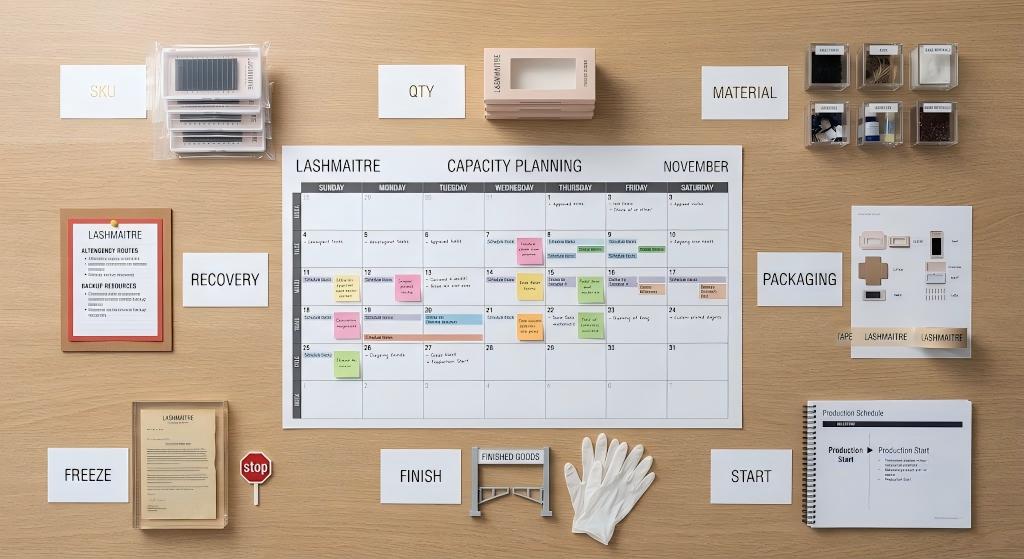
5. Production Start and Completion Window
Use a date range rather than one unsupported finish date. Distinguish production completion from inspection, packing, export readiness and carrier departure.
6. Freeze Date for Buyer Changes
Set the last date for changing SKU mix, quantity, artwork or packing instructions without rechecking capacity. After the freeze, changes may require a split shipment or moved date.
7. Deposit, Cancellation and Release Terms
State what confirms the hold, whether a deposit is refundable, when unused capacity is released and how cancellation costs relate to purchased materials or completed work.
8. Escalation and Recovery Plan
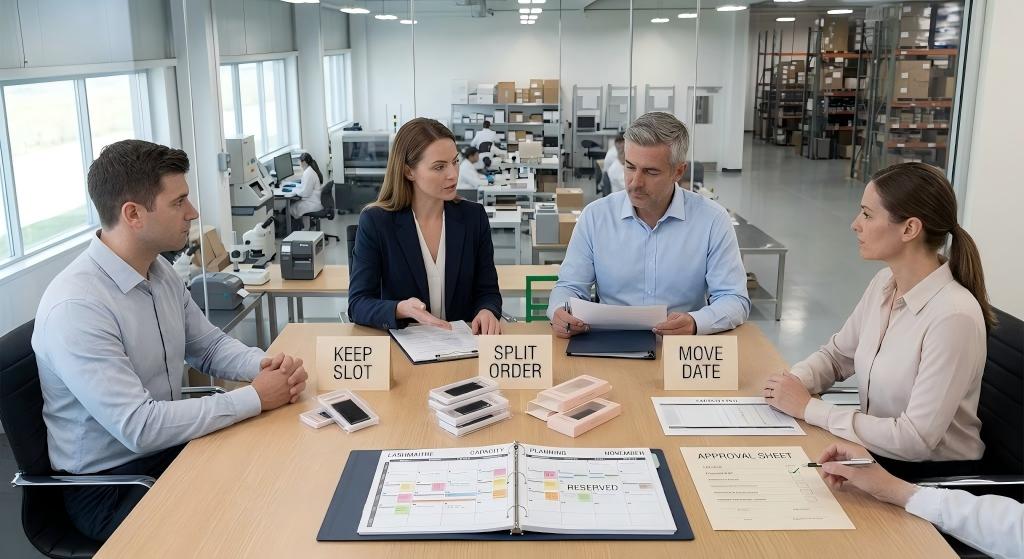
Define notification timing and decision owners for material shortages, approval delay, capacity overload or equipment failure. Pre-agree options such as keeping the original mix, splitting the order or moving the production window.
Reservation Milestone Table
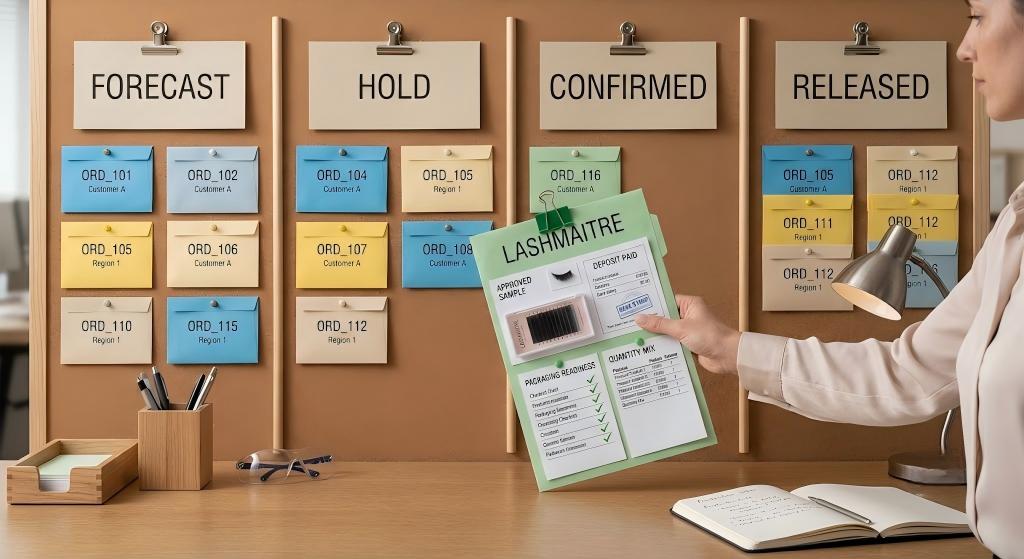
| Status | Evidence | Buyer meaning |
|---|---|---|
| FORECAST | Preliminary SKU and quantity plan | No slot commitment yet |
| HOLD | Supplier identifies a provisional window and expiry | Temporary, condition-based hold |
| CONFIRMED | Readiness, commercial trigger and dates are accepted | Defined slot is committed |
| RELEASED | Completed, cancelled or hold expired | Capacity may be assigned elsewhere |
Questions to Ask Before Paying a Capacity Deposit
Ask what capacity unit is being reserved, which production and packing resources are covered, when the hold expires, which approvals are outstanding, whether materials are already purchased, how mix changes are handled and what evidence will confirm the production start.
The agreement should also separate supplier delay from buyer-caused delay. If artwork, sample approval or final quantities arrive after the freeze date, the original window may no longer be achievable even when production capacity was initially available.
How to Handle a Change After the Freeze Date
Compare the requested change with material availability, packaging readiness and the remaining capacity in the reserved window. Keep the slot if the change is operationally neutral; split the order when only part of the mix is ready; move the date when the change creates new material, tooling or approval requirements.
Record the decision in the PO acknowledgment or approved order change so the factory schedule and buyer expectation stay aligned.
FAQ: Lash Production Capacity Reservation
When should a buyer reserve lash production capacity?
Reserve it when demand is time-sensitive, quantities are material, packaging has long lead times or the target period is predictably busy. Start with a forecast, then confirm after key specifications and commercial terms are stable.
Does a deposit guarantee the shipment date?
Not by itself. The agreement should identify what the deposit triggers, the production window, buyer readiness conditions, inspection and packing time, and events that can change the schedule.
Can the SKU mix change after capacity is reserved?
Only within the agreed change rules. A mix change can affect materials, work content, packaging and inspection, so the supplier should reconfirm capacity and dates.
Is capacity reservation the same as a purchase order?
No. A reservation holds planning capacity under defined conditions. The purchase order controls the actual products, quantities, prices and delivery terms; both documents should agree before production starts.
Convert the Forecast Into a Controlled Slot
Connect capacity planning with a validated lash extension sample, a realistic MOQ 50 wholesale lash plan, controlled private label lash packaging and a dated wholesale lash inquiry.
Authority reference: SAP Capacity Planning in Shop Floor Control.
Before the reserved slot is released, align the approval freeze and inspection evidence with the documented lash quality control plan so capacity is not consumed by an unapproved specification or packaging revision.
A reserved production slot should move to execution only after lash production readiness confirms the PO, specification, sample, packaging, materials, tools, capacity and quality controls.

Lash Maitre: Your Trusted Partner in Eyelash extension Solutions
Lash Maitre is dedicated to providing professional insights and tips in the eyelash extension industry. Sharing the latest trends, techniques, and product knowledge, Lash Maitre helps lash artists and enthusiasts enhance their skills, stay inspired, and achieve the perfect lash experience.