Lash Extension Supply Storage: 8 Inventory Checks for Wholesale Reorders
Share
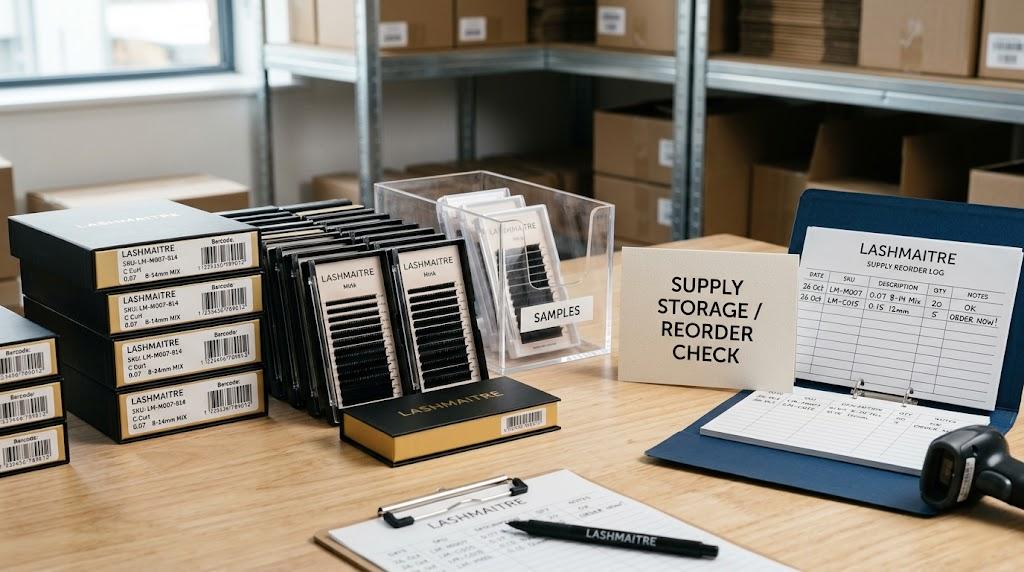
Lash extension supply storage is not only about keeping trays clean on a shelf. For wholesale buyers, storage affects how easily a team can find approved samples, match tray labels, confirm packaging proofs, check carton records, and place a repeat order without rebuilding the whole product file from memory.
If trays, sample cards, barcode labels, carton marks, and reorder notes are separated, the second order can become slower than the first one. A buyer may know that a style sold well, but still not know which curl, thickness, length range, packaging version, or carton note should be repeated.
Direct answer: Lash extension supply storage should keep sellable stock, approved sample stock, tray labels, carton records, packaging proofs, and reorder notes connected. A good storage system helps wholesale buyers confirm what was approved, what was sold, and what must be repeated before the next bulk order.
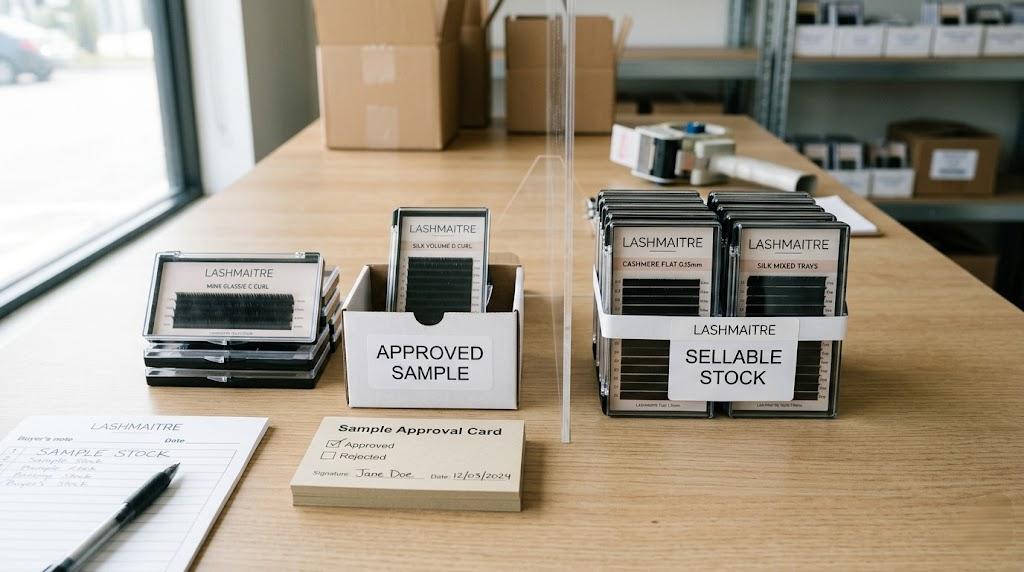
1. Separate Sellable Stock From Approved Sample Stock
The first storage rule is simple: do not let approved samples disappear into everyday inventory. Approved sample trays are reference tools. They should be stored where the buyer, warehouse team, and supplier contact can identify them later.
Sellable trays are used to fill orders. Approved samples are used to check repeat orders. When the two are mixed together, a team may accidentally sell the reference tray or compare a new batch against the wrong product.
| Stock type | Storage purpose | What to keep with it |
|---|---|---|
| Sellable stock | Fulfill salon, retail, or distributor orders | SKU, quantity, location, carton note |
| Approved sample stock | Confirm repeat production standard | Sample ID, approval date, product spec, photo note |
| Packaging proof stock | Confirm private label artwork and version | Tray card proof, box proof, barcode area, carton mark |
| Correction sample | Track changes before reorder | Correction note, rejected issue, next approval step |
For a new buyer, this can be as basic as one labeled sample box and one reorder folder. For a distributor, it may need a shelf location, SKU code, and digital inventory record. The goal is the same: approved samples should stay findable.
2. Keep Tray Labels Easy to Read and Match
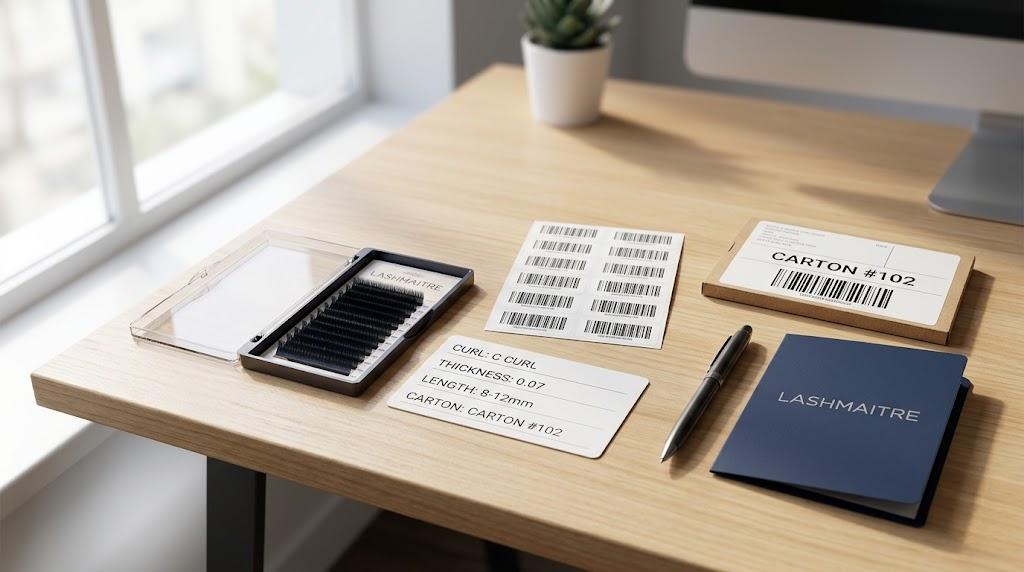
Lash tray storage becomes risky when tray labels are hidden, faded, inconsistent, or written differently from the reorder file. A tray can look familiar, but if the label does not match the approved sample record, the buyer may reorder the wrong curl, thickness, length range, or tray type.
Each stored tray should be easy to match with:
- Product family
- Curl
- Thickness
- Length range or single length
- Tray type
- Finish
- Private label version
- Internal SKU or buyer code
This matters most when the buyer manages several similar trays. For example, a classic C curl mixed tray and a classic CC curl mixed tray may look close in a quick photo, but they should never be stored or reordered from memory. The tray label and the reorder record need to agree.
Buyers planning sample ranges can connect storage records with their lash extension samples process so each approved tray has a clear sample ID before bulk production.
3. Store Carton Labels and Packing References With the Reorder File
Wholesale lash orders are not only tray-level orders. They also involve cartons, quantities, packing notes, carton marks, and sometimes barcode or customer label requirements.
Trade.gov explains that a packing list itemizes package contents and is used by freight forwarders and customs officials to check cargo. That same logic is useful for buyers, even before an order ships: the carton record should match the product and quantity record. Reference: Trade.gov packing list.
For lash extension supply storage, keep these references together:
- Carton mark or carton label
- Packing list reference
- Product SKU and quantity
- Tray label photo
- Approved sample photo
- Private label packaging version
- Reorder correction note
If your warehouse team stores cartons separately from sample records, use a simple linking field. That might be a carton number, order number, SKU code, or approved sample ID. The exact system can be simple, but the connection should not rely on memory.
4. Keep Packaging Proofs Beside the Approved Product Sample
Private label buyers often approve product samples and packaging proofs at different times. That is normal, but the final storage system should connect both.
A tray can be correct while the tray card is outdated. A box can be beautiful while the product spec printed on it is wrong. A carton label can be correct for the first order but not updated for a new packaging version.
For private label lash extensions, store:
- Approved tray sample
- Tray card proof
- Box or sleeve proof
- Label sheet
- Barcode or QR placement note
- Packaging version number
- Artwork approval date
- Any correction before reorder
This is especially important when a buyer reorders after a brand refresh. If the product is unchanged but packaging changes, the reorder file should show that clearly. If the product spec changes but the packaging stays the same, that should also be visible.
Buyers preparing branded trays can review LASHMAITRE private label lash extensions and custom lash packaging before connecting samples with packaging records.
5. Use SKU Notes for Tray Type, Row Map, and Version
Good lash tray storage should help the buyer know what to reorder, not only where a tray is located. A basic SKU note can prevent many repeat-order mistakes.
A useful lash tray inventory note can include:
| Field | Example |
|---|---|
| Product family | Classic, flat, volume, premade fan, YY, W |
| Curl | C, CC, D, M, L, or buyer-approved option |
| Thickness | 0.03, 0.05, 0.07, 0.10, 0.15, or approved spec |
| Length | Mixed 8-15mm, mixed 8-16mm, or single length |
| Tray type | Mixed tray, single length tray, sample tray, reorder tray |
| Packaging version | Tray card V1, box V2, label V1 |
| Sample ID | Approved sample number or date |
| Reorder note | Repeat, correct, hold, or replace |
The exact field names can change by buyer, but the record should be clear enough for a different team member to understand it later. If only one person can decode the storage system, it is too fragile for repeat wholesale orders.
6. Set Simple Reorder Points by Sales Speed and Lead Time
Lash extension supply storage should also support timing. Buyers need to know when a tray is getting low, how quickly it sells, and how long it takes to receive the next order.
Shopify describes reorder points as inventory levels that trigger a new order before stock runs out. IBM also explains safety stock as a buffer against uncertainty in demand or supply. Those concepts are useful for wholesale lash buyers, even if the buyer uses a simple spreadsheet instead of full inventory software. References: Shopify inventory management and IBM safety stock.
For lash trays, a simple reorder point can consider:
- Average monthly sales by tray type
- Lead time for production and shipping
- MOQ or first reorder quantity
- Seasonality or campaign timing
- Packaging production time
- Safety stock for best-selling SKUs
Do not set the same reorder point for every tray. A best-selling classic mixed tray may need earlier replenishment than a specialty length or limited private label style. A distributor may also need deeper safety stock than a new private label brand.
7. Check Older Stock Before Using It as a Reorder Reference
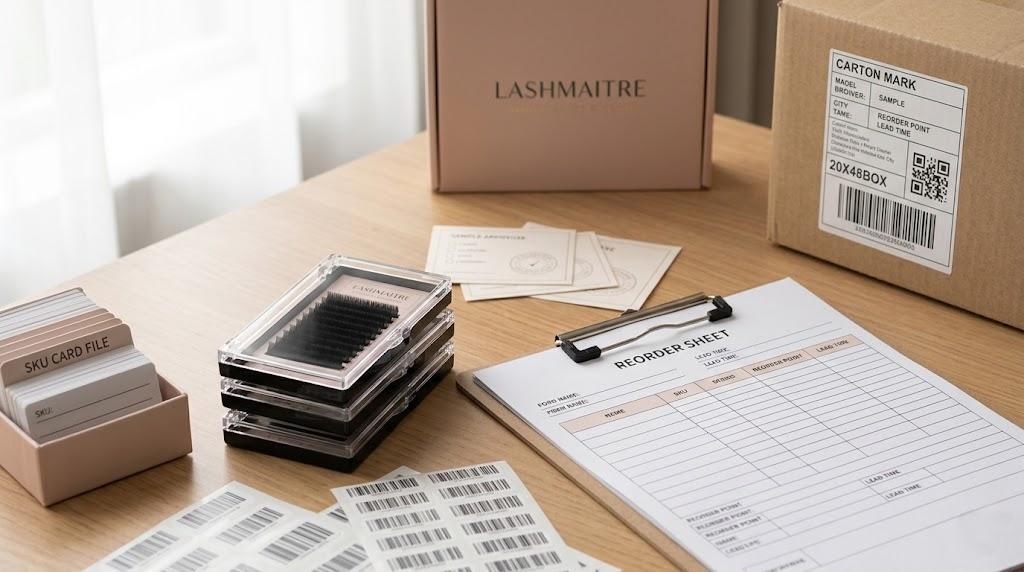
Older stock can be useful, but it should not automatically become the reorder standard. Before using an old tray as a reference, check whether it still matches the approved file.
Review:
- Is this the final approved sample or an earlier trial?
- Does the tray label match the current SKU?
- Was packaging updated after this tray was made?
- Did the buyer request any correction after this order?
- Is the carton mark still current?
- Is there a newer approved photo or sample record?
This is where storage connects with quality control. The buyer should compare the stored reference with the written record, not only with memory. LASHMAITRE lash quality control can help buyers think through sample-to-bulk and reorder checks before approving another production run.
8. Build a Reorder-Ready Storage Checklist
Before placing a repeat order, a buyer should be able to answer the questions below.
| Reorder check | Why it matters |
|---|---|
| Approved sample located | Confirms the physical reference still exists |
| Tray label readable | Prevents curl, thickness, and length confusion |
| SKU record current | Keeps warehouse and buyer records aligned |
| Packaging proof linked | Prevents wrong tray card, box, or label version |
| Carton label saved | Helps packing and receiving teams match cartons |
| Quantity history reviewed | Shows which trays should be reordered first |
| Reorder point checked | Reduces stockout risk |
| Correction notes reviewed | Prevents repeating the same issue |
For larger buyers, GS1 notes that GS1-128 barcodes can carry information such as batch or lot data and support supply-chain traceability. Not every small lash buyer needs that level of labeling, but the principle is useful: carton and batch information should help teams identify products as they move through storage and reorder workflows. Reference: GS1-128 barcode.
How LASHMAITRE Helps Buyers Organize Supply Storage for Reorders
LASHMAITRE helps wholesale buyers connect product samples, private label packaging, MOQ planning, quality control, and repeat-order records. If you are preparing a reorder, send more than a product name. Send the approved sample ID, product spec, packaging version, last order reference, correction notes, and target quantity.
For a first order, start with MOQ 50 wholesale lash extensions if you want a controlled sample-to-bulk path. For sample planning, use lash extension samples. For repeat order support, send your storage and reorder details through the wholesale lash extensions inquiry page.
FAQ: Lash Extension Supply Storage
How should wholesale buyers store lash extension trays before reorder?
Wholesale buyers should store lash extension trays with clear labels, sample IDs, SKU notes, carton references, and packaging version records. Approved samples should be kept separately from sellable stock so they remain available for repeat-order comparison.
Should approved lash samples be stored separately from sellable stock?
Yes. Approved samples are reference items, not everyday inventory. Keeping them separate helps buyers compare future production against the approved tray, label, and packaging record.
What records should stay with lash tray storage?
Keep product family, curl, thickness, length range, tray type, sample ID, packaging version, carton label, quantity history, and correction notes. For private label buyers, packaging proofs should stay connected to the approved sample.
Can lash extension supply storage reduce reorder mistakes?
Yes. A storage system that connects trays, labels, carton records, packaging proofs, and reorder notes makes it easier to repeat the correct product and avoid confusing similar SKUs.
Does every lash buyer need a barcode system?
Not every buyer needs a full barcode system at the beginning. Small buyers can start with clear SKU notes and sample records. Larger distributors may benefit from barcode or carton-label systems as inventory complexity grows.
Conclusion: Store Lash Supplies Around the Reorder
Good lash extension supply storage is a reorder system. It keeps the approved tray, sample record, packaging proof, carton label, SKU note, and reorder timing close enough that the next order can be checked quickly.
If your team is preparing repeat wholesale orders, organize the storage file before stock runs low. The best time to fix a reorder record is before the tray is needed, not after the buyer is already out of stock.

Lash Maitre: Your Trusted Partner in Eyelash extension Solutions
Lash Maitre is dedicated to providing professional insights and tips in the eyelash extension industry. Sharing the latest trends, techniques, and product knowledge, Lash Maitre helps lash artists and enthusiasts enhance their skills, stay inspired, and achieve the perfect lash experience.