Individual Cluster Eyelash Extensions Wholesale: Cluster Lash Manufacturing Guide
Share
Wholesale Buyer Summary
Before you source Cluster Lashes
This guide is written for retail brands and distributors sourcing cluster lashes, DIY lash clusters and kit-ready products. Use it to prepare a clearer individual cluster eyelash extensions wholesale request before asking for samples, MOQ, lead time, wholesale pricing, private label or OEM support.
- Main keyword: individual cluster eyelash extensions wholesale
- Best next step: compare specs, request samples and confirm packaging before bulk production.
- Send us: cluster style, band/base type, length mix, kit components, packaging and MOQ.
Author: Alex, LASHMAITRE — B2B eyelash extensions manufacturing & private-label programs (https://www.lashmaitretrade.com)
The Follicular Liability of Express Beauty
When regional beauty supply distributors and multi-location salon franchises audit their wholesale procurement strategies, they face a distinct polarization. This polarization surrounds the highly controversial category of express beauty services.
For many years, elite lash artists and salon directors vehemently rejected any inventory labeled as “clusters.” They viewed these products as amateur, damaging, and entirely unsuitable for a premium salon environment.
The historical, agonizing pain point for a B2B buyer attempting to enter this highly lucrative market was immense. It involved the catastrophic medical liability associated with cheap, outdated overseas manufacturing.
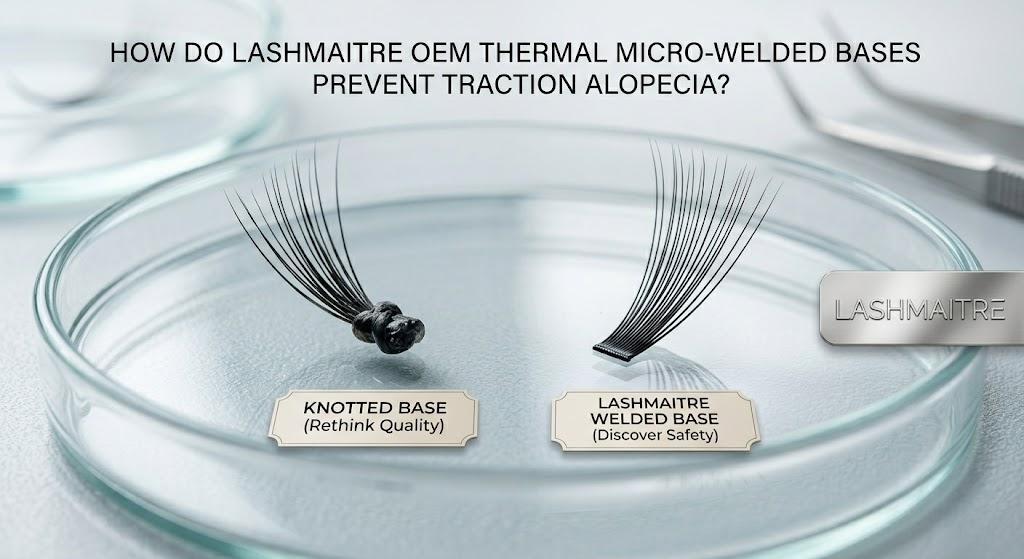
If a distributor imported generic clusters, they were inevitably importing products with thick, heavy, glue-dipped bases. In the professional beauty industry, these bulky bases are universally referred to as “knots.”
When applied to a client, these heavy knots fused multiple natural lashes together. Over a short period, this caused severe, permanent traction alopecia (bald spots) for the end consumer.
Unlike our previous supply chain analyses detailing the thermodynamic limits of cyanoacrylate adhesives, this briefing focuses on geometric engineering. We are strictly dissecting the microscopic architecture of synthetic PBT fibers.
The global beauty market is currently experiencing an explosive, unprecedented demand for “30-Minute Sets.” Simultaneously, there is massive consumer interest in premium “At-Home Weekend Kits.”
The profit margins in this rapidly expanding express sector are astronomical. However, the medical risks of supplying cheap, uncalibrated hardware remain equally high.
To capitalize on this demographic shift safely, B2B buyers must fundamentally restructure their procurement models. They must completely redefine how they evaluate their express lash inventory.
To dominate the highly lucrative market for individual cluster eyelash extensions, wholesale buyers must pivot immediately. They must transition away from outdated, glue-dipped trading company supplies.
The business of supplying modern express lashes is an exercise in microscopic weight distribution. It requires mastering advanced polymer micro-welding and geometric base flattening.
This comprehensive technical briefing completely dissects the physical danger of knotted bases. It outlines the exact thermal engineering required for safe, high-margin manufacturing.
Defining the Product in a Technical B2B Ecosystem
In the mathematically driven context of Original Equipment Manufacturing (OEM), professional procurement requires precise definitions. Procuring individual cluster eyelash extensions does not mean buying cheap “party lashes” found in discount retail drugstores.
Functionally, this B2B category is defined as the strategic acquisition of ultra-lightweight synthetic fibers. These fibers must be manufactured from premium Polybutylene Terephthalate (PBT) in 0.05mm to 0.07mm diameters.
These delicate fibers are then mechanically grouped together using advanced Thermal Micro-Welding. This is also commonly known in the industry as Heat-Bonding technology.
This highly specific manufacturing process strictly eliminates the use of heavy liquid adhesives at the base. True B2B procurement mandates a strictly “Knot-Free, Flat-Base” geometry.
This ensures that when the professional or consumer applies the product, the base sits completely flush. It rests flat against the natural lash line, distributing a negligible weight load.
This advanced manufacturing approach completely neutralizes the risk of follicular damage. It safely secures the product’s place within high-end salon operations.
The Physics of Failure: The Danger of Glue-Knotted Bases
To command authority as a premium distributor, you must speak the language of medical safety. You cannot successfully distribute wholesale supplies without understanding exactly why traditional manufacturing methods fail.
The Weight and Mass Dilemma
The average human natural eyelash can only safely support a very specific, microscopic weight load. Typically, this is the equivalent weight of a single 0.15mm extension.
When cheap overseas factories manufacture traditional clusters, they bypass weight protocols completely. They group 10 to 20 thick synthetic fibers together in a single bundle.
They then simply dip the bottom end into an industrial liquid polymer glue. This cheap, fast manufacturing method creates a massive, hard, blocky base.
This knot is incredibly heavy and physically rigid. When a salon artist applies this cheap product, the sheer mechanical weight initiates immediate trauma.
The weight begins to constantly stress the client’s delicate natural follicle. Over several days, this constant downward pulling causes the follicle to become inflamed and weakened.
The Cross-Over Liability
Because the knot is so bulky, precise isolation becomes physically impossible. The artist cannot attach the knot to a single natural human lash.
The knot inevitably glues three or four natural human lashes together into a single, fused cluster. This creates a devastating biological problem for the client.
Natural human lashes all grow at different biological speeds during the anagen and telogen phases. As these fused lashes attempt to grow at different rates, they physically pull against each other.
Eventually, the faster-growing lashes physically rip the slower-growing lashes right out of the eyelid. This painful process destroys the client’s lash line.
Supplying these knotted products to a professional salon guarantees a catastrophic outcome. The clients will return in two weeks with gaping bald spots.
The salon will face severe liability claims and public relations disasters. Consequently, they will permanently blacklist your wholesale brand from their future procurement budgets.
Banning the Knot in Procurement
To protect your brand equity, you must take definitive action. Your procurement protocol must explicitly ban any product manufactured with a glue-dipped base.
The only acceptable, medically safe manufacturing standard for modern individual cluster eyelash extensions is Heat-Bonding technology. There is absolutely zero room for compromise on this geometric specification.
“A true B2B distributor actively protects the physical health of the end-consumer. When procuring express lash inventory, the presence of a ‘knot’ at the base is an immediate indicator of outdated, cheap manufacturing. Premium OEM supply chains mandate thermal micro-welding to eliminate this liability.”
LASHMAITRE Engineering Directive: Structural Safety in Express Systems
Review our advanced polymer engineering data and request knot-free OEM samples
Thermal Micro-Welding: Engineering the Knot-Free Base
Standard glue-dipped bases mathematically guarantee follicular destruction. Therefore, B2B distributors must find an alternative way to help their salon clients capture the massive consumer traffic for express services.
The solution requires leveraging the advanced thermodynamic capabilities of a premium OEM factory. Wholesale buyers must shift their capital entirely toward mass-procuring OEM Heat-Bonded inventory.
The Heat-Bonding Manufacturing Process
Elite factories do not use liquid glue to bind the fibers together. Instead, they utilize highly specialized, high-heat micro-press machines.
The factory technician begins by precisely aligning ultra-fine PBT synthetic fibers. They meticulously arrange them into the desired shape, such as Wispy, Spiky, or Dense Volume.
Once aligned, the microscopic bases of these fibers are subjected to a calibrated thermal micro-press. The machine applies intense, highly targeted thermal energy.
This heat physically melts the microscopic bases of the individual PBT plastic fibers. As they melt, they fuse together seamlessly into a single, cohesive unit.
The Geometric Advantage of a Flat Base
The result of this thermal micro-welding is a completely knot-free geometry. The base lacks any external glue or chemical bulking agents.
Because of this, the base profile is razor-thin. It is physically flat, resembling a microscopic ribbon rather than a bulky ball.
When an artist or consumer applies this premium individual cluster eyelash extension, the flat base performs flawlessly. It wraps seamlessly around the cylindrical curve of the natural lash.
This creates a massive, uninterrupted surface area for the adhesive to bond to. Whether using professional cyanoacrylate or retail mastic, the retention is vastly improved without adding extra bulk.
Most importantly, this heat-bonded base is incredibly light and thin. It does not accidentally bridge across multiple natural lashes during application.
It moves organically with the natural lash line during the client’s daily activities. This absolute flexibility completely neutralizes the risk of traction alopecia.
Table 1: Manufacturing Specs: Glue-Knotted vs. Heat-Bonded
A technical comparison of base geometries and their direct impact on salon safety and liability.
| Manufacturing Technology | Base Geometry & Structural Weight | Application & Isolation Impact | B2B Procurement Verdict & Salon Liability |
| Traditional Glue-Dipped | Hard, bulky ball of industrial glue. Extremely heavy. | Impossible to isolate properly. Fuses multiple natural lashes. | Severe Risk. Causes traction alopecia. Generates massive liability lawsuits for the salon franchise. |
| OEM Thermal Micro-Welded | Razor-thin, seamless flat base. Ultra-lightweight profile. | Flawless Adhesion. Flat base hugs the natural lash perfectly; allows safe isolation. | Maximum ROI. Safe, fast application. Establishes the wholesale distributor as a highly premium, reliable supplier. |
Material Science: Mandating 0.05mm Ultra-Fine Fibers
Mastering the thermal micro-welding of the base is only the first engineering hurdle. Wholesale buyers must also dictate the exact specifications of the individual synthetic fibers used within the product.
The Stiff Plastic Trap
A distributor might successfully find a factory that uses heat-bonded bases. However, that factory might still try to cut costs by using standard 0.10mm or 0.15mm thick fibers.
Because these individual fibers are thick, grouping them together causes a secondary issue. It creates a stiff, rigid, highly uncomfortable “plate” of plastic on the client’s eyelid.
The client will constantly feel the stiff extensions poking their eyelid every time they blink. This sensory discomfort is highly irritating over a multi-day wear period.
Consequently, the client will begin to mechanically pick and pull at the stiff plastic. This nervous habit will ultimately destroy their natural lashes, regardless of the safe base design.
Mandating Cashmere-Soft Parameters
To ethically and safely supply premium individual cluster eyelash extensions, you must enforce strict fiber limits. Your Service Level Agreement (SLA) must mandate specific PBT diameters.
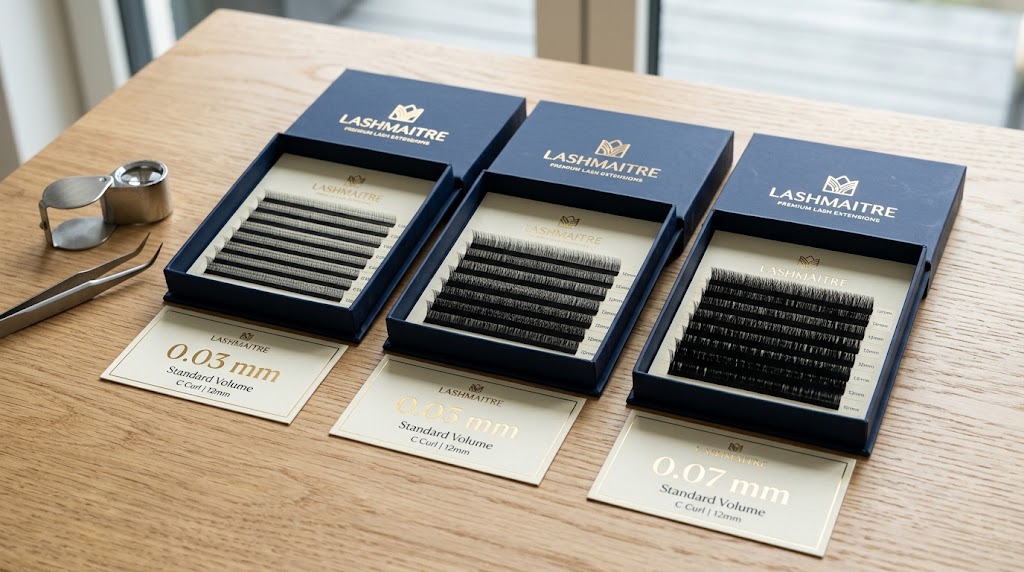
You must request PBT fibers manufactured exclusively in 0.05mm or 0.07mm diameters. These hyper-fine diameters are the absolute industry standard for luxury mega-volume applications.
By utilizing these cashmere-soft diameters, the factory can build a dense 20D or 30D fan. This fan will possess massive visual density and aggressive darkness.
However, despite the visual volume, it will physically weigh less than a single traditional classic lash. Furthermore, the 0.05mm fibers remain incredibly flexible and soft to the touch.
The client will not even feel them resting on their eyelid. This absolute comfort prevents mechanical picking and guarantees a flawless, premium wear experience.
B2B Economics: The Dual-Revenue Hybrid Strategy
Understanding the micro-manufacturing of the base ensures safety and compliance. However, scaling your wholesale brand requires aligning this advanced technology with highly profitable salon business models.
The market for high-end individual cluster eyelash extensions offers B2B buyers a massive financial opportunity. It opens up a highly lucrative, dual-revenue pipeline that traditional volume lashes cannot match.
Pipeline 1: The Express Lash Salon Menu
Labor remains the highest and most restrictive overhead cost in any professional beauty salon. A traditional, handmade mega-volume set requires 2 to 3 hours of intensive, uninterrupted labor.
By supplying salons with premium, knot-free clusters, you empower them to launch an entirely new menu item. They can now offer a premium “Express Volume Set.”
Because the units are pre-fanned and feature wide, heat-bonded bases, application is incredibly fast. A trained artist can apply a full, dramatic set in just 30 to 45 minutes.
The salon can charge a slightly lower premium than a custom set, attracting a wider demographic. More importantly, their daily chair turnover rate triples.
This allows the salon to service massive amounts of high-volume weekend traffic efficiently. Consequently, your OEM supplies become an indispensable, high-velocity consumable in their inventory.
Pipeline 2: The Private Label Retail “Weekend Kit”
The most explosive financial trend in the 2026 beauty supply chain is the “At-Home Weekend Kit.” Consumers actively want the ability to apply high-quality lashes themselves for quick events.
Salons currently lose this massive retail revenue to big-box drugstores and online consumer brands. As a B2B distributor, you can provide the ultimate solution to capture this lost capital.
You can provide your salon clients with a fully branded, private-label retail kit. This premium box sits beautifully on their front desk retail display.
This system includes your OEM knot-free individual cluster eyelash extensions. It also includes a safe, latex-free retail mastic adhesive and ergonomic retail applicator tweezers.
The salon buys these branded kits from you at bulk wholesale pricing. They then retail them to their walk-in clients at a 100% markup.
By executing this strategy, you capture both the professional back-bar consumption and the front-of-house retail revenue. This solidifies your position as a comprehensive business partner, not just a vendor.
Explore our customizable EVA foam packaging and private label weekend retail kits
Regulatory Compliance: Packaging and Adhesion Safety
Structuring these dual-revenue systems introduces complex regulatory challenges. This is especially true if you are supplying retail “at-home” kits alongside professional salon supplies.
Navigating international cosmetics law is absolutely critical for the survival of your B2B distribution company. You must clearly differentiate the chemicals you provide.
Differentiating Professional vs. Retail Adhesives
If your catalog of individual cluster eyelash extensions is intended for the consumer retail market, you face strict limits. You cannot legally or ethically supply professional cyanoacrylate adhesive in these kits.
Professional cyanoacrylate requires advanced training to use safely. It also strictly requires the client’s eyes to remain completely closed and taped shut during the entire application process.
If a consumer opens their eye while applying cyanoacrylate to themselves in a mirror, disaster strikes. The strong chemical fumes can cause immediate, severe ocular damage and corneal abrasions.
For retail kits, your OEM contract must mandate a completely different chemical approach. You must procure a safe, low-fume, MoCRA-compliant Acrylic or Latex-Free Mastic adhesive.
These consumer-safe mastics are specifically designed for 3-to-5 day temporary wear. They are completely safe for open-eye, at-home application in front of a bathroom mirror.
MoCRA Registration and FDA Compliance
In the United States, all imported cosmetic liquids are strictly monitored. This includes both the professional cyanoacrylates and the consumer retail mastics.
These chemicals are governed by the Modernization of Cosmetics Regulation Act (MoCRA). As the B2B distributor, you legally act as the official Importer of Record.
Your factory must provide a fully updated Material Safety Data Sheet (MSDS). They must also provide a Certificate of Analysis (COA) for any adhesive supplied in your kits.
Without this MoCRA-compliant paperwork proving the chemical safety of the liquids, you face severe risks. Customs and Border Protection (CBP) will aggressively seize the cargo at the port of entry.
This will instantly destroy your operational capital and leave your salon clients without inventory. Strict adherence to chemical safety documentation is non-negotiable for premium distributors.
Quality Assurance (QA): Advanced Logistics and Freight Protection
Sourcing premium, heat-bonded clusters is only the beginning of the wholesale process. The physical transportation of these delicate synthetic fibers requires rigorous, highly specialized logistical planning.
The Threat of Kinetic Shock
Individual cluster eyelash extensions are incredibly fragile constructs. The 0.05mm fibers can easily be crushed, bent, or permanently deformed during global ocean or air freight.
If a distributor attempts to cut costs by importing these items loosely packed in thin plastic bags, they will experience a massive loss. The kinetic shock of the cargo containers will destroy the delicate curl and crush the heat-bonded bases.
When the shipment arrives at your distribution warehouse, a significant percentage of the inventory will be completely unsellable. You will have to absorb massive financial losses before the product even reaches the salon.
Mandating EVA Foam and Rigid Acrylic
To prevent this transit damage, your Service Level Agreement (SLA) must mandate strict packaging protocols. You must dictate exactly how the OEM factory secures the product before shipping.
Premium factories utilize high-density EVA foam inserts. These foam layers are custom-cut to perfectly cradle the delicate lash trays, absorbing all kinetic vibrations during flight.
Furthermore, the trays themselves should be constructed from rigid acrylic, rather than flimsy PET plastic. This robust architecture ensures that the individual cluster eyelash extensions arrive in factory-perfect condition.
By prioritizing defensive logistics, you drastically reduce your wholesale return rates. You ensure that your salon clients receive a visually flawless product every single time they place a reorder.
Speak with our compliance team regarding MoCRA registration and secure EVA foam freight logistics
By recognizing the catastrophic medical liability of glue-dipped knots, wholesale buyers can completely transform their supply chain. They must firmly mandate thermal micro-welded, flat-base technology utilizing 0.05mm ultra-fine fibers.
By executing this shift, B2B buyers can completely neutralize the risk of traction alopecia. The professional wholesale market heavily rewards distributors who understand this microscopic engineering.
Capitalizing on the explosive demand for individual cluster eyelash extensions is not about importing cheap drugstore plastics. It is an exercise in engineering a flawless, medically safe, and highly profitable supply chain.
This advanced procurement strategy empowers the salon to scale their chair turnover massively. Simultaneously, it allows them to capture highly lucrative retail revenue, securing your position as their ultimate B2B partner.
FAQ: Wholesale & OEM — individual cluster eyelash extensions
Why do professional salons historically reject individual cluster eyelash extensions?
Historically, these items were manufactured using a highly damaging “glue-dipped” method. The factory would take 10 to 20 thick lashes and dip them directly into hard industrial glue. This created a heavy, bulky base commonly called a “knot.” When applied, this knot was so large it glued multiple natural lashes together. The massive weight physically ripped the natural lashes out of the follicle, causing severe traction alopecia and massive salon liability.
What is the difference between a “Knotted” base and a “Heat-Bonded” base?
A “knotted” base uses a heavy, rigid ball of liquid glue to bind the fibers together. This makes it bulky, heavy, and incredibly dangerous for the natural follicle. A premium “Heat-Bonded” (or Thermal Micro-Welded) base uses intense, targeted heat to physically melt the microscopic bases of the plastic fibers together. This completely eliminates the need for glue, resulting in a razor-thin, perfectly flat base that is 100% safe for the natural lash line.
How do premium express lashes increase salon chair turnover and profitability?
A traditional custom volume set requires the artist to manually create and place hundreds of individual fans. This takes 2 to 3 hours of highly intensive, uninterrupted labor. Premium OEM heat-bonded clusters are pre-fanned and feature wide, seamless bases. An artist can apply a full, dramatic “Express Volume Set” in just 30 to 45 minutes. This allows the salon to service three times as many clients per day, drastically increasing their daily gross revenue.
Can I include standard cyanoacrylate lash glue in a private-label retail kit?
Absolutely not. Professional cyanoacrylate adhesive emits strong chemical fumes. It strictly requires the client’s eyes to be completely closed and taped shut during the entire application process. It is highly dangerous for open-eye consumer self-application. If you are building a private-label retail kit for consumers to use at home, you must procure a MoCRA-compliant, safe, low-fume acrylic or mastic adhesive designed for 3-to-5 day temporary wear.
References
- Modernization of Cosmetics Regulation Act (MoCRA) Compliance and Safety – U.S. Food and Drug Administration (FDA) – https://www.fda.gov/cosmetics
- Guidelines for Quality Management Systems and Precision Polymer Manufacturing – International Organization for Standardization (ISO 9001) – https://www.iso.org/iso-9001-quality-management.html
- Alopecia and Hair Loss: Medical Overviews and Follicular Traction – American Academy of Dermatology (AAD) – https://www.aad.org/
Are you ready to mathematically eliminate the liability of traction alopecia and bypass cheap generic liquidators? Launch a premium OEM retail and professional product line engineered for absolute geometric safety. Partner with a B2B manufacturing facility that understands the rigorous physics of thermal micro-welding and strict MoCRA compliance. Contact us today to request comprehensive COA polymer documentation and order razor-thin heat-bonded samples. Secure a customized B2B manufacturing quote tailored to bringing your ultimate catalog of individual cluster eyelash extensions to wholesale dominance at https://www.lashmaitretrade.com.
Ready to source Cluster Lashes?
LASHMAITRE supports wholesale eyelash extensions, lash extensions, private label packaging, OEM lash products, samples, MOQ planning and supplier support for salons, distributors, academies and lash brands.

Lash Maitre: Your Trusted Partner in Eyelash extension Solutions
Lash Maitre is dedicated to providing professional insights and tips in the eyelash extension industry. Sharing the latest trends, techniques, and product knowledge, Lash Maitre helps lash artists and enthusiasts enhance their skills, stay inspired, and achieve the perfect lash experience.